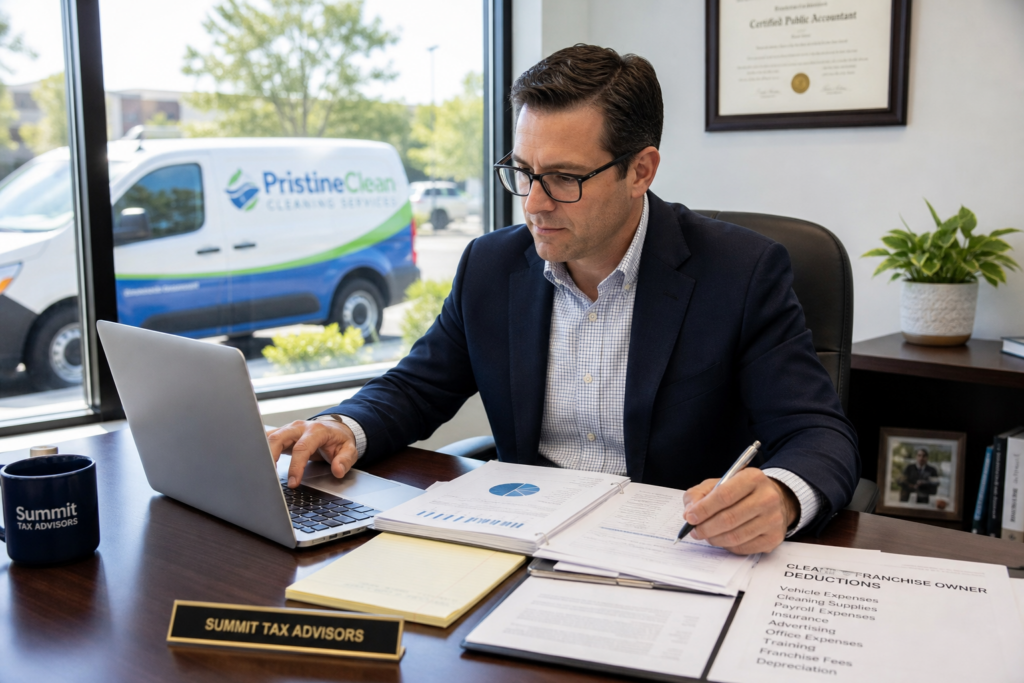
Cleaning Franchise Owner Deductions to Maximize for Clients: 2026 Guide
As a solo practitioner, mastering Cleaning Franchise Owner deductions to maximize for clients can set you apart fast. Cleaning franchise owners face unique costs, from royalties to supplies. For the 2026 tax year, smart planning turns these expenses into real savings. This guide gives you the exact deductions, limits, and strategies to deliver value. Furthermore, it shows how to build a profitable advisory practice around this niche. Want to book more advisory clients? Uncle Kam’s tax strategy tools can help.
Table of Contents
- Key Takeaways
- What Are the Top Cleaning Franchise Owner Deductions to Maximize for Clients?
- How Do Franchise Fees and Royalties Get Deducted?
- How Do You Handle Equipment and Vehicle Deductions?
- Can Cleaning Franchise Clients Claim the QBI Deduction?
- What Retirement Strategies Help Cleaning Franchise Owners?
- How Do You Price Advisory Services for This Niche?
- Uncle Kam in Action: A Solo CPA Wins a Franchise Client
- Related Resources
- Next Steps
- Frequently Asked Questions
 For Tax Professionals
Build your next chapter in tax advisory.
Explore how Uncle Kam Pro could support the next stage of your practice.
Key Takeaways
- Cleaning franchise owners can deduct royalties, supplies, equipment, and vehicle costs in 2026.
- Section 179 lets clients expense up to $2.5 million in equipment for 2026.
- The 20% QBI deduction remains permanent and applies to most franchise owners.
- Business mileage rates rose to 76 cents per mile from July 1, 2026.
- Niche advisory work grows your revenue faster than basic tax prep.
What Are the Top Cleaning Franchise Owner Deductions to Maximize for Clients?
Quick Answer: The top deductions include franchise royalties, cleaning supplies, equipment, vehicle mileage, labor, and retirement contributions. Each one lowers taxable income for 2026.
Cleaning franchise owners run cost-heavy businesses. Therefore, they benefit from careful expense tracking. As a solo practitioner, you can spot deductions many owners miss. This is where the Cleaning Franchise Owner deductions to maximize for clients strategy pays off. Moreover, it positions you as a true advisor, not just a preparer.
Let’s break down the core categories. Each one supports strong tax savings. In addition, each one gives you talking points for client meetings. Solo pros who serve busy small business owners can charge premium fees for this insight.
Everyday Operating Expenses
Cleaning businesses spend heavily on daily items. These costs are fully deductible when ordinary and necessary. For example, review the IRS rules in IRS business expense guidance. Common deductible items include:
- Cleaning chemicals, mops, vacuums, and supplies
- Uniforms and protective gear for staff
- Business insurance and bonding costs
- Marketing, website, and local advertising
- Software for scheduling and invoicing
Labor and Payroll Costs
Labor is often the biggest expense. As a result, it drives major deductions. Wages, payroll taxes, and benefits all reduce taxable income. Furthermore, contractor payments count too. However, you must classify workers correctly. Misclassification triggers penalties. Therefore, help clients set up clean payroll and bookkeeping systems early.
Pro Tip: Track every supply receipt digitally. Small daily costs add up to big yearly deductions.
How Do Franchise Fees and Royalties Get Deducted?
Quick Answer: Ongoing royalties are fully deductible each year. However, the initial franchise fee must be amortized over 15 years.
Franchise costs confuse many owners. As a solo practitioner, clear guidance builds trust fast. The initial franchise fee is a capital cost. Therefore, clients amortize it over 15 years under Section 197. In contrast, monthly royalties are current expenses. As a result, they lower taxable income right away.
You can confirm these rules through IRS Form 4562 instructions. This form handles both amortization and depreciation. Moreover, it keeps your client filing compliant. Cleaning franchise owners often pay large upfront fees. Consequently, proper amortization matters a lot.
Amortizing the Initial Fee
Suppose a client pays a $45,000 franchise fee. You divide it by 15 years. Therefore, the yearly deduction is $3,000. This spreads the benefit over time. In addition, it matches the cost to future income. Explain this clearly to avoid client frustration.
Deducting Ongoing Royalties
Most cleaning franchises charge royalties of 4% to 8% of revenue. These payments are fully deductible each year. For example, a client earning $500,000 with a 6% royalty deducts $30,000. That single deduction saves thousands in taxes. Furthermore, marketing fund contributions are usually deductible too.
Did You Know? Franchise transfer and renewal fees may also qualify for amortization treatment.
How Do You Handle Equipment and Vehicle Deductions?
Quick Answer: Use Section 179 or bonus depreciation for equipment. For vehicles, use the 2026 mileage rate or actual costs.
Equipment and vehicles drive big deductions. Cleaning franchises need vans, machines, and tools. Therefore, these purchases offer strong tax planning value. For 2026, Section 179 lets clients expense up to $2.5 million in equipment. The investment phase-out begins at $4 million. These limits come from the recent tax law changes.
You can verify current rules on the IRS newsroom page. Bonus depreciation is now permanent at 100% under recent legislation. As a result, clients can fully write off qualifying equipment. Solo practitioners who serve self-employed and contractor clients should master these rules.
Section 179 vs. Bonus Depreciation
Both tools speed up write-offs. However, they work differently. Section 179 has income limits. In contrast, bonus depreciation does not. Therefore, you should compare both for each client. The table below shows the 2026 rules side by side.
| Feature | Section 179 (2026) | Bonus Depreciation (2026) |
|---|---|---|
| Maximum deduction | $2.5 million | 100% of cost |
| Phase-out threshold | $4 million | None |
| Income limit | Yes | No |
| Can create a loss | No | Yes |
The 2026 Vehicle Mileage Rules
Vehicle deductions changed midyear in 2026. The IRS raised the business rate due to fuel prices. From January 1 to June 30, the rate was 72.5 cents per mile. From July 1 to December 31, it rose to 76 cents per mile. Therefore, clients must track two rates for 2026 returns.
Solo practitioners can use software to model these choices. Our Cleaning Franchise Owner playbook for tax pros helps you run these numbers fast for 2026. As a result, you deliver clear answers in client meetings.
Pro Tip: Heavy vans over 6,000 pounds may qualify for larger Section 179 deductions.
Can Cleaning Franchise Clients Claim the QBI Deduction?
Quick Answer: Yes. Most cleaning franchise owners can claim the 20% QBI deduction, which is now permanent under recent law.
The Qualified Business Income (QBI) deduction is a powerful tool. It lets owners deduct up to 20% of business income. Recent legislation made this deduction permanent. Therefore, cleaning franchise owners can plan around it long term. As a solo practitioner, this is a key advisory point.
Cleaning services are not a specified service trade. As a result, they avoid the harsh SSTB limits. You can review QBI rules through the IRS QBI deduction page. However, wage and property limits still apply above certain income levels.
How the 20% Deduction Works
Suppose a client has $200,000 in qualified business income. The QBI deduction could be $40,000. That is a huge tax saving. Furthermore, it stacks with other deductions. Therefore, you should always model QBI before filing. Strategies should never work in isolation. Instead, use an entity-aware tax planning software to evaluate the full portfolio. This tool reviews 1040s, 1120-Ss, and K-1s at the same time.
Entity Choice and QBI
Entity structure affects the QBI outcome. An S corp changes the wage picture. Therefore, it can help or hurt the deduction. Solo pros should review entity structuring options with each client. In addition, model both scenarios before recommending a change. A quick way to demonstrate the trade-offs is running the numbers through the LLC vs S-Corp Tax Calculator you can offer clients during discovery calls.
Did You Know? The 2026 standard deduction is $16,100 for singles and $32,200 for married couples filing jointly.
What Retirement Strategies Help Cleaning Franchise Owners?

Quick Answer: Solo 401(k) and SEP IRA plans let owners save large amounts while cutting their 2026 tax bill.
Retirement planning is a top advisory service. Cleaning franchise owners often ignore it. Therefore, you can add huge value here. A Solo 401(k) works well for owners with no employees. In contrast, a SEP IRA suits growing teams. Both plans create deductions and build wealth.
These contributions lower taxable income directly. As a result, they pair well with QBI planning. You should verify current limits at the IRS retirement plans page. The IRS updates these figures each year. Moreover, catch-up rules help owners over 50 save more.
Solo 401(k) Advantages
The Solo 401(k) allows both employee and employer contributions. Therefore, owners can save more than with other plans. In addition, a Roth option may exist. This flexibility appeals to many franchise owners. As a solo practitioner, explain the setup deadlines clearly.
SEP IRA Simplicity
The SEP IRA is simple to run. Owners contribute a percentage of pay. Furthermore, they can fund it up to the filing deadline. This late flexibility helps at tax time. However, employees must receive equal treatment. Explain this rule before setup.
Pro Tip: Pair retirement contributions with QBI planning for the biggest 2026 tax savings.
How Do You Price Advisory Services for This Niche?
Quick Answer: Charge based on tax savings, not hours. A $5,000 plan is easy when you save clients $20,000.
Tax prep pays little. Tax planning pays a lot. Therefore, solo practitioners should shift toward advisory work. Cleaning franchise owners are a great niche. They have clear, repeatable deductions. As a result, you can build a scalable process. This niche focus builds authority fast.
The biggest friction point for solo pros is proving value first. Competitors cap software usage or charge per analysis. In contrast, tax planning software with unlimited assessments lets you run client-ready reports on every prospect. Therefore, you show savings before signing an engagement. Want to see how the Uncle Kam marketplace helps tax pros transition to advisory? It bundles the AI software, MERNA certification, and warm leads you need to scale. Ready to grow? Book a Free Strategy Session today.
Value-Based Pricing Model
Price your plans against the savings you find. For example, charge 20% of first-year tax savings. Therefore, a $20,000 savings supports a $4,000 fee. Clients happily pay when the math is clear. Moreover, this model rewards your skill, not your time.
Building a Repeatable System
Niche work lets you build templates. As a result, each new client takes less time. You reuse checklists and deduction guides. Furthermore, you can raise prices as your authority grows. Study proven tax advisory approaches to scale faster. This is how solo pros build real profit. You can also apply the niche cleaning franchise playbook to standardize every new engagement.
Uncle Kam in Action: A Solo CPA Wins a Franchise Client
Client Snapshot: Maria is a solo CPA in her third year of practice. She wanted to move beyond basic tax prep. Therefore, she targeted cleaning franchise owners as a niche.
Financial Profile: Her prospect owned two cleaning franchise units. Combined revenue reached $620,000 for 2026. The owner had never done real tax planning.
The Challenge: The owner overpaid taxes for years. He missed Section 179, QBI, and retirement deductions. Furthermore, his franchise fee was never amortized correctly. As a result, his tax bill stayed far too high.
The Uncle Kam Solution: Maria used Uncle Kam’s tools to run a free assessment first. She showed the owner exact savings before he signed. Then she built a full plan. She applied Section 179 to a new equipment purchase. In addition, she set up a Solo 401(k). She also fixed the franchise fee amortization. Moreover, she optimized the 20% QBI deduction.
The Results: Maria found $28,000 in first-year tax savings. She charged a $6,000 planning fee. Therefore, the client’s return on investment was over 4x. The owner signed on for ongoing advisory work. As a result, Maria gained recurring revenue and a strong referral source. See more stories on the Uncle Kam client results page. This niche approach transformed her solo practice fast.
Related Resources
- Proactive Tax Strategy Services
- The MERNA Method Framework
- Tax Prep and Filing Support
- Uncle Kam Tax Strategy Blog
Next Steps
Ready to master this niche and grow your solo practice? Take these steps now:
- Build a deduction checklist for cleaning franchise clients.
- Run free assessments to show savings before you sign clients.
- Explore advisory service models to boost recurring revenue.
- Book a strategy session to scale your firm faster.
This information is current as of 7/17/2026. Tax laws change frequently. Verify updates with the IRS if reading this later.
Frequently Asked Questions
Are cleaning supplies fully deductible in 2026?
Yes. Cleaning supplies are ordinary and necessary business costs. Therefore, they are fully deductible in the year purchased. Keep clear receipts for every item.
Can a franchise owner deduct the initial franchise fee at once?
No. The initial franchise fee is a capital cost. Therefore, owners must amortize it over 15 years. Ongoing royalties, however, are deducted each year.
What is the 2026 business mileage rate?
The rate changed midyear. It was 72.5 cents per mile through June 30, 2026. Then it rose to 76 cents per mile from July 1, 2026.
Do cleaning franchise owners qualify for the QBI deduction?
Yes. Cleaning services are not a specified service trade. Therefore, most owners can claim the 20% QBI deduction. Wage and property limits may apply at higher incomes.
How much can solo pros charge for franchise tax planning?
Charge based on value, not hours. Fees of $4,000 to $6,000 are common. When you save clients $20,000, the fee feels small.
When should equipment be purchased for the best deduction?
Buy and place equipment in service before December 31, 2026. Therefore, clients capture the deduction this tax year. Timing matters for Section 179 and bonus depreciation.
Last updated: July, 2026

