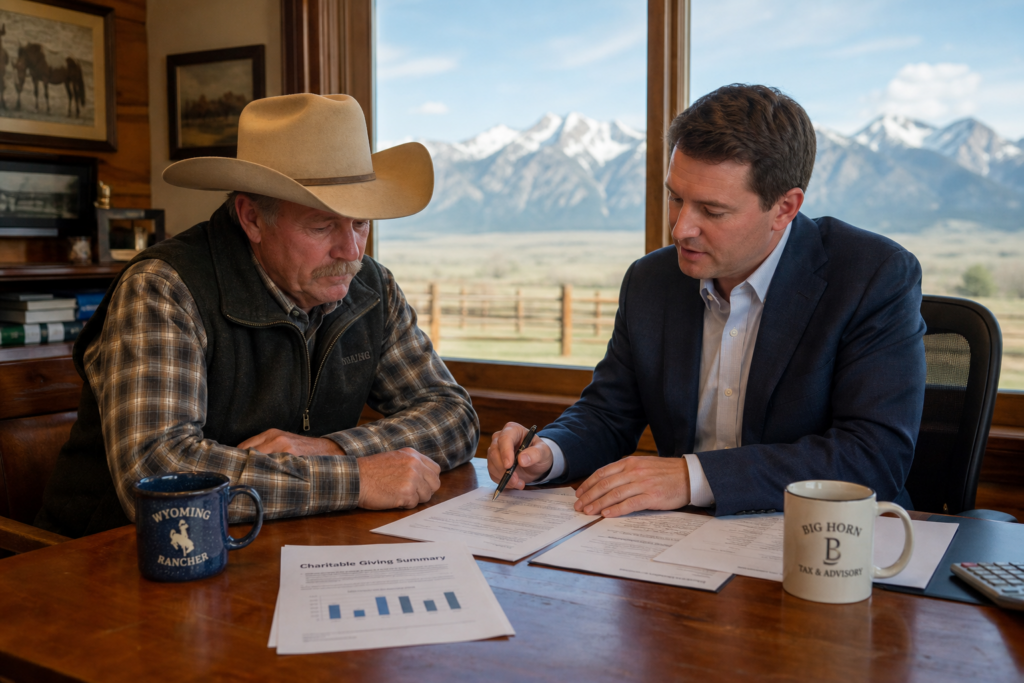
Charitable Giving Strategies Wyoming: 2026 Tax Guide
Smart charitable giving strategies Wyoming donors deploy in 2026 can dramatically lower federal taxes while funding causes you love. Because Wyoming has no state income tax, your planning focuses squarely on federal rules. New 2026 laws under OBBBA reshape how deductions work. Therefore, timing and structure matter more than ever. This guide breaks down the best charitable giving strategies Wyoming residents should consider this year.
Table of Contents
- Key Takeaways
- What Are the Best Charitable Giving Strategies Wyoming Donors Use?
- How Did OBBBA Change Charitable Deductions in 2026?
- How Do Business Owners Maximize Charitable Deductions in Wyoming?
- What Is a Donor-Advised Fund and Why Use One?
- How Can Retirees Give With Qualified Charitable Distributions?
- Uncle Kam in Action
- Related Resources
- Next Steps
- Frequently Asked Questions
Key Takeaways
- Wyoming has no state income tax, so charitable planning targets federal savings only.
- For 2026, non-itemizers can deduct up to $1,000 single or $2,000 joint.
- A new 0.5% AGI floor now reduces itemized charitable deductions in 2026.
- Donating appreciated stock avoids capital gains and boosts your deduction.
- Donor-advised funds let you bunch gifts and time deductions strategically.
What Are the Best Charitable Giving Strategies Wyoming Donors Use?
Quick Answer: The best charitable giving strategies Wyoming donors use in 2026 include donating appreciated assets, bunching gifts through donor-advised funds, and using qualified charitable distributions from IRAs.
Wyoming residents enjoy a rare advantage. The state imposes no personal income tax. Therefore, every charitable planning move focuses on federal tax savings. As a result, your strategy revolves around the standard deduction, itemizing thresholds, and the type of assets you give. Smart donors match the gift vehicle to their income level and goals.
Moreover, 2026 introduced meaningful federal changes. The One Big Beautiful Bill Act (OBBBA) reshaped how deductions work. Consequently, both high earners and modest donors must rethink old habits. A well-built proactive tax strategy plan ensures you capture every available dollar of savings.
Why Wyoming’s Tax Structure Matters
Because Wyoming collects no income tax, donors cannot claim a state charitable break. Nine states already operate without income tax, according to recent reporting on state tax revenue structures. Therefore, Wyoming donors lean entirely on the federal code. This makes federal timing and asset selection the core levers for savings.
Matching Strategy to Your Profile
Different donors need different tools. Consider these common matches for 2026:
- Modest givers: use the new non-itemizer deduction of up to $2,000.
- High earners: donate appreciated stock to skip capital gains.
- Retirees over age 70½: give directly from an IRA through a QCD.
- Business owners: bunch multiple years of gifts into a single tax year.
Pro Tip: Always confirm a charity’s tax-exempt status using the IRS search tool before giving.
How Did OBBBA Change Charitable Deductions in 2026?
Quick Answer: For 2026, OBBBA created a permanent non-itemizer deduction, added a 0.5% AGI floor for itemizers, and capped deduction value at 35% for top earners.
The One Big Beautiful Bill Act rewrote several charitable rules. These changes took effect for the 2026 tax year. Therefore, understanding them is essential before you write your next check. The IRS charitable contribution rules remain your authoritative reference. However, the new statute layers fresh limits on top of longstanding rules.
The New Non-Itemizer Deduction
Most taxpayers no longer itemize. For 2026, the standard deduction reached $16,100 for single filers and $32,200 for married couples filing jointly. Consequently, itemizing rarely pays off for average households. However, OBBBA now permits a permanent above-the-line deduction for cash gifts. Single filers may deduct up to $1,000. Joint filers may deduct up to $2,000. As a result, Wyoming donors who take the standard deduction still get a break.
The 0.5% AGI Floor for Itemizers
Itemizers face a new hurdle in 2026. A 0.5% adjusted gross income floor now applies. In other words, only contributions above 0.5% of your AGI count as deductible. For example, a donor with $400,000 AGI loses the first $2,000 of deductions. Therefore, larger, concentrated gifts become more valuable than small annual ones.
The 35% Cap for Top Earners
High earners also see a value cap. Taxpayers in the top federal bracket can only claim charitable deductions at a 35% rate. Previously, that value tracked the full 37% marginal rate. Therefore, wealthy Wyoming donors may want to accelerate gifts. Working with a high-net-worth tax advisor helps model the best timing.
| 2026 Rule | Who It Affects | Impact |
|---|---|---|
| Non-itemizer deduction ($1,000/$2,000) | Standard deduction filers | New savings on cash gifts |
| 0.5% AGI floor | Itemizers | Small gifts partly non-deductible |
| 35% deduction cap | Top-bracket earners | Reduced deduction value |
Did You Know? About 85% of filers received a tax cut in 2026 under OBBBA, per the Tax Policy Center.
How Do Business Owners Maximize Charitable Deductions in Wyoming?
Quick Answer: Business owners maximize deductions by donating appreciated assets, bunching gifts, and coordinating charity with entity structure for 2026.
Wyoming attracts many entrepreneurs and LLC owners. Because the state has no income tax, business owners keep more profit. Therefore, they often have room for larger charitable gifts. However, the entity you use affects how deductions flow through. As a result, coordination with your business tax plan matters greatly. Many Wyoming business owners overlook this connection.
Donating Appreciated Business Assets
Appreciated assets create powerful savings. When you donate long-held stock, you skip capital gains tax entirely. Furthermore, you deduct the full fair market value, subject to the 30% AGI limit. For cash gifts, the limit rises to 60% of AGI. Therefore, gifting appreciated shares often beats writing a check. Review the IRS Publication 526 guidelines for detailed limits.
Choosing the Right Entity Structure
Entity choice shapes your tax outcome. S corporations and partnerships pass charitable deductions to owners. Meanwhile, C corporations deduct gifts at the corporate level. Consequently, choosing wisely affects both business and personal returns. If you run an LLC, compare it against S-corp taxation carefully. Use our LLC vs S-Corp Tax Calculator for Jacksonville to estimate 2026 tax outcomes. Proper business entity structuring guidance can amplify your giving power.
Bunching Gifts Into One Year
Bunching helps clear the itemizing threshold. Instead of giving yearly, you concentrate several years of gifts. Therefore, your deductions exceed the standard deduction in that year. In off years, you simply take the standard deduction. As a result, you capture more total tax savings over time. A qualified Tax Preparation Near Me in Wyoming professional can map the ideal schedule.
Pro Tip: Never donate assets held under one year; you lose the fair-market-value deduction.
What Is a Donor-Advised Fund and Why Use One?
 Free Tax Write-Off Finder
Quick Answer: A donor-advised fund lets you deduct a large gift now in 2026 while distributing to charities over future years.
A donor-advised fund (DAF) works like a charitable savings account. You contribute assets and claim an immediate deduction. Then, you recommend grants to charities over time. Therefore, DAFs pair perfectly with the bunching strategy. Because the new 0.5% AGI floor rewards concentrated giving, DAFs shine in 2026.
How a DAF Saves Taxes
Consider a Wyoming donor with $500,000 AGI. They fund a DAF with $100,000 of appreciated stock. As a result, they avoid capital gains on the appreciation. Furthermore, they deduct the full value, subject to the 30% AGI cap for appreciated property. Then, they grant funds to local charities over several years. Therefore, timing and impact both improve.
DAF Versus Private Foundation
DAFs cost less than private foundations. They require no separate tax filings from you. Moreover, they offer higher AGI deduction limits than foundations. However, foundations grant more control over grantmaking. Therefore, most Wyoming donors prefer DAFs for simplicity. Guidance from the Consumer Financial Protection Bureau can help you vet financial providers.
| Feature | Donor-Advised Fund | Private Foundation |
|---|---|---|
| Cash AGI deduction limit | 60% | 30% |
| Annual filing burden | None for donor | Form 990-PF required |
| Setup cost | Low | High |
Did You Know? The IRS finalized rules in 2026 targeting abusive charitable trust arrangements as listed transactions.
How Can Retirees Give With Qualified Charitable Distributions?
Quick Answer: Retirees age 70½ or older can give directly from an IRA in 2026, excluding the gift from taxable income.
A qualified charitable distribution (QCD) offers a clean tax benefit. You transfer funds directly from your IRA to a charity. Therefore, the amount never appears in your taxable income. For 2026, the QCD limit exceeds $100,000 per person and is inflation-indexed. Moreover, a QCD can satisfy your required minimum distribution. As a result, retirees avoid pushing income into higher brackets.
Why QCDs Beat Regular Gifts
QCDs work even if you take the standard deduction. Because the gift skips your income entirely, no itemizing is needed. Therefore, retirees who cannot itemize still gain full value. Furthermore, lower reported income can reduce Medicare premiums. Consequently, QCDs deliver benefits far beyond a simple deduction. The IRS IRA distribution rules confirm the treatment.
Steps to Complete a QCD
Follow these steps for a compliant 2026 QCD:
- Confirm you are age 70½ or older.
- Ask your IRA custodian to send funds directly to the charity.
- Verify the charity is a qualified 501(c)(3) organization.
- Keep the acknowledgment letter for your records.
Because OBBBA changed the economics of giving, QCDs became even more valuable in 2026. Therefore, retirees should review this option early. Partnering with a trusted Wyoming tax preparation team ensures the paperwork is correct. Before moving forward, review your full plan with an experienced advisor.
Pro Tip: Complete QCDs before withdrawing your RMD; otherwise the exclusion may not apply.

Uncle Kam in Action: How a Wyoming Rancher Saved $58,000
Client Snapshot: Meet Dale, a Wyoming ranch owner and real estate investor near Cheyenne. He runs his operation through an S corporation. Additionally, he holds a large portfolio of appreciated stock.
Financial Profile: Dale reported roughly $620,000 in adjusted gross income for 2026. He planned to donate $120,000 to local charities over several years. Originally, he intended to write annual cash checks.
The Challenge: Dale’s cash gifts triggered two problems. First, the new 0.5% AGI floor erased his first $3,100 of deductions. Second, the 35% cap limited his high-bracket benefit. Therefore, his old plan wasted thousands in potential savings. Moreover, selling stock to fund gifts would have triggered large capital gains.
The Uncle Kam Solution: Our team redesigned his approach entirely. We recommended funding a donor-advised fund with $120,000 of appreciated stock in one year. As a result, Dale avoided capital gains on the appreciation. Furthermore, he cleared the itemizing threshold decisively. Then, he scheduled grants to charities over four years. We also coordinated the gift with his S corporation planning. Consequently, every dollar worked harder.
The Results: Dale saved approximately $58,000 in combined federal taxes for 2026. He paid Uncle Kam a $12,000 strategy and implementation fee. Therefore, his first-year return on investment reached nearly 5x. Moreover, his favorite charities still received the full $120,000 over time. Stories like Dale’s appear across our documented client results. His case proves that smart charitable giving strategies Wyoming donors adopt can transform both taxes and impact.
Related Resources
Next Steps
Ready to build your 2026 giving plan? Take these clear actions today:
- Review whether bunching or a DAF fits your income.
- Identify appreciated assets ideal for donation this year.
- Confirm QCD eligibility if you are age 70½ or older.
- Schedule a call to build your custom charitable tax strategy.
This information is current as of 7/13/2026. Tax laws change frequently. Verify updates with the IRS if reading this later.
Frequently Asked Questions
Does Wyoming offer a state charitable deduction in 2026?
No. Wyoming has no state income tax. Therefore, charitable giving strategies Wyoming donors use focus only on federal savings. This actually simplifies your planning considerably.
Can I deduct donations if I take the standard deduction?
Yes. For 2026, OBBBA allows a non-itemizer deduction. Single filers deduct up to $1,000. Joint filers deduct up to $2,000 for qualifying cash gifts.
What is the 0.5% AGI floor and how does it work?
The floor reduces itemized charitable deductions in 2026. Only gifts above 0.5% of your AGI count. Therefore, larger concentrated gifts deliver more value than small annual ones.
How much can I give from my IRA through a QCD?
For 2026, the QCD limit exceeds $100,000 per person and adjusts for inflation. Moreover, a QCD can satisfy your required minimum distribution while excluding income.
Is a donor-advised fund worth the cost?
Often, yes. DAFs cost little and require no personal tax filings. Furthermore, they pair perfectly with bunching. Therefore, they suit most Wyoming donors seeking flexibility and savings.
Should high earners accelerate charitable gifts in 2026?
Possibly. The new 35% deduction cap limits top-bracket value. Therefore, modeling different timing scenarios with an advisor helps you capture maximum savings.
Last updated: July, 2026

