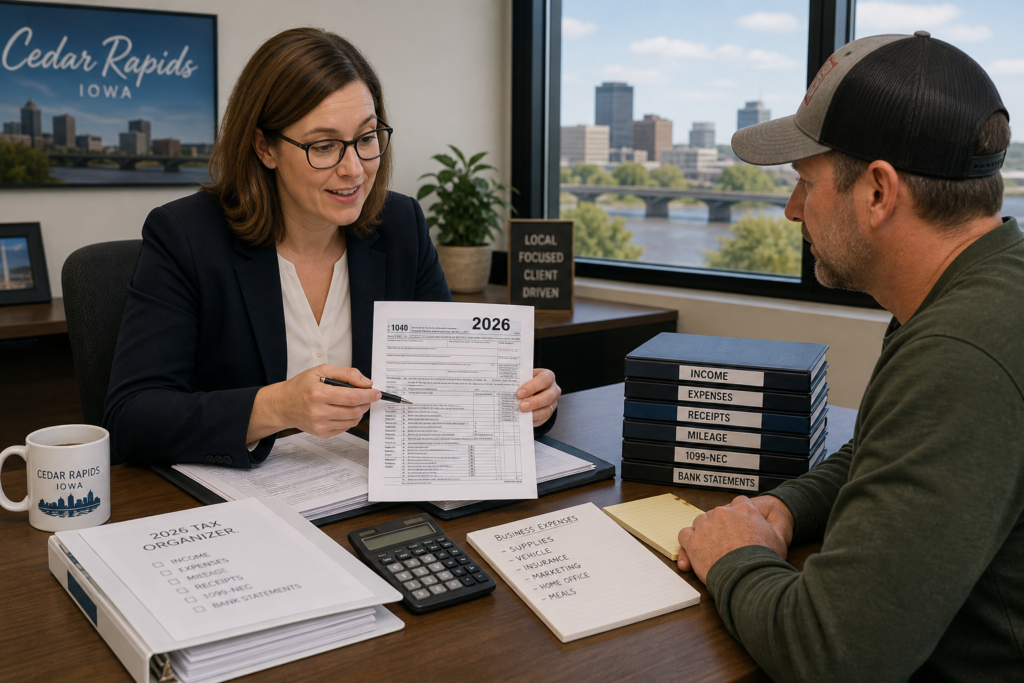
Cedar Rapids IRS Help Guide: 2026 Tax Resources and Support for Business Owners
Cedar Rapids IRS Help Guide: 2026 Tax Resources and Support for Business Owners
Finding reliable Cedar Rapids IRS help is essential for business owners, freelancers, and self-employed professionals navigating the complex 2026 tax landscape. Whether you’re managing quarterly estimated taxes, calculating self-employment tax obligations, or seeking to maximize deductions under new OBBBA rules, this guide connects you with local resources and expert strategies available through tax preparation services in Cedar Rapids. With recent changes affecting 1099 reporting thresholds, new deduction opportunities, and evolving IRS procedures, understanding your options has never been more critical.
Table of Contents
- Key Takeaways
- What IRS Resources Are Available in Cedar Rapids?
- How Much Self-Employment Tax Will You Owe for 2026?
- What Deductions Qualify for Self-Employed Professionals?
- When Are Your Quarterly Tax Payment Deadlines?
- Uncle Kam in Action
- Next Steps
- Frequently Asked Questions
Key Takeaways
- Self-employment tax for 2026 remains at 15.3% on net profit (12.4% Social Security + 2.9% Medicare).
- The 1099-NEC and 1099-MISC reporting threshold increased to $2,000 for 2026 under OBBBA.
- Q2 estimated tax payments are due June 15, 2026; mark all quarterly deadlines on your calendar.
- New 2026 deductions for tips, overtime, and car loan interest may benefit some business owners.
- Working with tax preparation services in Iowa ensures compliance and identifies missed deduction opportunities.
What IRS Resources Are Available in Cedar Rapids?
Quick Answer: Cedar Rapids businesses can access free IRS resources through the IRS website, taxpayer assistance centers, and local tax professional networks. The IRS also offers expanded digital support for returns, refund tracking, and payment plans for 2026.
Business owners seeking Cedar Rapids IRS help have multiple pathways to reliable tax guidance. The IRS continues to modernize its service delivery for 2026, making it easier for self-employed individuals and entrepreneurs to access information about compliance requirements, deductions, and payment options. Understanding what resources exist locally and online helps you resolve tax questions efficiently without unnecessary delays.
IRS.gov Tools and Digital Resources
The official IRS website provides free tools for entrepreneurs and self-employed professionals. You can verify estimated tax payment dates, download forms like Schedule C (business profit and loss), access Publication 334 (Tax Guide for Small Business), and find updates on 2026 tax law changes. The IRS Tax Pro Account allows tax preparers to track client return status and document uploads in real time, reducing communication delays. For individual taxpayers, the IRS enhanced its Identity Verification system through ID.me in 2026, streamlining refund tracking and account access.
Local Tax Professional Support
Cedar Rapids hosts a network of CPAs, enrolled agents, and tax attorneys specializing in small business taxation. These professionals provide personalized guidance on business structure optimization, deduction strategy, and compliance. Many operate under the MERNA method, a comprehensive planning framework that integrates tax, business, and financial strategies. Working with local professionals offers faster response times and familiarity with Iowa-specific tax rules that affect Cedar Rapids businesses.
Pro Tip: Schedule a consultation with Cedar Rapids tax professionals early in the calendar year (not April). This timing allows for strategic planning around quarterly estimated payments, business deduction maximization, and entity structure evaluation for 2026 and beyond.
How Much Self-Employment Tax Will You Owe for 2026?
Quick Answer: For 2026, self-employment tax is calculated at 15.3% of net self-employment income (12.4% for Social Security and 2.9% for Medicare). Freelancers and 1099 contractors report this on Schedule SE, and you can deduct half the amount as an adjustment to income.
Self-employment tax is the biggest tax concern for Cedar Rapids entrepreneurs. Unlike traditional W-2 employees who split payroll taxes with employers, self-employed professionals pay the full 15.3% rate. Understanding this obligation helps you avoid surprise tax bills and plan quarterly estimated payments strategically. Most self-employed individuals underestimate their tax liability, resulting in penalties and interest charges. Using our Self-Employment Tax Calculator early in the year helps project your 2026 obligations accurately.
Calculating Your Net Self-Employment Income
Self-employment tax applies only to net income after business deductions. For example, if you earn $60,000 in 1099 income but have $20,000 in qualifying business expenses, your net self-employment income is $40,000. The 15.3% self-employment tax applies to approximately 92.35% of net self-employment income (to account for the deductible portion of SE tax). This means a $40,000 net profit triggers roughly $5,480 in self-employment tax. The calculation appears complex, but Schedule SE (filed with your 1040) walks through the computation step-by-step.
The Self-Employment Tax Deduction Advantage
The IRS allows you to deduct half of your 2026 self-employment tax as an adjustment to gross income. This deduction appears on your 1040 Form and reduces your adjusted gross income (AGI). While this doesn’t reduce self-employment tax itself, it lowers your income tax burden. For someone paying $5,480 in self-employment tax, deducting $2,740 could save $700 to $950 in income tax (depending on your marginal rate). Strategic planning around this deduction, combined with other business deductions, significantly reduces your total tax liability.
| 2026 Self-Employment Tax Scenario | Gross 1099 Income | Business Deductions | Net Income | SE Tax (15.3%) |
|---|---|---|---|---|
| Freelancer with home office | $45,000 | $8,500 | $36,500 | ~$5,190 |
| Contractor with equipment | $85,000 | $18,000 | $67,000 | ~$9,530 |
| Service business | $120,000 | $25,000 | $95,000 | ~$13,530 |
What Deductions Qualify for Self-Employed Professionals?
 Free Tax Write-Off Finder
Quick Answer: Self-employed business owners can deduct ordinary and necessary business expenses on Schedule C for 2026, including home office, equipment, supplies, insurance, and professional fees. New OBBBA deductions for overtime and tips may also apply. The home office deduction allows $5 per square foot (simplified method) up to 300 square feet.
For Cedar Rapids IRS help purposes, understanding what you can deduct is critical to reducing self-employment tax and income tax liability. Business deductions directly reduce your Schedule C net profit, which in turn lowers your self-employment tax burden. Many self-employed professionals miss deductions they’re entitled to claim, leaving tax savings on the table. The IRS provides Publication 587 (Business Use of Your Home) and Publication 587A (Simplified Home Office Deduction) to guide self-employed individuals through calculation methods.
Common Business Deductions for Schedule C
- Home office deduction: Simplified method ($5/sq ft, max 300 sq ft = $1,500/year) or actual expense method with depreciation.
- Equipment and supplies: Computers, software, office furniture, machinery, and tools used in business.
- Professional services: Accounting, legal, bookkeeping, and tax preparation fees.
- Insurance: Business liability, malpractice, and health insurance premiums you pay (Self-Employed Health Insurance Deduction).
- Vehicle expenses: Mileage (standard rate for 2026) or actual expenses (fuel, maintenance, repairs, depreciation).
- Travel and meals: 50% of meal expenses while traveling on business; 100% of lodging.
- Marketing and advertising: Website maintenance, social media ads, business cards, promotional materials.
- Business use of phone and internet: Percentage of household expenses allocable to business use.
New 2026 OBBBA Deductions for Business Owners
Under the One Big Beautiful Bill Act, new deductions became available for 2026 tax returns. If you paid overtime (as an employee receiving a W-2 with overtime hours) or incurred car loan interest, you may qualify for additional deductions. While tips deduction typically applies to service industry workers, the $20,000 car loan interest deduction can benefit self-employed professionals with vehicle debt used for business. The IRS clarified these rules in final regulations effective June 12, 2026, so documentation and record-keeping are essential when claiming these new deductions on your 2026 return.
Pro Tip: Track business expenses in real-time during 2026 using accounting software (QuickBooks, FreshBooks, Wave). This approach eliminates last-minute scrambling to reconstruct deductions for tax filing and helps identify areas where additional business expenses might be deductible.
When Are Your Quarterly Tax Payment Deadlines?
Quick Answer: For 2026, estimated quarterly tax payments are due on April 15 (Q1), June 15 (Q2), September 15 (Q3), and January 15, 2027 (Q4). Missing deadlines triggers penalties and interest even if you ultimately owe taxes when filing your return.
Self-employed professionals and small business owners must submit estimated quarterly taxes to avoid penalties. Unlike W-2 employees with automatic withholding, freelancers and 1099 contractors bear full responsibility for calculating and paying estimated taxes four times annually. Falling behind on estimated taxes creates cash flow stress, triggers failure-to-pay penalties (0.5% per month), and complicates year-end tax filing. The IRS bases estimated tax requirements on your projected 2026 income minus deductions and credits. If you under-estimate your liability below 90% of your 2026 tax or 100% of your 2025 tax (whichever is lower), you may owe an estimated tax penalty.
2026 Quarterly Payment Schedule and Methods
The IRS provides multiple payment methods for Cedar Rapids business owners. You can pay online through IRS.gov’s payment portal, mail a check with Form 1040-ES, or arrange automatic payments through your bank. Electronic Federal Tax Payment System (EFTPS) enrollment allows recurring automatic payments. For business owners with irregular income, filing Form 1040-ES (Estimated Tax for Individuals) provides worksheets to calculate exact quarterly amounts. This approach ensures you pay exactly what you owe without over-paying or under-paying.
| 2026 Quarterly Payment | Due Date | For Income Earned | Payment Form |
|---|---|---|---|
| Q1 (First Quarter) | April 15, 2026 | January–March 2026 | Form 1040-ES |
| Q2 (Second Quarter) | June 15, 2026 | April–June 2026 | Form 1040-ES |
| Q3 (Third Quarter) | September 15, 2026 | July–September 2026 | Form 1040-ES |
| Q4 (Fourth Quarter) | January 15, 2027 | October–December 2026 | Form 1040-ES |
Strategic Quarterly Payment Planning
Smart Cedar Rapids business owners coordinate quarterly estimated payments with their financial planning. If your 2026 income fluctuates seasonally (common in construction, consulting, and service businesses), skipping or reducing estimates during slow quarters prevents over-payment. The IRS allows annualization of income through Form 2210, which adjusts your required estimated tax based on actual income in each quarter. This strategy benefits businesses with uneven cash flow. Additionally, if you expect 2026 to be significantly less profitable than 2025, timely reassessment of estimated payments avoids penalties for under-payment.

Uncle Kam in Action: Cedar Rapids Freelancer Cuts Tax Bill by $4,200
Client Profile: Sarah, a marketing consultant in Cedar Rapids, operated as a solo 1099 contractor with $72,000 in annual revenue. She was aware of her self-employment tax obligation but had never systematized business deductions. Like many self-employed professionals, she kept minimal records of expenses and assumed most home-based business costs weren’t deductible.
The Challenge: When Sarah’s initial tax calculation projected $18,500 in combined self-employment and income tax, she was shocked. Working with a Cedar Rapids tax professional through Uncle Kam’s approach, she discovered she’d been missing significant deductions. Her home office (250 sq ft), professional liability insurance ($1,200/year), software subscriptions ($2,400/year), and vehicle mileage (8,500 miles at 2026 standard rate) weren’t being deducted. This disorganization meant she was overpaying taxes by thousands annually.
The Solution: Uncle Kam’s MERNA method identified qualifying business deductions totaling $18,500, reducing Sarah’s net self-employment income from $72,000 to $53,500. This $18,500 deduction reduction directly lowered her self-employment tax by approximately $2,640 (15.3% of the deduction amount). Combined with income tax savings from the home office, insurance, and software deductions, her total tax liability dropped from $18,500 to $14,300—a 23% reduction.
The Results: Sarah’s 2026 tax bill dropped by $4,200 through systematic deduction organization. More importantly, she implemented a quarterly business expense tracking system for 2026, ensuring she doesn’t miss future deduction opportunities. Her estimated quarterly tax payments were adjusted downward based on the revised income projection, improving her monthly cash flow by $350. This engagement exemplifies how Cedar Rapids IRS help through professional guidance transforms tax obligations from a surprise burden into a manageable, strategic component of business planning. Sarah’s investment of $1,500 in professional tax planning yielded a 280% return in first-year tax savings alone.
Next Steps: Take Control of Your 2026 Tax Situation
Now that you understand Cedar Rapids IRS help resources and 2026 tax obligations, take these actionable steps before mid-year:
- Calculate your 2026 estimated tax using Form 1040-ES and schedule Q2 payment by June 15, 2026.
- Document all business expenses from January 1 onward (mileage, supplies, equipment, professional fees).
- Review your 1099-NEC and 1099-MISC received (note the $2,000 threshold change for 2026).
- Consult with Cedar Rapids tax professionals about entity structure optimization (LLC vs. S Corp) if you anticipate 2026 income above $60,000.
- Set up automated quarterly payment reminders for all 2026 estimated tax due dates.
Frequently Asked Questions
What is the 2026 self-employment tax rate, and has it changed from 2025?
The 2026 self-employment tax rate remains 15.3% (12.4% Social Security + 2.9% Medicare), unchanged from 2025 and previous years. This rate applies to approximately 92.35% of your net self-employment income. While the rate itself doesn’t change, the Social Security wage base limit may adjust annually for inflation. For 2026, verify the current limit on IRS.gov to ensure accurate calculations. This consistent rate simplifies multi-year planning but underscores the importance of quarterly estimated tax payments.
How did the OBBBA change 1099 reporting thresholds for Cedar Rapids contractors in 2026?
The One Big Beautiful Bill Act raised the federal 1099-NEC and 1099-MISC reporting threshold from $600 to $2,000 effective January 1, 2026. This means your clients only issue you a 1099-NEC/MISC if they paid you at least $2,000 during the year. However, you still must report all 1099 income on your Schedule C, whether or not you receive a 1099 form. Additionally, the 1099-K threshold reverted to $20,000 and 200 transactions (up from $600 under previous rules). This change affects your record-keeping and reporting requirements for 2026. Check whether Iowa conforms to the federal threshold or maintains its own reporting rules for state income tax purposes.
Can I claim home office expenses if I work from my dining room table occasionally?
To claim a home office deduction for 2026, the IRS requires the space be used regularly and exclusively for business. Working from your dining room table doesn’t qualify because it’s not exclusively dedicated to business use. However, if you maintain a dedicated home office (separate room or distinct area used only for business), you can claim either the simplified method ($5 per square foot, up to 300 sq ft = $1,500 maximum) or actual expense method (utility, rent, insurance, and depreciation allocation). The simplified method is often easier for Cedar Rapids solopreneurs. A dedicated home office demonstrates business legitimacy and withstands IRS scrutiny better than sporadic desk arrangements.
What happens if I miss a quarterly estimated tax payment deadline?
If you miss a quarterly estimated tax deadline, the IRS imposes a failure-to-pay penalty of 0.5% per month (or fraction thereof) on the underpayment. Additionally, you’ll owe interest on the unpaid amount from the original due date until you pay. These penalties compound, so a June 15 Q2 payment missed until September costs more than if you pay immediately. If you realize you’ve under-estimated for 2026, adjust subsequent quarterly payments upward to avoid larger penalties. Some Cedar Rapids business owners file their return earlier than April 15, 2027 and pay the full liability immediately if they discover mid-year that estimated payments were insufficient. This approach can reduce penalty exposure.
Can I deduct my car loan interest if I use my vehicle for business in Cedar Rapids?
Yes, under the 2026 OBBBA rules, you can deduct up to $20,000 in car loan interest if you use your vehicle for business. This deduction applies to vehicle loans taken out after January 1, 2024. You must allocate the deduction based on the percentage of miles driven for business versus personal use. For example, if you drove 6,000 business miles and 4,000 personal miles (60% business use), you can deduct 60% of your 2026 car loan interest, up to the $20,000 limit. Documentation through mileage logs is essential. The IRS provides Publication 917 (Business Use of Car) to guide this calculation for 2026 tax returns.
Should I file my 2026 return as a sole proprietor, LLC, or S Corporation in Cedar Rapids?
The optimal business structure depends on your 2026 income, state tax situation, and long-term plans. Sole proprietors report Schedule C income directly on their 1040 and pay full self-employment tax (15.3%). LLCs taxed as sole proprietorships work similarly but offer liability protection. S Corporations allow you to pay a reasonable salary (subject to payroll tax at 15.3%) and distribute remaining profits as dividends (not subject to self-employment tax). This saves approximately 15.3% on distributions exceeding your salary. However, S Corp compliance costs (payroll processing, quarterly filings, accountant fees) typically justify the structure only for incomes exceeding $60,000 annually. Schedule a consultation with Cedar Rapids tax professionals to model your specific 2026 scenario.
Where can I find the official IRS forms and publications for 2026 tax planning?
The official IRS Forms and Publications page provides all 2026 tax documents free of charge. Key publications for Cedar Rapids business owners include Publication 334 (Tax Guide for Small Business), Publication 587 (Business Use of Your Home), Publication 917 (Business Use of Car), and Schedule C (Profit or Loss from Business). Form 1040-ES provides estimated tax worksheets, while Form 1120-S guides S Corporation filers. Download these directly from IRS.gov or request them by phone. Tax professionals also access these resources to ensure compliance with current rules, so consulting a Cedar Rapids CPA or enrolled agent ensures you’re using the most current forms and guidance for your 2026 tax situation.
This information is current as of May 25, 2026. Tax laws change frequently. Verify updates with the IRS or FTB if reading this later.
Last updated: May, 2026

