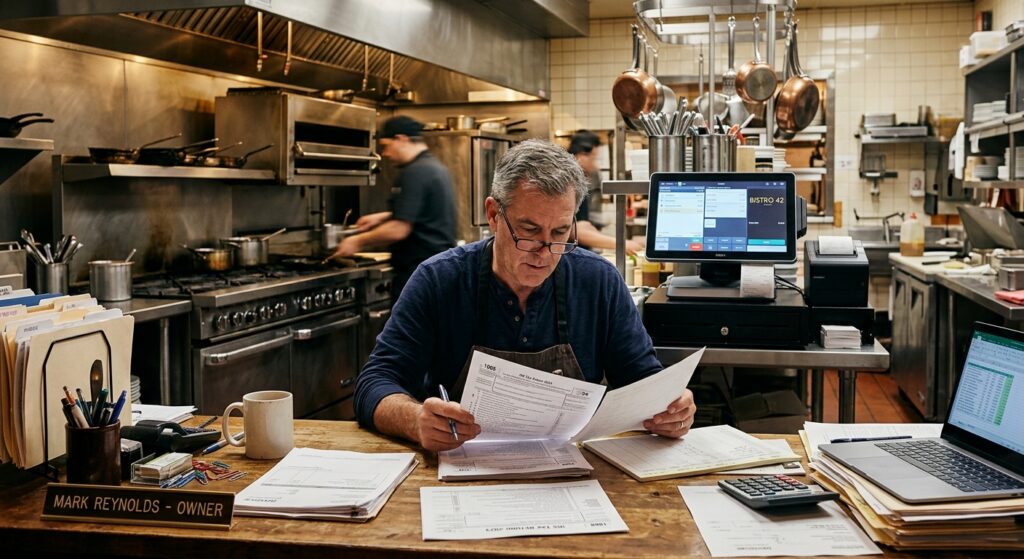
Can I Deduct Restaurant Equipment, POS Systems & Kitchen Gear? Complete 2026 Tax Guide
If you’ve been asking “can I deduct restaurant equipment, POS systems & kitchen gear,” the answer is a clear yes — and our restaurant equipment deduction resource shows you exactly how to claim it. For the 2026 tax year, restaurant owners benefit from 100% bonus depreciation restored by the One Big Beautiful Bill Act, generous Section 179 limits, and MACRS schedules that accelerate write-offs on commercial kitchen equipment, point-of-sale terminals, refrigeration units, and more. Read this guide to discover the deductions you may be leaving on the table.
Table of Contents
- Key Takeaways
- What Restaurant Equipment Qualifies for a Tax Deduction in 2026?
- How Does the Section 179 Deduction Work for Restaurant Owners in 2026?
- What Is the 2026 Bonus Depreciation Rule and How Does It Help Restaurants?
- Can I Deduct POS Systems and Technology for My Restaurant in 2026?
- How Does MACRS Depreciation Apply to Kitchen Gear and Equipment?
- Should I Lease or Buy Restaurant Equipment for the Best Tax Outcome in 2026?
- What Records Do I Need to Claim Equipment Deductions in 2026?
- Uncle Kam in Action: How One Restaurant Owner Saved Over $68,000
- Next Steps
- Related Resources
- Frequently Asked Questions
Key Takeaways
- For 2026, restaurant equipment, POS systems, and kitchen gear are deductible as business property under IRC Section 179 and bonus depreciation rules.
- The One Big Beautiful Bill Act restored 100% bonus depreciation for qualifying property placed in service in 2026.
- Section 179 lets you deduct the full purchase price in the year equipment is placed in service, subject to annual limits and business income caps.
- POS systems, kitchen technology, and self-service kiosks qualify as 5-year MACRS property eligible for accelerated write-offs.
- Proper documentation — invoices, placed-in-service dates, and business-use logs — is essential for surviving an IRS audit in 2026.
What Restaurant Equipment Qualifies for a Tax Deduction in 2026?
Quick Answer: Nearly all tangible personal property used in your restaurant business qualifies, including commercial ovens, refrigerators, fryers, POS systems, dishwashers, and self-service kiosks, as long as the equipment is used more than 50% for business purposes and placed in service during the 2026 tax year.
Restaurant owners often overlook the full scope of deductible equipment. The IRS broadly defines qualifying property under IRS Publication 946 as tangible personal property placed in service for business use. For the 2026 tax year, the key requirement is that the equipment must be used predominantly — meaning more than 50% — for your restaurant business. As a result, practically every piece of gear in your kitchen and front-of-house can qualify.
Back-of-House Kitchen Equipment
Commercial kitchen equipment forms the backbone of most restaurant write-offs. The IRS classifies this gear as 5-year or 7-year MACRS property, making it eligible for immediate expensing strategies. Common qualifying items include:
- Commercial ovens, combi ovens, and convection ovens
- Deep fryers, grills, broilers, and ranges
- Walk-in coolers, refrigerators, and freezers
- Commercial dishwashers and sinks
- Food prep equipment (slicers, mixers, blenders)
- Ventilation hoods and exhaust systems
- Warmers, steam tables, and holding cabinets
Each piece of kitchen gear you purchase and place in service in 2026 becomes a deductible asset. Furthermore, you can combine Section 179 and bonus depreciation strategies to maximize your first-year write-off on these high-value purchases.
Front-of-House and Technology Equipment
Many restaurant owners miss front-of-house deductions entirely. However, these assets qualify just as readily as kitchen gear. As part of your business owner tax strategy, you should track every technology purchase made for your restaurant operation. Qualifying front-of-house items include:
- Point-of-sale (POS) systems, terminals, and software
- Self-service ordering kiosks
- Tablets and handheld ordering devices
- Digital menu boards and display screens
- Cash registers and payment terminals
- Drive-thru headsets and speaker systems
- Security cameras and alarm systems
- Tables, chairs, booths, and bar equipment
Pro Tip: For 2026, even restaurant software subscriptions paid as annual lump sums may qualify as Section 179 property if the software is off-the-shelf and not customized. Always confirm with a tax advisor before claiming.
What Does NOT Qualify
Certain expenses do not qualify as equipment deductions. Building improvements and structural components are generally depreciated over 39 years as real property, not personal property. Items like landscaping, land, and artwork also fall outside Section 179 eligibility. Moreover, equipment used less than 50% for business does not qualify for the full deduction. Understanding these boundaries protects you from disallowed deductions during an IRS audit.
How Does the Section 179 Deduction Work for Restaurant Owners in 2026?
Quick Answer: Section 179 allows restaurant owners to immediately deduct the full cost of qualifying equipment in the year it’s placed in service, rather than depreciating it over multiple years. For 2026, the deduction limit is subject to final IRS inflation adjustment — verify the current limit at IRS.gov before filing.
Section 179 of the Internal Revenue Code is one of the most powerful tools available when you ask “can I deduct restaurant equipment, POS systems & kitchen gear.” This provision lets you expense the entire cost of qualifying property in the year you purchase and place it in service, dramatically reducing your taxable income in the current year. Working with a proactive tax strategy team ensures you optimize Section 179 alongside other deductions every year.
How Section 179 Works Step by Step
The mechanics of Section 179 are straightforward, but the details matter for maximizing your 2026 deduction. Here is how the process works:
- Step 1 – Purchase and place in service: You must buy the equipment and begin using it for business during the 2026 tax year.
- Step 2 – Elect Section 179: You make the election on IRS Form 4562, Depreciation and Amortization, filed with your 2026 return.
- Step 3 – Apply the dollar limit: The deduction cannot exceed the annual dollar limit (inflation-adjusted annually by the IRS). For reference, the 2025 limit was $1,160,000.
- Step 4 – Apply the phase-out threshold: The deduction phases out dollar-for-dollar when total equipment purchases exceed the phase-out threshold (in 2025 this was $2,890,000). Large multi-unit restaurant groups should monitor this carefully.
- Step 5 – Apply the taxable income limitation: Your Section 179 deduction cannot exceed your business’s taxable income. Any excess carries forward to future years.
Working with a qualified tax professional ensures you thread all three limitations together correctly. You can also find guidance on IRS Form 4562 directly from the IRS website.
Section 179 Deduction Example for a Restaurant in 2026
Consider this practical scenario for a small restaurant owner in 2026:
| Equipment Purchase (2026) | Cost | Section 179 Election |
|---|---|---|
| Commercial combi oven | $32,000 | Full deduction in 2026 |
| POS system (4 terminals) | $8,500 | Full deduction in 2026 |
| Walk-in refrigerator | $22,000 | Full deduction in 2026 |
| Commercial dishwasher | $12,000 | Full deduction in 2026 |
| Total Equipment Spend | $74,500 | $74,500 deducted Year 1 |
At a 25% effective tax rate, a $74,500 deduction in 2026 saves this restaurant owner approximately $18,625 in federal income taxes in the year of purchase. Compare that to spreading the same deduction over 5–7 years, which would produce far smaller annual tax savings. This is why timing your purchases matters enormously.
Pro Tip: For 2026, restaurant owners operating as Minnesota tax filers should confirm their state conformity to Section 179 federal limits. Working with a Minnesota tax preparation specialist ensures your federal and state returns are aligned to capture maximum equipment deductions.
What Is the 2026 Bonus Depreciation Rule and How Does It Help Restaurants?
Quick Answer: For 2026, qualifying restaurant equipment and kitchen gear placed in service during the tax year is eligible for 100% bonus depreciation under the One Big Beautiful Bill Act (OBBBA). This means you can write off the full cost in year one with no dollar limit.
Bonus depreciation is the second major tool restaurant owners should use when deducting equipment purchases. While Section 179 has dollar limits and a taxable income cap, bonus depreciation under IRC Section 168(k) does not carry the same income restriction — making it especially valuable for restaurants that are scaling up with large equipment investments in 2026. Consult a tax advisory professional to confirm your equipment qualifies under the OBBBA provisions.
The One Big Beautiful Bill Act and 100% Bonus Depreciation in 2026
Before the One Big Beautiful Bill Act was enacted, bonus depreciation was phasing down under the Tax Cuts and Jobs Act schedule. Under the prior rules, the bonus depreciation rate was dropping by 20% per year. However, the OBBBA, effective for tax years beginning after December 31, 2025, restored 100% first-year bonus depreciation for qualifying property. This is a major development for restaurant owners who invested in or plan to invest in new equipment in 2026. Furthermore, the law allows bonus depreciation to be claimed on both new and certain used qualifying equipment placed in service during the year.
Combining Section 179 and Bonus Depreciation for Maximum Impact
You are not forced to choose between Section 179 and bonus depreciation — you can use both strategically. Here is how they work together for a restaurant making large equipment purchases in 2026:
- Apply Section 179 first, up to the annual dollar limit (subject to IRS 2026 inflation adjustment).
- Apply 100% bonus depreciation to any remaining cost basis that exceeds the Section 179 limit.
- Use bonus depreciation even if it creates a net operating loss (NOL), which can carry forward to offset future income.
- Track all purchases by placed-in-service date to ensure 2026 eligibility.
This dual strategy is especially powerful for growing restaurant groups or franchise operators opening new locations in 2026. However, proper planning is required to ensure the deductions align with your overall income picture.
Did You Know? Under 100% bonus depreciation in 2026, a restaurant that purchases $150,000 in commercial kitchen equipment can potentially deduct the entire $150,000 in the first year, creating an immediate tax shield rather than waiting 5 to 7 years for the full write-off through standard MACRS depreciation.
Bonus Depreciation Rate History and 2026 Restoration
| Tax Year | Bonus Depreciation Rate | Key Law |
|---|---|---|
| 2022 | 100% | Tax Cuts and Jobs Act |
| 2023 | 80% | TCJA phase-down |
| 2024 | 60% | TCJA phase-down |
| 2025 | 40% (prior year) | TCJA phase-down |
| 2026 | 100% (Restored) | One Big Beautiful Bill Act |
Can I Deduct POS Systems and Technology for My Restaurant in 2026?
Quick Answer: Yes. POS systems, tablets, self-service kiosks, payment terminals, and related software all qualify as 5-year MACRS property for your 2026 restaurant return. Both Section 179 and 100% bonus depreciation apply to these technology assets.
Restaurant technology is evolving at a rapid pace in 2026. The 2026 NRA Show featured AI-driven self-service kiosks, integrated POS solutions, and automated payment terminals as central themes for food-service operations. Fortunately, every dollar you spend on these technology systems is potentially deductible in the year of purchase. As a Minnesota restaurant owner or operator in any state, you can claim these write-offs on Schedule C (for sole proprietors), Form 1065 (for partnerships), or Form 1120-S (for S corporations).
POS Hardware vs. POS Software: Different Rules Apply
The IRS treats POS hardware and software somewhat differently, so understanding the distinction helps you plan correctly:
- POS Hardware (tablets, terminals, cash drawers, printers): Qualifies as 5-year MACRS property. Eligible for Section 179 and 100% bonus depreciation in 2026.
- Off-the-shelf POS software (purchased outright): Qualifies as Section 179 property. Can be deducted fully in 2026 if purchased and placed in service.
- SaaS/cloud-based POS subscriptions (monthly or annual fees): These are typically deducted as ordinary business expenses — not as depreciation — and are fully deductible in 2026 as they are paid.
- Customized or internally developed software: Generally amortized over 15 years and does NOT qualify for Section 179 or bonus depreciation.
In addition, self-service kiosks installed in your restaurant in 2026 qualify as 5-year tangible personal property. Consequently, a $20,000 kiosk investment can be fully written off in the year of purchase using 100% bonus depreciation under the OBBBA rules, rather than spread across five years under standard MACRS schedules.
Pro Tip: When your restaurant upgrades its POS system in 2026, track the date the old system was retired and the new one placed in service. The IRS requires the equipment to be placed in service — meaning actively used — before year-end for you to claim the 2026 deduction.
Connectivity Equipment and Networking Gear
Don’t overlook ancillary technology equipment. Items like routers, networking switches, security cameras, and wiring installed to support your POS and ordering systems also qualify as deductible business property in 2026. Routers and network equipment typically fall under 5-year MACRS property. Security systems, however, may qualify as either personal property or structural components depending on how they are installed, so always confirm with a tax professional before categorizing.
Use our Minneapolis Small Business Tax Calculator to estimate your 2026 tax savings from equipment deductions based on your actual purchase amounts and business tax rate.
How Does MACRS Depreciation Apply to Kitchen Gear and Equipment?
 Free Tax Write-Off Finder
Quick Answer: Under MACRS, most restaurant equipment is classified as 5-year property, meaning you depreciate it over 5 years using an accelerated double-declining balance method. MACRS is the fallback for any equipment costs not fully expensed via Section 179 or bonus depreciation.
When restaurant owners don’t use Section 179 or bonus depreciation — or when equipment costs exceed these limits — the Modified Accelerated Cost Recovery System (MACRS) governs how the remaining cost basis is deducted over time. MACRS, as outlined in IRS Publication 946, provides a structured schedule for each category of business property. Understanding MACRS helps you plan multi-year deduction strategies for larger equipment investments.
MACRS Property Classes for Restaurant Equipment
The IRS assigns different recovery periods to different types of restaurant property. Here is a breakdown of the most common categories for 2026:
- 5-Year MACRS property: Computers, POS systems, tablets, most food preparation equipment, refrigeration units, and cooking equipment.
- 7-Year MACRS property: Restaurant furniture (tables, chairs, booths), bar fixtures, and general-use tools not specifically classified elsewhere.
- 15-Year MACRS property: Land improvements, parking lots, and certain outdoor signage.
- 39-Year real property: The restaurant building itself and permanent structural improvements (walls, roofs, HVAC systems embedded in the structure).
For most restaurant operators, the key insight is that kitchen equipment and technology fall into the 5-year property class. Therefore, even without Section 179 or bonus depreciation, you would recover the full cost over five years under an accelerated schedule. Partnering with a professional tax preparation service ensures your depreciation schedules are calculated correctly and captured on Form 4562.
MACRS 5-Year Double-Declining Balance Schedule
Using the half-year convention that applies to most restaurant equipment purchases in 2026, here is how MACRS depreciation works on a $50,000 piece of kitchen equipment if you choose not to use bonus depreciation:
| Year | MACRS Rate (5-Year) | Deduction on $50,000 Asset |
|---|---|---|
| Year 1 (2026) | 20% | $10,000 |
| Year 2 | 32% | $16,000 |
| Year 3 | 19.2% | $9,600 |
| Year 4 | 11.52% | $5,760 |
| Year 5 | 11.52% | $5,760 |
| Year 6 | 5.76% | $2,880 |
By comparison, using 100% bonus depreciation in 2026, you deduct the full $50,000 in year one. This front-loads your tax savings and improves your restaurant’s cash flow immediately. The time value of money makes the bonus depreciation approach substantially more valuable for most operators.
Should I Lease or Buy Restaurant Equipment for the Best Tax Outcome in 2026?
Quick Answer: Buying equipment in 2026 allows you to claim Section 179 and 100% bonus depreciation for immediate write-offs. Leasing provides smaller, recurring deductions as ordinary business expenses. The best choice depends on your cash flow, credit, and overall tax strategy for the year.
One of the most common questions restaurant owners ask — after confirming that they can deduct restaurant equipment, POS systems & kitchen gear — is whether to buy or lease equipment. Both approaches generate deductions, but they work very differently for 2026 tax purposes. Your entity structure also plays a role; an optimized entity structure can amplify the tax benefits of purchasing equipment in 2026.
Buying Equipment: Pros and Cons for 2026
Purchasing restaurant equipment outright or via financing unlocks the most powerful 2026 tax benefits:
- Pro: Eligible for 100% bonus depreciation under the OBBBA — entire cost deducted in 2026.
- Pro: Section 179 election available for immediate full expensing within the dollar limit.
- Pro: You build equity in the asset and can sell or trade it in later years.
- Pro: Equipment loan interest is separately deductible as a business expense.
- Con: Requires upfront capital or financing approval.
- Con: Technology equipment (POS systems, kiosks) may become outdated before the asset is fully worn out.
Leasing Equipment: Pros and Cons for 2026
Equipment leases are treated as operating expenses if they meet the IRS criteria for a true lease (not a disguised purchase). In that case:
- Pro: Monthly lease payments are fully deductible as ordinary business expenses in 2026.
- Pro: Lower upfront capital requirement, preserving cash flow for operations.
- Pro: Easier to upgrade POS and technology systems at end of lease term.
- Con: No Section 179 or bonus depreciation — deductions are smaller and spread over the lease term.
- Con: Total cost of leasing often exceeds the cost of purchasing over the equipment’s useful life.
In 2026, the pendulum swings strongly toward purchasing — thanks to restored 100% bonus depreciation. A restaurant with strong taxable income and sufficient capital to buy equipment will generally achieve superior after-tax results compared to leasing the same items.
What Records Do I Need to Claim Equipment Deductions in 2026?
Quick Answer: You need purchase invoices, payment records, placed-in-service dates, and documentation of business use percentage for every piece of equipment you deduct. Without proper records, the IRS can disallow your entire deduction upon audit.
Claiming deductions for restaurant equipment, POS systems, and kitchen gear is only half the battle — you also need to keep records that withstand IRS scrutiny. The IRS recordkeeping guidelines for business property require specific documentation to support each deduction claimed on your return. Additionally, professional bookkeeping and business solutions can automate your record-keeping to ensure nothing falls through the cracks.
Required Documentation Checklist for 2026 Equipment Deductions
For each piece of equipment you claim on your 2026 tax return, maintain the following:
- Purchase invoice or receipt: Shows item description, purchase price, vendor name, and purchase date.
- Placed-in-service date: The specific date you began using the equipment for your restaurant business. This triggers the 2026 deduction eligibility.
- Payment documentation: Bank statements, canceled checks, or credit card records confirming the purchase was paid.
- Business use percentage: For equipment used both for business and personal purposes, document what percentage is business use. Equipment must exceed 50% business use to qualify for Section 179.
- Asset log or depreciation schedule: A running list of all depreciable assets, their cost basis, and their placed-in-service dates, typically tracked in accounting software or Form 4562 workpapers.
- Financing documents (if applicable): Loan agreements showing the financed amount, as equipment purchased via financing still qualifies for full deduction under Section 179 and bonus depreciation in 2026.
Keep these records for at least three years from the date you file your 2026 return, and up to seven years if you claimed a loss. For long-lived assets like walk-in coolers or commercial ovens, maintain records for the entire period you hold the asset plus three years after disposal.
Pro Tip: Photograph every major piece of equipment with a timestamp on the day it is placed in service in your restaurant. This visual documentation, combined with your invoice, creates a strong audit trail that protects your 2026 deductions from IRS challenge.
Form 4562: The Central Filing Document for Equipment Deductions
All Section 179 elections and bonus depreciation claims are reported on IRS Form 4562. This form is attached to your business tax return (Schedule C, Form 1065, Form 1120-S, or Form 1120) and breaks down every piece of property claimed during the year. Ensure your tax preparer completes Part I (Section 179), Part II (Special Depreciation Allowance), and Part V (Listed Property) of Form 4562 for your 2026 return. Any errors on this form can trigger additional IRS scrutiny, so accuracy is essential.

Uncle Kam in Action: How One Restaurant Owner Saved Over $68,000
Client Snapshot: Maria operates a fast-casual Mexican restaurant in Minneapolis, Minnesota, organized as a single-member LLC taxed as an S corporation. In 2026, she decided to modernize her kitchen and front-of-house operations to reduce labor costs and improve throughput.
Financial Profile: Annual restaurant revenue of $1.1 million with net taxable business income of approximately $275,000 before equipment purchases.
The Challenge: Maria invested $210,000 in 2026 in new equipment: a state-of-the-art combi oven ($38,000), a walk-in freezer upgrade ($45,000), a complete POS system overhaul with four self-service kiosks ($32,000), commercial refrigeration ($28,000), new dining furniture and bar fixtures ($24,000), and ancillary kitchen gear including food prep equipment and shelving ($43,000). She initially planned to depreciate these purchases over five to seven years through standard MACRS schedules, not realizing the full power of 2026’s restored bonus depreciation rules.
The Uncle Kam Solution: Uncle Kam’s tax strategy team reviewed Maria’s full 2026 equipment list and identified which items qualified for 100% bonus depreciation under the One Big Beautiful Bill Act. They structured her deductions as follows: $210,000 in equipment purchases applied through a combination of Section 179 (for the first portion up to her taxable income limit) and 100% bonus depreciation for the remainder. The team also confirmed all placed-in-service dates fell within the 2026 tax year and prepared complete documentation for her asset log. They also reviewed her S corporation salary structure and confirmed her reasonable compensation was properly set. Furthermore, they ensured the dining furniture ($24,000 in 7-year property) was separately categorized from her 5-year kitchen equipment to maximize accuracy.
The Results:
- Total Equipment Deductions Claimed in 2026: $210,000
- Taxable Income Reduced to: $65,000 (from $275,000)
- Federal Tax Savings in 2026: Approximately $50,000
- Minnesota State Tax Savings: Approximately $18,400
- Total Tax Savings in Year One: Over $68,000
- Uncle Kam Advisory Fee: $4,200
- First-Year ROI: Over 16x
Without Uncle Kam’s 2026 tax strategy, Maria would have deducted only $42,000 in standard MACRS depreciation in 2026 — leaving over $168,000 in deductions to be spread across future years and losing tens of thousands of dollars in immediate tax savings. Explore more stories like Maria’s on our client results page.
Next Steps
Now that you know how to deduct restaurant equipment, POS systems, and kitchen gear in 2026, it’s time to take action. Working with our restaurant equipment deduction specialists ensures every dollar of qualifying property is captured on your 2026 return.
- Step 1: Compile a complete list of all equipment purchased or placed in service in 2026, with dates and costs.
- Step 2: Confirm which items are new vs. used — both qualify for 100% bonus depreciation under OBBBA rules in 2026.
- Step 3: Gather all invoices, receipts, and payment records and organize them by asset category.
- Step 4: Review your 2026 taxable income projection to determine whether Section 179, bonus depreciation, or MACRS best suits your situation.
- Step 5: Schedule a 2026 tax strategy session with Uncle Kam to maximize your restaurant equipment deductions before year-end.
Related Resources
- Tax Strategies for Business Owners — Uncle Kam
- 2026 Proactive Tax Strategy Planning
- Tax Preparation and Filing Services
- Uncle Kam Tax Guides — Full Library
- The MERNA Method — Uncle Kam’s Strategic Tax Framework
Frequently Asked Questions
Can I deduct used restaurant equipment in 2026?
Yes. Under the 100% bonus depreciation rules restored by the One Big Beautiful Bill Act for 2026, qualifying used property is generally eligible for full first-year expensing — as long as you did not previously use the equipment in your business and it was not acquired from a related party. This is a significant advantage for restaurant owners purchasing pre-owned commercial kitchen equipment or used POS systems at a lower price point. Section 179 also applies to used equipment in 2026, subject to the annual dollar limits and the requirement that the equipment is placed in service during the tax year.
What if I finance my restaurant equipment purchase — can I still deduct the full cost in 2026?
Absolutely. The IRS allows you to deduct the full purchase price of equipment — not just the down payment — in the year the equipment is placed in service, even if you financed it through a loan or equipment lease-to-own agreement. Therefore, a restaurant owner who puts $10,000 down on a $60,000 commercial oven financed for five years can still deduct the full $60,000 in 2026 using Section 179 or bonus depreciation. Additionally, the interest paid on the equipment loan is separately deductible as a business interest expense. This makes financing a powerful tool for accelerating deductions without exhausting your operating capital.
Does Section 179 apply to restaurant improvements like build-outs and remodels?
Section 179 can apply to certain qualified improvement property (QIP) — specifically interior improvements made to a non-residential building already placed in service. This includes restaurant remodels such as updated dining areas, kitchen reconfiguration, and interior upgrades. However, structural improvements to the building exterior, enlargements, or elevators do not qualify under Section 179. Under 2026 rules, QIP is classified as 15-year MACRS property and also qualifies for bonus depreciation. Always consult a tax professional to properly classify improvement costs between Section 179-eligible QIP and non-qualifying structural work.
Can I deduct restaurant equipment if my business had a loss in 2026?
If your restaurant operated at a loss in 2026, Section 179 deductions are limited by your business taxable income — you cannot use Section 179 to increase a net operating loss (NOL). However, bonus depreciation does NOT have this restriction. You can claim 100% bonus depreciation on qualifying equipment even if the deduction creates or increases a net operating loss in 2026. That NOL can then carry forward to offset future taxable income — potentially for many years. This makes bonus depreciation especially valuable for new restaurants or those in a growth phase that haven’t yet reached profitability.
What IRS forms do I need to claim restaurant equipment deductions in 2026?
The primary form is IRS Form 4562 (Depreciation and Amortization), which you attach to your business tax return. Part I covers your Section 179 election, Part II reports your special depreciation allowance (bonus depreciation), and Part V covers listed property such as computers and vehicles. Depending on your entity type, Form 4562 is attached to Schedule C (sole proprietors), Form 1065 (partnerships and LLCs), Form 1120-S (S corporations), or Form 1120 (C corporations). You can download the latest version of Form 4562 directly from the IRS.gov Form 4562 page. Accurate completion of this form is critical because errors can trigger correspondence audits or delayed refunds.
Are food delivery bags, uniforms, and small supplies deductible the same way as equipment?
No — small consumable supplies like disposable bags, napkins, uniforms, and cleaning products are generally deducted as ordinary business expenses on Schedule C or your entity’s operating expense line, not as depreciable equipment. The distinction is that equipment has a useful life of more than one year, while supplies are consumed in the normal course of business. Larger reusable items — like commercial-grade delivery bags or aprons used over multiple years — may cross into depreciable property territory at a low cost. However, the IRS allows a de minimis safe harbor election that lets businesses immediately expense items costing $2,500 or less per item (or $5,000 with audited financial statements), keeping your bookkeeping simple for low-cost gear.
This information is current as of 5/16/2026. Tax laws change frequently. Verify updates with the IRS or your tax professional if reading this later.
Last updated: May, 2026

