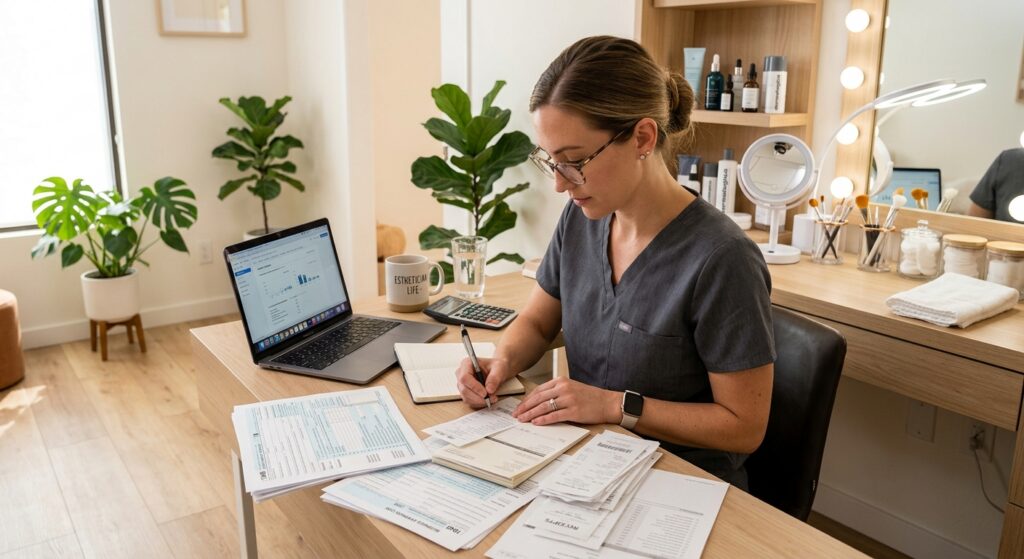
Booth Rent, Chair Rental & Salon Suite Fees Tax Rules 2026: The Complete Guide for California Beauty Pros
Understanding the booth rent, chair rental & salon suite fees tax rules 2026 can save California hairstylists, barbers, nail techs, and estheticians thousands of dollars every year. Whether you rent a chair at a shared salon or lease your own private suite, the IRS treats you as a self-employed business owner. That means you must report all income AND claim every deduction you are entitled to. This guide breaks down exactly how to do that for the 2026 tax year — including important updates from the One Big Beautiful Bill Act (OBBBA).
This information is current as of 5/22/2026. Tax laws change frequently. Verify updates with the IRS or California FTB if reading this later.
Table of Contents
- Key Takeaways
- What Is Booth Rent and How Does the IRS Classify Booth Renters in 2026?
- Is Booth Rent or Salon Suite Fees Tax Deductible in 2026?
- What Other Deductions Can California Booth Renters Claim in 2026?
- How Does Self-Employment Tax Work for Salon Suite Owners in 2026?
- What Are the 2026 1099-NEC Rules for Booth Rent and Tip Income?
- Should You Form an LLC or S Corp for Your Salon Business in 2026?
- Uncle Kam in Action: How a Los Angeles Esthetician Saved $9,800 in 2026
- Next Steps
- Related Resources
- Frequently Asked Questions
Key Takeaways
- For 2026, booth rent, chair rental fees, and salon suite payments are fully deductible business expenses on IRS Schedule C.
- The 2026 self-employment tax rate is 15.3% on net self-employment income — plan your quarterly estimated payments accordingly.
- Under the OBBBA, the 2026 federal 1099-NEC threshold rose from $600 to $2,000; California conforms to this new $2,000 threshold.
- A new tip income deduction (OBBBA) takes effect for qualified beauty industry workers — final IRS regulations issued April 2026.
- Structuring as an LLC or S Corp can significantly reduce your 2026 self-employment tax burden if your net profit exceeds roughly $50,000.
What Is Booth Rent and How Does the IRS Classify Booth Renters in 2026?
Quick Answer: The IRS classifies booth renters as self-employed independent contractors. You own your own business. You report income and deduct expenses on Schedule C of your Form 1040.
Booth rent is a business arrangement where a hairstylist, barber, nail technician, or esthetician pays a flat fee to a salon owner. In exchange, the renter uses a specific chair, station, or suite to serve their own clients. The renter sets their own prices, keeps all revenue, and operates as their own independent business. This arrangement is fundamentally different from being a salon employee.
Because you control your own business operations, the IRS treats you as a self-employed individual. This distinction is critical. It means no employer withholds taxes for you. However, it also means you can deduct virtually every legitimate business expense you incur — including the rent itself.
Employee vs. Independent Contractor: Why It Matters
California’s AB 5 law created strict tests for worker classification. However, booth renters operating under a legitimate rental agreement — where the renter sets their own schedule, prices, and policies — generally qualify as independent contractors. This is because they meet the ABC test’s key requirements: they work independently, they perform work outside the usual course of the salon owner’s business, and they operate an independent trade.
Consequently, booth renters must file and pay taxes as self-employed individuals using Schedule C. They also pay self-employment tax via Schedule SE. Understanding this 2026 classification is the foundation of effective tax planning for all California beauty professionals.
Three Common Salon Business Arrangements in 2026
California beauty professionals operate under different arrangements. Each one carries distinct tax implications for 2026. Understanding your specific arrangement helps you apply the right tax strategy.
| Arrangement | IRS Classification | 2026 Tax Form | Booth Rent Deductible? |
|---|---|---|---|
| Booth Renter (shared salon) | Self-Employed | Schedule C + SE | Yes — fully deductible |
| Salon Suite Owner/Lessee | Self-Employed | Schedule C + SE | Yes — fully deductible |
| Salon Employee (W-2) | Employee | Form W-2 / 1040 | No — not deductible |
Is Booth Rent or Salon Suite Fees Tax Deductible in 2026?
Quick Answer: Yes. For the 2026 tax year, booth rent, chair rental fees, and salon suite lease payments are 100% deductible as ordinary and necessary business expenses on Schedule C. Keep all receipts and rental agreements.
This is one of the most valuable deductions available to California beauty professionals. Under IRS Publication 535, a business expense is deductible if it is both ordinary (common in your industry) and necessary (helpful and appropriate for your business). Booth rent and salon suite fees clearly meet both tests. Every dollar you pay in rent directly reduces your taxable income in 2026.
How to Deduct Booth Rent on Schedule C
You report booth rent payments under Part II, Line 20b of Schedule C — labeled “Other business property.” Salon suite fees go in the same location. You do not need to separate these from other rent payments. However, you should maintain clear records showing the rental agreement, the monthly amount, and proof of payment for every month of the 2026 tax year.
Furthermore, if your salon owner charges you additional fees beyond base rent — such as a utilities surcharge, towel service fee, or product restocking fee — those charges may also be deductible. The key test is whether each charge is directly related to your business operations. Working with a tax professional who understands self-employed beauty workers ensures you capture every deductible dollar.
Real-World 2026 Deduction Calculation
Here is a straightforward example for a California nail technician renting a booth for the 2026 tax year:
- Monthly booth rent: $600 × 12 months = $7,200 deducted
- At a 22% federal tax bracket: saves approximately $1,584 in income tax
- Plus self-employment tax savings (deduction of half of SE tax): additional ~$510
- Total 2026 federal tax savings from booth rent alone: approximately $2,094
That does not include California FTB income tax savings, which are separate. The California income tax rate can range from 1% to 13.3% depending on your income level, meaning additional state savings on top of your federal deduction.
Pro Tip: Never pay booth rent in cash without getting a receipt. For 2026 audits, the IRS requires documentation of all deductions. Use Zelle, Venmo Business, or a check so you have a digital trail.
What Other Deductions Can California Booth Renters Claim in 2026?
Quick Answer: Beyond rent, California booth renters can deduct supplies, equipment, education, marketing, health insurance premiums, and retirement contributions in 2026. These deductions directly reduce your taxable income and self-employment tax.
The booth rent, chair rental & salon suite fees tax rules 2026 extend far beyond just the rent payment itself. As a self-employed beauty professional, your entire business operation generates deductible expenses. Most beauty professionals leave significant money on the table each year by underreporting their deductions. Working with a knowledgeable tax strategy advisor can help you identify every legitimate write-off available under current 2026 IRS rules.
The Full List of 2026 Schedule C Deductions for Beauty Pros
Here is a comprehensive breakdown of deductible expenses for booth renters and salon suite owners in 2026:
| Expense Category | Examples | Schedule C Location |
|---|---|---|
| Rent / Suite Fees | Booth rent, chair rent, suite lease payment | Line 20b |
| Supplies & Products | Hair color, shampoo, nail polish, wax, skincare | Line 22 |
| Equipment | Clippers, dryers, curling irons, UV lamps | Line 13 (depreciation) |
| Education & Licensing | Continuing education, California CSLB renewal fees | Line 27a (other expenses) |
| Marketing | Instagram ads, website, business cards, photography | Line 8 |
| Health Insurance | Self-employed health insurance premiums | Form 1040 (above-the-line) |
| Retirement Contributions | SEP IRA (up to $72,000 in 2026), SIMPLE IRA | Form 1040 (above-the-line) |
| Uniforms / Protective Clothing | Aprons, gloves, scrubs (not suitable for everyday wear) | Line 27a |
| Phone & Internet | Business portion of cell phone, scheduling app subscriptions | Line 27a |
| Mileage / Auto | Driving to supply stores, education, client appointments | Line 9 |
The 2026 QBI Deduction: Up to 20% Off Your Taxable Income
One of the most powerful deductions available to booth renters in 2026 is the Qualified Business Income (QBI) deduction under IRS Section 199A. This deduction allows eligible self-employed individuals to deduct up to 20% of their qualified business income from their taxable income. For a booth renter earning $80,000 in net profit, that represents up to $16,000 in additional deductions before calculating your tax bill.
The QBI deduction applies broadly to sole proprietors filing Schedule C. Most booth renters and salon suite lessees qualify. Moreover, this deduction reduces your federal income tax — not your self-employment tax. Therefore, it stacks on top of other deductions to further lower your overall 2026 tax liability.
Pro Tip: The QBI deduction phases out at higher income levels for some service businesses. For 2026, confirm your eligibility with a tax professional, especially if your net income exceeds $190,000 (single) or $380,000 (married filing jointly). Beauty services generally qualify as a non-specified service trade, so most booth renters face no income-based phase-out.
SEP IRA Retirement Contributions in 2026
For 2026, self-employed beauty professionals can contribute up to $72,000 to a SEP IRA. This is one of the most effective tax reduction tools available to booth renters. Every dollar you contribute to a SEP IRA reduces your adjusted gross income, lowering both your federal income tax and your California state tax bill. Furthermore, SEP IRA contributions are above-the-line deductions — meaning you claim them even if you take the standard deduction.
To illustrate, a hairstylist with $90,000 in net self-employment income could contribute roughly $16,200 (approximately 18% of net self-employment earnings after the SE tax deduction) to a SEP IRA. This directly reduces taxable income and results in substantial tax savings for the 2026 tax year. You have until your 2026 tax return due date (including extensions) to make this contribution.
How Does Self-Employment Tax Work for Salon Suite Owners in 2026?
Quick Answer: The 2026 self-employment tax rate is 15.3% (12.4% Social Security + 2.9% Medicare) on your net self-employment earnings. You pay this on top of regular income tax. However, you can deduct half of the SE tax paid from your income.
Self-employment tax is often the biggest shock for new booth renters. As a self-employed individual, you pay both the employee and employer portions of Social Security and Medicare taxes. The 2026 rate is 15.3% on net earnings up to the Social Security wage base, and 2.9% on all earnings above that threshold. This applies to all California hairstylists, barbers, nail techs, and estheticians who operate as self-employed workers.
The Two-Step SE Tax Reduction Strategy
Fortunately, the IRS gives you two important offsets to reduce the sting of self-employment tax in 2026:
- Step 1 — Deduct half of your SE tax: The IRS allows you to deduct 50% of your self-employment tax as an above-the-line adjustment to income on Form 1040. This reduces your adjusted gross income before calculating regular income tax.
- Step 2 — Maximize business deductions: Your SE tax is based on net self-employment income. Every deductible business expense (including booth rent) reduces your net income and therefore reduces your SE tax liability for 2026.
2026 Quarterly Estimated Tax Payments for Beauty Professionals
Because no employer withholds taxes for you, the IRS requires self-employed individuals to make quarterly estimated tax payments. For the 2026 tax year, the four key deadlines are:
- Q1 2026: April 15, 2026 (for January – March income)
- Q2 2026: June 16, 2026 (for April – May income)
- Q3 2026: September 15, 2026 (for June – August income)
- Q4 2026: January 15, 2027 (for September – December income)
Missing these deadlines results in underpayment penalties. California requires separate estimated payments to the Franchise Tax Board (FTB) as well. The FTB’s 2026 estimated tax schedule differs slightly from the IRS schedule, so verify both deadlines with a qualified tax preparer familiar with California self-employment rules.
Pro Tip: A common rule of thumb is to set aside 25–30% of every client payment for taxes. Open a dedicated savings account and transfer this percentage automatically after each payment. This prevents the end-of-quarter scramble that catches many California beauty professionals off guard.
What Are the 2026 1099-NEC Rules for Booth Rent and Tip Income?
 Free Tax Write-Off Finder
Quick Answer: For 2026, the 1099-NEC and 1099-MISC reporting threshold increased to $2,000 (up from $600 previously). California conforms to this new $2,000 federal threshold. Additionally, the OBBBA created a new tip income deduction for qualifying workers.
The One Big Beautiful Bill Act (OBBBA) significantly changed 1099 reporting requirements effective January 1, 2026. The federal 1099-NEC and 1099-MISC reporting threshold rose from $600 to $2,000. This means salon owners who pay rent to booth renters do not need to issue a 1099-NEC unless total payments for the year exceed $2,000. California has adopted this $2,000 threshold for tax year 2026, conforming with the federal change.
The New 2026 Tip Income Deduction for Salon Workers
One of the most exciting 2026 tax developments for California beauty professionals is the new tip income deduction created by the OBBBA. Final IRS regulations on this deduction were issued April 10, 2026, with an effective date of June 12, 2026. This deduction potentially allows qualifying workers in traditionally tipped occupations to exclude a portion of their tip income from federal income tax.
Hairstylists, barbers, nail techs, and estheticians are recognized among traditional tipping-industry workers. However, the deduction applies to tips received from customers for services — not service charges or additional fees added by the business. Furthermore, the deduction is available to employees whose tips are reported on W-2s. Self-employed booth renters should consult a tax advisor to determine their specific eligibility under the 2026 OBBBA tip rules, as final guidance continues to evolve.
Do You Need to Report All Cash Tips in 2026?
Yes. Whether or not a 1099 is issued, all income must be reported on your 2026 Schedule C. This includes cash tips, Venmo payments, CashApp transfers, and any other form of payment from clients. The IRS requires self-employed individuals to report all gross receipts. The 1099-NEC threshold change only affects the reporting obligation of the payer — it does not change your obligation to report and pay tax on all income you receive, regardless of amount.
Did You Know? California’s FTB has access to bank deposit data through information-sharing agreements. Depositing large amounts of unreported cash tips can trigger FTB audit inquiries for California beauty professionals. Always report all income accurately.
Should You Form an LLC or S Corp for Your Salon Business in 2026?
Quick Answer: If your salon business generates more than roughly $50,000 in annual net profit, forming an LLC taxed as an S Corp could save thousands in self-employment tax annually. For 2026, this strategy is more valuable than ever given current SE tax rates.
Many California booth renters start as sole proprietors and never revisit their business structure. However, as income grows, the 15.3% self-employment tax becomes a significant burden. Entity structuring strategies — particularly the S Corporation election — can dramatically reduce this tax burden for high-earning beauty professionals.
How an S Corp Election Reduces SE Tax for Salon Suite Owners
When your salon business elects S Corp status, you pay yourself a reasonable salary — subject to payroll taxes — and take any remaining profits as distributions. Distributions are not subject to self-employment tax. This creates immediate 2026 tax savings. For example:
- Without S Corp: $100,000 net income × 15.3% SE tax = $15,300 in SE tax
- With S Corp: $60,000 salary (subject to payroll taxes) + $40,000 distribution (no SE tax)
- Approximate SE/payroll tax saving: $3,000–$5,000 per year
However, note that California imposes an $800 minimum franchise tax on LLCs and S Corps, plus an additional LLC fee based on gross receipts. Therefore, the breakeven point for California beauty professionals is typically higher than in other states. Use our LLC vs S-Corp Tax Calculator to estimate your potential 2026 savings based on your specific revenue level before making this decision.
LLC vs. Sole Proprietor vs. S Corp: 2026 Comparison for California Beauty Pros
Each business structure offers different 2026 tax implications. The right choice depends on your income level, risk tolerance, and long-term growth plans. Partnering with experienced California tax strategists ensures you choose the optimal structure for your specific situation. Here is a side-by-side overview:
- Sole Proprietor: Simple to maintain, no annual state filing fees (other than the FTB minimum), but 100% of net profit subject to 15.3% SE tax.
- Single-Member LLC: Adds liability protection, taxed same as sole proprietor by default. California’s $800 annual minimum franchise tax applies. Good for beauty pros earning $30,000–$60,000 net.
- S Corporation: Splits income into salary and distributions, reducing SE/payroll taxes significantly. Best for net profits above $60,000–$80,000 in California. Requires payroll setup and more complex accounting.
Additionally, California-based beauty professionals should consult with California tax strategists who specialize in self-employed workers before electing S Corp status. California does not always follow federal S Corp rules in every situation, and the FTB applies its own 1.5% S Corp franchise tax rate on net income.

Uncle Kam in Action: How a Los Angeles Esthetician Saved $9,800 in 2026
Client Snapshot: Vanessa M. is a licensed esthetician based in Los Angeles, California. She leases a private salon suite in a Luxury Suite concept in the Koreatown neighborhood. She has been in business for six years and serves a loyal client base for facials, waxing, and skincare treatments.
Financial Profile: For 2026, Vanessa’s gross service revenue totaled $112,000. Her salon suite lease cost $1,500 per month ($18,000 annually). Before working with Uncle Kam, she was filing her own Schedule C and capturing only her suite fees, product costs, and phone bill as deductions.
The Challenge: Vanessa came to Uncle Kam frustrated after receiving an unexpected $8,200 federal tax bill in early 2026 for the prior year. She had no quarterly estimated payments set up. She was also not claiming her continuing education, professional liability insurance, scheduling software, or the business-use portion of her vehicle. Additionally, she had not opened a retirement account, meaning she was losing out on powerful above-the-line deductions available to self-employed workers.
The Uncle Kam Solution: Uncle Kam’s team conducted a full tax strategy review and identified the following 2026 action plan:
- Claimed all missed deductions: $18,000 suite fees, $11,400 in products and supplies, $2,800 in continuing education, $1,200 in professional liability insurance, $1,440 in scheduling software, and $3,600 in vehicle mileage.
- Opened a SEP IRA and made a $14,000 contribution for 2026, reducing her AGI significantly.
- Set up a quarterly estimated tax payment plan to avoid underpayment penalties.
- Applied the QBI deduction of 20% to her eligible net income.
The Results:
- Total Tax Savings (2026): $9,800 in combined federal and California state tax reduction
- Uncle Kam Investment: $1,800 annual advisory fee
- First-Year ROI: 444% — Vanessa received more than five times her advisory fee back in tax savings
Vanessa also avoided the stress of a surprise tax bill by implementing the quarterly estimated payment plan. She now feels fully in control of her salon business finances — and is building a retirement nest egg for the first time.
Next Steps
Now that you understand the 2026 booth rent, chair rental & salon suite fees tax rules, take these action steps immediately. Working with a business solutions team that understands beauty industry taxes can help you execute each step efficiently.
- Organize your 2026 records: Gather all booth rent receipts, supply invoices, and equipment purchases from January through today.
- Open a SEP IRA: Establish a SEP IRA before your 2026 tax deadline to reduce your 2026 AGI by up to $72,000.
- Set up quarterly estimated payments: Your next 2026 estimated payment (Q2) is due June 16, 2026 — don’t miss it.
- Evaluate entity structuring: If your 2026 net profit exceeds $50,000, review whether an LLC or S Corp makes sense for 2027 planning.
- Connect with a California tax strategist: Schedule a review with Uncle Kam to identify every deduction and strategy available to your specific salon business before year-end.
Related Resources
- Self-Employed Tax Guide for 1099 Contractors
- Tax Strategy Planning for Independent Professionals
- LLC vs. S Corp: Entity Structuring for Self-Employed Workers
- Free Tax Calculators for Self-Employed Professionals
- 2026 Self-Employed Tax Deadline Calendar
Frequently Asked Questions
Can I deduct booth rent if I pay monthly in cash?
Yes — but you must have documentation. The IRS allows cash payment deductions for booth rent only when you can substantiate the expense. You should obtain a written rental agreement showing the monthly amount, a receipt signed by the salon owner for each payment, or a bank record (like a withdrawal that matches the rental amount). Without documentation, the IRS can disallow the deduction on audit. Always ask your salon owner to sign a receipt even for cash payments.
Does my salon owner need to give me a 1099 in 2026?
Not necessarily. The 1099 rules are different for rent vs. services. If the salon owner is paying you commissions or fees for services that exceed $2,000 for 2026, they may need to issue a 1099-NEC. However, if you are the one paying booth rent to the salon owner, a different form (1099-MISC for rent) would apply — and only if you paid more than $2,000 to that landlord during 2026. The new OBBBA-driven $2,000 threshold applies for all payments made on or after January 1, 2026. Regardless of whether a 1099 is issued, you must report all your income on Schedule C.
Is there a difference between booth rent and a salon suite lease for tax purposes?
Both types of payments are fully deductible as rent expense on Schedule C for 2026. The primary tax difference involves the level of independence and control each arrangement provides. Salon suite lessees typically have a separate, private space and often bear more of their own overhead costs (utilities, amenities), which can generate additional deductions. Booth renters in shared salons have fewer additional overhead costs but may have access to shared utilities included in their rent. In both cases, the payment goes on Line 20b of Schedule C and reduces your net taxable income.
Can I deduct the products I use on clients as a business expense?
Absolutely — and this is one of the most commonly missed deductions for booth renters. Hair color, developer, shampoos, conditioners, styling products, nail polish, gels, acrylics, wax, skincare products, facial serums, and any other professional products you purchase and use in the course of providing services are fully deductible as supply expenses on Line 22 of Schedule C for 2026. Keep all receipts from professional supply stores like Sally Beauty, Cosmoprof, or direct brand orders. The IRS recognizes these as ordinary and necessary business expenses for beauty professionals.
What happens if I don’t make quarterly estimated tax payments in 2026?
If you owe $1,000 or more in federal taxes after subtracting withholding and credits, the IRS will assess an underpayment penalty. This penalty is based on the IRS underpayment interest rate, which changes quarterly. For 2026, underpayment penalties apply separately at the federal level (IRS) and California state level (FTB). California’s underpayment penalty can add 5% of the underpaid amount. The best strategy is to make quarterly payments equal to either 100% of your prior year tax liability or 90% of your current year liability — whichever is smaller. Visit IRS.gov’s estimated tax guidance for exact 2026 rules and safe harbor calculations.
Do California state taxes apply differently to booth renters than federal taxes?
Yes, there are key California-specific considerations in 2026. California does not have a separate self-employment tax (the federal SE tax covers Social Security and Medicare). However, California does impose its own income tax on your net Schedule C profit, with rates ranging from 1% to 13.3% depending on your income. Additionally, California requires all self-employed individuals to file estimated tax payments with the FTB on a different schedule than the IRS. California also requires most self-employed workers to obtain a Seller’s Permit if they sell retail products to clients. Check the California Franchise Tax Board website for the most current guidance on self-employed filing requirements in 2026.
Should I hire a tax professional for my salon business, or can I file on my own?
Self-filing is possible, but most booth renters who work with a tax professional discover significant missed deductions that more than cover the advisory cost. For 2026, the complexity of the OBBBA changes — including the new tip income deduction, the updated 1099-NEC threshold, and potential entity restructuring opportunities — makes professional guidance especially valuable. Uncle Kam specializes in self-employed beauty professionals and can identify strategies specific to California booth renters. Review our tax advisory services to learn how we help California salon professionals reduce their 2026 tax burden legally and confidently.
Last updated: May, 2026

