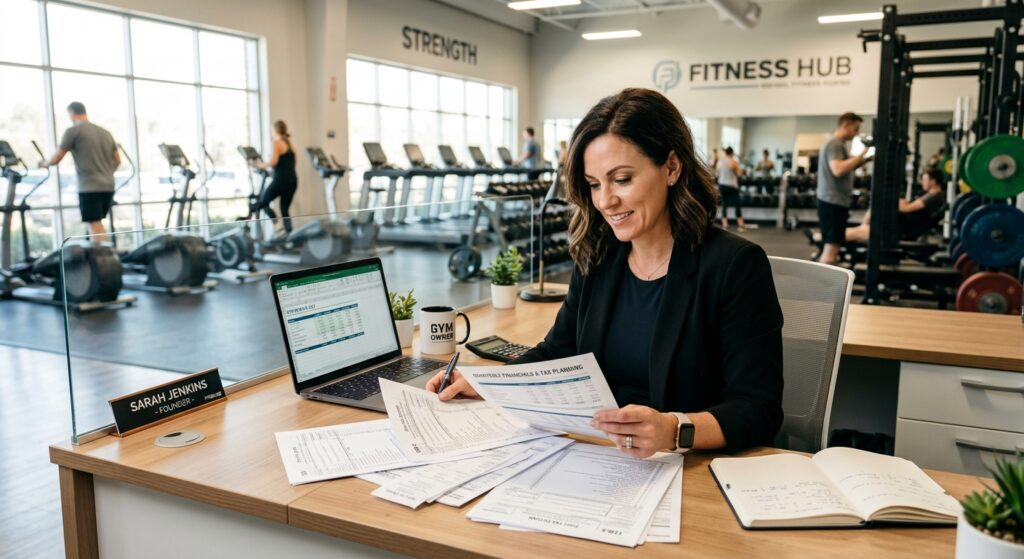
Best Tax Write-Offs for Gym Owners in 2026: The Complete Deduction Playbook
If you own a fitness business, knowing the best tax write-offs for gym owners can dramatically lower your tax bill for 2026. Gym owners face a unique tax landscape — from heavy equipment costs to payroll, lease expenses, and marketing. Meanwhile, the One Big Beautiful Bill Act (OBBBA) made 100% bonus depreciation permanent, giving fitness entrepreneurs a powerful new tool. Working with a knowledgeable tax advisor helps you capture every dollar of savings available this year.
Table of Contents
- Key Takeaways
- What Qualifies as a Tax Write-Off for a Gym Owner?
- How Can Gym Owners Maximize Equipment Depreciation in 2026?
- What Operating Expenses Can a Gym Owner Deduct?
- How Do Payroll and Staffing Deductions Work for Gym Owners?
- What Retirement and Health Deductions Are Available for Gym Owners?
- Can Gym Owners Deduct Home Office and Vehicle Expenses?
- How Does Business Structure Affect a Gym Owner’s Tax Write-Offs?
- Uncle Kam in Action: Gulfport Gym Owner Saves $28,400
- Next Steps
- Related Resources
- Frequently Asked Questions
Key Takeaways
- For 2026, gym owners can fully expense equipment in the year of purchase using 100% bonus depreciation, now permanently available under the OBBBA.
- Ordinary and necessary business expenses — including rent, utilities, insurance, and marketing — are fully deductible for the 2026 tax year.
- Self-employed gym owners pay a 15.3% self-employment tax in 2026, but can deduct half of that amount from gross income.
- Gym owners structured as S Corps can split income between salary and distributions, reducing the 15.3% self-employment tax burden significantly.
- Retirement contributions — including Solo 401(k) and SEP-IRA — provide high-impact deductions that compound over time for gym business owners.
What Qualifies as a Tax Write-Off for a Gym Owner?
Quick Answer: For 2026, any expense that is both ordinary (common in your industry) and necessary (helpful for running your gym) qualifies as a tax deduction under IRS guidelines for business expenses.
The foundation of tax strategy for any gym owner starts with the IRS “ordinary and necessary” standard. According to IRS Publication 535, a business expense is deductible if it is both ordinary — meaning common in your trade — and necessary — meaning helpful and appropriate for your business. As a fitness business owner, nearly every dollar you spend to run your gym can meet this test.
Furthermore, 2026 is a particularly powerful year for gym owners to maximize deductions. The business owners who understand the new rules under the One Big Beautiful Bill Act (OBBBA) are already positioned ahead of their competitors. The OBBBA made 100% bonus depreciation permanent, which means you can write off the full cost of qualifying equipment and property in the year you place it in service — not just a fraction of it.
The Two-Part Test Every Gym Expense Must Pass
Before claiming any deduction, every gym expense must pass two questions:
- Is it ordinary? Would other fitness businesses commonly incur this expense?
- Is it necessary? Does it help your gym operate, grow, or serve clients?
If both answers are yes, the expense is almost certainly deductible. For example, treadmills, squat racks, cleaning supplies, and personal training software all pass this test with ease. However, personal expenses — like your own gym membership fees at another facility for personal workouts — do not qualify.
The Major Categories of Gym Owner Deductions in 2026
Gym owners can claim deductions across several broad categories. Each category can yield thousands of dollars in tax savings annually. Here is a high-level overview:
| Deduction Category | Examples | 2026 Rule / Limit |
|---|---|---|
| Equipment & Assets | Treadmills, weights, software | 100% bonus depreciation (permanent) |
| Facility Costs | Rent, utilities, repairs | Fully deductible |
| Payroll & Contractors | Trainer wages, 1099 instructors | Fully deductible |
| Marketing | Social media ads, website, signage | Fully deductible |
| Retirement Contributions | Solo 401(k), SEP-IRA | Employee: $23,000; SEP: up to 25% of compensation |
| Insurance | Liability, health insurance premiums | Fully deductible |
| Professional Services | CPA, attorney, consulting | Fully deductible |
Pro Tip: Document every expense throughout the 2026 tax year. Keep receipts, invoices, and bank statements organized by category. The IRS requires contemporaneous records — not reconstructed ones — to support deductions in the event of an audit.
How Can Gym Owners Maximize Equipment Depreciation in 2026?
Quick Answer: For 2026, gym owners can deduct 100% of qualifying equipment costs in the first year using bonus depreciation — now permanently available under the One Big Beautiful Bill Act (OBBBA). This is one of the most powerful tax write-offs for gym owners this year.
Equipment is typically a gym owner’s largest capital investment. Fortunately, the 2026 tax rules offer extraordinary relief. The OBBBA permanently restored 100% bonus depreciation, meaning you no longer need to depreciate fitness equipment over five to seven years. Instead, you deduct the full purchase price in the same tax year the equipment is placed in service.
This is a game-changer for fitness entrepreneurs. A gym that spends $80,000 on new commercial treadmills, weight machines, and cardio equipment can write off the entire $80,000 in 2026. That deduction directly reduces taxable income, potentially dropping the owner into a lower tax bracket.
What Equipment Qualifies for 100% Bonus Depreciation?
For 2026, qualifying equipment generally includes tangible personal property used in your business with a recovery period of 20 years or less. For gym owners, this covers most fitness-related assets:
- Cardio machines (treadmills, ellipticals, stationary bikes, rowing machines)
- Strength training equipment (weight racks, cable machines, benches)
- Free weights and functional training equipment
- Sound systems, televisions, and other in-gym technology
- Point-of-sale systems, computers, and tablets used in the business
- Commercial washers and dryers for towel service
- Furniture used exclusively in your business (reception desks, waiting area furniture)
Section 179 vs. Bonus Depreciation: Which Should Gym Owners Use?
Gym owners have two primary options to accelerate equipment write-offs in 2026: Section 179 expensing and bonus depreciation. Both deliver first-year deductions, but they work differently.
Section 179 allows you to elect immediate expensing up to a set annual dollar limit (indexed for inflation each year — check with your tax advisor for the current 2026 confirmed limit). However, Section 179 cannot create a business tax loss. Bonus depreciation, on the other hand, has no such restriction and can create or increase a net operating loss, which you can then carry forward to future profitable years.
For most gym owners investing heavily in new equipment, bonus depreciation is the preferred strategy for 2026. However, the optimal approach depends on your income level and business structure. A customized tax strategy helps you determine the best combination for your specific situation.
Pro Tip: If you plan to buy new gym equipment before year-end 2026, time the purchase so the equipment is placed in service before December 31. The equipment must be operational — not just ordered or delivered — to qualify for 2026 bonus depreciation.
Leasehold Improvements: A Often-Missed Deduction
If you lease your gym space, qualified improvement property (QIP) — such as interior renovations, flooring upgrades, or HVAC improvements — may also qualify for 100% bonus depreciation in 2026. This includes work done to improve the interior of a non-residential building after it was first placed in service. For a gym owner who renovated a studio, installed rubber flooring, or upgraded changing rooms, these costs can deliver massive first-year deductions. Always work with a qualified tax professional when categorizing improvement costs.
What Operating Expenses Can a Gym Owner Deduct?
Quick Answer: For 2026, gym owners can deduct virtually all ordinary and necessary operating expenses — including rent, utilities, insurance, cleaning, software subscriptions, and continuing education costs.
Day-to-day operating expenses form the backbone of tax savings for most gym owners. These costs occur every month and, when properly tracked, can add up to tens of thousands of dollars in annual deductions. Getting these deductions right requires clean bookkeeping and a proactive approach to tax compliance and filing.
Rent and Facility Costs
Rent is typically the largest ongoing expense for gym owners, and it is fully deductible for 2026. Whether you lease a warehouse, commercial strip mall space, or a standalone building, every dollar of rent you pay to operate your gym reduces your taxable income dollar for dollar. Related facility costs are also deductible:
- Electricity, water, gas, and internet utilities
- Janitorial and cleaning services
- Security system subscriptions and monitoring fees
- Routine repairs and maintenance
- Pest control and waste disposal
Gym owners in Mississippi can also benefit from working with a local expert to ensure state-specific deductions are captured correctly. Connecting with a tax preparation specialist in Mississippi helps gym owners navigate both federal and state filing requirements accurately.
Insurance Premiums
Business insurance is another high-value deduction for gym owners in 2026. Most fitness businesses carry multiple policies, and all business-related premiums are fully deductible:
- General liability insurance (essential for any gym)
- Professional liability / errors and omissions coverage
- Property and equipment insurance
- Workers’ compensation insurance
- Business interruption insurance
Software, Subscriptions, and Technology
Modern gyms depend on technology, and those costs are deductible. Gym management software (like Mindbody or Glofox), scheduling apps, payroll platforms, accounting software, and point-of-sale systems all qualify as ordinary and necessary business expenses. Additionally, music licensing fees (such as BMI, ASCAP, or Soundtrack Your Brand) are deductible for gyms that play licensed music for members.
Marketing and Advertising
Every dollar spent to attract new members and retain existing ones is fully deductible in 2026. This category covers a wide range of expenses:
- Social media advertising (Facebook, Instagram, TikTok)
- Google Ads and search engine marketing
- Website design, hosting, and maintenance
- Branded merchandise given to members (shirts, water bottles, bags)
- Referral program costs and promotional discounts
- Photography and video production for social media content
Did You Know? Gym owners who invest in continuing education — personal training certifications, nutrition coaching programs, or business development courses directly related to their gym — can also deduct those costs as education expenses under the business expense rules for 2026.
How Do Payroll and Staffing Deductions Work for Gym Owners?
Quick Answer: For 2026, all wages, salaries, and payroll taxes you pay for employees — as well as fees paid to independent contractor trainers — are fully deductible business expenses. These deductions reduce your taxable income dollar for dollar.
Payroll is often the second-largest expense category for gym owners after facility costs. The good news is that the IRS allows full deductions for all compensation-related costs in 2026. Proper business financial systems make it easy to track and categorize these expenses throughout the year.
Employee Wages and Benefits
All wages, salaries, and hourly compensation paid to W-2 employees are fully deductible in 2026. This includes front desk staff, personal trainers employed as W-2 workers, class instructors, and management. Additionally, the following employee benefit costs are deductible:
- Employer-paid health insurance premiums
- Employer contributions to employee retirement plans
- Employer payroll taxes (Social Security and Medicare)
- Workers’ compensation premiums (also an insurance deduction)
- Uniforms and required clothing with your gym logo
Independent Contractor Trainers and Instructors
Many gym owners use 1099 independent contractors for personal training, group fitness classes, and specialized programming. Payments to properly classified 1099 contractors are fully deductible as a business expense. However, classification matters enormously. Misclassifying an employee as a contractor can trigger significant IRS penalties, back taxes, and interest. The IRS uses a multi-factor test to determine worker classification — so consult a qualified tax advisor before deciding how to classify your instructors.
If you pay any contractor $600 or more during the 2026 tax year, you must issue them a Form 1099-NEC and file it with the IRS. Maintaining accurate records of all contractor payments protects your deduction and keeps you compliant.
Pro Tip: Consider using the Self-Employment Tax Calculator for Gulfport to estimate your 2026 self-employment tax liability and model the savings from switching to a more tax-efficient structure.
What Retirement and Health Deductions Are Available for Gym Owners?
 Free Tax Write-Off Finder
Quick Answer: For 2026, self-employed gym owners can contribute up to $23,000 to a Solo 401(k) as an employee, plus an employer contribution — and deduct 100% of self-employed health insurance premiums paid for themselves and their families.
Retirement and health benefits are among the most tax-efficient write-offs available to gym owners in 2026. As a self-employed business owner, you bear the full 15.3% self-employment tax rate — but smart retirement planning creates large above-the-line deductions that reduce both income tax and, in some cases, SE tax exposure.
Solo 401(k) for Gym Owners
A Solo 401(k) is one of the best retirement tools for a gym owner who has no full-time W-2 employees. For 2026, you can contribute up to $23,000 as the employee and an additional employer contribution of up to 25% of your net self-employment income. The total combined contribution limit is $69,000 for 2026. Every dollar contributed reduces your 2026 taxable income.
For example, a gym owner earning $200,000 in net profit could potentially contribute $23,000 plus an employer contribution, sheltering tens of thousands from federal income tax in 2026. This strategy also aligns with the MERNA method of building long-term wealth while minimizing current-year taxes.
SEP-IRA: Simple and Powerful
A SEP-IRA allows self-employed gym owners to contribute up to 25% of their net self-employment income (or a set maximum) in 2026. The SEP-IRA has fewer administrative requirements than a Solo 401(k) and works well for gym owners with variable income. Contributions are fully deductible from gross income, providing immediate tax savings for the 2026 tax year.
Self-Employed Health Insurance Deduction
Gym owners who pay for their own health insurance — and are not eligible for coverage through a spouse’s employer plan — can deduct 100% of those premiums as an above-the-line deduction in 2026. This includes premiums for medical, dental, and vision coverage for yourself, your spouse, and your dependents. This deduction reduces your adjusted gross income directly and is not subject to the 7.5% of AGI floor that applies to itemized medical deductions.
Can Gym Owners Deduct Home Office and Vehicle Expenses?
Quick Answer: Yes — gym owners who use part of their home exclusively and regularly for administrative business tasks can claim the home office deduction in 2026. Similarly, vehicles used for business purposes generate mileage or actual expense deductions.
Even if you run your gym from a commercial location, you may still have legitimate home office and vehicle deductions. Many gym owners handle bookkeeping, scheduling, billing, and client communications from a dedicated home workspace. The IRS allows a home office deduction for any space used exclusively and regularly for business purposes.
The Home Office Deduction
There are two methods for calculating the home office deduction in 2026:
- Simplified method: Deduct $5 per square foot of dedicated office space, up to 300 square feet (maximum $1,500 deduction for 2026).
- Regular method: Calculate the actual percentage of home expenses (mortgage interest or rent, utilities, insurance) attributable to the office space. This method typically yields a larger deduction for those with higher home expenses.
The key requirement is exclusive use. If your home office doubles as a guest room or personal space, it does not qualify for 2026. Work with a Mississippi tax preparation expert to confirm your home office meets the IRS standard before claiming this deduction.
Vehicle Deductions for Gym Owners
If you drive for business purposes — such as visiting clients for personal training sessions, attending fitness expos, or picking up supplies — those miles are deductible in 2026. The IRS sets the standard mileage rate annually; verify the current 2026 rate at IRS.gov standard mileage rates. Alternatively, you can deduct actual vehicle expenses — gas, insurance, repairs, depreciation — based on the percentage of business use. Keep a mileage log throughout 2026 to support any vehicle deduction you claim.
Pro Tip: Never mix personal and business driving. The IRS specifically excludes commuting miles — driving between home and your regular gym location — from the vehicle deduction. Only miles driven for separately documented business purposes count for 2026.
How Does Business Structure Affect a Gym Owner’s Tax Write-Offs?
Quick Answer: For 2026, the right entity structure amplifies every write-off. An S Corp can eliminate a significant portion of the 15.3% self-employment tax on gym profits, potentially saving a mid-size gym owner $7,000 to $15,000 or more per year compared to operating as a sole proprietor.
The best tax write-offs for gym owners become even more valuable when paired with the right entity structure. Operating as a sole proprietor or single-member LLC without an S Corp election means you pay 15.3% self-employment tax on every dollar of net profit in 2026. That adds up fast for a profitable fitness business.
The S Corp Advantage for Gym Owners
An S Corporation allows gym owners to split income between a reasonable salary (subject to payroll taxes) and owner distributions (not subject to self-employment taxes). This structure does not eliminate any business deductions — it actually stacks on top of them, creating a double layer of savings.
Here is a simplified 2026 comparison:
| Scenario | Net Gym Profit | SE Tax (15.3%) | Estimated 2026 Savings |
|---|---|---|---|
| Sole Proprietor / Single-Member LLC | $150,000 | ~$21,200 | Baseline |
| S Corp (Salary: $60,000; Distribution: $90,000) | $150,000 | ~$9,180 (on salary only) | ~$12,020 saved annually |
The salary must represent “reasonable compensation” for the services you provide. The IRS scrutinizes S Corp owners who pay themselves unreasonably low salaries to avoid payroll taxes. However, when set correctly, the S Corp structure is a legitimate and IRS-approved strategy for 2026.
The Qualified Business Income (QBI) Deduction
Many gym owners also qualify for the Section 199A Qualified Business Income (QBI) deduction in 2026. This provision allows pass-through business owners to deduct up to 20% of their qualified business income, further reducing taxable income. Gyms and fitness studios that operate as sole proprietorships, partnerships, S Corps, or LLCs generally qualify for this deduction, subject to income thresholds and other limitations. Consult the IRS QBI deduction guidance or a tax professional to confirm eligibility for your 2026 filing.
Moreover, gym owners who are scaling their business and considering outside investment should be aware that the OBBBA enhanced the Qualified Small Business Stock (QSBS) exclusion under Section 1202 — raising the capital gains exclusion from $10 million to $15 million and increasing the qualifying gross assets limit to $75 million. While most small gym operators won’t hit this threshold, rapidly growing fitness franchises or multi-location owners raising capital should explore this with their advisors. Learn more via the QSBS changes under the OBBBA.

Uncle Kam in Action: Gulfport Gym Owner Saves $28,400 in 2026
Client Snapshot: Marcus is a 41-year-old entrepreneur who owns a 4,500-square-foot functional fitness gym in Gulfport, Mississippi. He employs two part-time front desk workers as W-2 employees and uses four independent contractor personal trainers. He was filing as a sole proprietor when he first came to Uncle Kam.
Financial Profile: Marcus’s gym generated $310,000 in gross revenue in the 2026 tax year. After basic expenses, his net profit before tax strategy was approximately $185,000.
The Challenge: Marcus was paying 15.3% self-employment tax on his entire $185,000 in net profit. He had also purchased $55,000 worth of new commercial-grade equipment during 2026 but was not aware of the 100% bonus depreciation rules. Furthermore, he was not contributing to any retirement plan and was paying full out-of-pocket health insurance premiums without deducting them above the line.
The Uncle Kam Solution: Uncle Kam implemented a three-part strategy for the 2026 tax year:
- Entity restructure: Elected S Corp status with a reasonable salary of $75,000 and $110,000 in distributions, eliminating SE tax on the distribution portion.
- 100% bonus depreciation: Immediately expensed the $55,000 equipment purchase in 2026 instead of spreading it over seven years.
- Solo 401(k) + health insurance deduction: Maximized retirement contributions at $23,000 (employee) plus employer contributions and deducted $14,400 in annual health insurance premiums above the line.
The Results:
- Tax Savings: $28,400 in total 2026 federal tax savings (SE tax reduction + income tax savings from deductions + retirement contributions)
- Uncle Kam Investment: $3,800 for advisory and filing services
- First-Year ROI: 647% return on investment
Marcus’s case illustrates that the best tax write-offs for gym owners are only fully captured when combined with the right structure and strategic guidance. See more client outcomes like Marcus’s at Uncle Kam’s client results page.
Next Steps
Ready to maximize the best tax write-offs for your gym in 2026? Here is what to do now. You can also explore more gym owner tax write-off strategies on our dedicated resource page.
- Audit your 2026 expenses — categorize every dollar you’ve spent this year and identify missed deductions.
- Review your entity structure — determine whether an S Corp election could reduce your 2026 self-employment tax burden.
- Open a retirement account — if you don’t have a Solo 401(k) or SEP-IRA for 2026, set one up before year-end to maximize your deduction.
- Plan equipment purchases strategically — if you need new fitness equipment, buy and place it in service before December 31, 2026 to capture 100% bonus depreciation.
- Schedule a strategy session — connect with an Uncle Kam tax advisor today to build a customized 2026 tax plan for your fitness business.
This information is current as of 5/13/2026. Tax laws change frequently. Verify updates with the IRS or consult a qualified tax professional if reading this later.
Related Resources
- Tax Strategy Services for Small Business Owners
- Entity Structuring: LLC, S Corp, and C Corp Comparisons
- Self-Employed Tax Strategies for Fitness Entrepreneurs
- Uncle Kam Tax Calculators — Estimate Your 2026 Savings
- Tax Strategy Blog — Latest 2026 Updates for Business Owners
Frequently Asked Questions
Can a gym owner deduct their own gym membership or fitness costs?
Generally, no. A gym owner cannot deduct personal gym memberships or personal fitness expenses simply because they own a gym. The IRS requires that expenses be for the trade or business — not personal benefit. However, if you pay for continuing education certifications, industry conferences, or fitness training directly related to services you provide at your gym, those costs may qualify. Always separate personal fitness costs from legitimate business education costs to avoid issues with the IRS.
Is a gym owner’s own health insurance fully deductible in 2026?
Yes — self-employed gym owners can deduct 100% of health insurance premiums for themselves, their spouses, and dependents as an above-the-line deduction in 2026, provided they are not eligible for coverage through an employer’s plan. This deduction applies to medical, dental, and vision insurance premiums. It reduces your adjusted gross income directly, making it one of the most valuable deductions a sole proprietor or S Corp owner can claim. Review the current rules at IRS Publication 535 for complete guidance.
How does the 2026 bonus depreciation rule affect gym equipment purchases?
For 2026, the One Big Beautiful Bill Act (OBBBA) permanently restored 100% first-year bonus depreciation for qualifying business assets. This means a gym owner who purchases and places commercial fitness equipment in service during 2026 can deduct the entire purchase price in the current tax year — rather than spreading the deduction over five to seven years. For example, a $60,000 investment in treadmills, strength machines, and cardio equipment results in a full $60,000 deduction in 2026. This is confirmed by the OBBBA’s permanent expensing provisions, which took effect starting with the 2025 tax year and apply fully in 2026.
Can a gym owner deduct meals and entertainment expenses in 2026?
Meals with a legitimate business purpose — such as meeting with a potential corporate wellness client or discussing business with a key contractor — are generally 50% deductible in 2026 under current IRS rules. Entertainment expenses, such as tickets to sporting events for clients, remain non-deductible under current law. To deduct any meal expense, you must document the business purpose, the names of attendees, and the relationship to your gym business. Keep receipts and notes for every business meal you claim on your 2026 return. Check IRS guidance on business meal deductions for the current rules.
What records must a gym owner keep to support tax deductions in 2026?
The IRS requires contemporaneous records to support all business deductions. For gym owners in 2026, this means maintaining receipts, invoices, bank statements, and cancelled checks for every deductible expense. Equipment purchases should be supported by purchase agreements and evidence that the asset was placed in service during 2026. For vehicle deductions, keep a detailed mileage log with date, destination, business purpose, and miles driven for each trip. The general rule is to keep business tax records for at least three years from the filing date of the return — and in some cases, up to seven years. A digital bookkeeping system makes this process significantly easier and reduces audit risk.
When should a gym owner consider switching to an S Corp in 2026?
Most tax professionals suggest that a gym owner consider electing S Corp status when net profit consistently exceeds $50,000 to $60,000 per year. At that income level, the self-employment tax savings on distribution income typically exceed the costs of running payroll, preparing corporate tax returns, and additional compliance. For 2026, with the SE tax rate at 15.3%, a gym owner earning $150,000 in net profit could save $10,000 to $15,000 or more through an S Corp structure. The election must generally be made by March 15 of the tax year to take effect — however, late elections are sometimes permitted. Consult a qualified tax advisor for your specific situation.
Are personal training certifications and education deductible for gym owners in 2026?
Yes — education and professional development expenses that maintain or improve skills required in your current business are deductible in 2026. For gym owners, this includes costs for personal training certifications, nutrition coaching courses, continuing education for existing credentials, fitness business management courses, and industry conferences. However, education costs for entering a new profession do not qualify. The key is that the education must relate directly to skills you already use — or are required to maintain — in your gym business. Document all education expenses with receipts and a brief note explaining the business connection.
Last updated: May, 2026

