
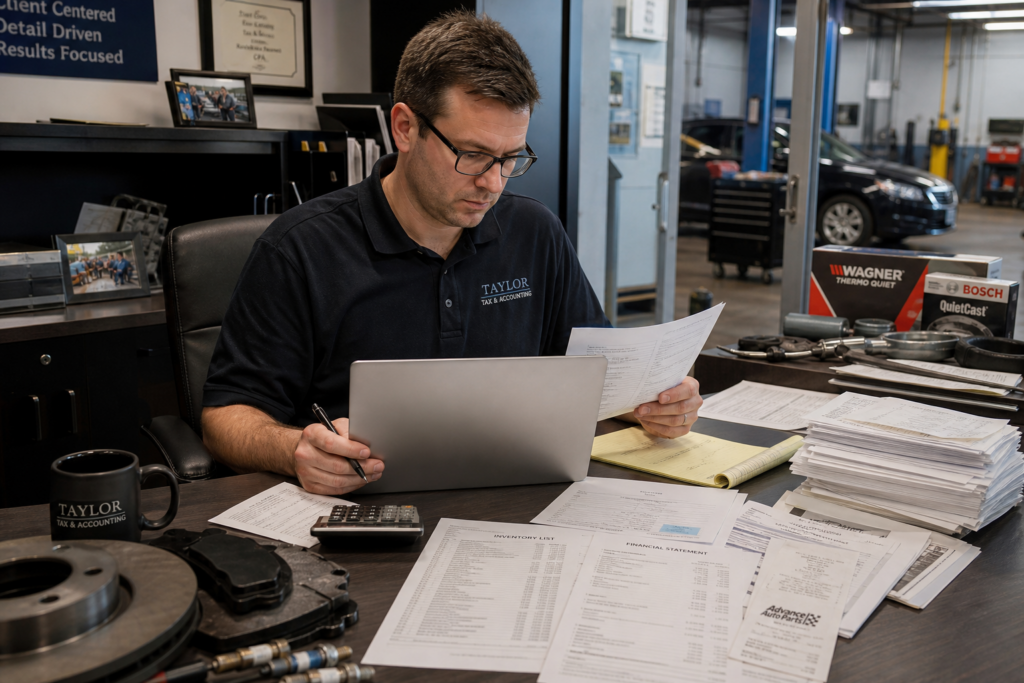
Auto Repair Shop Bookkeeping: 2026 Tax Pro Guide
Auto repair shop bookkeeping is more complex in 2026 than ever before. Updated tax rules, a boom in equipment-related deductions, and inflation-driven parts pricing put new pressure on shop owners—and new opportunity in the hands of proactive tax professionals. This guide explains how to structure books for tax savings, regulatory compliance, and advisory growth.
Table of Contents
- Key Takeaways
- What Is Auto Repair Shop Bookkeeping?
- How Should Repair Shops Track Parts Inventory and COGS?
- How Do You Separate Labor Costs From Technician Payroll?
- What Equipment Deductions Apply to Repair Shops in 2026?
- How Can Entity Structure Reduce a Shop Owner’s Tax Bill?
- What Bookkeeping Mistakes Cost Repair Shops the Most?
- How Can Tax Pros Turn Bookkeeping Into Advisory Revenue?
- Uncle Kam in Action
- Next Steps
- Related Resources
- Frequently Asked Questions

Key Takeaways
- Auto repair shop bookkeeping requires separate tracking for parts, labor, sublet costs, and equipment depreciation.
- Permanent 100% bonus depreciation rules allow shops to deduct equipment fully in 2026.
- Entity structure and payroll setup can cut self-employment tax by thousands annually for shop owners.
- Tax pros who master repair shop books create value-driven, recurring advisory opportunities.
What Is Auto Repair Shop Bookkeeping?
Quick Answer: Auto repair shop bookkeeping tracks revenue and spending in categories tailored to the industry: parts, inventory, technician labor, sublet work, and equipment. This clarity supports tax minimization and smarter business decisions.
Unlike a typical retail business, an auto repair shop’s costs blend parts, labor, and outside services. Clean books separate:
- Parts cost of goods sold (COGS)
- Technician payroll (W-2 wages and flat-rate commissions)
- Sublet expenses (calibration, towing, outsourced alignments)
- Equipment asset purchases and depreciation
Well-structured charts of accounts enable gross profit per repair order and lay the foundation for leveraging deductions.
Role of Repair Order Software
Most shops use software integrating job tracking and payments. Advising clients to connect this data into their accounting system ensures accuracy, reduces manual entry, and supports IRS-ready documentation for cash-intensive operations.
Pro Tip: Reconcile gross sales by job type each month to spot errors, omissions, and fraud risk early.
How Should Repair Shops Track Parts Inventory and COGS?
Quick Answer: Record parts used at cost as COGS and reconcile inventory at least quarterly using software integrated with vendor statements.
Inflation, supply chain shocks, and warranty processing make tracking parts essential. Failing to separate parts from shop supplies or services leads to margin erosion and missed deductions.
| Category | Correct Treatment | Common Error |
|---|---|---|
| Parts Inventory Used | COGS at purchase price | Lumped with shop supplies |
| Core Charges | Recorded as short-term liability | Recorded as income |
| Warranty Parts | Separate account for reimbursement timing | Included in regular sales |
Perpetual Inventory System
Modern shops use perpetual inventory software that updates part counts in real-time, matching vendor receipts to installs. This allows shop owners to see true margins and prepare for 2026’s parts cost volatility.
How Do You Separate Labor Costs From Technician Payroll?
Quick Answer: Report flat-rate technician pay and shop hourly wages separately, and classify all technicians as W-2 employees, not 1099 contractors.
Labor is an auto shop’s largest controllable cost. The IRS scrutinizes technician classification—a W-2 employee who receives a per-job commission is still subject to payroll tax. Misclassification leads to costly audits and penalties.
- Flat-rate commissions require custom payroll setup
- Double-check payroll provider supports shop-specific pay structures
- Review employee vs contractor classification yearly using IRS guidelines
What Equipment Deductions Apply to Repair Shops in 2026?
Quick Answer: 100% bonus depreciation for 2026 lets shops write off the full cost of eligible equipment in the year purchased and placed in service.
- Qualifying items: lifts, alignment racks, diagnostic tools, calibration equipment
- Section 179 deduction can be combined with bonus depreciation for further acceleration (watch annual caps)
- Keep invoices and in-service documentation for audits
Example: A shop buys $80,000 worth of ADAS calibration tools in 2026. A 30% marginal tax rate results in $24,000+ immediate tax savings.
| Deduction Option | Limitations | Best Used When |
|---|---|---|
| Section 179 | Annual cap, cannot create a business loss | Shop has strong profits |
| Bonus Depreciation | No cap, can create a loss | Large purchases or low profit year |
How Can Entity Structure Reduce a Shop Owner’s Tax Bill?

Quick Answer: S corporation election allows a shop owner to pay a reasonable salary (subject to payroll tax) with the remaining profit distributed, saving on self-employment tax if profits are $80,000 or higher.
Many shop owners overpay tax by running as schedule C sole proprietors. After S corp election:
- Owner’s salary is subject to payroll and income tax
- Distributions above salary avoid self-employment tax
For multi-location owners, consider holding companies and LLC structures for additional asset protection and planning flexibility.
What Bookkeeping Mistakes Cost Repair Shops the Most?
- Mixing personal and business transactions (commingling funds)
- Misclassifying technicians as independent contractors
- Not separating parts inventory from shop supplies
- Ignoring sales tax differences between parts and labor
- Failing to reconcile parts inventory accounts
Tax pros should start every client relationship with an account structure and workflow audit to eliminate these issues before filing season.
How Can Tax Pros Turn Bookkeeping Into Advisory Revenue?
Quick Answer: Annual or quarterly review of books paired with entity, equipment, and retirement strategy lifts billable advisory fees far above basic tax prep.
- Clean books unlock strategic conversations about timing of equipment purchases and entity changes
- Modern tax planning software accelerates this process and models outcomes for clients
- Shop owners with evidence of proven tax savings are eager to pay higher retainers
Uncle Kam in Action: The $31,000 Savings Case Study
Background: A two-bay shop operating as a sole proprietor with $410,000 revenue and three technicians.
Problem: Owner was subject to payroll and full self-employment tax, missed Section 179 and bonus depreciation on new equipment.
Solution: S corp election, salary study, full depreciation for new alignment rack, new accounts structure for accurate parts/labor separation.
- Tax savings: $31,200 (combined self-employment tax and depreciation savings in 2026)
- Advisory fee: $5,500 (one-time planning and setup)
- ROI: Over 5x in year 1
More stories at Uncle Kam client results.
Next Steps
- Audit your client’s chart of accounts for part/labor separation
- Review technician classification and payroll records
- Model S corporation tax savings for clients with $80,000+ profit
- Check Section 179 and bonus depreciation timing for 2026 equipment
- Book a strategy session to learn best practices
Related Resources
- Tax Strategies for Business Owners
- Entity Structuring Services
- Tax Prep and Filing Support
- Tax Calculators
- The MERNA Method
Frequently Asked Questions
Does auto repair shop bookkeeping require a special chart of accounts?
Yes, it should clearly distinguish parts, labor, sublet, and equipment cost categories for profit and tax accuracy.
Can shop owners write off all equipment purchased in 2026?
Most qualifying equipment can be immediately expensed under bonus depreciation and Section 179, subject to annual caps and income limits.
Should technicians be W-2 or 1099?
Almost all technicians must be W-2 employees under current law, even if paid by the job.
How often should books be reviewed?
Quarterly is recommended for advisory clients; annually at minimum for compliance-only clients.
Where can I learn more about auto repair shop tax strategies?
See Tax Strategies for Business Owners for additional details.
Last updated July 2026

