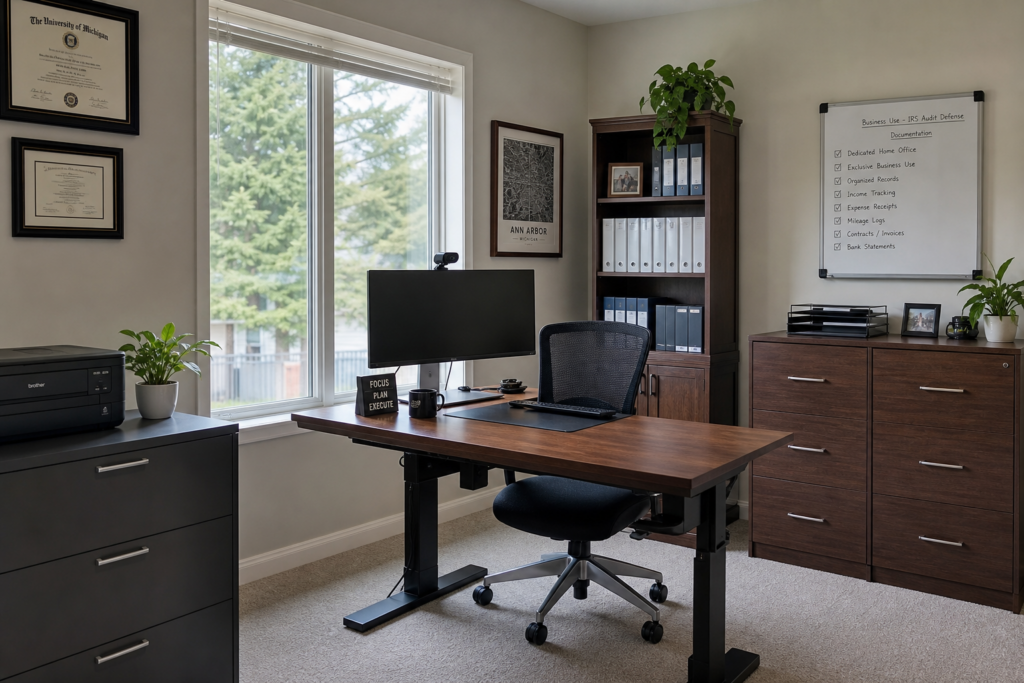
Ann Arbor Home Office Audit Defense: Complete 2026 Strategy Guide
For the 2026 tax year, Ann Arbor home office audit defense requires proactive planning and meticulous documentation. Whether you’re a University of Michigan employee working remotely, a freelance contractor, or a small business owner, claiming a home office deduction puts your return under closer IRS scrutiny. This guide shows you exactly how to defend your deduction if audited.
Table of Contents
- Key Takeaways
- What Counts as a Home Office in Michigan?
- Common Home Office Audit Triggers for Ann Arbor Taxpayers
- How to Prepare Now to Defend Your Home Office Deduction
- What to Do When You Receive an Audit Notice
- Special Issues for Ann Arbor Homeowners
- Uncle Kam in Action
- Next Steps
- Frequently Asked Questions
- Related Resources
Key Takeaways
- Home office deductions require exclusive, regular business use of a dedicated workspace.
- The 2026 simplified method allows $5 per square foot (maximum 300 sq ft = $1,500 annual deduction).
- Documentation is critical: maintain detailed records of workspace, usage logs, and business expenses.
- The IRS in 2026 is using AI-driven enforcement with reduced staff, making data-driven audits more common.
- Ann Arbor homeowners face special considerations with hybrid work and property tax assessments.
What Counts as a Home Office in Michigan?
The IRS definition of a qualifying home office is clear: it must be used regularly and exclusively for business purposes. Under the 2026 tax year guidelines found in IRS Publication 587 (Business Use of Your Home), you cannot claim a deduction for a spare bedroom used occasionally for client meetings or a dining room where you work part-time.
Quick Answer: Your workspace must be used exclusively and regularly for business. You can claim the deduction using either the standard method (actual expenses) or the simplified method ($5 per sq ft, max 300 sq ft).
The Exclusive Use Requirement
Exclusive use means your home office cannot serve a dual purpose. If you claim a 10-by-12-foot room as your office, that entire room must be dedicated to business. Personal use—even occasionally—disqualifies the expense. The IRS has been strict on this rule for decades, and the 2026 enforcement environment with increased AI-driven audits makes this even more important to document.
For Ann Arbor home office workers, this is often the first stumbling block. Many remote workers set up a desk in a bedroom or use a corner of a larger room. If that space is not exclusively devoted to business—if family members use it for other purposes—the entire deduction is at risk.
Regular Use: The Consistency Test
Regular use requires you to use the space on a consistent, ongoing basis. Claiming a home office deduction while working in that space only one or two days per month will not survive an audit. For 2026, the IRS expects to see documented patterns of usage aligned with your income-generating activities.
- Self-employed contractors working full-time from home satisfy this easily.
- W-2 employees with approved hybrid schedules (3+ days per week) may qualify.
- Occasional use, seasonal work, or part-time gigs typically do not meet the “regular” standard.
Pro Tip: Maintain a simple calendar or spreadsheet for 2026 showing the dates and hours you worked in your home office. This log becomes your first line of defense in an audit.
Simplified vs. Standard Method Explained
For the 2026 tax year, you have two methodologies to calculate your home office deduction. Each has audit defense implications.
Simplified Method: You multiply the number of square feet used for business by $5. The maximum is 300 square feet, yielding a maximum 2026 deduction of $1,500. This method requires no itemization of utilities, mortgage interest, property tax, or repairs. It is simpler to explain in an audit and leaves less room for the IRS to disallow specific expenses.
Standard Method: You calculate the percentage of your home used for business (office square footage ÷ total home square footage) and apply that percentage to actual home expenses: mortgage interest (or rent), utilities, property tax, repairs, depreciation, and insurance. This method can yield a larger deduction but requires detailed receipts and expense tracking.
Ann Arbor homeowners should know that Michigan does not allow a state home office deduction on state income tax, even though the federal deduction is permitted. You may deduct the expense federally on Schedule C (Form 1040), but not on Michigan’s return.
Common Home Office Audit Triggers for Ann Arbor Taxpayers
Understanding what prompts the IRS to examine your home office deduction is the first step in audit defense. In 2026, the IRS is deploying AI and advanced data analytics to flag returns with patterns that deviate from established norms. Here are the primary triggers that put Ann Arbor returns at risk.
Quick Answer: Large home office deductions (above 20% of gross income), claimed with inconsistent income reporting, or without supporting documentation are most likely to trigger audit selection in 2026.
Disproportionate Deduction-to-Income Ratio
The IRS looks for outliers. If your home office deduction is significantly larger than similar taxpayers in your industry, you attract scrutiny. For example, a freelancer claiming $8,000 in home office expenses on $12,000 of gross income (67% ratio) is far more likely to be audited than one claiming $3,000 on $45,000 (7% ratio). The ratios signal whether the expense is proportional to actual business activity.
W-2 Employee Status with Large Home Office Deduction
W-2 employees cannot claim home office expenses as employee business deductions under current law (the provision expired after 2017). If you are a W-2 employee claiming a home office deduction, you risk automatic disallowance. Ann Arbor residents who work for the University of Michigan or other employers should verify their employment status before claiming the deduction.
Inconsistent or Missing Documentation
In 2026, with the IRS deploying AI-driven enforcement, audit notices are increasingly targeted. When the IRS selects your return, they are looking for specific documentation. If you cannot provide proof of the workspace, photographs, square footage calculations, or a usage log, the auditor will disallow the entire deduction. Many taxpayers lose their deduction not because the office was improperly claimed, but because they failed to document it.
Schedule C Loss Years
If you claim a home office deduction but your Schedule C shows a net loss year after year, the IRS may question whether your activity is a legitimate business or a hobby. A taxpayer with a home office but consistently negative business income attracts audit attention.
| Red Flag | What It Signals | Audit Risk Level |
| Home office expense exceeds 25% of gross income | Possible overstatement or lack of documentation | High |
| No supporting documentation provided | Deduction is not substantiated | Very High |
| Claimed by W-2 employee (post-2017) | Deduction disallowed under current law | Certain Disallowance |
| Schedule C loss claimed with home office deduction | Questions whether it is a legitimate business | High |
How to Prepare Now to Defend Your Home Office Deduction
The best audit defense is prevention through meticulous documentation. For the 2026 tax year and beyond, implement these strategies now to ensure your home office deduction survives scrutiny. A comprehensive tax strategy begins with proper documentation from day one.
Quick Answer: Create a comprehensive documentation file now: workspace photos, square footage calculation, usage calendar, and a list of all home expenses (utilities, internet, insurance) with percentages allocated to business use.
Step 1: Document the Workspace
Take clear photographs of your home office from multiple angles. Include close-ups showing your desk, computer, filing cabinets, and any equipment. Photograph the entire room to show its exclusive business use. Include a photo with a ruler or measuring tape visible to establish scale and legitimacy.
For Ann Arbor homeowners in particular, photograph the location within your home and any signage or setup that clearly indicates business use (e.g., a nameplate, business license, professional lighting).
Step 2: Calculate Square Footage Precisely
Measure your office space in feet and inches, and calculate the total square footage. For the simplified method, this number directly determines your deduction ($5 × square footage). For the standard method, calculate the percentage of your home dedicated to business (office sq ft ÷ total home sq ft).
Document this calculation in writing. Include your home’s total square footage (from your property tax assessment, real estate listing, or appraisal) and your office square footage. The IRS examiner will compare your figures to public records, so accuracy is critical.
Step 3: Maintain a Usage Log
Create a simple spreadsheet or calendar tracking the dates and hours you use your home office. For self-employed individuals, this log should align with your business activity. For hybrid employees, document the approved days you work from home.
This log does not need to be elaborate. A simple entry like “May 5, 2026: 8 hours (client work)” is sufficient. However, the log must cover the entire tax year and show consistent, regular use.
Step 4: Gather Home Expense Documentation
If you use the standard method, collect receipts and statements for all home expenses:
- Mortgage interest or rent payments
- Property tax bills
- Homeowners or renters insurance policies
- Utility bills (electricity, gas, water, internet)
- Repairs and maintenance invoices
- HOA fees or condo association fees (if applicable)
For Ann Arbor properties, property tax assessments may be adjusted based on home improvements or reassessments. Obtain your most recent property tax bill to establish the accurate annual property tax amount.
Pro Tip: Create a separate folder for all home office documentation. Label it clearly and organize by category (photos, measurements, usage logs, expense receipts). A well-organized file demonstrates professionalism to an auditor and shows you take the deduction seriously.
What to Do When You Receive an Audit Notice
 Free Tax Write-Off Finder
If the IRS sends you a notice of examination regarding your home office deduction, your response strategy is critical. In 2026, the IRS is conducting more audits with fewer staff members, meaning individual auditors have less time but are equipped with advanced AI tools. Follow these steps.
Quick Answer: Do not ignore the notice. Respond within the deadline, provide all requested documentation, and consider hiring a tax professional or representative to respond on your behalf. The IRS in 2026 favors data-driven analysis, so detailed records are your best defense.
Immediate Steps: Within the First Week
1. Do not panic. An audit notice does not mean you will lose the deduction. Many home office audits result in partial acceptance or are resolved through correspondence.
2. Review the notice carefully. The IRS letter will specify exactly what items they are examining. If it mentions the home office deduction, note the exact page and form references (e.g., Schedule C, line 30).
3. Mark the deadline. The notice will provide a response deadline (typically 30 days from the notice date). Circle it on your calendar and set a reminder. Missing the deadline can result in automatic disallowance.
4. Gather your documentation file. Locate the folder with photographs, square footage calculations, usage logs, and expense receipts. If you have been diligent with 2026 record-keeping, this step is straightforward. If not, begin reconstructing records immediately.
Preparing Your Response
The IRS may request a response in writing or may schedule an in-person or telephone examination. If correspondence is requested, prepare a brief written statement and organize all supporting documents in the order requested.
Your response should include:
- A cover letter explaining that you are responding to the audit notice with supporting documentation
- Copies of photographs showing the workspace and its exclusive business use
- A written calculation of the square footage and business-use percentage
- Your usage log showing consistent, regular use
- Copies of all home expense documentation (utilities, insurance, property tax)
- A simple summary sheet showing the calculation of your deduction
For Ann Arbor taxpayers, it is strongly recommended to work with a local tax professional familiar with Michigan home office deductions. The professionals at Uncle Kam can ensure your response meets all IRS standards and maximizes your chances of success.
In-Person vs. Correspondence Examination
If the IRS requests an in-person examination, you have the right to request a correspondence examination instead (unless the notice specifically requires in-person). Many home office audits can be resolved by mail, which saves time and stress.
If you opt for correspondence, mail your response to the address specified in the notice. Keep copies of everything for your records. Send via certified mail so you have proof of delivery.
Your Rights During the Audit
You have the right to professional representation. You can have a CPA, enrolled agent, or tax attorney represent you before the IRS. In 2026, when the IRS is conducting more data-driven audits with limited staff resources, having professional representation often leads to better outcomes. The representative can negotiate on your behalf and respond to detailed questions from the examiner.
Special Issues for Ann Arbor Homeowners
Ann Arbor homeowners face unique considerations when claiming home office deductions that are less common in other regions. Understanding these local factors strengthens your audit defense.
Quick Answer: Ann Arbor has a high concentration of remote-work professionals, hybrid employees, and university-affiliated workers. Property tax assessments and zoning may intersect with home office usage in ways that affect your deduction and audit risk.
University of Michigan Employee Status
Many Ann Arbor residents work for the University of Michigan. W-2 employees cannot claim home office deductions under current federal tax law. However, university employees who are paid as independent contractors (1099 workers) may qualify. Verify your actual employment classification on your tax documents before claiming the deduction.
Hybrid Work and Employment Agreements
If your employer has approved a specific hybrid schedule (e.g., three days in office, two days remote), document this approval in writing. Retain email confirmations, employee handbooks, or letters from your HR department specifying your remote work days. This documentation supports your claim that you use the home office regularly and exclusively.
Property Tax Assessment and Zoning Considerations
Ann Arbor property assessments and local zoning regulations do not directly affect your federal home office tax deduction. However, in an audit, the IRS may cross-reference your property tax assessment data to verify your home’s total square footage. Ensure your home’s documented square footage is consistent across all documents (property tax bill, real estate appraisal, insurance policy).
Additionally, some Ann Arbor neighborhoods restrict home-based businesses due to zoning. If your neighborhood has such restrictions, claiming a home office deduction could raise questions. If you face this issue, consult a tax professional about whether your specific business use complies with zoning requirements while still qualifying for the tax deduction.
Sale of the Home: Depreciation Recapture
If you claim home office depreciation using the standard method, you must recapture that depreciation when you sell your home. This means the depreciation you deducted during the years you owned the home becomes taxable gain upon sale. Ann Arbor homeowners should be aware of this long-term tax consequence when deciding whether to claim the home office deduction.

Uncle Kam in Action: How Sarah Defended Her Ann Arbor Home Office Deduction
Sarah is a freelance graphic designer who has worked from her Ann Arbor home since 2024. For 2026, she claimed a home office deduction of $2,400 using the simplified method on 480 square feet of dedicated workspace. In April 2026, she received an IRS audit notice requesting documentation of the deduction.
The Challenge: Sarah’s deduction represented about 18% of her gross freelance income. The IRS had flagged her return for examination based on several factors: the deduction was relatively large compared to her income, and her initial response lacked documentation.
Her Action Plan: Sarah immediately contacted Uncle Kam’s tax advisory team. Together, they compiled a comprehensive documentation file within two weeks. They included: (1) high-quality photographs from multiple angles of her dedicated office room, (2) a written calculation showing 480 square feet of office space out of 2,000-square-foot home (24% total, but she conservatively claimed 480 sq ft at 300 sq ft max using simplified method), (3) a usage calendar spanning the entire 2026 tax year showing her working in the office 4–5 days per week, (4) copies of her homeowners insurance policy, property tax bill, and utility statements, and (5) a professional cover letter explaining the business use and deduction calculation.
The Result: Within 60 days of submitting the documentation via certified mail, the IRS issued a favorable determination. The examiner accepted the $1,500 home office deduction in full (based on the 300-square-foot simplified method maximum). The audit was closed with no adjustment.
Sarah’s Outcome: She retained her full $1,500 deduction, saving approximately $360 in federal income tax for 2026 (at a 24% bracket). More importantly, she now understands the importance of documentation and has committed to maintaining detailed usage logs and expense records going forward. Uncle Kam’s representation cost her $800 in professional fees, but her tax savings of $360 plus the peace of mind of a resolved audit made the investment worthwhile.
Next Steps
Now that you understand home office audit defense, take these three concrete actions:
- Photograph your workspace this week and document its square footage.
- Start a usage log now and maintain it through 2026.
- Schedule a consultation with a tax advisor to review your specific situation and ensure your deduction is documented correctly.
Ann Arbor homeowners and remote workers deserve peace of mind that their home office deduction is defensible. Professional guidance ensures you claim the maximum deduction allowed while minimizing audit risk.
Frequently Asked Questions
Can I claim a home office if I work from home only 2 days per week?
Possibly. The IRS requires “regular” use, which typically means consistent use that aligns with your business activities. If your employer has approved two days per week as your permanent remote schedule (not occasional), you may qualify. However, occasional work-from-home does not meet the “regular” standard. Consult a tax professional to evaluate your specific arrangement.
Does Ann Arbor city or Michigan state allow a deduction for home office on local tax returns?
No. Michigan does not provide a state income tax deduction for home office expenses. You may claim the deduction on your federal Form 1040 (Schedule C), but not on Michigan’s state return. Ann Arbor does not impose a local income tax, so there is no Ann Arbor-specific issue here.
What is the maximum home office deduction I can claim using the simplified method for 2026?
For 2026, the simplified method allows $5 per square foot of office space used for business, with a maximum of 300 square feet. This yields a maximum deduction of $1,500 (300 sq ft × $5). This is a safe, easy-to-defend approach if your office qualifies.
If I receive an audit notice about my home office deduction, do I have to meet with the auditor in person?
No. You can request a correspondence examination, which allows you to respond by mail. Many home office audits are resolved through correspondence without an in-person visit. This is often the preferred approach because it is less stressful and allows you to provide written documentation at your own pace.
Can I claim a home office deduction if I am a W-2 employee whose employer allows remote work?
Generally, no. As a W-2 employee, you cannot deduct home office expenses as employee business deductions under current law (the provision expired after 2017). However, if you are classified as an independent contractor (1099), you may qualify. If you are unsure of your status, check your tax documents or contact your employer’s HR department.
What happens to my home office deduction if I sell my house?
If you claimed depreciation on your home office using the standard method, you must recapture that depreciation when you sell. This means the depreciation deductions you took during ownership become taxable gain upon sale. This does not affect the simplified method, which does not claim depreciation. Consider this long-term consequence when deciding which method to use.
Will claiming a home office deduction increase my chance of being audited?
Home office deductions do raise audit flags, particularly if they are large relative to your income or claimed without documentation. However, with proper documentation and a reasonable deduction amount, many taxpayers claim the deduction without audit issues. The key is substantiation: demonstrate exclusive business use, regular usage, and accurate calculations.
What is the difference between “exclusive use” and “regular use” for home office purposes?
Exclusive use means the space cannot be used for personal purposes. It must be devoted entirely to business. Regular use means you use it consistently and frequently, not just occasionally. Both requirements must be met. A spare bedroom used exclusively for business but only one day per month does not qualify (fails regular use test). A home office used four days per week but shared with family for personal activities does not qualify (fails exclusive use test).
Should I hire a tax professional if I receive an audit notice about my home office deduction?
Yes, it is highly recommended. A tax professional or tax strategist can ensure your response is organized, complete, and professionally presented. In 2026, with the IRS using AI-driven data analysis, a well-documented response significantly increases your chances of a favorable outcome. The professional fee is often far less than the value of the deduction you defend.
Related Resources
- IRS Publication 587: Business Use of Your Home
- Tax Preparation Services in Michigan
- Comprehensive Tax Strategy Planning
- Tax Solutions for Business Owners
- Tax Strategies for Self-Employed Professionals
Last updated: June, 2026
This information is current as of 6/1/2026. Tax laws change frequently. Verify updates with the IRS or a tax professional if reading this later.

