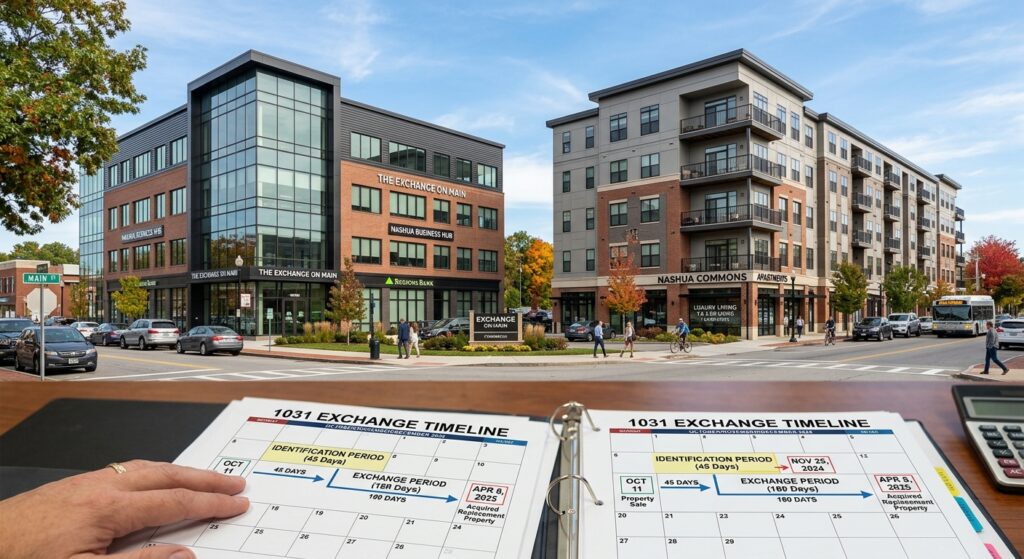
2026 Nashua 1031 Exchange Guide: Tax-Deferred Real Estate Strategies for New Hampshire Investors
For 2026, real estate investors in Nashua seeking to defer capital gains taxes should understand the critical importance of Nashua 1031 exchange requirements and timelines. A 1031 exchange allows you to defer—not eliminate—federal income tax when you sell an investment property and reinvest the proceeds into a like-kind property of equal or greater value.
Key Takeaways
- 1031 exchanges allow indefinite tax deferral on investment property sales when reinvesting in like-kind property.
- Strict IRS timelines: 45 days to identify replacement property, 180 days to close (2026 deadlines are firm).
- Nashua real estate investors can defer capital gains taxes indefinitely through strategic property exchanges.
- Unlike capital gains exclusions ($250,000/$500,000 for primary homes), 1031 exchanges offer unlimited deferral for investment property.
- Depreciation recapture taxes still apply at 25% rate on deductions claimed during ownership.
Table of Contents
- What Is a 1031 Exchange?
- What Are the Critical 2026 IRS Timelines?
- What Qualifies as Like-Kind Property?
- How Much Can You Save in Capital Gains Taxes?
- How Does Entity Structure Impact 1031 Exchange Tax Benefits?
- What Are Nashua’s Specific Real Estate Investment Considerations?
- Uncle Kam in Action
- Next Steps
- Frequently Asked Questions
What Is a 1031 Exchange?
Quick Answer: A 1031 exchange is an IRS mechanism allowing you to defer federal income tax when selling investment property and reinvesting in like-kind replacement property of equal or greater value. Tax deferral continues indefinitely until you sell the replacement property without completing another exchange.
Section 1031 of the Internal Revenue Code permits property owners to exchange real estate without triggering immediate capital gains tax recognition. Under this provision, when you sell an investment property—such as a rental apartment, commercial building, or vacant land in Nashua—and use the proceeds to purchase a replacement property, the gain recognition is deferred rather than eliminated.
This is fundamentally different from the capital gains exclusion available for primary home sales. For 2026, the federal capital gains exclusion remains $250,000 for single filers and $500,000 for married couples filing jointly—amounts unchanged since 1997 despite home price inflation. With a 1031 exchange, there is no income limit or dollar cap on tax deferral.
To execute a valid 1031 exchange, you must follow strict IRS rules regarding property identification timelines, qualified intermediaries, and the definition of like-kind property. Failure to meet any requirement can result in the entire transaction being treated as a taxable sale, exposing you to immediate capital gains tax.
How 1031 Exchanges Defer Taxes Indefinitely
The power of a 1031 exchange lies in continuous deferral. You can complete one exchange, hold the replacement property, and then execute another exchange when you decide to sell—indefinitely deferring tax recognition. This strategy is especially valuable for investors building multi-property portfolios over decades.
However, depreciation recapture taxes still apply at a 25% federal rate on accumulated depreciation deductions you claimed during ownership. This recapture is unavoidable in a 1031 exchange and must be calculated separately from capital gains tax.
Key Benefit: No Income Limits or Dollar Caps
Unlike standard capital gains exclusions, 1031 exchanges have no phase-out ranges or maximum deferral amounts. A Nashua investor with $2 million in capital gains can defer the entire amount if they follow proper procedures. This makes 1031 exchanges essential for high-net-worth real estate investors.
What Are the Critical 2026 IRS Timelines?
Quick Answer: You have 45 calendar days from your relinquished property sale to identify replacement properties, and 180 calendar days to close on the replacement property. Both deadlines are firm; the IRS does not grant extensions for these timelines.
The IRS timeline requirements for 1031 exchanges are unforgiving and represent the most critical compliance element of the entire transaction. Missing these deadlines results in the entire exchange being disqualified, and your sale is taxed as a regular transaction.
45-Day Identification Period
You must identify your replacement property (or properties) to a qualified intermediary within 45 calendar days of closing on your relinquished property. The identification must be in writing and delivered before midnight on the 45th day. Timing counts from day one of the sale closing.
During this window, you can identify up to three replacement properties of any value, or unlimited properties if their total fair market value does not exceed 200% of the relinquished property’s value. Most investors use the three-property rule because it is straightforward.
180-Day Exchange Period
You must close on at least one identified replacement property within 180 calendar days of selling the relinquished property. This deadline is equally firm, and weekend/holiday extensions are not permitted. If your closing occurs on day 181, the exchange fails.
Importantly, you do not need to reinvest the entire sale proceeds. If sale proceeds exceed the replacement property price, you can retain the difference (called boot), but that amount becomes taxable in the year of the exchange.
What Qualifies as Like-Kind Property?
Quick Answer: For 2026, like-kind property means real property exchanged for real property. You can exchange a Nashua residential rental for commercial real estate, land, or apartment buildings. Real property cannot be exchanged for personal property (vehicles, equipment, cryptocurrency, or stocks).
The Tax Cuts and Jobs Act of 2017 significantly narrowed the definition of like-kind property for 1031 exchanges. For exchanges completed after December 31, 2017, only real property can be exchanged for other real property. Personal property, equipment, and intangible assets no longer qualify.
Real Property Examples That Qualify
- Residential rental properties (single-family homes, apartments, condos held for investment)
- Commercial real estate (office buildings, retail spaces, warehouses)
- Vacant land held for investment or future development
- Farm or ranch property used in business or held for investment
- Industrial or manufacturing facilities
Key Restriction: Property Must Be Held for Investment
Both the relinquished property and the replacement property must be held primarily for investment or business use. Your primary residence does not qualify for 1031 treatment. Properties held for personal use cannot be exchanged under Section 1031 rules, even if you own them as part of a real estate portfolio.
The IRS also scrutinizes dealer status closely. If you are a real estate dealer (frequently buying and selling properties for resale profit), your transactions may not qualify as investment exchanges. Your CPA or tax advisor must evaluate your pattern of activity.
How Much Can You Save in Capital Gains Taxes?
Quick Answer: For 2026, a Nashua investor can defer unlimited federal capital gains tax through a 1031 exchange. Federal long-term capital gains rates are 0%, 15%, or 20% depending on income. New Hampshire property sales to out-of-state buyers avoid state income tax, making the tax deferral even more valuable.
The tax savings from a 1031 exchange depend on your holding period (long-term vs. short-term), your federal income bracket, and applicable state taxes. New Hampshire has no state income tax, which is a significant advantage for real estate investors executing 1031 exchanges in the region.
Federal Capital Gains Tax Rates for 2026
Long-term capital gains (property held over one year) are taxed at three federal rates: 0%, 15%, or 20%. Your rate depends on your filing status and total income, with 20% applying to the highest earners. A 1031 exchange defers these federal rates entirely until a later taxable sale.
Depreciation Recapture Tax (25% Federal Rate)
Even in a 1031 exchange, depreciation recapture tax is due on deductions you claimed during ownership. This tax is calculated at a flat 25% federal rate and applies to the lesser of net depreciation deductions or total gain recognized. This is unavoidable and must be planned for.
Real-World Tax Deferral Calculation
Suppose you sell a Nashua rental property with $1.5 million in capital gain. Without a 1031 exchange, you owe approximately $300,000 in federal capital gains tax (at 20% long-term rate) plus potential Medicare surtax on net investment income. With a 1031 exchange, you defer this entire liability. If you hold the replacement property and execute another exchange 10 years later, you extend the deferral another decade.
Pro Tip: The value of deferral is time value of money. Deferring $300,000 in taxes for 10 years at 5% annual return value equals approximately $195,000 in foregone investment growth. This makes 1031 exchanges especially valuable for large gains.
How Does Entity Structure Impact 1031 Exchange Tax Benefits?
 Free Tax Write-Off Finder
Quick Answer: Individual property owners and partnerships can execute 1031 exchanges. C Corporations cannot. LLCs taxed as partnerships can. For Nashua investors, your entity structure must be evaluated before you sell to ensure 1031 eligibility. Use our LLC vs S-Corp Tax Calculator to compare entity structures and their impact on 1031 strategy.
The entity through which you hold property directly affects whether a 1031 exchange is available. This is a critical planning consideration before purchasing investment real estate.
Entity Types and 1031 Exchange Eligibility
| Entity Type | 1031 Exchange Eligible? | Notes for Nashua Investors |
|---|---|---|
| Individual Ownership | Yes | Full 1031 eligibility. Direct property exchange in individual name. |
| Partnership | Yes | Partnership can execute exchange. Partners may have separate tax consequences. |
| LLC (taxed as Partnership) | Yes | Treated as partnership for tax purposes. 1031 available. Liability protection preserved. |
| S Corporation | Yes (Rare) | Technically possible but creates tax complications. Generally not recommended for real estate. |
| C Corporation | No | C Corps cannot use 1031 treatment. Property sales trigger corporate tax plus shareholder tax on distributions. |
For Nashua investors, individual ownership or partnership/LLC structures are most favorable for 1031 exchanges. If you hold property in a C Corporation, you face double taxation on any sale and cannot access 1031 deferral benefits.
What Are Nashua’s Specific Real Estate Investment Considerations?
Quick Answer: Nashua is New Hampshire’s second-largest city with strong rental demand, moderate appreciation, and no state income tax. For 1031 exchanges, this means capital gains deferral has lasting value since your ongoing income is not subject to state tax. Property values in Nashua have appreciated steadily, making many long-term rentals eligible for substantial 1031 exchanges.
Nashua’s real estate market presents specific opportunities and considerations for 1031 exchange planning. The city attracts out-of-state investors due to New Hampshire’s tax advantage and Nashua’s regional economic strength.
No State Income Tax Advantage
New Hampshire has no state income tax, meaning your capital gains deferral through a 1031 exchange avoids both federal and state tax exposure. This is a significant advantage compared to Massachusetts (5.0% capital gains rate) or Connecticut (6.99% highest rate). Over multiple decades of 1031 exchanges, this state tax advantage compounds substantially.
Strong Rental Market Dynamics
Nashua maintains strong rental demand from regional commuters and relocating professionals. This creates reliable replacement property options for your 1031 exchange. If you identify multiple replacement properties within the 45-day window, Nashua’s active market provides choices in different property types and price points.
Property Appreciation and Tax Basis
Properties purchased in Nashua 15-20 years ago have appreciated 80%-150%, creating substantial gains for owners. These appreciated properties are ideal candidates for 1031 exchanges into newer replacement properties, allowing you to defer taxes while upgrading your portfolio.
Pro Tip: If you own Nashua property purchased in 2005-2010, consult a tax professional immediately to evaluate potential appreciation gains. You may have significant built-in gains that make 1031 exchanges valuable for future sales.

Uncle Kam in Action: 1031 Exchange Success Story
Client Snapshot: Marcus, a Nashua-based real estate investor with three rental properties, decided to consolidate his portfolio by selling two older properties and acquiring one newer, fully renovated apartment building with strong cash flow.
Financial Profile: Combined relinquished property sale proceeds: $2.8 million. Accumulated capital gains: $1.5 million. Depreciation recapture exposure: $180,000.
The Challenge: Marcus had owned his rental properties for 18+ years. Without a 1031 exchange, selling would trigger approximately $300,000 in federal capital gains tax (20% rate) plus $45,000 in depreciation recapture tax. Additionally, he was reinvesting in a replacement property worth $2.9 million—requiring careful compliance with the 45-day identification and 180-day closing requirements.
The Uncle Kam Solution: We structured a three-step 1031 exchange: First, we identified Marcus’s specific replacement property within the 45-day deadline. Second, we engaged a qualified intermediary to hold the $2.8 million in sale proceeds and prevent Marcus from taking receipt of funds (which would disqualify the exchange). Third, we managed the 180-day closing timeline, ensuring the new apartment building closing occurred on day 142—well within the deadline. We also calculated depreciation recapture liability upfront ($45,000) and advised Marcus to reserve funds for this unavoidable tax.
The Results: Marcus successfully deferred $300,000 in federal capital gains tax through the 1031 exchange. His new apartment building generates $18,500/month in rental income (vs. $12,400/month from the two older properties combined), improving his cash flow by 49%. Tax savings: $300,000. Depreciation recapture (unavoidable): $45,000. First-year net benefit: $255,000. Return on investment for Uncle Kam’s planning and execution: 450% in year one, with ongoing benefits as he continues to defer taxes on the new property.
Visit our client results page to see more real estate investor success stories and tax preparation near me in New Hampshire to schedule your consultation.
Next Steps
If you own investment real estate in Nashua and are considering a sale, immediate action is critical. The 1031 exchange rules are unforgiving, and planning must begin before the property sale closes. Here’s your action plan:
- Step 1 – Property Valuation: Have your Nashua investment property professionally appraised to establish current fair market value and identify your capital gain.
- Step 2 – Tax Basis Review: Work with Uncle Kam to calculate your tax basis, accumulated depreciation, and depreciation recapture exposure before listing.
- Step 3 – Qualified Intermediary Selection: Before closing, identify and hire a qualified intermediary who will handle the sale proceeds and replacement property acquisition.
- Step 4 – Replacement Property Search: Begin identifying replacement properties immediately after your property enters escrow, allowing 45 days to finalize selection.
- Step 5 – Exchange Execution and Reporting: Complete closing within 180 days and file Form 8824 with your tax return to report the 1031 exchange.
Pro Tip: Don’t wait until property sale closing to plan your 1031 exchange. Begin discussions with Uncle Kam 6-12 months before selling to optimize entity structure, property selection, and qualified intermediary coordination.
Frequently Asked Questions
Can I Use a 1031 Exchange to Sell My Primary Home?
No. Your primary residence is not eligible for 1031 treatment, regardless of how long you owned it. Primary homes fall under different capital gains exclusion rules ($250,000 single/$500,000 married for 2026). If you rent out your home for 2+ years and then sell, it still doesn’t qualify for 1031 because primary residences are excluded. The property must be investment property from the outset.
What Happens If I Miss the 45-Day Identification Deadline?
The entire 1031 exchange fails. Your sale is treated as a taxable transaction, and you owe immediate capital gains tax on the full gain. The IRS does not grant extensions for the 45-day deadline under any circumstances. Many investors have lost 1031 status due to administrative delays. This is why qualified intermediaries and careful deadline management are essential.
Can the Replacement Property Cost Less Than the Relinquished Property?
Yes, but the difference becomes taxable. If you sell a $1 million property and buy a $800,000 replacement, you have $200,000 in boot (cash received). This $200,000 becomes taxable in the year of exchange. To defer all taxes, reinvest the full sale proceeds or more in the replacement property.
Are There Tax Advantages for 1031 Exchanges of Commercial vs. Residential Property?
No. The tax deferral benefits are identical whether you exchange residential or commercial properties. However, depreciation recapture calculations may differ based on the building component vs. land. Commercial properties typically depreciate over 39 years vs. residential (27.5 years), affecting accumulated depreciation amounts.
Must I Use a Qualified Intermediary for My 1031 Exchange?
Yes. You cannot take receipt of sale proceeds; a qualified intermediary must hold the funds from closing until they are applied to the replacement property purchase. If you touch the funds, the exchange fails immediately. Qualified intermediaries are required by IRS rules and typically charge 0.5%-1.5% of transaction value.
Can I Roll a 1031 Exchange Indefinitely, Never Paying Tax?
Yes, technically. You can complete exchange after exchange, indefinitely deferring tax recognition. However, at death, your heirs receive a stepped-up basis in the property, essentially eliminating all deferred capital gains tax. The tax is never paid—it’s forgiven at death. This makes 1031 exchanges especially powerful for estate planning.
What Is Boot in a 1031 Exchange, and How Does It Affect Taxes?
Boot is any cash or non-real-property received in exchange. If your relinquished property sale generates $1.5 million and your replacement property costs $1.2 million, you receive $300,000 in boot. This $300,000 is taxable income in the year of exchange. To defer all taxes, avoid receiving boot by reinvesting the full sale proceeds.
Does New Hampshire State Tax Affect 1031 Exchange Benefits?
No, because New Hampshire has no state income tax. Unlike Massachusetts or Connecticut residents, Nashua investors avoid state capital gains tax entirely. This makes the federal 1031 deferral even more valuable since you also avoid state tax exposure on investment property sales.
What Documents Must I Maintain for a 2026 1031 Exchange?
The IRS requires you to keep records of both the relinquished and replacement property until the statute of limitations expires on the year you dispose of the replacement property in a taxable transaction. Generally, keep 1031 exchange documentation (closing statements, qualified intermediary agreements, property identification notices, appraisals) for at least seven years from the exchange date, and longer if you continue to defer through additional exchanges.
This information is current as of May, 2026. Tax laws change frequently. Verify updates with the IRS or a tax professional if reading this later.
Related Resources
- Real Estate Investor Tax Strategies & Planning
- Custom Tax Strategy for High-Income Professionals
- Entity Structuring for Rental Property & Real Estate Investment
- Business Owner Tax Deductions & Credits for 2026
- Uncle Kam’s MERNA Method: Proactive Tax Planning Framework
Last updated: May, 2026

