2026 Massachusetts Home Office Audit Defense: A Complete Guide for Business Owners & Self-Employed Professionals
2026 Massachusetts Home Office Audit Defense: A Complete Guide for Business Owners & Self-Employed Professionals
Defending a Massachusetts home office audit requires meticulous documentation and strategic preparation. For the 2026 tax year, business owners and self-employed professionals claiming home office deductions face increased scrutiny from the IRS, making proper audit defense strategies essential. This comprehensive guide reveals exactly how to protect your deduction, document your workspace, and successfully defend against IRS inquiries using proven 2026 audit defense tactics.
Table of Contents
- Key Takeaways
- What Triggers Home Office Audits?
- Form 8829 Requirements for 2026
- Documentation Strategies That Defend Your Deduction
- Massachusetts-Specific Home Office Rules
- What Entity Structure Maximizes Your Home Office Deduction?
- Red Flags to Avoid During Home Office Audits
- Uncle Kam in Action: Success Story
- Next Steps
- Frequently Asked Questions
Key Takeaways
- Proper documentation on Form 8829 is your strongest defense against a home office audit in 2026.
- Massachusetts home office deductions must comply with both federal and state requirements.
- Exclusive and regular use of your workspace is the primary test the IRS applies during audits.
- Maintaining contemporaneous receipts, photos, and expense logs eliminates audit risk.
- Strategic entity structuring (S Corp vs. LLC) can enhance your audit defense position.
What Triggers Home Office Audits?
Quick Answer: The IRS targets home office deductions when taxpayers claim unusually high percentages of home expenses, lack supporting documentation, or fail the exclusive-use test.
For the 2026 tax year, understanding what triggers home office audits is critical for your audit defense strategy. The IRS maintains specific criteria that flag returns for examination, and knowing these triggers allows you to structure your deduction defensibly from the start.
Home office audits typically begin when taxpayers claim deductions that exceed reasonable thresholds relative to their home size and income. A 500-square-foot office claimed on a 1,200-square-foot home raises red flags because the percentage seems excessive. Additionally, the lack of contemporaneous documentation—receipts, invoices, utility bills, and expense logs—signals to IRS auditors that the deduction may not be legitimate.
The IRS’s Primary Audit Trigger: The Exclusive-Use Test
The IRS focuses intensely on the exclusive-use requirement, which mandates that your home office space be used regularly and exclusively for business purposes. If the IRS discovers that you use your office for personal activities—storing personal items, entertaining friends, or using it as a guest bedroom—your entire home office deduction becomes vulnerable. This is why documentation proving exclusive business use is your strongest audit defense.
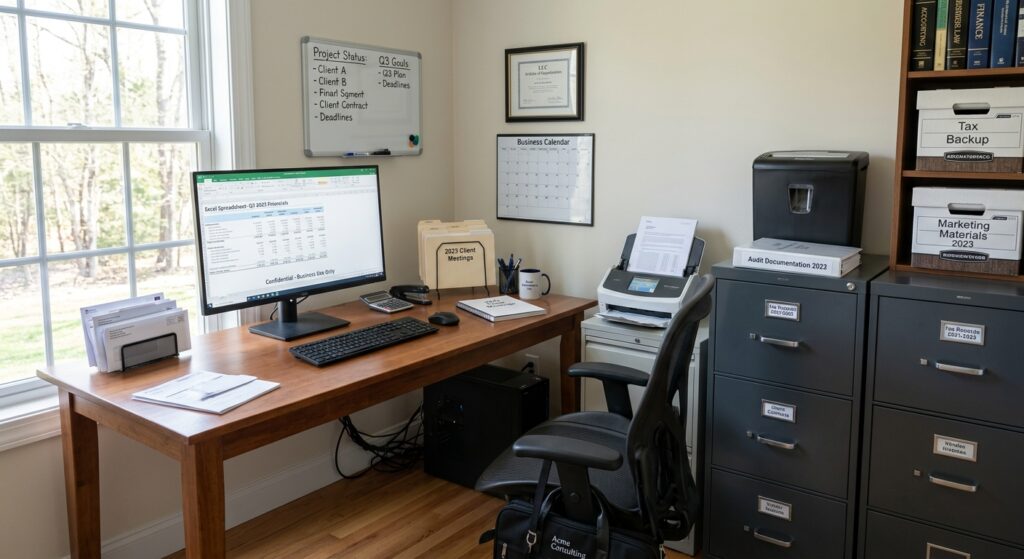
During an audit, IRS agents often request photographs of the space, business calendars showing time spent in the office, and client communications referencing meetings held there. The absence of these materials weakens your position significantly.
Secondary Red Flags: Income Inconsistency and Disproportionate Deductions
The IRS also scrutinizes home office deductions when they appear disproportionate to reported income. A freelancer reporting $45,000 in annual revenue while claiming $12,000 in home office expenses (26% of income) triggers audit algorithms. This doesn’t mean the deduction is improper—it means you must be prepared to defend it with detailed expense allocation calculations.
Pro Tip: Keep business expenses separated from personal expenses in your accounting system. Use separate credit cards or expense tracking software that categorizes home office costs. This separation makes audit defense far simpler and demonstrates IRS compliance intent.
Form 8829 Requirements for 2026
Quick Answer: Form 8829 requires you to calculate your home office percentage, list all deductible expenses, and maintain documentation proving exclusive business use for the entire tax year.
Filing Form 8829 (Expenses for Business Use of Your Home) correctly is essential for audit defense in 2026. This IRS form requires precise calculations that the agency will scrutinize during an examination. Understanding each section ensures your deduction withstands audit review.
Part 1: Calculating Your Home Office Percentage
Form 8829 begins with a critical calculation: determining the percentage of your home used for business. This percentage is calculated by dividing your office square footage by your total home square footage. For example, a 200-square-foot office in a 2,000-square-foot home equals 10 percent.
During an audit, the IRS will verify this percentage by requesting floor plans, property tax records, and photos. Accuracy here is non-negotiable. Overstating your office size by even 50 square feet can trigger deeper scrutiny into all your deductions.
Part 2: Allocating Direct and Indirect Expenses
Form 8829 distinguishes between direct expenses (deductible 100 percent) and indirect expenses (deductible based on your office percentage). Direct expenses include office equipment, furniture, and office-specific utilities. Indirect expenses include mortgage interest, property taxes, utilities, insurance, and repairs—all multiplied by your office percentage.
The IRS audits this allocation carefully. Misclassifying a home repair as a direct expense, when it actually affects the entire home, signals audit risk. Conversely, properly allocating expenses demonstrates IRS compliance knowledge.
Pro Tip: Use a spreadsheet to track home expenses with formulas that automatically calculate the office percentage. This reduces calculation errors and demonstrates to the IRS that you used systematic methodology during audit defense.
Documentation Strategies That Defend Your Deduction
Quick Answer: Contemporaneous documentation including photos, receipts, utility bills, and business calendars creates an audit-proof defense for your home office deduction.
Documentation is the cornerstone of home office audit defense. Without contemporaneous records created during the tax year, you cannot defend your deduction if the IRS examines your return. This is where most taxpayers fail audits—not because their deduction is improper, but because they lack documentation.
Essential Documents for Audit Defense
- Digital photographs of your office space taken during the tax year (multiple angles showing exclusive business use)
- Floor plan with office dimensions clearly marked (obtain from property assessor or create yourself)
- Receipts and invoices for all office equipment, furniture, and supplies purchased during the tax year
- Utility bills showing your home address and account number (for indirect expense allocation)
- Business calendar or log documenting hours worked in the office (especially for client meeting documentation)
- Insurance policy confirmation showing homeowner’s insurance coverage (relevant for casualty loss scenarios)
- Property tax records confirming home ownership and square footage
- Mortgage statements or rental agreements showing housing costs for deduction allocation
When the IRS contacts you for an audit, you should be able to produce all these documents within one week. This responsiveness and preparedness signal to auditors that your deduction is legitimate and well-maintained.
The Contemporaneous Documentation Requirement
IRS auditors specifically look for documentation created during or immediately after the expense was incurred. Receipts dated in the current year are far more persuasive than reconstructed expense lists created after audit notification. If you cannot produce original receipts, credit card statements and cancelled checks become your fallback documentation, though they are less ideal.
For photography, timestamps on digital images prove when photos were taken. If you use your smartphone, metadata embedded in the image file shows the date and time automatically—this metadata is admissible in IRS audits and strengthens your defense significantly.
Massachusetts-Specific Home Office Rules
 Free Tax Write-Off Finder
Quick Answer: Massachusetts requires home office deductions to comply with both federal IRS rules and state-specific requirements, including proper business entity classification and Schedule C reporting.
Massachusetts taxpayers face unique audit challenges because they must defend home office deductions on both federal and state levels. The Massachusetts Department of Revenue (DOR) applies similar audit standards to the IRS but maintains state-specific rules that federal deductions alone do not satisfy.
Massachusetts DOR Requirements for Home Office Deductions
The Massachusetts Department of Revenue requires that home office deductions be properly classified on Schedule C (Profit or Loss from Business) if you file as a sole proprietor. If you operate as an LLC or S Corporation, the deduction flows through the entity’s tax return and then to your personal return. The Massachusetts DOR audits these filings to ensure consistency between federal and state reporting.
Massachusetts has no separate home office deduction rules—it conforms to federal rules. However, the state audit rate for Massachusetts self-employed and small business taxpayers has increased in recent years, making robust documentation even more critical.
Pro Tip: When claiming a home office deduction in Massachusetts, ensure your business entity type (sole proprietor, LLC, or S Corp) is properly registered with the Massachusetts Secretary of State. Entity misclassification can trigger both federal and state audits, jeopardizing your entire home office deduction.
Nexus Requirements: Massachusetts Doing Business Standards
Massachusetts requires that you actually conduct business from your home office. If you claim a home office deduction but conduct all client meetings at client sites and perform administrative work at a coffee shop, the Massachusetts DOR may challenge your deduction’s legitimacy. The state requires that the home office be your principal place of business, matching federal standards.
During Massachusetts DOR audits, auditors request proof that clients know about your office location, that you conduct phone calls and video conferences from your office, and that you maintain business files there. This nexus requirement strengthens the case for audit defense when properly documented.
What Entity Structure Maximizes Your Home Office Deduction?
Quick Answer: S Corporations and LLCs taxed as S Corporations provide superior home office deduction audit defense compared to sole proprietorships because they allow more defensible rent allocations and reduce self-employment tax exposure.
Your business entity structure directly impacts home office audit defense. Sole proprietors claiming home office deductions on Schedule C face higher audit rates than owners of S Corporations or LLCs. This is because S Corporation structures demonstrate intentional business organization, signaling to the IRS that the deduction is legitimate and deliberate.
Additionally, S Corporations can reimburse owners for home office rent, creating a paper trail that supports the deduction’s legitimacy. When you structure your business as an S Corporation and document the rent allocation to yourself, you create compelling audit defense evidence. The IRS views documented transactions between entities more favorably than sole proprietor deductions on Schedule C.
S Corp Home Office Strategy: Rent Reimbursement Documentation
If you operate an S Corporation, you can establish a fair market rent for your home office and have the S Corp reimburse you monthly. This reimbursement structure creates contemporaneous documentation (monthly invoices and checks) that audit defense can leverage. The IRS is far more likely to accept a home office deduction supported by documented rent payments than a Schedule C home office deduction with no supporting paper trail.
Using our LLC vs S-Corp Tax Calculator, you can model whether S Corporation status increases your total tax savings when home office deductions are optimized. Many Massachusetts business owners discover that S Corp election becomes beneficial once home office deductions and reasonable salary allocations are factored in.
Red Flags to Avoid During Home Office Audits
Quick Answer: Avoid claiming deductions exceeding 20 percent of home square footage, failing to maintain contemporaneous receipts, and using personal items to furnish your office—all are major audit red flags.
Successful audit defense requires understanding which claims trigger IRS scrutiny. By avoiding these common red flags, you significantly reduce audit probability and strengthen your position if audited.
| Red Flag | Audit Risk Level | Defense Strategy |
|---|---|---|
| Home office exceeds 20% of home square footage | Very High | Document exclusive business use with photos; provide floor plans; show client meeting documentation |
| No contemporaneous receipts for office expenses | Very High | Reconstruct expenses using credit card statements and cancelled checks; gather bank records |
| Home office deduction exceeds 30% of gross income | High | Allocate expenses correctly; document that office supports higher-margin business activities |
| Furniture and decor classified as business equipment | High | Reclassify as office furniture; prove items are office-specific, not duplicates of home furniture |
| No documentation of exclusive office use | Very High | Obtain current photos; create business calendar; gather emails showing office-based work |
| Sole proprietor Schedule C claiming home office without supporting documentation | High | Consider entity conversion to S Corp; gather all possible documentation retroactively |
Common Deduction Overstatements That Trigger Audits
Many taxpayers overstate home office deductions by including personal expenses improperly. Claiming home internet as a 100 percent business expense when you use it personally, or including mortgage interest on your entire home when only a portion is office space, are common mistakes. These overstatements trigger audit algorithms because they violate the allocation formula required by Form 8829.
Similarly, claiming home office utilities (heating, cooling, electricity) at 100 percent when the office occupies only 10 percent of your home is a major red flag. The IRS audits these disproportionate allocations immediately.
Pro Tip: Calculate your deduction conservatively initially. It’s far better to claim a lower deduction that passes audit review than to claim an aggressive amount and face sustained audit challenges. The IRS respects conservative reporting.

Uncle Kam in Action: Massachusetts Home Office Audit Defense Success
Sarah Chen, a Boston-based marketing consultant, faced an IRS audit on her 2024 return regarding her home office deduction. She had claimed $8,400 annually on a Schedule C filing, but the audit notice suggested the deduction exceeded reasonable thresholds for her reported income of $85,000.
Sarah initially panicked because she had not maintained detailed expense documentation. However, she worked with Uncle Kam’s team to reconstruct her defense. Here’s what we did:
First, we obtained her property tax records showing her home’s square footage (1,800 SF) and calculated her office percentage at exactly 12 percent (she had a 215 SF dedicated office). Second, we gathered credit card statements and utility bills covering the entire tax year, creating a contemporaneous expense trail. Third, we obtained current and dated photographs of her office showing exclusive business use, with her desk, computer setup, and business filing cabinets prominently displayed.
We also gathered her business calendar showing 18-20 billable hours per week conducted from her home office, along with client emails referencing office meetings and conference calls. This documentation demonstrated to the IRS auditor that her office was legitimately her principal place of business.
The IRS auditor accepted Sarah’s full $8,400 deduction without adjustment. More importantly, we recommended that Sarah convert to an S Corporation structure for 2025. By doing so, she can now allocate a fair market rent to her home office ($1,200 annually for a 215 SF office in Boston), creating documented rent payments that strengthen future audit defense. Her total home office deduction will remain similar, but the paper trail supporting it becomes considerably stronger.
Financial Results: Sarah’s deduction of $8,400 saved her approximately $2,100 in federal and state taxes in 2024. By moving to S Corporation status in 2025, her increased deduction documentation and reasonable salary allocation are projected to save an additional $3,200 annually, representing a 150% return on the S Corp setup cost.
Next Steps
To strengthen your home office audit defense for the 2026 tax year, take these immediate actions:
- Measure your office space and obtain your home’s total square footage from property tax records.
- Take dated photographs of your office from multiple angles, showing exclusive business use.
- Begin tracking all office expenses with receipts in a dedicated folder (physical or digital).
- Consult a tax professional to determine if Massachusetts tax preparation services or entity restructuring would benefit your audit defense.
- Review your 2025 return to identify any deductions that lacked supporting documentation; gather retroactive evidence now.
Frequently Asked Questions
Can I claim a home office deduction if I also work at an employer’s office?
If you work as an employee at your employer’s office during the day but operate a side business from your home office in the evenings, you can claim a home office deduction for the business portion. However, if your employer provides office space but you choose to work from home, the deduction becomes questionable. The IRS requires that your home office be your principal place of business, not a backup location. If you have dedicated workspace at your employer, your home office deduction faces audit risk. To defend this deduction, document that your side business is the primary focus and that client meetings happen at your home.
What is the difference between the simplified method and regular method for home office deductions?
The IRS offers two methods: the simplified method ($5 per square foot, up to 300 square feet, for a maximum of $1,500 annually) and the regular method (calculating actual expenses and allocating them by office percentage). The simplified method requires minimal documentation and carries virtually zero audit risk. However, it typically produces lower deductions than the regular method. For audit defense, the simplified method is ideal if your office is small and expenses are modest. The regular method requires comprehensive documentation but can yield significantly higher deductions if your actual expenses are substantial. Choose based on whether your actual expense calculation exceeds the simplified method threshold.
Can I defend a home office deduction if I use my office for personal activities occasionally?
No. The IRS’s exclusive-use requirement is absolute. If you use your office as a guest bedroom occasionally, store personal items there, or use it for family entertainment, you fail the exclusive-use test and lose the entire deduction. Occasional personal use cannot be defended. This is why audit defense requires strict separation between business and personal space. Many tax professionals recommend having your office door with a lock to demonstrate exclusive business control. If you genuinely need occasional guest accommodation or personal storage, designate a different room as your office to satisfy the exclusive-use requirement.
What documentation does the IRS request most frequently during home office audits?
IRS auditors request photographs of the space (to verify exclusive use), floor plans with dimensions, receipts for office equipment and supplies, utility bills, mortgage statements or rental agreements, property tax records, and business records showing hours worked in the office. Having all of these documents organized and ready to submit demonstrates professionalism and strengthens audit defense. Create a dedicated folder (digital or physical) containing copies of all documentation. When the IRS contacts you, submit everything within one week. This responsiveness signals that your deduction is legitimate and well-documented.
How does Massachusetts state tax treat home office deductions differently from federal tax?
Massachusetts state tax conforms to federal rules for home office deductions. There are no separate state rules or more favorable state standards. However, Massachusetts audits home office deductions on sole proprietor returns at rates slightly higher than the national average. This means that Massachusetts taxpayers should maintain even more rigorous documentation than federal standards require. Additionally, if Massachusetts DOR contacts you for an audit, they often coordinate with the IRS. Preparing for Massachusetts audit defense means preparing for potential federal review simultaneously.
Should I convert to an S Corporation primarily for home office deduction audit defense?
S Corporation conversion should not be motivated solely by home office audit defense. However, if your business generates sufficient income ($50,000 plus annually), S Corporation status offers multiple tax benefits beyond home office deductions, including self-employment tax savings and salary-deduction flexibility. The home office audit defense advantage is that documented rent payments to yourself from your S Corp create stronger evidence than Schedule C deductions alone. Evaluate the total tax picture, not just the home office deduction, when considering S Corporation election.
Can I claim a deduction for my entire home if my home is my office?
No. Even if your entire home is dedicated to your business, you can deduct only the square footage actually used for business. For example, if you have a 2,000 square foot home and operate a consulting business exclusively from there, you can deduct 100 percent. However, if your home has multiple rooms used for personal purposes (bedroom, dining room, living room), you deduct only the percentage devoted to business. The IRS applies strict allocation rules. Most home office deductions represent 10-25 percent of the home. Claiming 100 percent triggers immediate audit because the IRS presumes you use portions of your home personally.
This information is current as of April 20, 2026. Tax laws change frequently. Verify updates with the IRS or Massachusetts Department of Revenue if reading this later.
Related Resources
- Tax Strategy Services for Business Owners
- Entity Structuring for Maximum Tax Efficiency
- Self-Employed Tax Planning Services
- Ongoing Tax Advisory for Audit Defense
- See How We’ve Defended Other Clients’ Deductions
Last updated: April, 2026

