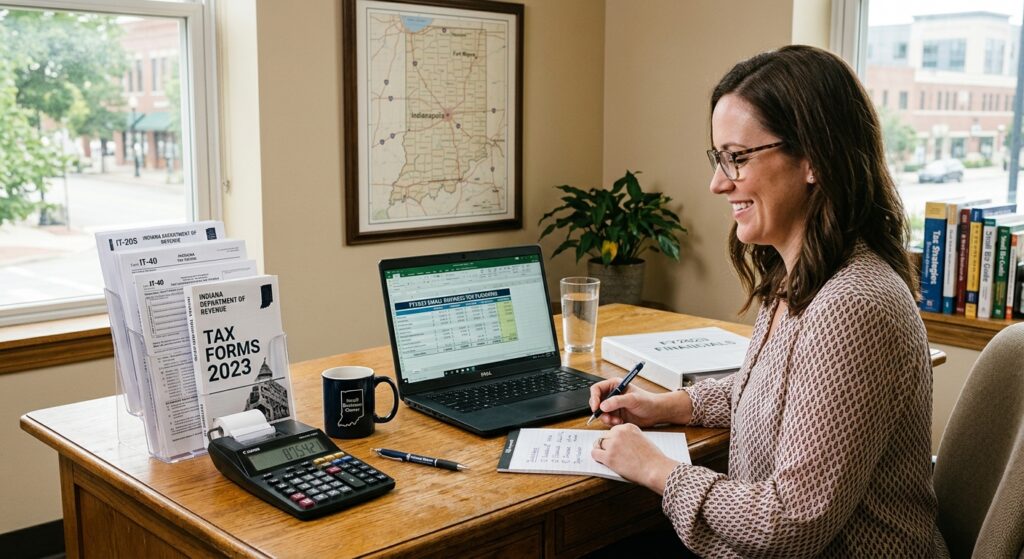
2026 Indiana Small Business Tax Rules: Complete Guide to Changes, Compliance & Planning
Indiana small business tax rules are shifting again for the 2026 tax year. State lawmakers have continued aligning Indiana with recent federal changes while delaying major local income tax reforms until 2029. For business owners, this creates both uncertainty and opportunity: the rules are in motion, but you have a valuable planning window to get ahead.
This guide explains the most important 2026 Indiana small business tax rules in plain language and highlights practical steps to stay compliant and reduce your overall tax burden.
Table of Contents
- Key Takeaways
- Federal–State Alignment and Why It Matters
- Local Income Tax Changes Delayed to 2029
- Penny Phaseout and Sales Tax Rounding
- Key Deductions and Credits for Indiana Small Businesses
- 2026 Compliance & Planning Checklist
- Working With an Indiana Tax Professional
- Frequently Asked Questions
Key Takeaways
- Indiana continues to conform to many federal rules, which reduces differences between your federal and state business returns but still requires careful review.
- Major changes to local income tax distribution and rate authority are delayed until 2029, giving small businesses several years to plan for possible payroll and cash-flow effects.
- Retailers and other businesses that collect sales tax must pay attention to updated guidance on penny rounding and point‑of‑sale system settings.
- Depreciation rules, small‑business expensing, and selected credits (like child‑care related incentives) remain some of the most valuable tools to reduce Indiana taxable income.
- Consistent recordkeeping and periodic check‑ins with a knowledgeable Indiana tax professional are essential as the law continues to evolve.
Federal–State Alignment and Why It Matters
In plain terms: Indiana generally starts with your federal taxable income and then makes a series of additions and subtractions. When Indiana conforms to federal rules, it’s easier to project what you will owe at the state level.
For small businesses, much of the complexity in Indiana tax comes from the differences between federal and state treatment of income, deductions, and credits. In recent sessions, the Indiana General Assembly has passed conformity bills that bring state law closer to federal standards. While the exact bill numbers and provisions change over time, the direction is clear: less mismatch, but still not a perfect one‑to‑one copy of the Internal Revenue Code.
What This Means for Depreciation and Expensing
Federal rules for bonus depreciation and Section 179 expensing are often more generous than Indiana’s default rules. In many years, the legislature chooses whether to follow federal limits or keep separate Indiana calculations.
- If Indiana conforms for a given year, your equipment and machinery write‑offs may match your federal return, simplifying recordkeeping.
- If Indiana does not fully conform, you may need a separate depreciation schedule for state purposes, which affects your cash‑flow projections.
Before you purchase vehicles, machinery, or major technology in 2026, it is wise to confirm how those assets will be treated at both the federal and Indiana levels. The goal is to avoid surprises where you expect a full write‑off but Indiana stretches deductions over several years.
Interest, Losses, and Pass‑Through Income
Other areas where alignment matters include business interest limitations, net operating losses, and the way Indiana handles income from S‑corporations, partnerships, and LLCs. Many Indiana small businesses are pass‑through entities, which means owners report business income on their personal returns.
Because of this, you should look at your structure (sole proprietor, partnership, S‑corp, or C‑corp) and ask: Does my current choice still make sense under the 2026 rules? The right answer can affect not just your federal tax bill, but also your Indiana adjusted gross income and local tax obligations.
Local Income Tax Changes Delayed to 2029
Key point: Lawmakers have chosen to delay a major overhaul of local income tax rules until 2029, recognizing that Indiana’s counties and cities have very different needs.
Indiana allows counties to impose local income taxes that are generally withheld from wages and reported along with your state return. Recent legislation outlined a new framework for how those taxes are shared and how cities and towns can participate, but implementation has been pushed back to 2029.
What Small Businesses Should Watch
- Potential caps on overall county local income tax rates and new authority for cities or towns to impose their own components within those caps.
- Revised distribution formulas that may shift revenue between counties, cities, and towns, indirectly influencing local services and infrastructure.
- New withholding tables and payroll rules that your software or provider will need to implement for wages paid in 2029 and beyond.
Even though the changes do not take effect until 2029, 2026–2028 are ideal years to run “what‑if” scenarios. For example, you can estimate your payroll costs if your county rate decreases but your city adds a new component, or vice versa. That information can guide hiring, compensation, and location decisions.
| Planning Question | Why It Matters |
|---|---|
| Is my workforce concentrated in one county or spread across several? | Different local income tax rates by county can change your overall payroll tax cost and employee take‑home pay. |
| Could city or town‑level taxes apply to my location in 2029? | Future city authority may increase or rebalance local rates within a county cap. |
| Is my payroll software prepared for frequent Indiana updates? | Accurate withholding is critical to avoid penalties and employee complaints. |
Penny Phaseout and Sales Tax Rounding
 Free Tax Write-Off Finder
Who this affects: Retailers, restaurants, and any business that collects Indiana sales tax at the point of sale.
Indiana’s statewide sales tax rate is straightforward, but real‑world transactions often produce totals that require rounding to the nearest cent. Discussions about “penny phaseout” or rounding are really about how your point‑of‑sale (POS) system calculates, displays, and records those fractions of a cent.
Practical Steps for Retail Businesses
- Confirm with your POS provider that the system follows current Indiana rounding guidance for sales tax.
- Periodically test sample transactions (for example, low‑dollar sales or multi‑item receipts) to ensure totals and tax are displayed and stored correctly.
- Keep documentation from your vendor that shows how the system calculates tax; this is helpful in an audit.
Tip: If you operate in more than one state, make sure location‑specific tax settings are clearly labeled so Indiana rounding and rate rules are not mixed up with other states.
Key Deductions and Credits for Indiana Small Businesses
The foundation of most Indiana small business tax strategies is still the core set of deductions and credits that apply year after year. While the details can change, the categories below are consistently important.
Depreciation, Section 179, and Equipment Planning
- Track all asset purchases (vehicles, machinery, computers, furniture) with invoices and in‑service dates.
- Ask how much you can expense immediately under federal Section 179 and how much Indiana allows you to match.
- Review whether bonus depreciation applies and whether Indiana conforms for that tax year.
Employer‑Provided Benefits and Credits
Indiana has periodically expanded or clarified credits related to child care and other employee benefits. If you help employees with child‑care access, transportation, or similar support, ask your advisor whether any state‑level credits are currently available for the 2026 tax year.
- Maintain clear records of employer contributions (subsidies, contracts with providers, or on‑site facility costs).
- Coordinate state incentives with any federal credits so you do not leave money on the table.
Common Everyday Deductions That Still Matter
| Category | Examples |
|---|---|
| Business Use of Vehicle | Mileage logs, fuel, repairs, or actual‑expense method when advantageous. |
| Home Office (if applicable) | Portion of utilities, rent, mortgage interest, and insurance tied to a qualified workspace. |
| Professional Fees | Legal, accounting, tax preparation, and consulting fees related to your business. |
| Marketing and Technology | Websites, advertising, software subscriptions, and online tools. |
2026 Compliance & Planning Checklist
Use this high‑level checklist as a conversation starter with your CPA or tax advisor. Adjust it to your industry and entity type.
- Entity review: Confirm that your current structure (sole proprietor, partnership, LLC, S‑corp, C‑corp) still matches your income level, growth plans, and Indiana tax exposure.
- Depreciation strategy: Decide whether to accelerate write‑offs or spread them out, taking into account both federal and Indiana treatment.
- Payroll and local tax: Verify your payroll provider is using current Indiana and local income tax tables and that employees are assigned to the correct county codes.
- Sales tax and POS: Test your system for correct Indiana sales tax rates and rounding; document the process for audits.
- Recordkeeping: Store receipts, invoices, bank statements, and mileage logs in a consistent digital or paper system, ideally organized by tax category.
- Quarterly reviews: Set calendar reminders to revisit your tax position at least quarterly instead of waiting until filing season.
Working With an Indiana Tax Professional
Because Indiana’s rules interact closely with federal law and with county‑level taxes, working with a preparer who regularly handles Indiana small business returns can save time and reduce the risk of costly errors. Look for someone who:
- Explains both federal and Indiana consequences of major decisions like buying equipment or changing entity type.
- Offers proactive planning, not just once‑a‑year filing.
- Understands how local income taxes, credits, and incentives apply in your specific county or city.
If you prefer a firm that focuses on small businesses, you can explore specialized Indiana services such as local small‑business tax preparation and planning. Comparing a few providers can help you find the right fit for your budget and complexity level.

Frequently Asked Questions
1. How often do Indiana small business tax rules change?
Indiana typically passes tax‑related bills during each legislative session, and federal law can also shift in ways that affect Indiana conformity. As a result, you should expect some level of change every year, even if the changes are minor. Checking annually—ideally with professional help—is the safest approach.
2. Do changes to local income tax rates automatically change my business’s withholding?
Yes, but only after the Indiana Department of Revenue publishes updated withholding tables and your payroll system applies them. If you run payroll manually or use outdated software, you may need to update rates yourself and verify county codes for each employee.
3. I’m a sole proprietor. Should I switch to an LLC or S‑corp because of these rules?
There is no one‑size‑fits‑all answer. Changing entities can affect self‑employment tax, Indiana adjusted gross income, payroll requirements, and liability protection. It is best to model your last one to two years of income under different structures with a tax professional before you make the move.
4. How do I know if Indiana follows a particular federal deduction in 2026?
You can review Indiana’s conformity bill language, Department of Revenue guidance, or reliable professional summaries. Another option is to ask your tax preparer to show you the Indiana additions and subtractions page from your prior‑year return and walk through where the state “decouples” from federal law.
5. What records should I keep in case of an Indiana audit?
Keep bank statements, invoices, receipts, payroll reports, mileage logs, and proof of sales‑tax collections for at least the standard statute of limitations period (often three years, longer in some situations). Organizing these by year and category makes any audit or review far less stressful.
6. Where can I find official guidance on Indiana small business tax rules?
The Indiana Department of Revenue publishes forms, instructions, and bulletins on its official website. You can also review legislative updates through the Indiana General Assembly’s site. For user‑friendly explanations, many CPA firms and professional tax resources post summaries when major changes occur.
This article is for general educational purposes only and is not legal, tax, or accounting advice. Indiana and federal tax laws can change after publication. Always consult a qualified professional who understands current Indiana rules before making decisions.

