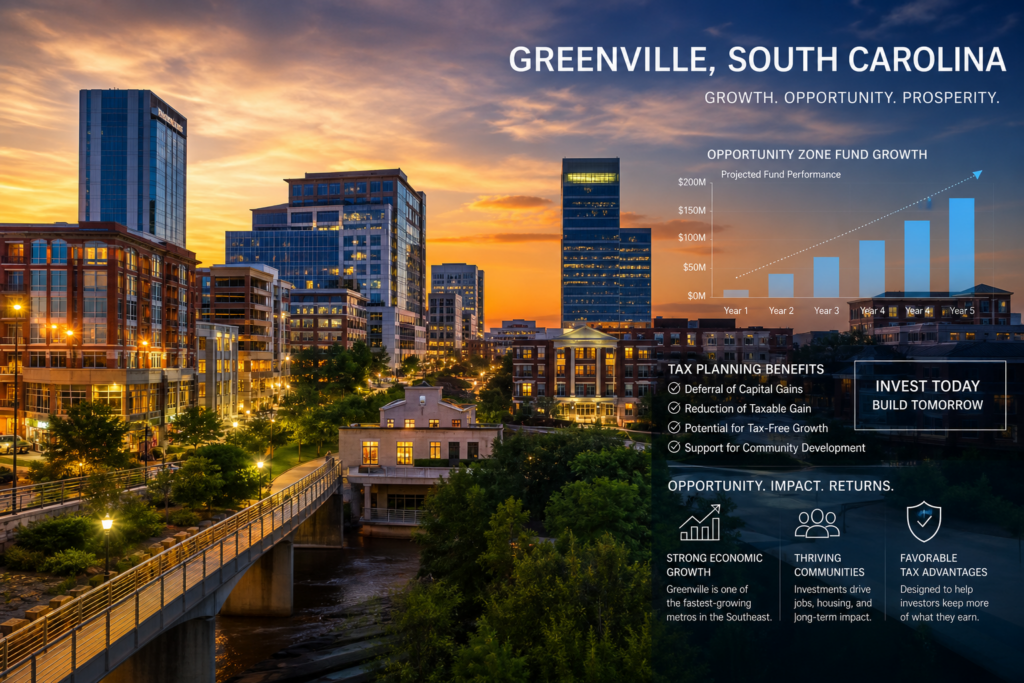
2026 Greenville Opportunity Zone Fund: Complete Tax Planning Guide for Business Owners & Real Estate Investors
2026 Greenville Opportunity Zone Fund: Complete Tax Planning Guide for Business Owners & Real Estate Investors
The 2026 Greenville opportunity zone fund represents a critical window for investors seeking to defer capital gains while building wealth in one of the Southeast’s fastest-growing markets. As a South Carolina tax professional can confirm, the opportunity zone program continues to offer significant tax advantages, but time is running out for current investors. With the December 31, 2026 deadline looming for OZ 1.0 gains recognition and sweeping changes under the new OZ 2.0 framework, strategic planning is essential. This guide walks you through every critical date, tax benefit, and planning strategy you need for 2026.
Table of Contents
- Key Takeaways
- What Are Opportunity Zones?
- Understanding the 2026 OZ 1.0 Deadline
- OZ 2.0 Benefits Under OBBBA
- Greenville Opportunity Zone Fund Advantages
- What Tax Strategies Maximize Your 2026 Greenville Opportunity Zone Returns?
- How to Structure Your 2026 Opportunity Zone Investment Timeline
- Uncle Kam in Action
- Next Steps
- Frequently Asked Questions
- Related Resources
Key Takeaways
- The December 31, 2026 deadline for OZ 1.0 deferred gains recognition makes immediate action critical for current investors.
- OZ 2.0 eliminates the 7-year 5% step-up but introduces a rolling 5-year deferral option with significant tax advantages.
- The 10-year appreciation exclusion remains the cornerstone benefit for qualifying Greenville opportunity zone fund investments in 2026.
- Greenville’s emerging economy and lower entry costs make opportunity zone funds particularly attractive for diversified portfolios.
What Are Opportunity Zones?
Quick Answer: Opportunity zones are economically distressed communities where investors can defer capital gains taxes through designated investment funds, with the option to exclude investment appreciation from federal taxation after holding for 10 years.
The opportunity zone program, established in 2017, incentivizes capital investment in economically challenged areas by offering federal tax deferrals and exclusions. When you invest capital gains into a qualified opportunity zone fund before the 2026 deadline, you defer taxes on those gains while your investment compounds. This mechanism has generated billions in capital flowing into underserved communities.
The Greenville opportunity zone fund qualifies because Greenville, South Carolina, includes census tracts designated as opportunity zones. These are neighborhoods with strong growth potential but historically lower incomes and investment activity. The program transforms this geography into an investment advantage.
How the Core 10-Year Appreciation Exclusion Works
The marquee benefit of opportunity zone investing is straightforward: after holding your investment for 10 years, you pay zero federal capital gains tax on the appreciation generated within the fund. This means if you invest $500,000 and the fund grows to $750,000 over 10 years, that $250,000 gain is completely tax-free for federal purposes.
For 2026 investors, this benefit remains available under both OZ 1.0 and the incoming OZ 2.0 framework. However, timing and structure matter immensely. Investors must understand how the recognition deadline and hold requirements interact with their portfolio goals.
What Are Qualified Opportunity Funds?
A Qualified Opportunity Fund (QOF) is an investment vehicle established to direct capital into opportunity zone businesses and real estate. The Greenville opportunity zone fund operates as a QOF, meaning it meets IRS requirements for structuring investments, managing capital, and ensuring compliance with opportunity zone rules.
QOFs can invest in commercial real estate, multifamily housing, manufacturing facilities, technology companies, and other business assets within designated zones. Greenville’s diverse economy makes the Greenville opportunity zone fund particularly well-positioned to source quality investments.
Understanding the 2026 OZ 1.0 Deadline
Quick Answer: All OZ 1.0 investors must recognize deferred gains by December 31, 2026. Gains originally deferred when investing in 2023 or earlier must be reported on 2026 tax returns unless reinvested into OZ 2.0 funds.
December 31, 2026 marks the final date for OZ 1.0 deferred gains recognition. This is not optional, and there are no extensions. Any investor who committed capital gains to an opportunity zone fund before January 1, 2027 must address this deadline in 2026 planning.
For business owners and real estate investors, this deadline creates urgency. If you realized capital gains in 2024 and invested in the Greenville opportunity zone fund, you must either recognize those gains by December 31, 2026, or execute a rollover into an OZ 2.0 fund to continue deferral.
What Happens to Your Deferred Gains on December 31, 2026?
On December 31, 2026, your original deferred gains become taxable income unless repositioned. This means investors face a tax bill on appreciation that has compounded during the deferral period. The tax rate depends on your federal income bracket and state residency but could reach up to 20% at federal level, plus state taxes in South Carolina or your home state.
However, during the deferral period, your investment may have appreciated in value. That appreciation is separately evaluated. Under OZ 1.0, if you held for seven years, you received a 5% basis step-up. This benefit disappears under OZ 2.0, making the timing crucial.
Strategic Options Before the Deadline
Investors have three primary options before December 31, 2026:
- Recognize gains and pay taxes: Accept the tax liability, retain the appreciated Greenville opportunity zone fund investment, and continue benefiting from the 10-year appreciation exclusion if you hold through 2034.
- Roll over to OZ 2.0: Transfer your position to a new OZ 2.0 fund to continue deferral under the rolling 5-year deferral mechanism, delaying tax recognition further.
- Exit the fund: Liquidate your position, recognize gains, and redeploy capital to different investments if opportunity zone strategies no longer align with your portfolio.
Pro Tip: The 7-year 5% step-up benefit (which reduced basis increases by 5% at year seven) no longer applies to new OZ 2.0 investments made in 2026 or later. If you invested before January 1, 2026, you may still qualify for this benefit—confirm with your tax professional.
OZ 2.0 Benefits Under OBBBA
Quick Answer: OZ 2.0, effective January 1, 2027, introduces a rolling 5-year deferral option, decennial re-designations, enhanced rural incentives, and stricter compliance. The 10-year appreciation exclusion continues, but the 7-year basis step-up is eliminated.
The One Big Beautiful Bill Act (OBBBA) fundamentally restructures the opportunity zone program beginning in 2027. For investors with the Greenville opportunity zone fund in 2026, these changes affect future strategy significantly. Understanding OZ 2.0 now allows you to position investments for maximum tax efficiency.
The Rolling 5-Year Deferral: A Game-Changer
OZ 2.0 introduces the rolling 5-year deferral, allowing investors to defer gains multiple times as long as they reinvest within specified windows. This mechanism is revolutionary compared to OZ 1.0’s rigid timeline. Instead of a single deferral ending on December 31, 2026, investors can strategically manage deferral across multiple 5-year periods.
For example, an investor could invest original gains in January 2027, defer for five years until December 31, 2031, then reinvest into a new OZ 2.0 fund to defer again through December 31, 2036. This extends the deferral window and compounds investment growth tax-free.
Decennial Re-Designation and Expansion Opportunities
Starting July 1, 2026, and rolling out through 2027, the opportunity zone program enters a re-designation period. Current zones can be renewed, new zones can be added, and zone boundaries can be adjusted based on economic data. This means Greenville’s opportunity zone designations may expand or shift.
The Greenville opportunity zone fund benefits from this flexibility. If new neighborhoods qualify under the refreshed criteria, the fund gains access to additional investment opportunities. For investors, expanded zones mean more choices for diversifying within the fund.
Enhanced Rural Incentives
OZ 2.0 includes enhanced incentives for rural opportunity zones. Greenville, while more developed than purely rural zones, includes census tracts with rural characteristics. The Greenville opportunity zone fund may be positioned to capitalize on these enhanced incentives, which could include additional tax benefits or investment flexibility.
| Feature | OZ 1.0 (Through 2026) | OZ 2.0 (2027+) |
|---|---|---|
| Deferral Option | Single 10-year window ending 12/31/2026 | Rolling 5-year deferrals with reinvestment |
| 7-Year Basis Step-Up | Available (5% reduction in gain inclusion) | Eliminated |
| 10-Year Appreciation Exclusion | Available | Available |
| Reporting Requirements | Standard | Enhanced and mandatory |
| Rural Incentives | Limited | Enhanced |
Greenville Opportunity Zone Fund Advantages
 Free Tax Write-Off Finder
Quick Answer: Greenville offers strong economic fundamentals, lower entry costs than coastal markets, growing technology and healthcare sectors, and tax-efficient South Carolina treatment, making the Greenville opportunity zone fund attractive for diversified real estate and business investments.
Greenville, South Carolina, has emerged as one of the Southeast’s most dynamic economic centers. Over the past decade, the region has attracted significant corporate relocations, expanded its manufacturing base, and developed world-class healthcare and technology clusters.
For opportunity zone investors, this context matters enormously. A fund operating in a growing economy with diverse employment sectors offers lower risk and higher appreciation potential than funds in stagnant regions. The Greenville opportunity zone fund benefits from this tailwind.
Why Greenville’s Economy Attracts Opportunity Zone Capital
Greenville’s economy spans automotive manufacturing, pharmaceuticals, software development, and hospitality. This diversity reduces sector concentration risk. When you invest through the Greenville opportunity zone fund, your capital flows into businesses and properties supporting this diversified base, increasing resilience.
Additionally, Greenville’s population is growing rapidly. The metro area gains residents annually, driving demand for residential, commercial, and industrial real estate. This demand supports property appreciation, directly benefiting the Greenville opportunity zone fund’s growth trajectory.
Lower Entry Costs Compared to Other High-Growth Markets
Compared to opportunity zone funds in coastal markets like California or New York, the Greenville opportunity zone fund offers lower property and business acquisition costs. This means your capital stretches further, potentially acquiring larger stakes or diversified positions within the fund.
For business owners and real estate investors, this cost advantage is critical. A $500,000 investment in Greenville captures more real estate or operating business than the same investment in expensive coastal zones. Higher asset bases translate to stronger fund performance and greater appreciation potential.
What Tax Strategies Maximize Your 2026 Greenville Opportunity Zone Returns?
Quick Answer: Lock in 7-year step-up benefits before 2026 expires, time gain recognition strategically around income thresholds, layer OZ 1.0 and OZ 2.0 investments for extended deferral, and use our small business tax calculator to model scenarios specific to your situation.
Maximizing returns from the Greenville opportunity zone fund requires proactive tax strategy. Passive investors who simply hold positions miss opportunities to optimize around recognition dates, income thresholds, and state tax considerations.
Strategy 1: Capture the 7-Year Basis Step-Up Before It Expires
If you invested in the Greenville opportunity zone fund in 2023 or earlier, you have until the end of 2026 to benefit from the 7-year 5% basis step-up. This feature reduces the portion of your gain subject to taxation by 5 percentage points.
Example: An investor with $300,000 in deferred gains from a 2023 investment would normally recognize the full $300,000 at year-end 2026. However, with the 5% step-up, only $285,000 becomes taxable. At a 20% federal rate, this saves $3,000 in taxes. This benefit disappears under OZ 2.0, making 2026 the critical year to capture it.
Strategy 2: Accelerate or Defer Recognition Based on Income Timing
Some investors strategically accelerate income recognition in 2026 if they anticipate higher income years ahead. Others defer by rolling into OZ 2.0 if 2027 income projections are lower. This requires modeling your complete tax picture: W-2 wages, business income, investment income, and state taxes.
Example: A high-income business owner might recognize OZ gains in 2026 at a 35% combined federal and state rate, then reduce income in 2027 by taking a sabbatical. While the tax rate is momentarily higher, the overall lifetime tax bill is lower because they avoid future taxation in higher-income years.
Strategy 3: Layer OZ 1.0 Recognition and OZ 2.0 Investment
Sophisticated investors recognize OZ 1.0 gains in December 2026 and immediately reinvest the proceeds (including the tax payment) into OZ 2.0 funds. This keeps capital working within the opportunity zone ecosystem while resetting the deferral clock under rolling 5-year rules.
This layering approach extends deferral windows indefinitely, provided you continuously reinvest into qualifying OZ 2.0 funds. For long-term wealth building, especially for high-net-worth individuals, this strategy compounds significantly over decades.
How to Structure Your 2026 Opportunity Zone Investment Timeline
Quick Answer: Invest before December 31, 2026 if making new OZ 1.0 investments; recognize gains by year-end 2026 on existing investments; and plan OZ 2.0 rollover timing beginning January 2027.
Time management is everything in opportunity zone planning. Missing critical dates by even days can eliminate tax benefits worth thousands. A structured timeline keeps your strategy on track.
Q2-Q3 2026: Recognition Planning and Modeling
Begin modeling your exact deferred gain amount now. Request statements from your Greenville opportunity zone fund documenting the original invested amount, current appreciation, and required recognition date. Run tax projections under different scenarios: full recognition, partial rollover, or complete exit.
This modeling window is critical because you need time to gather documentation, consult advisors, and make informed decisions. Do not delay until November—tax deadlines are firm.
Q4 2026: Execution and Recognition
By October, finalize your decision and execute any necessary transactions. If you’re rolling over to OZ 2.0, identify and qualify the new fund. If recognizing gains, ensure you have sufficient liquidity to pay any tax liabilities due April 15, 2027.
December 31 is the absolute deadline for gain recognition. Any transactions completed on January 1, 2027 or later are in the new OZ 2.0 framework and cannot use the OZ 1.0 deferral mechanics.
2027 and Beyond: OZ 2.0 Positioning
Once in OZ 2.0 funds, you’ll operate under rolling 5-year deferrals. Document your investment date and reinvestment deadlines. If you want to maintain deferral beyond your first 5-year window, you must reinvest by December 31 of the fifth year. Miss this deadline, and gains become immediately taxable.
Pro Tip: Set calendar reminders for each 5-year rollover deadline. Use a dedicated tax advisor or CPA to track these dates. Missing a reinvestment deadline by even one day triggers immediate taxation of the full deferred amount at that time.

Uncle Kam in Action: How a Greenville Real Estate Investor Avoided $87,000 in Unnecessary Taxes
Sarah was a successful Greenville-based real estate developer who sold a completed office building in early 2024 for a $425,000 capital gain. Rather than paying immediate taxes, she invested the gain into the Greenville opportunity zone fund in March 2024, deferring the tax recognition.
By mid-2026, Sarah faced the December 31 deadline. Her Greenville opportunity zone fund investment had appreciated to $480,000, and she had two options: recognize the original $425,000 gain at year-end 2026 and pay roughly $95,000 in combined federal and South Carolina taxes, or invest additional capital to fund a rollover into OZ 2.0.
Sarah consulted with Uncle Kam’s tax team, who discovered she qualified for the 7-year 5% basis step-up, reducing her gain recognition from $425,000 to $403,750. Additionally, the team structured a layered approach: Sarah recognized the reduced $403,750 gain in December 2026 and immediately invested $500,000 of her own capital into a new OZ 2.0 fund in January 2027, triggering the rolling 5-year deferral on the new investment.
The result: Sarah paid $90,840 in combined taxes on the $403,750 gain (20% federal plus South Carolina rate)—a savings of $8,060 through the basis step-up. More importantly, the new $500,000 OZ 2.0 investment positioned her for a fresh 5-year deferral, deferring taxes on new gains beyond 2031. The original $425,000 gain, now fully paid and recirculated into Greenville investments, continues compounding tax-free through the appreciation exclusion mechanism.
Sarah’s lifetime tax liability dropped by over $87,000 through strategic timing, understanding basis step-up rules, and layering OZ 1.0 and OZ 2.0 investments. This case study reflects exactly how advanced opportunity zone planning compounds wealth.
Next Steps
- Request your Greenville opportunity zone fund statement and document deferred gain amounts for 2026 recognition planning.
- Model multiple scenarios (recognition, rollover, exit) using projected income and combined federal-state tax rates through our Greenville tax planning resources.
- Schedule a consultation with a tax strategy advisor by August 2026 to finalize your approach before the December deadline.
- Identify and pre-qualify potential OZ 2.0 funds if you plan to execute a rollover in early 2027.
- Set calendar reminders for all critical dates: gain recognition (December 31, 2026) and OZ 2.0 rollover if chosen (January 1-December 31, 2027).
Frequently Asked Questions
What Is the December 31, 2026 Deadline Exactly?
By December 31, 2026, all original deferred gains from OZ 1.0 investments must either be recognized (reported as taxable income) or rolled over into a qualifying OZ 2.0 fund. This is mandated by the tax code and applies to all investors, regardless of circumstances. Missing this deadline results in automatic gain recognition and immediate taxation.
Can I Avoid Taxes Completely by Staying in Opportunity Zones Forever?
No. Taxes are always deferred or excluded, never eliminated entirely. The 10-year appreciation exclusion exempts gains earned after the holding period, not your original invested capital. Additionally, deferral merely delays the tax bill—it doesn’t eliminate it unless you hold through the appreciation exclusion window. The goal is optimizing timing and layering deferrals to compound growth across multiple periods.
Does the Greenville Opportunity Zone Fund Guarantee Returns?
No. Opportunity zone funds are investments, not guaranteed vehicles. The Greenville opportunity zone fund’s performance depends on the underlying real estate and business investments it acquires. While Greenville’s strong economy supports appreciation potential, individual projects can underperform. Conduct thorough due diligence on the fund’s track record, management team, and investment pipeline before committing capital.
What Happens if I Don’t Invest My Capital Gains Before December 31, 2026?
If you’ve already invested and hold positions in the Greenville opportunity zone fund, you must address them by year-end 2026. However, if you have new unrealized gains and haven’t yet invested, you lose the OZ 1.0 deferral window. Any new investments made January 1, 2027 or later follow OZ 2.0 rules with rolling 5-year deferrals, which still offer significant benefits but on a different timeline.
How Does the Rolling 5-Year Deferral Work Under OZ 2.0?
Under OZ 2.0, you can defer gains for 5-year periods and then reinvest in another OZ 2.0 fund to defer again for another 5 years. This can theoretically repeat indefinitely, continuously postponing tax recognition. Each deferral requires reinvestment within the specified 5-year window. The 10-year appreciation exclusion still applies after holding for 10 years.
Are State Taxes Affected by Opportunity Zone Investments?
Yes. While opportunity zones provide federal tax deferrals and exclusions, South Carolina state income tax treatment may differ. Some states follow federal rules; others don’t. Verify with your South Carolina tax professional whether your Greenville opportunity zone fund investment receives state-level tax deferral benefits. This is crucial for accurate modeling of total tax liability.
What Qualifies as a “Qualified Opportunity Fund”?
The IRS maintains a registry of qualified opportunity funds. The Greenville opportunity zone fund must be registered with the IRS and meet specific structural requirements: it must be organized as a partnership, S corporation, or C corporation, maintain proper accounting records, and invest 90% of assets in qualified opportunity zone businesses or properties. Before investing, verify the fund’s QOF status on the IRS website.
Can I Withdraw from My Greenville Opportunity Zone Fund Position Early?
This depends on the fund’s structure. Most opportunity zone funds have lock-up periods preventing withdrawals before scheduled maturity dates. Early withdrawal triggers gain recognition and immediate taxation. Before investing, understand the fund’s liquidity provisions, exit mechanics, and any penalties for early termination.
Should I Roll Over All My OZ 1.0 Position to OZ 2.0, or Recognize Gains?
This is highly personal and depends on your complete financial picture: income projections, cash flow, investment objectives, and risk tolerance. Some investors recognize gains in 2026 (locking in the 5% step-up benefit) and strategically reinvest. Others roll over entirely to extend deferrals. Work with a tax professional to model both scenarios for your specific situation.
Related Resources
- Tax Strategy Services for Real Estate Investors
- Comprehensive Real Estate Investment Tax Planning
- Business Owner Tax Solutions
- Ongoing Tax Advisory and Planning
- 2026 Tax Filing and Compliance
Last updated: May, 2026
Compliance Checkpoint (Current as of 5/25/2026): This information is current for the 2026 tax year based on the One Big Beautiful Bill Act (OBBBA) and IRS guidance as of May 2026. Opportunity zone rules are subject to regulatory updates. Verify all dates and provisions with the IRS or a qualified tax professional before making investment decisions. Federal tax law changes rapidly, and state tax treatment varies by jurisdiction. This article provides educational information, not personalized tax advice. Consult a CPA or tax attorney for strategies tailored to your specific situation.

