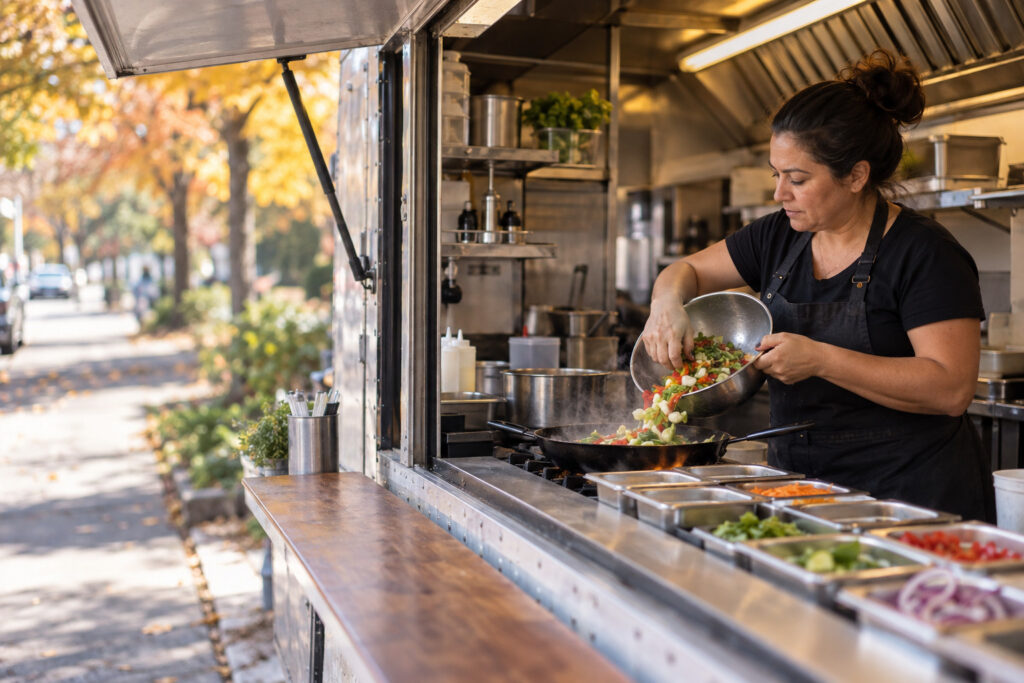
2026 food, beverage & ingredient costs deduction: A Restaurant Owner’s Guide
Your food, beverage & ingredient costs deduction depends on what you buy and who consumes it. Ingredients sold to customers differ from client lunches, employee meals, and personal groceries. This national guide explains federal treatment for the 2026 tax year. Restaurant, cafe, bar, catering, and food-truck owners can use it to classify purchases, understand inventory timing, and build records that support their returns without claiming the same cost twice.
Key Takeaways
- Customer ingredients generally belong in product-cost accounting, not the ordinary business-meal category.
- Inventory and accounting methods affect when you recover ingredient costs.
- Business meals generally face a 50% limit; exceptions need separate support.
- Employee meals require special review under the rules applicable in 2026.
- Personal consumption and duplicate spoilage deductions do not qualify.
A useful restaurant tax planning strategy starts with classification. The food, beverage & ingredient costs deduction is not one universal percentage.
Table of Contents
- Key Takeaways
- Which Costs Qualify for the food, beverage & ingredient costs deduction?
- How Do Inventory and Accounting Methods Affect Deduction Timing?
- When Do Business Meals and Employee Meals Face Limits?
- How Should You Handle Spoilage, Personal Use, and Sales Tax?
- What Records Support Your Food and Beverage Deductions?
- Uncle Kam in Action
- Next Steps
- Related Resources
- Frequently Asked Questions
Which Costs Qualify for the food, beverage & ingredient costs deduction?
Quick Answer: Ingredients and beverages bought for customer sales generally enter product-cost accounting. Business meals, employee food, and personal consumption require different treatment.
Start with the purpose of each purchase, not the supplier’s name. One warehouse receipt might include restaurant chicken, a client lunch, cleaning products, and groceries for home. Those items do not share one tax treatment. Likewise, paying with a business card does not establish deductibility.
The IRS identifies Publication 334 for small businesses as general federal guidance for sole proprietors. Its product-cost framework helps explain why food for resale differs from meal expenses. Owners using other entity types should apply the appropriate return instructions and accounting rules.
Customer food is a product cost
A cafe buys coffee beans, milk, and pastry ingredients to make products customers purchase. A bar buys beer, wine, spirits, and mixers for the same commercial purpose. A caterer purchases ingredients for contracted events. These costs generally belong in inventory or the applicable product-cost method, rather than a client-meal account.
Suppose a food truck uses $2,400 of ingredients to prepare customer orders during a period. That amount does not become a $1,200 deduction merely because the products are edible. The ordinary business-meal percentage does not automatically apply to food sold to customers. However, the accounting method still determines when the business recovers the $2,400.
For food service business owners, this distinction also improves management reports. Combining customer ingredients with owner lunches distorts food-cost percentages and hides personal spending.
Classify the recipient and purpose
| Purchase | Starting classification | Main review |
|---|---|---|
| Ingredients for customer orders | Product costs or COGS | Inventory and recovery timing |
| Lunch with a prospective commercial customer | Potential business meal | Business purpose and generally 50% limitation |
| Food provided to employees | Employee-meal review | Section 274 restrictions and exceptions |
| Groceries taken home by the owner | Personal withdrawal | Exclude from business deductions |
The same bottle of wine can have different treatment depending on its use. Selling glasses to guests differs from serving a business prospect or taking the bottle home. Record that use when it happens. Reconstructing it months later invites errors, especially when restaurant purchases also serve household needs.
Pro Tip: Create separate accounts for customer ingredients, business meals, employee meals, and owner withdrawals before importing bank transactions.
How Do Inventory and Accounting Methods Affect Deduction Timing?
Quick Answer: Buying food does not always create an immediate deduction. Inventory rules and your permitted accounting method determine when you recover costs.
Cost of goods sold, or COGS, connects product costs with sales. Under conventional inventory accounting, purchases increase stock before they become costs associated with goods sold. Therefore, a large December delivery does not automatically reduce taxable income by its full invoice amount.
The IRS small business tax guide is a starting resource for the inventory framework. Review your actual method with your preparer before changing year-end treatment. Cash leaving the bank and a deductible cost appearing on the return are not always simultaneous events.
Work through a basic COGS calculation
Consider a hypothetical cafe using conventional inventory accounting for 2026. It starts with $12,000 of inventory, makes $168,000 of qualifying purchases, and ends with $15,000. Assume these amounts exclude personal withdrawals and unrelated meal expenses. Also assume no other includible product costs or adjustments.
| Calculation component | Amount |
|---|---|
| Beginning inventory | $12,000 |
| Plus qualifying purchases | $168,000 |
| Goods available | $180,000 |
| Less ending inventory | ($15,000) |
| Illustrative COGS | $165,000 |
The formula is beginning inventory plus qualifying purchases minus ending inventory. Here, $12,000 plus $168,000 minus $15,000 equals $165,000. Deducting all purchases separately would duplicate costs already included in this calculation. Similarly, excluding usable stock from ending inventory would overstate COGS.
Small business eligibility does not mean unlimited expensing
Eligible small business taxpayers may use simplified inventory treatment under section 471(c). Eligibility involves the applicable gross-receipts test and other restrictions, including tax-shelter rules. This article does not provide an unverified 2026 dollar threshold. Related-business aggregation can also affect the analysis, so restaurant size alone does not settle eligibility.
Available approaches can include treating inventory as nonincidental materials and supplies or following an eligible financial-statement or books-and-records method. These alternatives have different requirements. In particular, treating inventory as materials and supplies does not automatically mean deducting every delivery when paid. Do not switch methods informally because a different treatment produces a larger deduction.
Our restaurant food cost deduction guide provides a central reference for organizing these questions. Before expanding locations, document the method used by each reporting business and review consistency with your adviser.
Pro Tip: Count stock even when simplified tax accounting applies. Operational counts help identify waste, theft, and inaccurate purchase classifications.
When Do Business Meals and Employee Meals Face Limits?
Quick Answer: Ordinary qualifying business meals generally face a 50% limit. Employee food needs separate analysis, particularly under section 274(o) in 2026.
Section 162 supplies the ordinary-and-necessary business-expense framework. Section 274 then restricts certain food, beverage, and entertainment deductions. Having a plausible business purpose does not eliminate those restrictions. Moreover, food does not escape the rules merely because you call it a snack or refreshment.
The IRS food and beverage regulations explain the general limitations and exceptions. They also explain that meal costs include delivery charges, tips, and sales tax. Apply the relevant percentage to the properly classified total, not just the menu price.
Client meals are different from customer orders
Suppose a caterer spends $240 on a qualifying lunch with a prospective corporate customer. Assume the total includes applicable tax and tip. If the ordinary 50% limitation applies, the deductible amount is $120. That lunch differs from ingredients used to fulfill the customer’s eventual catering order.
Record the attendees, business relationship, date, location, and business purpose. The taxpayer or an employee generally must attend, and the expense cannot be lavish or extravagant under the circumstances. A receipt alone does not explain why a meal served the business. Entertainment has separate restrictions, so do not combine tickets and food into one unsupported deduction.
Also, purchasing lunch from a restaurant does not automatically make it fully deductible. Restaurant purchases do not receive a blanket 100% business-meal deduction for 2026.
Employee meals need a specific exception analysis
For expenses paid or incurred after 2025, section 274(o) disallows deductions for covered employer-provided meals and eating-facility expenses, subject to applicable exceptions. The supplied Bloomberg Tax meal deduction guide discusses this 2026 restriction. It is secondary guidance, not a substitute for the current statute and applicable IRS instructions.
Do not interpret that restriction as eliminating every restaurant employee-meal deduction. The food-service exception can protect qualifying restaurant or catering employee meals involving food prepared for sale to customers. However, simply operating a restaurant does not make every employee food purchase eligible. Separately purchased staff lunches, owner meals, and off-site perks require their own analysis.
For example, staff eating the same food prepared for paying customers presents different facts from an owner ordering outside lunches. Document the source of the food, recipients, and exception supporting the treatment. Employee income exclusion and employer deductibility are separate questions. A meal can require different analysis on each side.
Did You Know? The food-service exception is fact-specific. Neither a restaurant receipt nor a staff-meal label establishes full deductibility.
How Should You Handle Spoilage, Personal Use, and Sales Tax?
 Free Tax Write-Off Finder
Quick Answer: Reconcile spoiled stock through your accounting method, remove personal withdrawals, and analyze sales tax separately. Never deduct one cost twice.
Food businesses experience expired stock, preparation waste, damaged packaging, and refrigeration failures. Those events matter, but they do not create a second deduction for costs already recovered. Track what happened and how the books recognized it before calculating any tax adjustment.
Likewise, a federal income-tax deduction does not establish a state sales-tax exemption. These systems answer different questions. For meal expenses specifically, the IRS meal expense definition includes sales tax in the meal cost subject to the applicable deduction treatment.
Document waste without creating another deduction
Assume a restaurant starts with $5,000 of inventory and purchases another $25,000 during a period. Its accurate ending count is $4,000 after disposing of spoiled ingredients. Under the simplified example, COGS equals $5,000 plus $25,000 minus $4,000, or $26,000. The discarded ingredients already affect that calculation through the lower ending balance.
If $600 of documented spoilage is already reflected there, adding a separate $600 deduction would overstate total recovery. Businesses using another permitted method must similarly check whether they already deducted the cost. Record supplier credits, insurance reimbursements, and other recoveries for separate review rather than ignoring them.
Maintain a waste log with quantities, purchase cost, disposal date, and reason. For a freezer failure, keep service records and photographs when practical. Use cost, not the menu value of meals you hoped to sell. Lost expected profit is not the same as a purchased ingredient cost.
Separate household withdrawals and sales-tax questions
An owner who takes $300 of restaurant groceries home has a personal withdrawal, not a customer ingredient expense. Remove that cost from business purchases or otherwise adjust the product-cost records consistently. The same principle applies when the business pays for family groceries directly. A legitimate restaurant invoice can contain nondeductible personal items.
State and local rules govern resale certificates, prepared-food taxation, and potential use tax on withdrawals. This national article does not prescribe a universal exemption. Ask the relevant revenue agency about your actual transactions. Do not use a California exemption description to decide treatment in another state.
Our small business tax guides can help organize broader questions. Nevertheless, keep the federal deduction analysis separate from the sales-tax return. A cost can qualify for federal recovery even when a purchase or subsequent sale has state tax consequences.
Pro Tip: Reconcile waste logs to inventory adjustments. A log supports the accounting entry; it does not automatically justify another expense.
What Records Support Your Food and Beverage Deductions?
Quick Answer: Keep itemized invoices, payment evidence, inventory records, and records showing each purchase’s purpose. Reconcile those documents to the return.
Good records explain both the amount and the classification. A bank statement may show that a payment occurred. However, it rarely identifies ingredients, supplies, personal items, or employee meals within that payment. Itemized source documents close that gap and help your preparer apply the right rules.
The IRS business meal regulations show why classifications matter. Different exceptions and limitations can apply to apparently similar food purchases. Your records should preserve the facts needed to choose the correct category rather than relying on year-end guesses.
Build a purchase-to-return record trail
Save supplier invoices by date and vendor. Match invoices to receiving records, credits, and payments. For mixed purchases, split the invoice before posting it. A $900 wholesale purchase might contain $760 of ingredients, $100 of cleaning supplies, and $40 of personal items. Posting all $900 to food cost would misclassify $140.
- Keep item descriptions, quantities, prices, delivery charges, and applicable taxes.
- Document inventory counts and the valuation method used.
- Record employee meals and the basis for any claimed exception.
- Attach business-purpose notes to client-meal receipts.
- Track waste, owner withdrawals, refunds, and supplier credits separately.
Also reconcile platform reports to deposits and recorded sales. Delivery-platform fees and net deposits should not obscure ingredient costs or customer receipts. Keep the supporting reports even when bookkeeping software imports summary transactions automatically.
Close monthly rather than rebuilding annually
Choose a monthly process that fits the operation. A small food truck may use a simple spreadsheet and receipt archive. A multi-location restaurant may need inventory software and location-level controls. Either system should let someone trace a reported cost back to its source and understand its business use.
Review unusually high food-cost percentages, negative inventory balances, and repeated miscellaneous entries. These signals do not prove a tax problem. However, they often reveal duplicate invoices, missing credits, or household withdrawals. Fixing them monthly protects both margins and the eventual food, beverage & ingredient costs deduction.
Before year-end, confirm the accounting method and outstanding issues with your preparer. Ask whether any proposed change requires formal consent or additional filing. Keep a written explanation of employee-meal exceptions and inventory adjustments. A short contemporaneous memo is more useful than an unsupported explanation created after an examination begins.
Pro Tip: Assign one person to approve inventory adjustments and another to review unusual meal classifications whenever staffing permits.

Uncle Kam in Action: A Cafe Separates Product Costs From Meals
Here is a hypothetical example of how this works in practice.
A cafe owner preparing the 2026 books has grouped all food spending into one expense account. The account includes customer ingredients, business lunches, and groceries taken home. The owner also wants to deduct spoilage separately, although the ending inventory count already excludes discarded products.
The challenge and proposed approach
Uncle Kam would first separate each category and confirm the accounting method. Assume the cafe uses conventional inventory accounting. Beginning inventory is $8,000, qualifying customer-product purchases are $112,000, and ending inventory is $10,000. These figures already exclude personal withdrawals and separately classified meals.
The resulting COGS estimate is $110,000: $8,000 plus $112,000 minus $10,000. Qualifying business lunches total another $1,200. Assuming the ordinary 50% limitation applies, those lunches support a $600 deduction. Meanwhile, $900 of household groceries does not become deductible through the cafe.
Illustrative financial impact
The two qualifying categories produce $110,600 of cost recovery and meal deductions before other business expenses. If the owner mistakenly limited customer-product COGS to 50%, the return would omit $55,000 of cost recovery. Correcting that mistake could reduce federal income tax by roughly $13,200 at an assumed 24% marginal rate.
That rate is an illustrative assumption, not a prediction of this owner’s bracket. The estimate excludes other tax interactions. Separately, the preparer would prevent a duplicate spoilage deduction and review any employee meals individually. This example is not a client result or a guaranteed saving. For actual reported outcomes, see Uncle Kam client results.
Use the food and beverage COGS resource to organize your own classification questions before meeting your preparer.
Next Steps
Start with one recent month instead of reorganizing an entire year at once. Separate invoices, reconcile stock, and list unresolved employee-meal questions. Then apply the same process consistently across the remaining months. This creates a manageable review trail and identifies recurring classification problems before your return reaches preparation.
- Separate customer ingredients, business meals, employee food, and personal withdrawals.
- Confirm your permitted inventory method before planning year-end purchases.
- Reconcile spoilage logs, supplier credits, and ending inventory.
- Review employee meals under the rules applicable to 2026 expenses.
- Arrange business tax preparation and filing with your reconciled records.
Related Resources
Explore these resources for broader deductions, personalized review, and common compliance questions. Use them alongside your source records and accounting-method documentation, rather than treating a general deduction list as approval for every purchase.
Frequently Asked Questions
Are restaurant ingredients limited to a 50% deduction?
Not simply because they are food. Ingredients purchased to make customer products generally enter the business’s product-cost accounting. The ordinary business-meal limitation addresses a different category. For example, flour used in pastries for sale differs from lunch with a prospective supplier. Nevertheless, inventory and accounting rules can delay recovery of ingredient costs. Full cost recovery does not necessarily mean an immediate deduction when purchased. Classify the purpose first, then determine timing. Do not apply one percentage to the entire food ledger without examining its contents.
Can a bar deduct alcohol and mixers?
Alcohol and mixers purchased for customer sales generally follow the applicable product-cost method. They do not become nondeductible merely because they contain alcohol. However, use matters. Stock taken home is personal, while beverages served during a business meal require meal-expense analysis. Track broken bottles, spills, complimentary drinks, and owner withdrawals separately. Their treatment depends on the facts and existing accounting entries. Also, this federal guide does not resolve alcohol excise taxes, licensing rules, or state sales-tax obligations. Those require separate review.
Are all employee meals nondeductible in 2026?
No blanket answer fits every arrangement. Section 274(o) restricts covered employer meals after 2025, but applicable exceptions matter. Qualifying restaurant or catering employee meals may receive different treatment from ordinary employer cafeteria meals. The IRS discussion of meal exceptions provides useful background, although that older regulation is not standalone verification of every 2026 provision. Document what employees ate, where the food came from, and which exception supports the deduction. Do not assume all staff food qualifies because the employer sells meals.
Should I buy extra ingredients before year-end?
Not solely for a hoped-for deduction. Under conventional inventory accounting, usable stock remaining at year-end generally stays in ending inventory. Eligible simplified methods still have requirements and do not automatically authorize unlimited immediate expensing. First confirm your accounting method, expected usage, storage capacity, and spoilage risk. Spending $10,000 to obtain a smaller tax benefit can weaken cash flow. Review timing before ordering, rather than asking your preparer to justify treatment afterward. Implement classification improvements now, but discuss accounting-method changes before applying them.
Does a deduction reimburse the entire purchase price?
No. A deduction generally reduces taxable income rather than reimbursing the expense dollar for dollar. For illustration, a $1,000 deduction produces $240 of federal income-tax reduction at an assumed 24% marginal rate. A meal limited to a $500 deduction produces $120 under that same assumption. Actual results depend on the taxpayer’s circumstances and other tax interactions. Therefore, evaluate the business value of the purchase first. Wasteful spending remains wasteful even when some tax recovery is available. These assumptions do not establish anyone’s actual 2026 bracket.
Can I deduct spoiled food and its lost menu value?
Do not deduct anticipated menu revenue as though you paid that amount. Track the actual cost and determine how your accounting method already recovered it. If spoiled stock has already reduced ending inventory and increased COGS, another deduction duplicates the cost. Keep disposal records, supplier credits, and reimbursement information so your preparer can reconcile the full transaction. The food, beverage & ingredient costs deduction should reflect supported costs, not lost sales estimates. Ask for a review when a major refrigeration failure creates unusual adjustments or insurance recoveries.
Educational disclaimer: This article provides general federal tax information, not individualized tax, legal, or accounting advice. State and local rules can differ. Information is current as of November 6, 2026, subject to the evidence and qualifications identified above. Confirm current IRS guidance and your specific facts before filing or changing an accounting method.
Published: November 6, 2026. Last updated: November, 2026.

