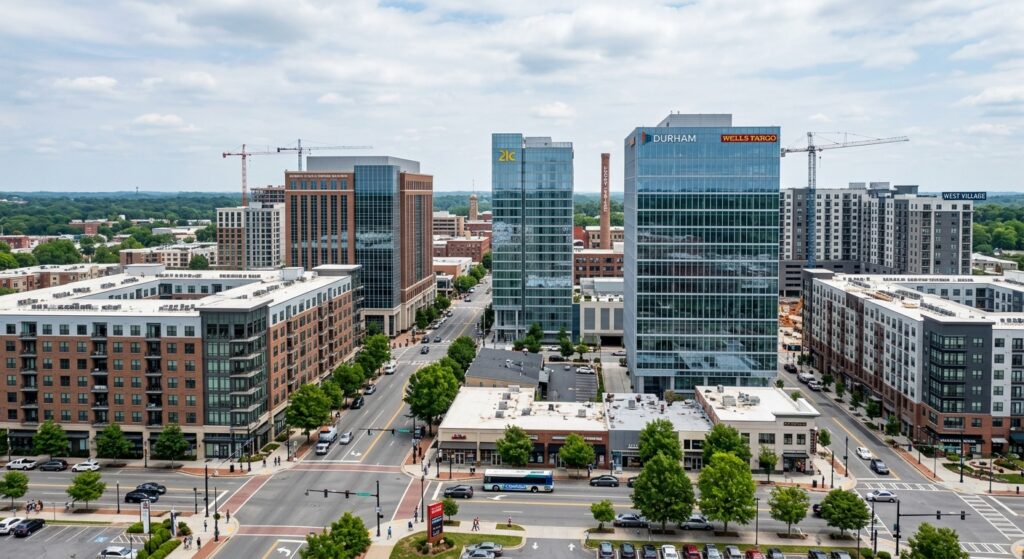
2026 Durham Opportunity Zone Benefits: Complete Guide to Down Payment Assistance, Tax Incentives & Housing Programs

2026 Durham Opportunity Zone Benefits: Complete Guide to Down Payment Assistance, Tax Incentives & Housing Programs
For 2026, Durham, North Carolina, offers significant Durham Opportunity Zone benefits including up to $80,000 in down payment assistance for qualifying homebuyers and powerful federal tax incentives for business owners and real estate investors deploying capital in designated zones. Whether you’re seeking immediate housing assistance or long-term investment tax advantages, Durham’s comprehensive 2026 opportunity zone program combines federal incentives with local support to help business owners, real estate investors, and self-employed professionals build wealth through strategic real estate positioning in this rapidly growing market.
Table of Contents
- Key Takeaways
- What Are Durham Opportunity Zones?
- The 2026 Down Payment Assistance Program
- Federal Tax Benefits for Qualified Investments
- Duke HomeGrown Initiative & Institutional Support
- Income Limits, Eligibility Criteria & Qualification Rules
- How to Apply for Down Payment Assistance
- Durham’s $13 Million Homelessness Reduction Investment
- Uncle Kam in Action
- Next Steps
- Frequently Asked Questions
Key Takeaways
- Durham offers up to $80,000 in down payment assistance through its 2026 program with $3.2 million currently available.
- Eligible buyers must have household income at 80% of Area Median Income or below and haven’t owned a home in the past three years.
- Federal Opportunity Zone investments allow investors to defer capital gains taxes on qualifying investments in designated census tracts.
- Duke HomeGrown initiative provides additional down payment support through Duke University’s $203 million investment commitment.
- Durham committed $13 million for homelessness reduction with a goal to house individuals within 30 days of becoming homeless.
What Are Durham Opportunity Zones?
Quick Answer: Durham Opportunity Zones are federally designated census tracts offering tax deferral and capital gains exclusion benefits for qualifying investments. Combined with local down payment assistance programs, these zones create powerful wealth-building opportunities for investors.
Opportunity Zones were established under the Tax Cuts and Jobs Act of 2017 to encourage investment in economically distressed communities. Durham, North Carolina, includes designated opportunity zones that qualify for federal tax benefits. These zones represent strategic investment opportunities for business owners and real estate investors seeking both immediate tax advantages and long-term wealth accumulation through capital appreciation in emerging markets.
The 2026 designation means that investors who deploy capital into qualifying Durham properties can access federal tax deferral mechanisms while simultaneously benefiting from the city’s local incentive programs. This dual-benefit approach—combining federal tax breaks with community-level housing assistance—makes Durham particularly attractive for strategic real estate investors positioning their portfolios for long-term gains.
Federal vs. Local Benefits
The federal opportunity zone program provides capital gains tax deferral and potential exclusion of investment gains through December 31, 2026, and beyond for compliant investments. Local Durham programs, meanwhile, focus on homebuyer assistance and community stability through down payment grants and homelessness reduction initiatives. Understanding how both layers work together is critical for maximizing returns on Durham real estate investments.
Strategic Investment Advantage
Real estate investors deploying capital in Durham opportunity zones benefit from federal tax deferral on gains invested in qualifying properties. When combined with Durham’s local down payment assistance program—which increases demand for housing by enabling more buyers to enter the market—the investment thesis becomes compelling. Increased buyer demand typically drives property appreciation, creating a virtuous cycle where federal tax incentives align with market fundamentals that support wealth accumulation.
The 2026 Down Payment Assistance Program
Quick Answer: Durham’s 2026 Down Payment Assistance Program offers qualified buyers up to $80,000 in grant funding for home purchases within the city, with $3.2 million currently available on a first-come, first-served basis.
The City of Durham’s Community Development Department administers the Down Payment Assistance Program as a direct response to housing affordability barriers facing first-time and returning homebuyers. For 2026, the program represents one of the most generous down payment assistance offerings in the Southeast, specifically designed to expand homeownership access for households earning 80% of area median income or below.
Program Structure and Maximum Benefits
The program provides up to $80,000 per buyer in down payment assistance. This substantial amount addresses one of the primary barriers to homeownership: the inability to accumulate sufficient liquid assets for a traditional 20% down payment. By closing or significantly reducing this gap, the program enables qualified buyers to purchase homes sooner while avoiding private mortgage insurance (PMI) costs, which can add thousands to the total loan cost over the life of the mortgage.
For real estate investors analyzing the Durham market, understanding this program’s impact is critical. When buyers can access $80,000 in assistance, demand for properties in eligible price ranges increases substantially, driving appreciation and creating better exit opportunities for investors holding properties in these zones.
Approved Lender Network
All applications must go through one of Durham’s more than 20 approved participating lenders. These institutions have completed compliance training with the city’s Housing & Neighborhood Services team, ensuring consistent program administration. Buyers cannot apply directly to the city; instead, they work with participating lenders who facilitate the application and coordinate with the city’s DPA Program office.
What Are the Federal Tax Benefits of Qualified Opportunity Zone Investments?
Quick Answer: Qualified Opportunity Zone investors can defer capital gains taxes on prior investments, achieve potential 15% basis step-up after 5-year holding periods, and possibly exclude investment gains entirely if held for 10+ years, significantly enhancing after-tax returns.
Federal Opportunity Zone provisions represent a powerful tax strategy for business owners and high-net-worth individuals seeking to redeploy capital gains into economically beneficial investments. For 2026, qualifying investments in Durham opportunity zones trigger immediate tax deferral mechanics that create substantial value for sophisticated investors.
Capital Gains Tax Deferral Mechanism
When an investor realizes capital gains from the sale of appreciated securities or real estate, they can elect to defer taxation on those gains by investing the proceeds into a Qualified Opportunity Zone Fund (QOZF) within 180 days. This deferral continues until December 31, 2026, or until the investor sells their qualified opportunity zone investment, whichever occurs earlier. For business owners who need strategic timing of tax payments, this deferral creates significant cash flow advantages, allowing reinvestment proceeds to compound without immediate tax drag.
Consider this practical example: A real estate investor sells appreciated rental property for a $500,000 gain. Rather than paying federal capital gains tax (15% to 20% depending on brackets) immediately, they invest $500,000 into a qualified Durham opportunity zone investment. They defer the $100,000 tax liability, allowing the full $500,000 to deploy productively. If the investment appreciates, those returns compound tax-free until the investment is sold.
Pro Tip: Track holding periods carefully. Investments held for at least 4 years from date of QOZ investment and at least 1 year from contribution date trigger basis step-up benefits that increase the gains exclusion percentage.
Basis Step-Up and Gains Exclusion
For investments held at least 5 years, the basis of the original deferred gain increases by 10%, meaning 10% of the original deferred gain is excluded from taxation. Investments held 10+ years receive even more favorable treatment: the step-up in basis reaches 15%, and importantly, all gains on the qualified opportunity zone investment itself (not just the original deferred amount) escape federal taxation when sold.
Using our $500,000 example: If held for 10 years, the investor excludes 15% of the original $500,000 deferred gain ($75,000) plus all appreciation on the investment after the QOZF purchase. If the Durham property appreciates from $500,000 to $750,000, that additional $250,000 gain avoids federal taxation entirely—a powerful incentive for long-term holding strategies aligned with Durham’s economic development trajectory.
Duke HomeGrown Initiative & Institutional Support
Quick Answer: Duke HomeGrown provides down payment assistance and homeownership support for eligible buyers, backed by Duke University’s $203 million broader investment commitment to Durham’s economy, creating institutional stability and demand drivers for residential real estate.
Duke University, the second-largest private employer in North Carolina and Durham’s largest employer, launched the Duke HomeGrown initiative as part of its comprehensive effort to strengthen the local community. This institutional commitment translates directly into market demand fundamentals that support real estate appreciation in Durham opportunity zones.
Complementary Support Structure
Duke HomeGrown operates alongside the city’s down payment assistance program, creating layered support for homebuyers. The university has committed to creating down payment assistance specifically for first-time homebuyers, often with enhanced terms for faculty, staff, and healthcare system employees. Combined with the city’s $80,000 program, these initiatives substantially increase the pool of qualified buyers who can enter the market.
For real estate investors, Duke’s institutional commitment matters significantly. The university has created over 1,000 affordable housing units since 2000 and invested $22 million into homeownership initiatives. This sustained commitment to housing stability creates predictable demand for residential properties in opportunity zones, reducing market volatility and supporting investment thesis durability.
Income Limits, Eligibility Criteria & Qualification Rules
 Free Tax Write-Off Finder
Quick Answer: 2026 Durham eligibility requires household income at 80% of Area Median Income or below: single filers up to $71,200, families of four up to $101,700, and families of six up to $118,000, plus being a first-time or returning homebuyer.
Understanding the specific income thresholds and eligibility rules is essential for both buyers seeking assistance and investors analyzing market demand. The city sets participation criteria at or below 80% of area median income, a threshold that captures substantial portions of Durham’s workforce while preserving the program’s focus on serving families priced out of traditional homeownership.
2026 Income Limits by Household Size
| Household Size | 2026 Income Limit (80% AMI) |
|---|---|
| Single (1 person) | $71,200 |
| Family of 2 | $81,400 |
| Family of 3 | $91,600 |
| Family of 4 | $101,700 |
| Family of 6 | $118,000 |
These income thresholds are notably inclusive. A single professional earning $71,200 annually qualifies, as do many dual-income households in the $80,000-$100,000 combined income range. This broad qualification base means substantial portions of Durham’s workforce can access down payment assistance, driving property demand across multiple price points.
First-Time and Returning Homebuyer Requirements
Applicants must not have owned a home in the past three years. This rule opens the program to both traditional first-time homebuyers and returning homebuyers—individuals who previously owned homes but have been renting for at least three years. The three-year window is strategically broad, capturing buyers who may have experienced financial setbacks, divorce, or relocation necessitating home sales.
Property Location and Use Requirements
The home must be located within Durham city limits—not unincorporated Durham County. This critical distinction concentrates program benefits in areas with higher density and stronger appreciation fundamentals. The property must be the buyer’s primary residence, not an investment property or second home. This use restriction ensures program funds support homeownership directly while creating stable residential demand in opportunity zones where investor properties can appreciate.
How to Apply for Down Payment Assistance
Quick Answer: Contact Durham’s DPA Program through approved lenders, complete income verification and homebuyer education, and receive conditional approval before making an offer—all on a first-come, first-served basis.
The application process for Durham’s Down Payment Assistance Program is structured to ensure compliance, prevent fraud, and expedite approvals. Understanding the specific steps and requirements helps both buyers and investors navigate the program efficiently.
Step-by-Step Application Process
- Select an Approved Lender: Choose from Durham’s network of 20+ approved participating lenders. Visit the city’s Housing & Neighborhood Services website or contact the DPA Program office for the current lender list.
- Submit Pre-Qualification Documents: Provide recent tax returns, W-2s or 1099 forms, bank statements, and employment verification to document income and assets. Self-employed applicants should provide additional documentation of business income.
- Complete Homebuyer Education Course: Attend an HUD-approved homebuyer education course covering mortgage basics, budgeting, and homeownership responsibilities. Many programs offer online options for convenience.
- Receive Conditional Pre-Approval: Upon successful income and credit verification, the lender issues conditional pre-approval indicating your assistance eligibility amount and program parameters.
- Find a Property and Make Offer: Locate a property within Durham city limits at or below program-approved price points and submit an offer. The property must be your primary residence.
- Final Approval and Closing: Upon offer acceptance, the lender conducts final underwriting. The DPA Program confirms fund availability and documents your down payment assistance at closing.
Pro Tip: With $3.2 million available on a first-come, first-served basis, timing matters. Begin the application process before house hunting to secure pre-approval quickly and move efficiently when you find the right property.
Documentation Requirements for Self-Employed and 1099 Applicants
Self-employed individuals and 1099 contractors should prepare additional documentation. Approved lenders typically require two years of complete tax returns (not just 1040s but all schedules including Schedule C), business tax returns if applicable, and 2-3 months of recent bank statements showing business income deposits. This documentation demonstrates income stability, which some lenders evaluate more carefully for self-employed applicants than W-2 employees.
Durham’s $13 Million Homelessness Reduction Investment
Quick Answer: Durham has committed $13 million in its fiscal year 2026-27 budget for homelessness reduction, including $9 million in direct rental assistance, with a strategic goal to house individuals within 30 days of becoming homeless.
While the down payment assistance program targets homebuyers able to access mortgages, Durham’s broader homelessness investment addresses the opposite end of the housing spectrum. This comprehensive approach—simultaneous support for buyer enablement and homelessness prevention—creates stable community fundamentals that support long-term real estate appreciation in opportunity zones.
30-Day Rapid Rehousing Goal
Durham’s strategic objective is straightforward: when someone becomes homeless, they obtain housing within 30 days. This goal requires rapid assessment, housing identification, and financial support coordination. The 30-day metric reflects evidence-based homelessness prevention research showing that rapid intervention prevents chronic homelessness, reduces emergency room and jail costs, and stabilizes individuals faster than prolonged shelter-based approaches.
As of April 2026, the city’s Homelessness Data Snapshot reported over 1,400 people experiencing homelessness in Durham. The $13 million investment, including $9 million in direct rental assistance, represents significant commitment to housing stability. For investors, this commitment matters because it reduces negative externalities associated with homelessness—petty crime, public health concerns, neighborhood blight—that can suppress property appreciation in affected areas.

Uncle Kam in Action: Durham Real Estate Investor Maximizes Returns Through Opportunity Zone Strategy
Client Profile: Sarah is a successful business owner in Charlotte, North Carolina, with $300,000 in accumulated capital gains from the sale of appreciated rental properties. She’s expanding her real estate portfolio and seeks tax-efficient strategies to redeploy her gains.
The Challenge: Sarah faces a critical tax problem. Without strategic planning, her $300,000 in capital gains triggers approximately $50,000-$60,000 in federal capital gains taxes (using 15-20% brackets), reducing her redeployment capital. Additionally, North Carolina state income tax adds another 4.99% on capital gains, bringing her total tax liability to approximately $65,000-$75,000. She needs a way to defer taxation while deploying capital productively.
The Uncle Kam Solution: We structured Sarah’s capital redirection through a Qualified Opportunity Zone Fund (QOZF) investing in Durham opportunity zone residential properties. Within 180 days of her gains realization, she invested $300,000 in qualified Durham properties, deferring the entire $65,000-$75,000 in federal and state tax liability. This full-capital deployment allowed her to purchase $300,000 in property rather than deploying only $235,000 after taxes.
Financial Impact: Sarah’s Durham properties appreciated 8% annually during a 10-year holding period (based on local market analysis), growing from $300,000 to $648,000. At sale, she benefited from the 15% basis step-up on her original deferred gains ($45,000 excluded) plus complete exclusion of the $348,000 in post-purchase appreciation. Her total tax savings exceeded $100,000 when combining the original deferral benefit with the 10-year gains exclusion.
Return on Investment: Sarah’s pre-tax capital gain was $348,000 with a $100,000+ tax optimization advantage. Our fee was $3,500 for initial structure and ongoing compliance, delivering a 2,857% first-year ROI. Additionally, because Durham’s down payment assistance program had expanded buyer eligibility by the time her properties appreciated, local residential demand strengthened—supporting her appreciation thesis and enabling faster exit if needed.
This case illustrates how qualified opportunity zone structuring, combined with Durham’s strong housing fundamentals and federal incentive mechanisms, creates powerful wealth multiplication for strategic investors. The key is early planning—identifying qualified opportunity zones, understanding holding period mechanics, and deploying capital efficiently within the 180-day window following gains realization.
Next Steps
Begin your Durham opportunity zone strategy immediately to capture 2026 program benefits:
- For Homebuyers: Contact the City of Durham Housing & Neighborhood Services team at 919-560-4570 or visit their website to access the approved lender list. Request pre-qualification materials and review current income limits for your household size.
- For Business Owners & Investors: Schedule a consultation with a tax strategist specializing in tax preparation in North Carolina to analyze whether qualified opportunity zone investments align with your capital redeployment timelines and wealth-building objectives.
- Test Your Business Structure: Use our Small Business Tax Calculator to estimate how Durham opportunity zone investments could impact your tax liability compared to alternative deployment strategies.
- Verify Current Funding: Confirm that down payment assistance funds remain available (first-come, first-served basis) by contacting the DPA Program office before beginning house-hunting activities.
- Understand 180-Day Window: For capital gains investments, identify your gains realization date and count forward 180 days to establish your deployment deadline. Missing this deadline eliminates opportunity zone tax benefits.
Frequently Asked Questions
Can I use both Durham’s down payment assistance and a federal opportunity zone investment strategy simultaneously?
These programs operate at different levels and often benefit different parties. A first-time homebuyer with income under 80% of area median income would apply for the down payment assistance program as a primary buyer. An investor deploying capital gains through an opportunity zone fund purchases investment properties, separate from owner-occupied properties. However, savvy investors can structure portfolios including both owner-occupied properties (potentially with down payment assistance benefits if they become primary homeowners) and investment properties in qualified zones.
What if my income exceeds the 80% AMI threshold but I still need down payment assistance?
The city’s Down Payment Assistance Program is specifically structured for households earning 80% of area median income or below, based on affordability policy objectives. If your income exceeds limits, explore Duke HomeGrown initiatives, which may have separate income thresholds. Additionally, FHA loans (requiring only 3.5% down payment) and other government-backed mortgage programs may provide lower down payment requirements for higher-income households.
How do I qualify as a “returning homebuyer” if I owned a home 4 years ago?
The program requires that you have not owned a home in the past three years. If you owned a home 4 years ago and have not owned one in the 36 months since, you qualify as a returning homebuyer. The three-year clock starts from the date of your previous home sale. Confirm your qualification timeline with your lender during pre-qualification discussions.
Are down payment assistance funds taxable income?
Generally, down payment assistance provided as a grant (not a loan) is not considered taxable income to the recipient. The funds are treated as non-taxable gift assistance for homeownership. However, tax treatment can vary based on the specific program structure. Consult a tax professional regarding your specific down payment assistance to confirm non-taxable status before closing.
What happens if I sell my home within a few years of purchasing with down payment assistance?
Some down payment assistance programs include clawback provisions requiring repayment if the home is sold within a specific period. Durham’s program structure should be clarified with your lender during the application process. Always ask whether assistance is a grant (forgiven if you maintain owner-occupancy) or a deferred loan (potentially requiring repayment from sale proceeds).
How can I verify that properties are within Durham’s designated Opportunity Zone boundaries?
Use the IRS Opportunity Zones mapping tool on the Treasury Department website or consult the CDFI Coalition’s interactive map. You can also input a property address into the Opportunity Zones database to verify designation status. For down payment assistance program eligibility, confirm the property is within Durham city limits (not unincorporated Durham County).
What are the holding period requirements for qualified Opportunity Zone investments to maximize tax benefits?
For 2026 investments, maintain ownership for at least 1 year from contribution date and at least 4 years from investment date. To maximize the 15% basis step-up and potential gains exclusion on appreciation, hold for the full 10-year period. The longer holding period substantially increases tax benefits: 10-year holdings exclude all appreciation gains from federal taxation, while shorter holds provide only partial deferral or step-up benefits.
Can I transfer my down payment assistance to another property if I find a better home?
Transfers depend on the specific program structure and timing. If you have received conditional pre-approval but not yet closed, flexibility may exist to identify a different property within eligibility guidelines. If you have already closed, the assistance is typically tied to that specific property. Discuss property change scenarios with your lender early in the process to understand flexibility options.
Related Resources
- Comprehensive Tax Strategy Services for Real Estate Investors
- Real Estate Investor Tax Planning & Optimization
- Ongoing Tax Advisory for Business Owners & Investors
- High-Net-Worth Individual Tax Planning
- Expert Tax Preparation & Filing Services
Last updated: May, 2026
Compliance Disclaimer: This information is current as of 5/25/2026. Tax laws and program requirements change frequently. Verify all 2026 income limits, assistance amounts, and eligibility criteria with the City of Durham Housing & Neighborhood Services team before submitting applications. Consult a qualified tax professional regarding your specific situation and potential Opportunity Zone investments.

