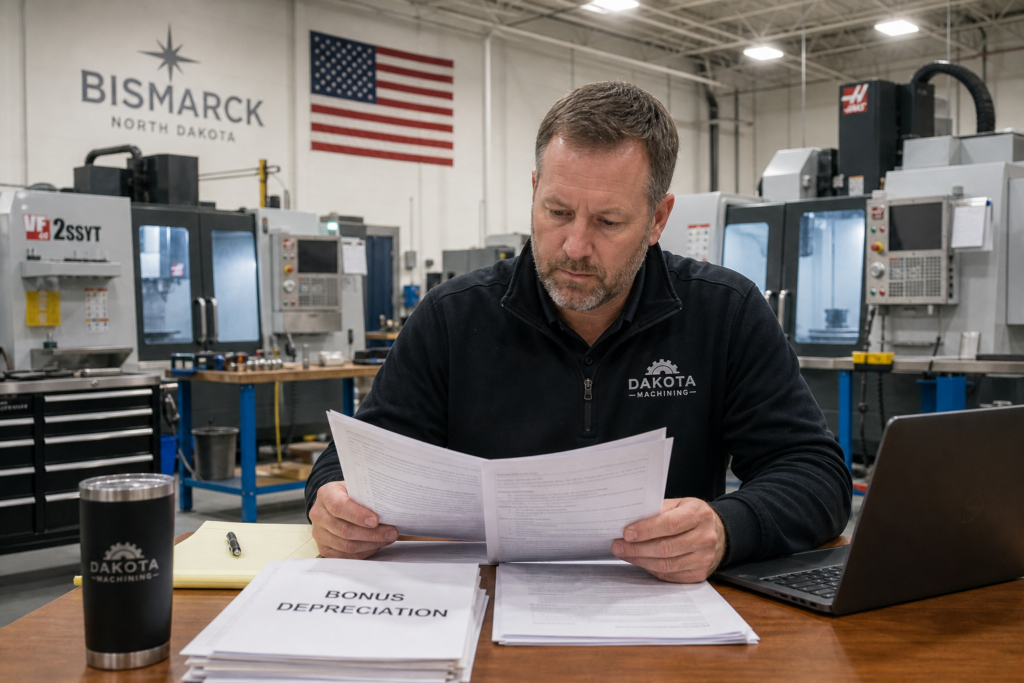
2026 Bismarck Bonus Depreciation: How Local Businesses Fully Expense Equipment
For the 2026 tax year, Bismarck bonus depreciation planning lets local businesses fully deduct qualifying equipment in the year they place it in service. Thanks to the One Big Beautiful Bill Act (OBBBA), 100% bonus depreciation is now permanent. As a result, Bismarck bonus depreciation gives manufacturers, farmers, and investors a powerful cash-flow advantage. This guide breaks down the rules, examples, and smart strategies for 2026.
Table of Contents
- Key Takeaways
- What Is Bismarck Bonus Depreciation in 2026?
- Who Qualifies for 100% Bonus Depreciation in 2026?
- How Do You Calculate Bonus Depreciation in 2026?
- How Does It Help Bismarck Manufacturers and Farmers?
- How Does Bonus Depreciation Compare to Section 179?
- What Are the Risks and Common Mistakes?
- Uncle Kam in Action
- Next Steps
- Related Resources
- Frequently Asked Questions
Key Takeaways
- The OBBBA made 100% bonus depreciation permanent for property acquired after January 19, 2025.
- Bismarck businesses can fully deduct qualifying equipment in the year it is placed in service.
- For 2026, the Section 179 limit rose to $2.5 million with a higher phaseout threshold.
- Manufacturers, farmers, and real estate investors gain the biggest cash-flow benefits.
- Placed-in-service timing and documentation determine your 2026 deduction.
What Is Bismarck Bonus Depreciation in 2026?
Quick Answer: Bismarck bonus depreciation is the local application of federal 100% first-year expensing. It lets qualifying North Dakota businesses fully deduct equipment costs in 2026.
Bonus depreciation is a federal tax provision under Section 168(k) of the tax code. It allows businesses to deduct a large share of an asset’s cost immediately. Traditionally, businesses depreciated equipment slowly over five, seven, or more years. However, bonus depreciation front-loads that write-off into year one. Therefore, Bismarck bonus depreciation simply means how ND business owners apply these federal rules locally.
The rules changed dramatically in 2025. The One Big Beautiful Bill Act, signed into law on July 4, 2025, made 100% bonus depreciation permanent. Consequently, Bismarck companies no longer face the old phase-down schedule. For qualifying property acquired after January 19, 2025, the full deduction applies. Uncle Kam helps Bismarck business owners capture these savings correctly.
How the OBBBA Changed the Rules
Under the earlier Tax Cuts and Jobs Act, bonus depreciation was phasing out. It dropped to 40% for many 2025 acquisitions under prior law. Nevertheless, the OBBBA reversed this decline. The IRS newsroom and Treasury issued guidance confirming the permanent 100% rate. Moreover, IRS Notice 2026-11 provides interim rules on how Section 168(k) now works.
Pro Tip: The acquisition date matters. Property acquired before January 20, 2025, may still follow the old phase-down schedule.
Why This Matters for North Dakota
North Dakota’s economy leans heavily on capital-intensive sectors. Agriculture, energy, construction, and manufacturing all buy expensive equipment. As a result, permanent 100% expensing has an outsized local impact. Farmers upgrading combines and manufacturers adding machinery both benefit. Furthermore, a solid proactive tax strategy plan turns these purchases into major savings. Working with a Tax Preparation service in North Dakota keeps you compliant while maximizing deductions.
Who Qualifies for 100% Bonus Depreciation in 2026?
Quick Answer: Most businesses qualify. Property must be depreciable, have a recovery period of 20 years or less, and be placed in service in 2026.
Bonus depreciation is broadly available. Sole proprietors, LLCs, S corporations, partnerships, and C corporations all qualify. In addition, there is no income limit to use bonus depreciation. This differs from some other incentives. Therefore, Bismarck bonus depreciation reaches nearly every business type in the region.
What Property Qualifies?
Qualifying property generally includes tangible assets with short recovery periods. The IRS Publication 946 details these depreciation rules. Common examples include:
- Machinery, tools, and manufacturing equipment
- Farm equipment like tractors, combines, and seeders
- Business vehicles over 6,000 pounds gross weight
- Computers, software, and office furniture
- Qualified improvement property inside commercial buildings
The Placed-in-Service Rule
Timing is everything. The asset must be placed in service during the tax year. “Placed in service” means ready and available for use, not just purchased. For example, a combine delivered in December 2026 but not usable until spring may fail the test. Consequently, documentation of the in-service date protects your deduction. Real estate investors should review our real estate investor tax strategies for property-specific timing.
Pro Tip: Used equipment can qualify too. The property must simply be new to your business.
How Do You Calculate Bonus Depreciation in 2026?
Quick Answer: Multiply the asset’s cost basis by 100%. For 2026, the full cost is deductible in year one for qualifying property.
The math is refreshingly simple in 2026. Because the rate is 100%, your entire qualifying cost becomes a first-year deduction. Compare this to standard MACRS depreciation. Under MACRS, that same asset would deduct over five to seven years. Therefore, the cash-flow difference is substantial.
A Bismarck Equipment Example
Imagine a Bismarck manufacturer buys a $500,000 CNC machine in 2026. Under 100% bonus depreciation, the full $500,000 is deductible immediately. If the company sits in the 24% bracket, that deduction saves roughly $120,000 in federal tax. Meanwhile, standard depreciation would spread the benefit across many years. As a result, bonus depreciation frees up cash for hiring and expansion now.
Estimating your own savings helps you plan smarter. Use our Small Business Tax Calculator for San Francisco to model 2026 outcomes before you buy.
MACRS vs Bonus Depreciation Comparison
| Method | Year 1 Deduction ($500K Asset) | Full Write-Off Timeline |
|---|---|---|
| 100% Bonus Depreciation (2026) | $500,000 | 1 year |
| Standard MACRS (7-year) | Approx. $71,000 | 7+ years |
Did You Know? You can elect out of bonus depreciation. Sometimes spreading deductions saves more over multiple years.
How Does It Help Bismarck Manufacturers and Farmers?
Quick Answer: Capital-intensive businesses gain the most. Full expensing improves cash flow, lowers tax bills, and funds growth.
North Dakota businesses invest heavily in machinery. Manufacturers buy production lines, and farmers replace aging equipment yearly. Consequently, permanent 100% expensing rewards these purchases. Industry groups such as the National Association of Manufacturers have long argued that full expensing protects jobs and wages.
Agriculture and Farm Equipment
Agriculture drives a large share of North Dakota’s economy. Each summer, the North Dakota State Fair showcases modern farm technology. However, that equipment costs hundreds of thousands of dollars. Bonus depreciation lets a farmer buy a $400,000 precision seeder and deduct it fully in 2026. Therefore, farmers can adopt new technology without waiting years for tax relief. Self-employed producers should explore our self-employed tax planning resources.
Manufacturing and Energy
Manufacturers and energy firms also win big. A Bismarck fabrication shop can fully expense welding robots and CNC machines. Meanwhile, energy service companies deduct trucks and field equipment immediately. As a result, capital reinvestment stays strong across the region. For structuring these purchases wisely, review entity structuring options that maximize deductions.
Pro Tip: The OBBBA also added Qualified Production Property rules for certain manufacturing facilities. Ask your advisor how these apply.
How Does Bonus Depreciation Compare to Section 179?
 Free Tax Write-Off Finder
Quick Answer: Both allow immediate expensing. Section 179 has dollar caps and income limits, while bonus depreciation does not.
Section 179 and bonus depreciation often work together. Both let you write off assets immediately. However, they follow different rules. For 2026, the Section 179 expensing limit rose to $2.5 million under the OBBBA. Additionally, the phaseout threshold increased significantly. Therefore, most Bismarck businesses can combine both tools.
Key Differences to Understand
| Feature | Section 179 (2026) | Bonus Depreciation (2026) |
|---|---|---|
| Deduction Rate | Up to $2.5 million cap | 100%, no dollar cap |
| Income Limit | Cannot create a loss | Can create a loss |
| Flexibility | Choose asset by asset | Applies by asset class |
How to Coordinate Both
Smart planners layer these deductions. Typically, you apply Section 179 first, then bonus depreciation on the remaining basis. Because bonus depreciation can create a loss, it offers more flexibility. Nevertheless, coordination requires careful modeling. A dedicated tax advisor relationship ensures you pick the best mix for 2026.
What Are the Risks and Common Mistakes?
Quick Answer: Common risks include state conformity gaps, poor documentation, and recapture on early asset sales.
Bonus depreciation is powerful, but it carries risks. First, not every state conforms to federal rules. Second, poor records can trigger IRS challenges. Third, selling an asset early may cause depreciation recapture. Therefore, understanding these pitfalls protects your savings.
State Conformity in North Dakota
Federal and state rules do not always match. The North Dakota Office of State Tax Commissioner sets state depreciation policy. Fortunately, North Dakota generally follows federal depreciation closely. However, you should always confirm current conformity before filing. Consequently, professional review prevents costly surprises.
Documentation and Recapture
Good records win audits. Keep invoices, delivery dates, and in-service proof for every asset. Moreover, watch for recapture if you sell equipment soon after buying it. Recapture can convert past deductions into taxable income. As a result, disciplined tax filing and documentation matters as much as the deduction itself. Bismarck taxpayers benefit from working with a local Bismarck tax preparation team that tracks these details year-round.
Pro Tip: This article is educational, not tax advice. Always confirm your situation with a qualified professional.

Uncle Kam in Action: A Bismarck Manufacturer Cuts Its Tax Bill
Client Snapshot: Meet a mid-size metal fabrication company based near Bismarck. The owners run an S corporation with 22 employees.
Financial Profile: The business generated roughly $3.2 million in annual revenue for 2026. Net profit hovered near $600,000 before planning.
The Challenge: The owners wanted to modernize their shop floor. They planned to buy $850,000 of new machinery and automation. However, they feared a large tax bill would drain cash reserves. Additionally, they were unsure how bonus depreciation interacted with their S corp income.
The Uncle Kam Solution: Our team built a full equipment-timing plan. First, we confirmed each asset qualified under the permanent 100% bonus depreciation rules. Next, we coordinated Section 179 with bonus depreciation for maximum flexibility. Then, we scheduled placed-in-service dates before year-end. Finally, we modeled the pass-through impact on the owners’ personal returns. Consequently, the entire $850,000 became deductible in 2026.
The Results: The full deduction slashed the company’s taxable income dramatically. Combined with pass-through savings, the owners cut their federal tax bill by approximately $178,000 for 2026.
- Tax Savings: Roughly $178,000 in the first year
- Investment: $12,000 in Uncle Kam planning fees
- Return on Investment: About 14x in year one
This outcome freed cash for two new hires. See more real client results and case studies for similar wins across industries.
Next Steps
Ready to capture your 2026 deductions? Take these actions before year-end. Furthermore, planning early gives you the most flexibility. Bismarck taxpayers can start with a local North Dakota tax preparation partner who understands these rules.
- List all planned equipment purchases through 2027.
- Confirm each asset qualifies and verify in-service dates.
- Model bonus depreciation with our proactive tax strategy team.
- Coordinate Section 179 and bonus depreciation for the best mix.
- Keep detailed records to support every deduction.
Related Resources
- Proactive Tax Strategy Services
- Tax Planning for Business Owners
- Strategies for Real Estate Investors
- High-Net-Worth Tax Planning
- Free Tax Calculators
Frequently Asked Questions
Is 100% bonus depreciation still available in 2026?
Yes. The OBBBA made 100% bonus depreciation permanent. It applies to qualifying property acquired after January 19, 2025. Therefore, Bismarck businesses can use it fully in 2026.
Can small businesses use both Section 179 and bonus depreciation?
Absolutely. Most businesses apply Section 179 first, then bonus depreciation. Because bonus depreciation can create a loss, it adds flexibility. However, coordination requires careful planning.
What types of equipment qualify for Bismarck bonus depreciation?
Most tangible property with a 20-year or shorter recovery period qualifies. Examples include machinery, farm equipment, computers, and qualified improvement property. Both new and used assets can qualify.
How does bonus depreciation affect North Dakota state taxes?
North Dakota generally conforms closely to federal depreciation rules. Nevertheless, you should verify current state conformity each year. The North Dakota Office of State Tax Commissioner provides guidance.
When should I place equipment in service to claim the 2026 deduction?
The asset must be ready and available for use by December 31, 2026. Delivery alone does not count. Consequently, plan installation and setup before year-end.
Can I elect out of bonus depreciation if it is not helpful?
Yes. You may elect out by asset class. Sometimes spreading deductions across years saves more tax. Therefore, model both options before deciding.
This information is current as of 7/27/2026. Tax laws change frequently. Verify updates with the IRS or the North Dakota Office of State Tax Commissioner if reading this later.
Last updated: July, 2026

