
Tax Preparation Services in Stamford, Connecticut
Stamford Tax Preparation Services
Strategic, Accurate Tax Support for Stamford’s Finance Professionals, NYC Commuters, Executives, Contractors & Investors
Stamford is one of the highest-income, most financially sophisticated markets in Connecticut — home to corporate headquarters, finance & consulting firms, NYC commuters, private equity professionals, high-income tech employees, real estate investors, and business owners. Because of this, the typical Stamford resident faces tax complexity that requires far more than basic filing.
- NYC commuter income
- High-income W-2 with bonuses
- Stock compensation (RSUs, ESPP, ISO)
- K-1 partnership income (common in finance)
- Consulting & contractor 1099 income
- Multi-state allocation (CT ⇄ NY)
- STR/LTR rental properties
- Capital gains from investments or home sales
- Multi-income household strategy
- Estimated taxes
- Retirement & pension planning
- Financial analysts, bankers & private equity
- Consultants & legal professionals
- NYC commuters
- Hedge fund & asset management employees
- Tech workers
- Real estate investors
- Contractors & small business owners
- Healthcare professionals
- High-income families
In Stamford, tax optimization isn’t optional — it’s mandatory.
Why Stamford Residents Choose Our Tax Preparation Firm
- Deep expertise in finance, compensation & executive tax structures
- CT/NY commuter tax strategy
- Stock compensation & capital gains optimization
- Rental depreciation for Stamford & Fairfield County properties
- Multi-income household maximization
- IRS notices, audits & amended returns
- Full bookkeeping cleanup for business owners
- Transparent flat-rate pricing
- MERNA™ long-term tax planning included

Tax Preparation Services for Individuals in Stamford
- Finance & banking professionals
- NYC commuters
- Executives & managers
- Consultants & advisors
- High-income dual-earner families
- Real estate investors
- Remote tech workers
- Healthcare professionals
- K-1 partners
- Retirees & veterans
- Federal + Connecticut filing
- CT/NY commuter income optimization
- High-income planning & deduction strategy
- STR/LTR rental depreciation
- Stock compensation (RSU/ESPP/ISO)
- Capital gains optimization
- K-1 partnership reconciliation
- IRS letters & amended returns
- Pension + SSA planning
- Estimated taxes
- MERNA™ long-term planning
Stamford residents benefit most from commuter strategy + stock compensation precision + rental depreciation + high-income planning.

Tax Preparation Services for Stamford Business Owners
- Professional services (legal, finance, consulting)
- Real estate LLCs & investors
- Tech & IT firms
- Contractors & self-employed specialists
- Restaurants & retail
- Healthcare practices
- E-commerce companies
- Multi-LLC entrepreneurs
- S-Corp, LLC, C-Corp & partnership filings
- Full bookkeeping cleanup
- Payroll setup & compliance
- Multi-entity bookkeeping
- Depreciation schedules
- Quarterly forecasting
- Multi-state compliance (CT, NY, NJ)
- Audit-ready financial statements
- MERNA™ entity optimization
We help Stamford business owners stay compliant, efficient, and tax-optimized.
What Sets Our Stamford Tax Preparers Apart
- Stock compensation (biggest source of overpayment)
- CT ⇄ NY commuting rules
- Multi-income household complexities
- K-1 partnership income
- Capital gains from equity compensation
- STR/LTR depreciation
- Remote worker payroll errors
- High-income deduction limitations
- Estimated tax burdens
- Pension + SSA timing
- Fairfield County’s high-income environment
- NYC commuter double-taxation traps
- Stock comp & cost-basis corrections
- Rental depreciation in high-value markets
- K-1 timing & allocation
- Executive compensation plans
- High-income MERNA™ frameworks
We optimize the ENTIRE financial ecosystem, not just the return.

Areas We Serve Across Stamford & Fairfield County
Downtown Stamford
Harbor Point
North Stamford
Shippan
Glenbrook
Cove
Springdale
Ridgeway
Davenport
South End
Old Greenwich (adjacent)
Darien (adjacent)
Norwalk (adjacent)
What Stamford Clients Say

Case Study — Stamford, CT
- CT/NY allocation wrong
- RSU cost basis incorrect
- Rental depreciation missing
- High-income bracket issues
- Estimated taxes mismanaged
- Corrected CT/NY commuter sourcing
- Fixed RSU basis + capital gains
- Built full depreciation schedule
- Adjusted withholding + estimated taxes
- Applied MERNA™ multi-year plan
Result:
$8,940 saved in the first year, from commuter optimization + stock correction + depreciation.
Model Your Taxes by State- Before You File

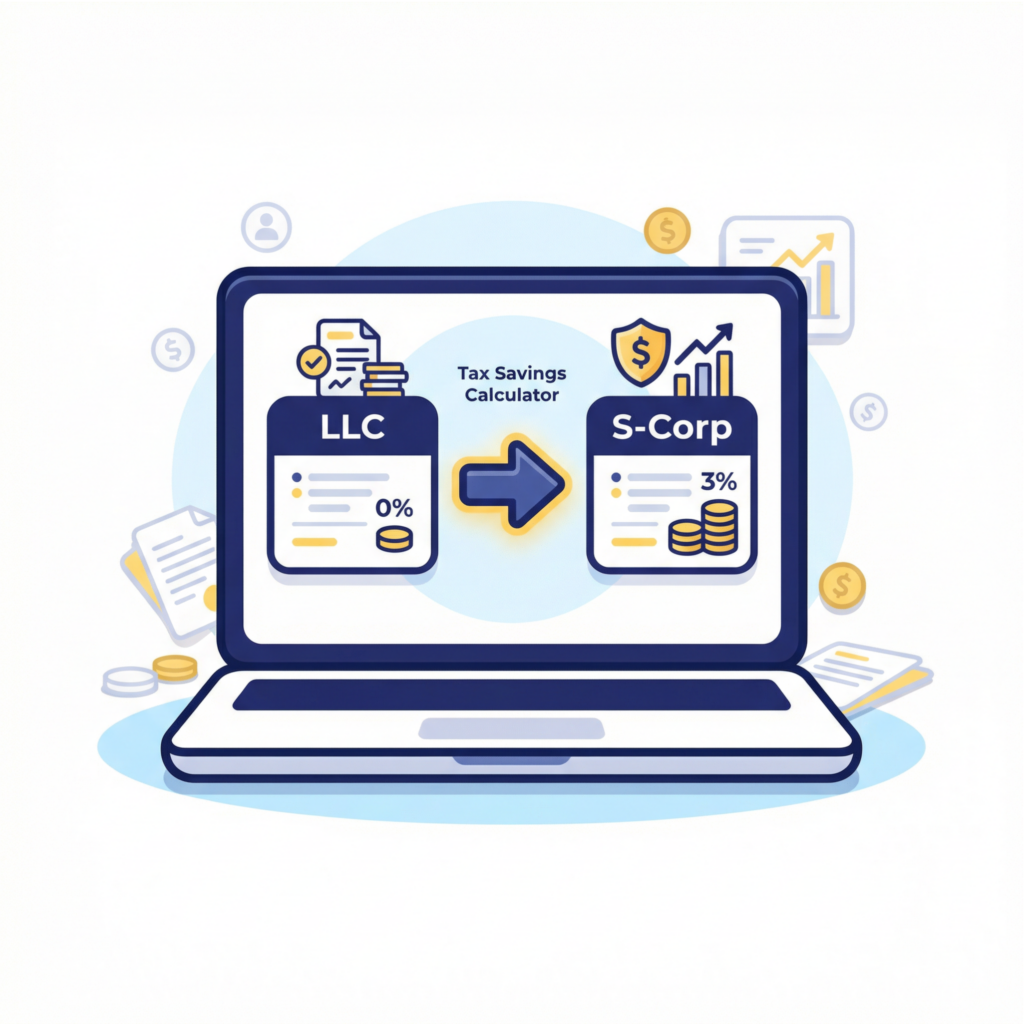
LLC vs S-Corp Tax Calculator
Self-Employment tax Calculator
Small Business Tax Calculator

Not TurboTax. Not H&R Block. A Real Strategy.
Software files your taxes. We engineer your tax strategy. There’s a difference — and it’s worth thousands.
We Find What They Miss
TurboTax asks questions. H&R Block fills out forms. Our MERNA™-certified strategists dig into your income, entity structure, and lifestyle to uncover deductions most CPAs overlook — legally saving clients $15K–$150K+ per year.
Strategy, Not Just Filing
Filing your return is the last step. We start months earlier — restructuring entities, layering write-offs, and building a tax plan that works year-round. By the time we file, you’ve already won.
A Real Strategist in Your Corner
No chatbots. No call centers. You get a dedicated, MERNA™-certified tax strategist who knows your situation, answers your questions, and fights for every dollar — every year.
Work With a Stamford Tax Firm That Understands Commuter, Stock Compensation & Rental Tax Strategy
Book a Free Strategy Call and Meet Your Match.
Professional, Licensed, and Vetted MERNA™ Certified Tax Strategists Who Will Save You Money.
FAQ — TAX PREPARATION IN STAMFORD
As a Stamford resident working remotely for a New York-based company, am I subject to New York state income tax, and how does Connecticut's credit for taxes paid to other states apply?
Yes, if your employer is based in New York, you may be subject to New York State income tax, especially if you previously worked there or your employer has a ‘convenience of the employer’ rule. Connecticut (CT) allows a credit for income taxes paid to another state on income derived from that state, preventing double taxation. You’ll file a CT Form CT-1040, Schedule 2, to claim this credit, ensuring you’re not paying both states on the same income.
I own a small business in Stamford's South End, operating out of a co-working space. Are there specific local business permits or taxes I need to be aware of beyond state requirements, and can I deduct my co-working space fees?
While Stamford does not have a separate city income tax, you may need specific local permits or licenses depending on your business type, particularly for food service, retail, or certain professional services, which you can verify with the Stamford City Clerk’s office. Yes, your co-working space fees are generally 100% deductible as an ordinary and necessary business expense under IRS Section 162, provided the space is used exclusively for business purposes.
Given Stamford's high property values, are there any specific Connecticut property tax relief programs or deductions available for homeowners, especially those near areas like Shippan or North Stamford?
Connecticut offers a Property Tax Credit for income tax purposes, allowing eligible Stamford residents to claim a credit of up to $200 against their state income tax for property taxes paid on their primary residence or motor vehicle. Additionally, certain elderly or disabled homeowners may qualify for programs like the ‘Circuit Breaker’ or ‘Freeze’ programs, administered locally through the Stamford Tax Assessor’s office, offering significant relief based on income thresholds.
I'm a self-employed financial consultant based in Harbor Point, Stamford. What are the key deductible expenses specific to my industry in Connecticut, and how do estimated taxes work for self-employed individuals?
As a financial consultant, key deductions include professional development (e.g., CFP exam fees, industry conferences like those in NYC), subscriptions to financial data services (Bloomberg, FactSet), E&O insurance, and home office expenses if exclusively used for business. For estimated taxes, you’ll generally pay federal and Connecticut estimated taxes quarterly (Form CT-1040ES) if you expect to owe at least $1,000 in state tax, typically by April 15, June 15, September 15, and January 15 of the following year, to avoid penalties.
I recently sold a rental property in the Westover neighborhood of Stamford. What are the Connecticut capital gains tax implications, and can I defer these gains through a 1031 exchange if I reinvest in another property within the state?
Connecticut taxes capital gains as ordinary income, at rates ranging from 3% to 6.99% depending on your adjusted gross income. While federal law allows for 1031 exchanges to defer capital gains on like-kind property, Connecticut generally conforms to federal rules for these exchanges. However, you must ensure the replacement property is also located in the U.S. and the exchange strictly adheres to IRS Section 1031 guidelines regarding identification and acquisition timelines to qualify for deferral on your CT return.
I commute from Stamford to New York City for work. Can I deduct my Metro-North train pass and other commuting expenses on my Connecticut state tax return?
Unfortunately, under current Connecticut tax law, commuting expenses to your primary place of employment, such as your Metro-North train pass, are generally not deductible on your state income tax return. This is considered a personal expense. However, if you incurred unreimbursed employee business expenses for which your employer did not compensate you, some of those might be deductible on your federal Schedule A if they exceed 2% of your Adjusted Gross Income, though this is a very high bar for most individuals.
Tax Strategists Serving All of Connecticut
Uncle Kam’s MERNA™-certified strategists serve cities across Connecticut. Find your nearest location.
View all Connecticut locations →