
Pennsylvania 2026 Tax Changes — What the One Big Beautiful Bill Act (OBBBA) Means for You

On July 4, 2025, the One Big Beautiful Bill Act (OBBBA) was signed into law, making permanent many of the tax cuts originally introduced by the Tax Cuts and Jobs Act (TCJA) and introducing a host of new, taxpayer-friendly provisions. This is a major shift from the expected 2026 “tax cliff” and brings significant, positive changes for every Pennsylvania resident, small business owner, real estate investor, and family.
Pennsylvania’s tax structure is uniquely different from most states — understanding exactly how OBBBA interacts with PA’s flat-rate system is critical to making the right moves in 2026.
Pennsylvania Tax Planning You Can Trust

Guaranteed Strategy Backed by IRS Code
Every analysis is tied directly to the permanent federal tax code established by OBBBA.

Maximum Savings Promise
If you qualify for a federal or state-level tax savings strategy and we miss it, we redo your plan for free.

100% Accuracy Guarantee
All strategies are reviewed by a licensed MERNA™ Strategist.
What's Actually Changing in 2026 — The Pennsylvania OBBBA Update
The narrative has changed. Instead of tax hikes, OBBBA has locked in benefits and added new ones. Here’s what Pennsylvania residents need to know — and where PA’s unique tax structure means the impact is different from most states.
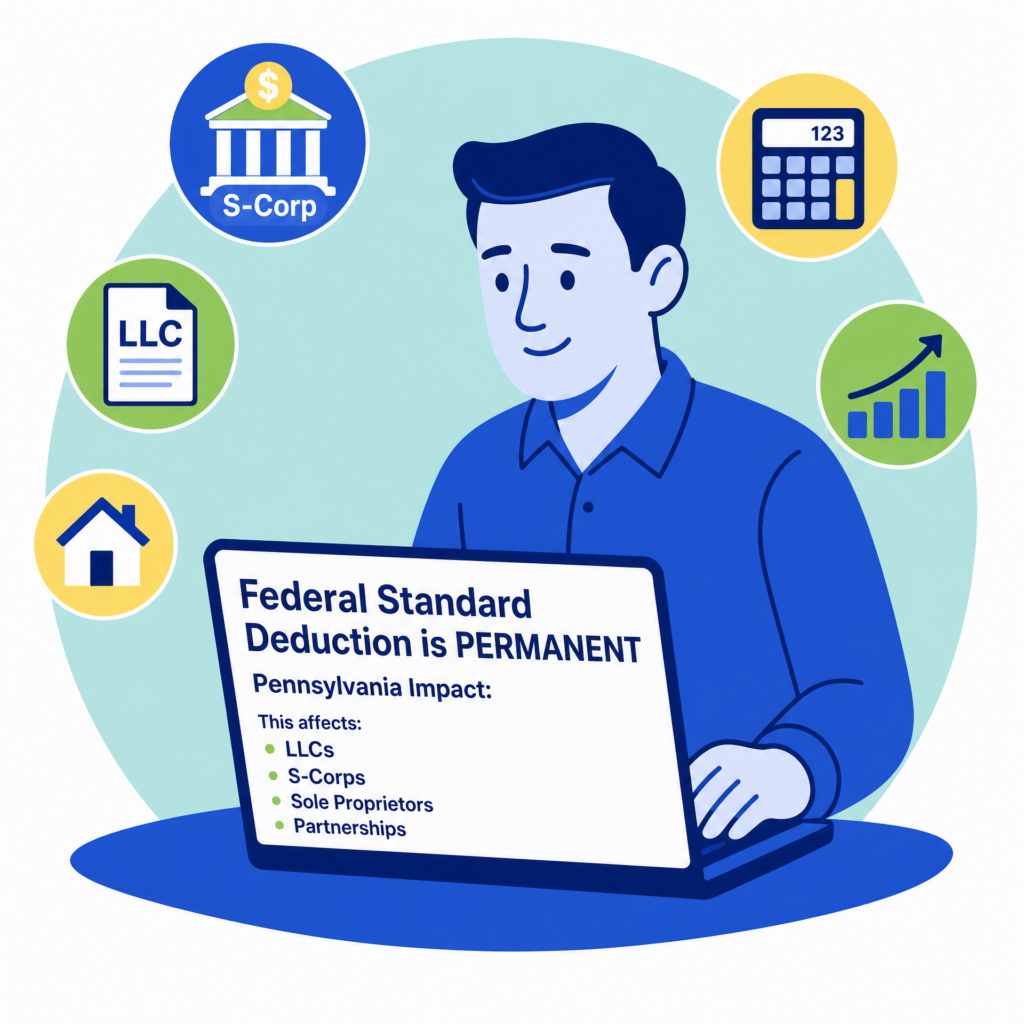
Federal Standard Deduction is PERMANENT
The increased standard deduction, which was set to expire, is now a permanent part of the tax code.
👉 Pennsylvania Impact
This is the key difference from most states: Pennsylvania has no state standard deduction or personal exemption at all. Pennsylvania taxes 8 defined classes of income directly (compensation, interest, dividends, business net profits, gains, rents/royalties, estate/trust income, gambling winnings) with no deduction mechanism. The permanent federal standard deduction increase has zero effect on a Pennsylvanian’s state tax bill. The federal benefit is real — but do not expect it to flow through to your PA return.
Lower Federal Tax Brackets are PERMANENT
The lower individual income tax rates from the TCJA are also here to stay
👉 Pennsylvania Impact
Pennsylvania has a single flat rate of 3.07%, stable since 2004 — no brackets at all. The federal bracket changes are irrelevant to Pennsylvania’s state tax calculation. This is a contrast point, not a parallel to most states. The federal benefit is real for PA taxpayers, but it does not interact with the state rate. High earners in Philadelphia, Pittsburgh, and the Lehigh Valley get a proportionally smaller state-level benefit from federal bracket permanence than residents of graduated-rate states.
The QBI Deduction is PERMANENT and ENHANCED
Contrary to previous expectations, the 20% Qualified Business Income (QBI) Deduction is not ending. OBBBA made it permanent and even improved it
This is a game-changer for Pennsylvania’s:
- LLCs
- S-Corps
- Sole Proprietors
- Partnerships
Key OBBBA Enhancements to QBI:
- Permanence: The 20% deduction is locked in for 2026 and
- Minimum Deduction: A new $400 minimum deduction is available for businesses with at least $1,000 in qualified
- Expanded Phase-Outs: The income phase-out ranges for Specified Service Trades or Businesses (SSTBs) have been increased, allowing more professionals in fields like healthcare, law, and finance to claim the
Pennsylvania Impact:
The federal 20% QBI deduction reduces federal taxable income only — Pennsylvania’s income tax base does not conform to federal AGI or taxable income, so there is no state-level QBI equivalent. Pennsylvania LLCs, S-Corps, and sole proprietors still benefit significantly at the federal level. A PA business earning $150,000 that was expecting to lose this deduction will now keep it, saving thousands in federal taxes annually.
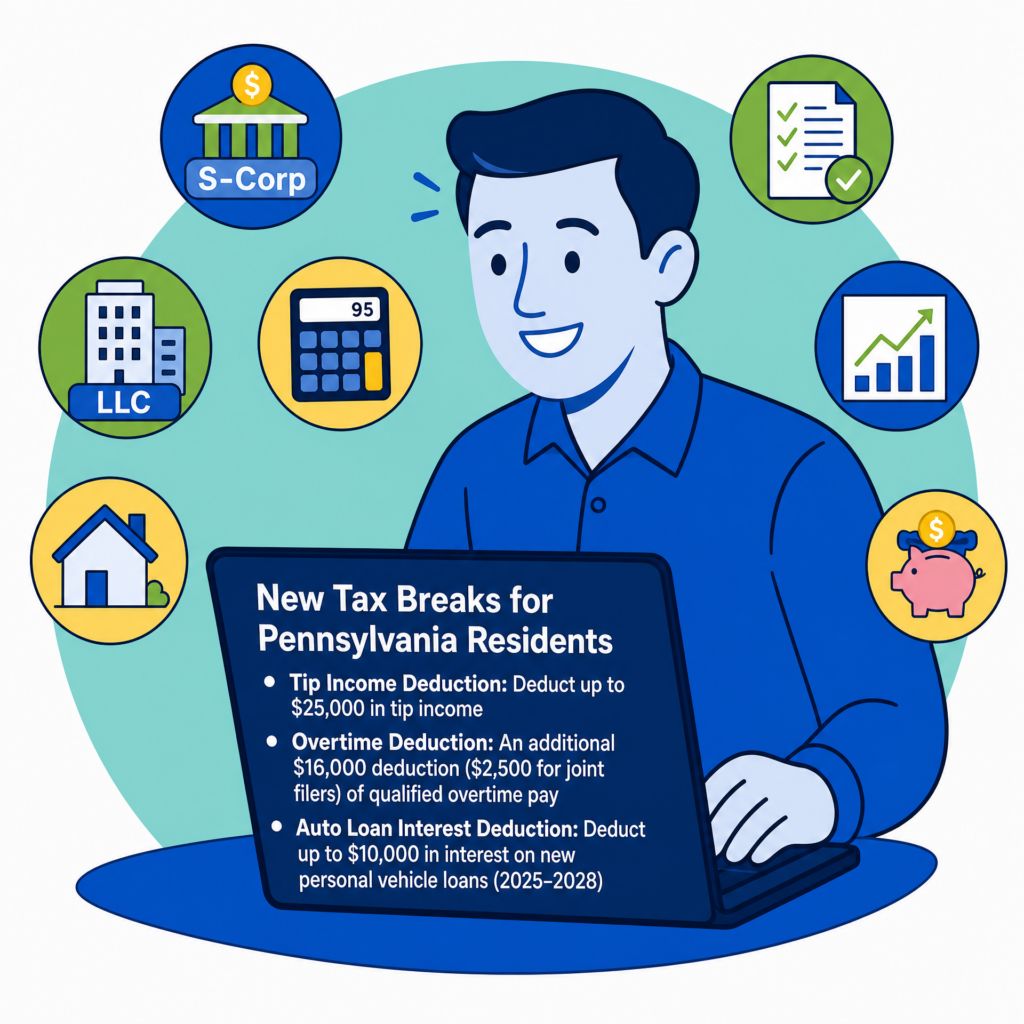
New Tax Breaks for Pennsylvania Residents
OBBBA introduced several new federal deductions that will benefit many in Pennsylvania:
- Tip Income Deduction: Deduct up to $25,000 in tip income — relevant for Pennsylvania’s hospitality industry in Philadelphia, Pittsburgh, and the Poconos.
- Senior Deduction: An additional $6,000 federal deduction for individuals 65 and older (subject to phase-out) — pairs especially well with Pennsylvania’s already-favorable retirement income exemption.
- Overtime Deduction: Deduct up to $12,500 ($25,000 for joint filers) of qualified overtime compensation.
- Auto Loan Interest Deduction: Deduct up to $10,000 in interest on new personal vehicle purchases made in 2025–2026.
Pennsylvania-Specific Considerations for 2026
Pennsylvania's Flat 3.07% Rate Doesn't Move With Federal Changes
Unlike states with graduated brackets, Pennsylvania taxpayers see zero change to their state rate from federal reform — the 3.07% flat rate has been stable since 2004. Local Earned Income Tax (1–3.75%, e.g. Philadelphia 3.75%, Pittsburgh ~3%) still applies on top and is also unaffected by OBBBA. Your total PA tax picture is: federal rate (now permanently lower) + PA flat 3.07% + local EIT.
Retirement Income Stays Fully Exempt
Social Security, pensions, and 401(k)/IRA distributions remain fully exempt from Pennsylvania income tax for filers age 59½ and older — one of the most favorable retirement tax treatments of any state. This pairs well with the new federal $6,000 senior deduction under OBBBA, making Pennsylvania an excellent state for retirement income planning.
Real Estate & STR (Short-Term Rental) Changes
For investors in Philadelphia, Pittsburgh, and Pocono STR markets, OBBBA’s permanent 100% bonus depreciation applies federally the same as any state. Pennsylvania imposes no separate state-level depreciation conformity issue for individual filers — however, this conformity point should be verified against current PA DOR guidance before publishing, as PA’s income tax base does not conform to federal AGI in all respects. (⚠️ Flag: PA depreciation conformity for individual filers — verify against PA DOR before going live.)
Who Benefits Most in Pennsylvania from OBBBA?
- Philadelphia and Pittsburgh Professionals: Permanent lower federal brackets directly reduce federal tax liability; PA's flat rate means the benefit is proportionally larger for middle-income earners than in high-bracket states.
- Pocono/Lehigh Valley STR Investors: Permanent 100% bonus depreciation enhances cost segregation strategies for short-term rental properties.
- Pennsylvania Small Business Owners (LLCs, S-Corps): The permanent federal QBI deduction is a direct boost to your bottom line, even though PA does not conform at the state level.
- Retirees (59½+): The new $6,000 federal senior deduction pairs with Pennsylvania's full retirement income exemption for a uniquely favorable combined tax position.
- W-2 Earners with Overtime or Tips: New federal deductions for overtime and tip income provide direct relief at the federal level.

What Pennsylvania Taxpayers Should Do Now
- Re-evaluate Your Tax Plan Your old plan based on TCJA expiration is now obsolete. It's time for a new strategy based on permanence.
- Review Your Business Entity: With QBI permanent, is your current structure (LLC, S- Corp) still the most tax-efficient?
- Maximize New Deductions: Plan to take full advantage of the new tip, overtime, and senior deductions in 2026.
- Accelerate Investments: Leverage the permanent 100% bonus depreciation for any planned equipment or property purchases.

Pennsylvania 2026 Tax FAQ
Are Pennsylvania Taxes Going Up in 2026?
No — Pennsylvania’s flat 3.07% state rate is unaffected by federal changes. Local Earned Income Tax rates are set separately by municipality and are also unchanged by OBBBA. Your federal tax bill is likely lower due to permanent brackets.
Does Pennsylvania Have a Standard Deduction?
No — Pennsylvania has no state standard deduction or personal exemption, unlike most states. Pennsylvania taxes 8 defined classes of income directly. The federal standard deduction increase has zero effect on your PA state tax bill.
Is Retirement Income Taxed in Pennsylvania?
No — Social Security, pensions, and 401(k)/IRA withdrawals are fully exempt from Pennsylvania income tax for filers age 59½ and older. This is one of the most favorable retirement tax treatments in the country, and it pairs well with the new federal $6,000 senior deduction under OBBBA.
Do Pennsylvania STR Operators (Airbnb) Get Impacted?
Yes — OBBBA’s permanent 100% bonus depreciation applies federally to STR properties in Philadelphia, Pittsburgh, and the Poconos. Cost segregation strategies are more powerful than ever. PA-specific depreciation conformity for individual filers should be verified with a tax professional before implementing.
Will My Paycheck Be Smaller?
No — Pennsylvania’s flat 3.07% state rate means no bracket-driven change at the state level. Your federal withholding should remain at or below current levels due to permanent lower federal brackets. Local EIT rates are set by your municipality and are unaffected by OBBBA.
Get Your Personalized 2026 Pennsylvania Tax Plan
The tax landscape has permanently shifted in your favor. Don’t operate on outdated assumptions. A personalized strategy session will ensure you are structured to maximize every new and permanent benefit under OBBBA.