
Missouri 2026 Tax Changes — What the One Big Beautiful Bill Act (OBBBA) Means for You

On July 4, 2025, the One Big Beautiful Bill Act (OBBBA) was signed into law, making permanent many of the tax cuts originally introduced by the Tax Cuts and Jobs Act (TCJA) and introducing a host of new, taxpayer-friendly provisions. This is a major shift from the expected 2026 “tax cliff” and brings significant, positive changes for every Missouri resident, small business owner, real estate investor, and family.
Forget what you thought you knew about the TCJA expiring. This guide breaks down exactly how the new permanent tax laws under OBBBA will impact Missouri taxpayers in 2026 and beyond.
Planning ahead? Read the 2027 Missouri Tax Changes Guide to see what business owners and investors should prepare for next.
Missouri Tax Planning You Can Trust

Guaranteed Strategy Backed by IRS Code
Every analysis is tied directly to the permanent federal tax code established by OBBBA.

Maximum Savings Promise
If you qualify for a federal or state-level tax savings strategy and we miss it, we redo your plan for free.

100% Accuracy Guarantee
All strategies are reviewed by a licensed MERNA™ Strategist.
What's Actually Changing in 2026 — The Missouri OBBBA Update
The narrative has changed. Instead of tax hikes, OBBBA has locked in benefits and added new ones. Here’s what Missouri residents need to know.
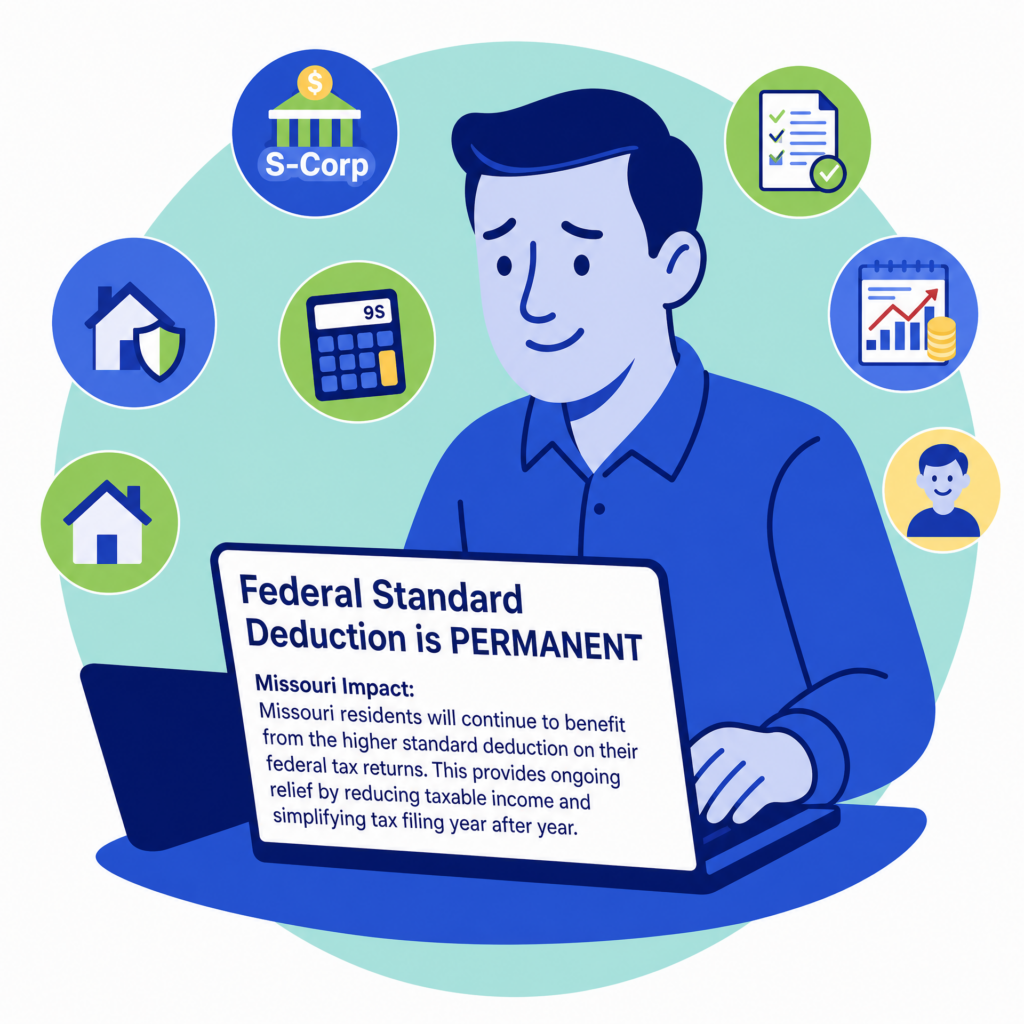
Federal Standard Deduction is PERMANENT
The increased standard deduction, which was set to expire, is now a permanent part of the tax code.
👉 Missouri Impact
Missouri has its own state standard deduction, separate from the federal one. The permanent, higher federal standard deduction simplifies federal tax planning and provides stability — but it does not change Missouri’s own state deduction amount. Missouri filers benefit primarily at the federal level.
Lower Federal Tax Brackets are PERMANENT
The lower individual income tax rates from the TCJA are also here to stay
👉 Missouri Impact
Missouri’s top state income tax rate fell to 4.7% as of January 1, 2025. Missouri is not a no-income-tax state — the 4.7% rate remains in effect. Pending legislation (HB 798) proposes moving to a flat 4.7% rate starting tax year 2026, with a possible gradual reduction to 3.7% over 10 years if revenue triggers are met — this is proposed, not yet enacted. The permanent lower federal brackets are a direct win for Missouri professionals and business owners in the $75k–$300k income range across the KC and STL metro corridors.
The QBI Deduction is PERMANENT and ENHANCED
Contrary to previous expectations, the 20% Qualified Business Income (QBI) Deduction is not ending. OBBBA made it permanent and even improved it
This is a game-changer for Missouri’s:
- LLCs
- S-Corps
- Sole Proprietors
- Partnerships
Key OBBBA Enhancements to QBI:
- Permanence: The 20% deduction is locked in for 2026 and
- Minimum Deduction: A new $400 minimum deduction is available for businesses with at least $1,000 in qualified
- Expanded Phase-Outs: The income phase-out ranges for Specified Service Trades or Businesses (SSTBs) have been increased, allowing more professionals in fields like healthcare, law, and finance to claim the
Missouri Impact:
Missouri has no separate state-level QBI provision — the federal 20% deduction reduces federal taxable income only. Missouri LLCs, S-Corps, and sole proprietors still benefit significantly at the federal level. A Missouri business earning $150,000 that was expecting to lose this deduction will now keep it, saving thousands in federal taxes annually. S-Corp and LLC structuring remains a critical strategy.
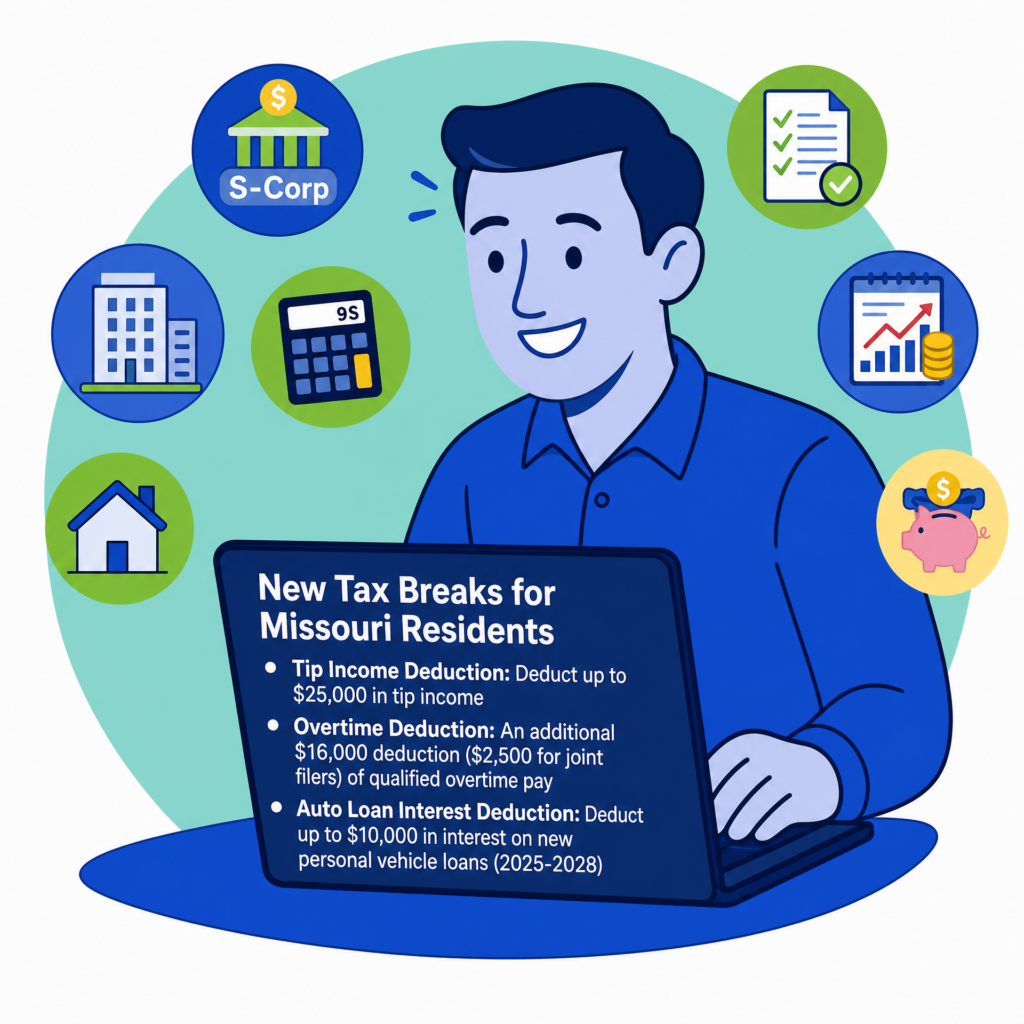
New Tax Breaks for Missouri Residents
OBBBA introduced several new deductions that will benefit many in Missouri:
- Tip Income Deduction: Deduct up to $25,000 in tip income — relevant for Missouri’s hospitality and service industries in KC, STL, and Branson.
- Senior Deduction: An additional $6,000 deduction for individuals 65 and older (subject to phase-out).
- Overtime Deduction: Deduct up to $12,500 ($25,000 for joint filers) of qualified overtime compensation.
- Auto Loan Interest Deduction: Deduct up to $10,000 in interest on new personal vehicle purchases made in 2025–2026.
Missouri-Specific Considerations for 2026
Missouri Capital Gains Tax Fully Eliminated
In July 2025, Missouri became the first state to fully exempt capital gains from state income tax (HB 594), covering gains on stocks, bonds, and other investment sales. This is a major planning point for investors and business sellers — Missouri is now one of the most favorable states in the country for capital gains realization.
Income Tax Elimination — Proposed, Not Current Law
A constitutional amendment (HJR 173) to phase out Missouri’s income tax over 5 years, funded by expanded sales tax, passed the legislature in April 2026 and is expected on the November 2026 ballot. This is not current law — frame it as something to watch and plan around, not something in effect. Uncle Kam will monitor this closely for clients.
Real Estate & STR (Short-Term Rental) Changes
For investors in Branson, Lake of the Ozarks, and the KC/STL metro STR markets, OBBBA’s permanent 100% bonus depreciation applies at the federal level the same as any state. Immediate expensing of qualified property makes cost segregation and strategic asset acquisition more powerful than ever. Careful planning around passive vs. active income classification for STRs remains critical.
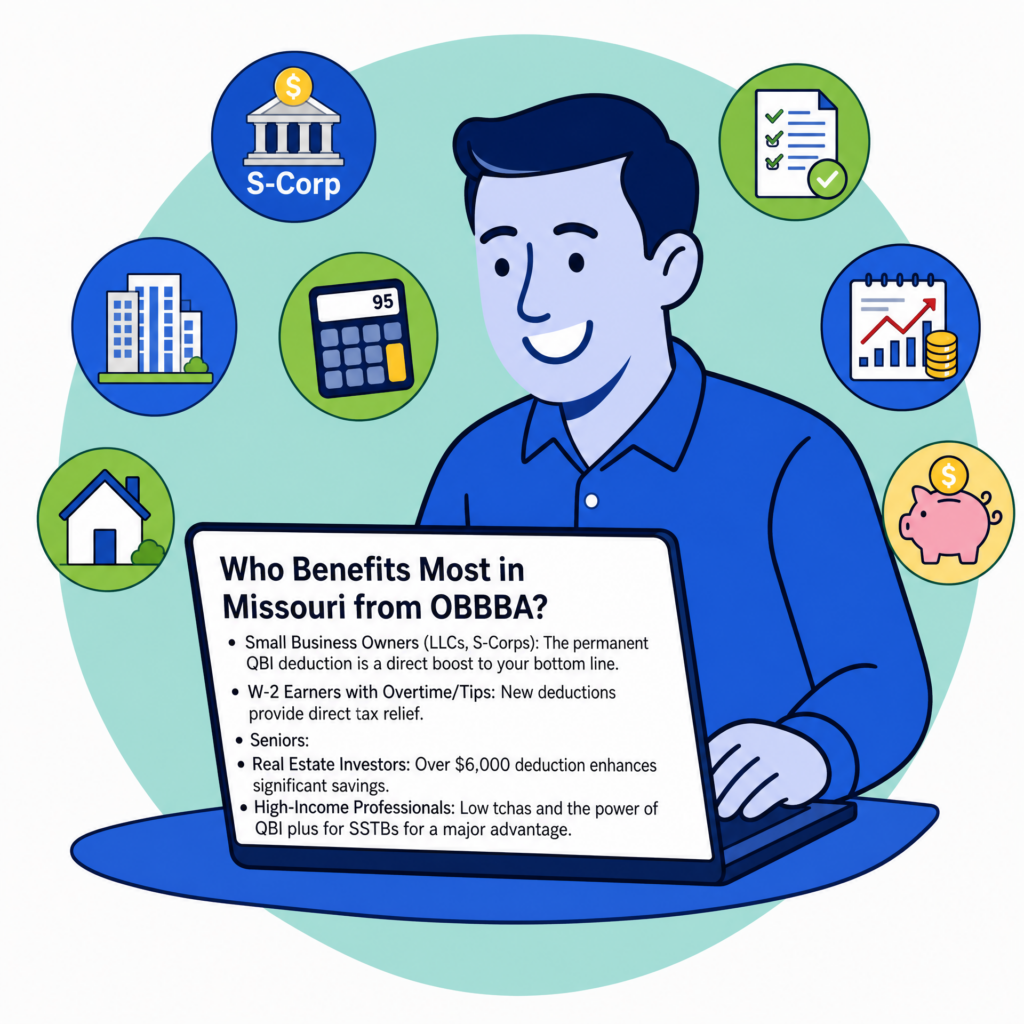
Who Benefits Most in Missouri from OBBBA?
- KC/STL Tech and Professional Corridor Workers: Permanent lower federal brackets directly reduce your federal tax liability.
- Branson/Lake of the Ozarks STR Investors: Permanent 100% bonus depreciation and favorable capital gains treatment make Missouri one of the best STR markets in the country.
- Missouri Small Business Owners (LLCs, S-Corps): The permanent QBI deduction is a direct boost to your bottom line.
- Seniors: The new $6,000 federal deduction offers significant savings, especially combined with Missouri's favorable capital gains exemption.
- Investors and Business Sellers: Missouri's full capital gains exemption at the state level, combined with federal permanence, creates a uniquely favorable environment.
What Missouri Taxpayers Should Do Now
- Re-evaluate Your Tax Plan Your old plan based on TCJA expiration is now obsolete. It's time for a new strategy based on permanence.
- Review Your Business Entity: With QBI permanent, is your current structure (LLC, S- Corp) still the most tax-efficient?
- Maximize New Deductions: Plan to take full advantage of the new tip, overtime, and senior deductions in 2026.
- Accelerate Investments: Leverage the permanent 100% bonus depreciation for any planned equipment or property purchases.

Missouri 2026 Tax FAQ
Is Missouri Eliminating Its Income Tax in 2026?
Not yet. A ballot measure (HJR 173) is expected in November 2026, but as of now Missouri’s income tax remains in effect at a 4.7% top rate. Uncle Kam will keep clients updated as this develops.
Are Missouri Capital Gains Taxed in 2026?
No — Missouri fully exempted capital gains from state income tax starting in 2025 (HB 594), the first state in the country to do so. This is a significant planning opportunity for investors and business sellers.
Will Missouri Homeowners Pay More?
Federal SALT limitations continue to affect Missouri homeowners who itemize. The permanent higher standard deduction means fewer Missourians will itemize at the federal level, simplifying planning for most. State-level property tax is set locally and is unaffected by OBBBA.
Do Missouri STR Operators (Airbnb) Get Impacted?
Yes — bonus depreciation and STR classification rules matter significantly, especially in Branson and Lake of the Ozarks markets. Permanent 100% bonus depreciation under OBBBA enhances the power of cost segregation for STR properties.
Will My Paycheck Be Smaller?
No — the permanent lower federal tax brackets mean your federal withholding should remain at or below current levels. Missouri’s 4.7% state rate is unchanged. Most Missouri workers will see no reduction in take-home pay from OBBBA.
Get Your Personalized 2026 Missouri Tax Plan
The tax landscape has permanently shifted in your favor. Don’t operate on outdated assumptions. A personalized strategy session will ensure you are structured to maximize every new and permanent benefit under OBBBA.