
Tax Preparation Services in Savannah, Georgia
Savannah Tax Preparation Services
Elite Tax Preparation for Savannah’s Professionals, Entrepreneurs, Creatives & Real Estate Owners
Savannah is one of Georgia’s strongest and fastest-growing economic regions — home to
corporate professionals, port and logistics workers, creatives, hospitality teams, medical staff,
military families, retirees, real estate investors, and multi-income households. These taxpayers
often require precise, compliant, and intelligent tax preparation — not basic software or
one-size-fits-all filing.
- W-2 income + bonuses
- Rental income (long-term + short-term / Airbnb)
- Hybrid W-2 + contractor income
- Stock compensation (RSUs, ESPPs, options)
- Multi-state income (GA + FL, GA + SC, GA + NC)
- Small-business or side-business income
- Real estate appreciation + capital gains
- Retirement income (pension, annuity, SSA)

Why Savannah Residents Trust Our Tax Preparers
- Precise federal + Georgia state filing accuracy
- Rental property depreciation & Schedule E expertise
- Stock compensation (RSUs, ESPPs, options) handled correctly
- Multi-state income corrections (GA, FL, SC, NC, TN)
- Audit-ready documentation & bookkeeping cleanup
- High-income, investor & business-owner tax strategy
- Transparent flat-rate pricing — no surprise invoices
We prepare returns that are clean, complete, compliant, and optimized.

Individual Tax Preparation for Savannah Residents
- Federal & Georgia state tax filing
- Airbnb/STR & long-term rental property depreciation
- Stock compensation processing (RSUs/ESPPs/options)
- Multi-state residency income allocation
- Capital gains & investment income reporting
- Roth conversion & retirement withdrawal planning
- IRS notices, audits & amended returns
- Estimated tax calculations & planning
Business Tax Preparation for Savannah Entrepreneurs
- Creatives & freelancers
- Hospitality & tourism operators
- Contractors & home-service providers
- Medical practices & wellness professionals
- Transportation & port-related businesses
- Real estate investors & property managers
- E-commerce & mobile businesses
- S-Corp, LLC, C-Corp & partnership tax filing
- Bookkeeping cleanup + year-end reconciliation
- Payroll setup, support & compliance
- Depreciation & fixed-asset planning
- Multi-entity tax structure optimization
- Quarterly forecasting & estimated tax planning
- Sales tax & compliance support
We help Savannah business owners stay compliant, organized, and profitable.


What Makes Our Savannah Tax Team Different
- Georgia + multi-state income rules
- Short-term rental depreciation optimization
- High-income + multi-stream households
- Stock compensation for remote tech workers
- Retiree income planning (pension + SSA + investments)
- Capital gains on property appreciation
- Contractor + W-2 hybrid income
- LLC + S-Corp tax positioning
Areas We Serve Across Savannah & Coastal Georgia
We support tax clients throughout:
Historic District
Midtown Savannah
Ardsley Park
Isle of Hope
Skidaway Island
Thunderbolt
Wilmington Island
Pooler
Port Wentworth
Garden City
Tybee Island
If you live anywhere near the Savannah metro or coastal corridor, we support you.
What Savannah Clients Say

Savannah Tax Case Study — Real Client Scenario
- Corrected RSU cost basis & multi-year reporting
- Rebuilt depreciation schedule for STR
- Fixed GA/FL income allocation
- Set quarterly estimated tax plan
- clean multi-state alignment + reduced audit risk.
Result:
$18,750 in first-year tax savings
Model Your Taxes by State- Before You File

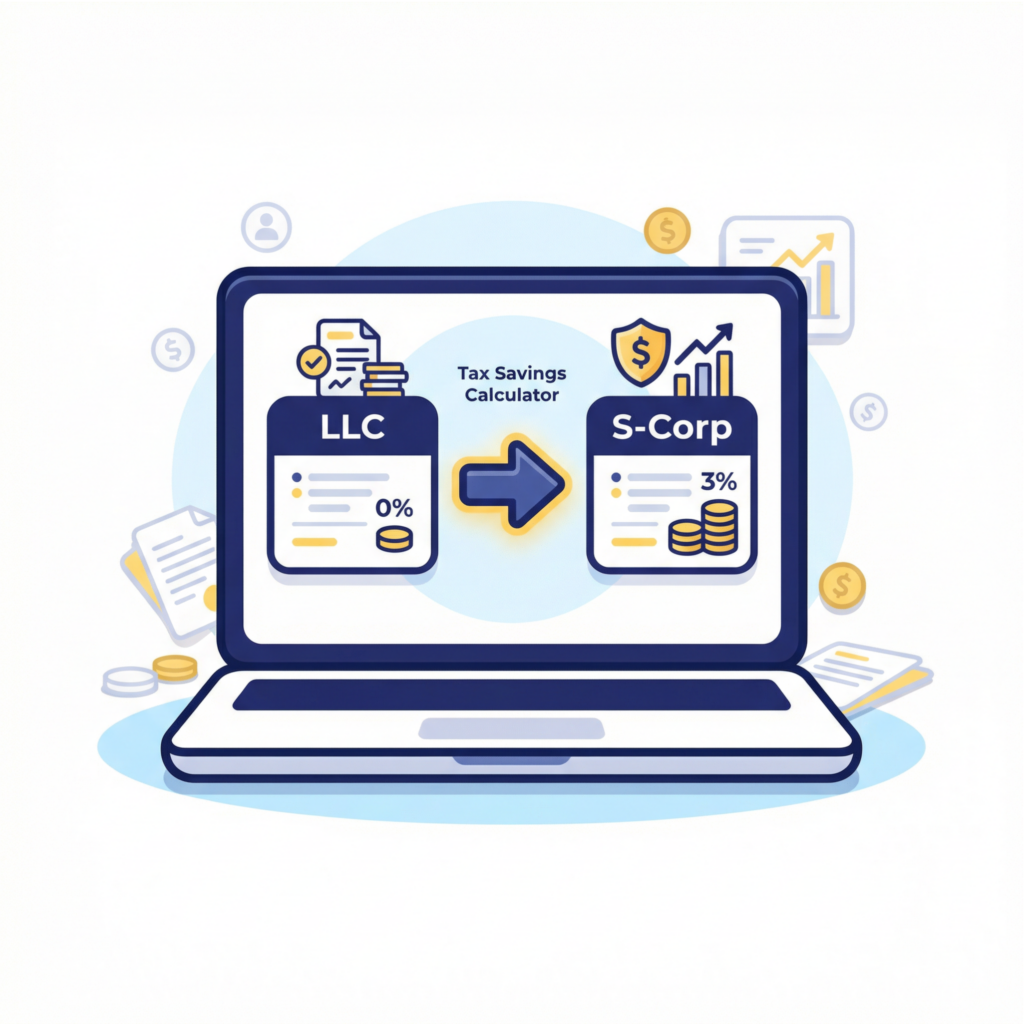
LLC vs S-Corp Tax Calculator
Self-Employment tax Calculator

Small Business Tax Calculator

Not TurboTax. Not H&R Block. A Real Strategy.
Software files your taxes. We engineer your tax strategy. There’s a difference — and it’s worth thousands.
We Find What They Miss
TurboTax asks questions. H&R Block fills out forms. Our MERNA™-certified strategists dig into your income, entity structure, and lifestyle to uncover deductions most CPAs overlook — legally saving clients $15K–$150K+ per year.
Strategy, Not Just Filing
Filing your return is the last step. We start months earlier — restructuring entities, layering write-offs, and building a tax plan that works year-round. By the time we file, you’ve already won.
A Real Strategist in Your Corner
No chatbots. No call centers. You get a dedicated, MERNA™-certified tax strategist who knows your situation, answers your questions, and fights for every dollar — every year.
Book a Free Strategy Call and Meet Your Match.
Professional, Licensed, and Vetted MERNA™ Certified Tax Strategists Who Will Save You Money.
FAQ — TAX PREPARATION IN SAVANNAH
I own a historic short-term rental property in the Savannah Historic District. Are there specific local tax advantages or deductions I should be aware of beyond federal depreciation?
Yes, beyond federal depreciation (e.g., Section 168), Savannah property owners in historic districts may qualify for Georgia’s preferential property tax assessment for rehabilitated historic property, which can freeze the property’s assessed value for eight years. Additionally, ensure you’re correctly remitting the 7% Chatham County lodging tax and the 3% City of Savannah lodging tax, which are separate from state sales tax and must be filed monthly.
As a small business owner in the Starland District, what are the local business license and occupation tax requirements, and how do they impact my federal Schedule C deductions?
Savannah businesses, including those in Starland, are required to obtain a General Business License (Occupational Tax Certificate) from the City of Savannah. The occupation tax is based on your gross receipts and industry classification, and these fees are fully deductible as ordinary and necessary business expenses on your federal Schedule C (Form 1040), reducing your taxable income. Ensure you renew it annually by March 15th to avoid penalties.
I'm a freelance tour guide operating primarily around Forsyth Park and River Street. Can I deduct the costs of my annual Savannah Tour Guide License and ongoing education, and are there specific thresholds?
Absolutely. The cost of your annual Savannah Tour Guide License, which is mandatory for operating within the city, is a fully deductible business expense on your Schedule C. Additionally, any reasonable expenses for continuing education directly related to maintaining or improving your skills as a tour guide (e.g., historical society memberships, specialized workshops) are also deductible, provided they don’t qualify you for a new trade or business.
I recently bought a home in Ardsley Park and am considering energy-efficient improvements. Does Georgia offer any state-specific tax credits for these, beyond the federal Residential Clean Energy Credit?
While Georgia previously offered state income tax credits for certain energy-efficient improvements, most have expired. However, you can still leverage the federal Residential Clean Energy Credit (formerly the ITC), which offers a 30% credit for the cost of new, qualified clean energy property for your home, including solar, wind, and geothermal systems, through 2032. Keep meticulous records for both federal and potential future state incentives.
My small manufacturing business, located near the Port of Savannah, frequently incurs expenses for shipping and logistics. Are there any specific Georgia sales tax exemptions for equipment or services used in manufacturing/shipping that I should be claiming?
Yes, Georgia offers significant sales tax exemptions for qualified manufacturing businesses. Specifically, machinery and equipment used directly in the manufacturing process are exempt from state sales tax (currently 4%) and local sales taxes (like Chatham County’s 3%), provided they meet the ‘direct use’ criteria. Additionally, certain repairs and replacement parts for exempt machinery are also exempt, so ensure your vendors are applying these correctly.
I'm a remote worker living in Pooler, but my employer is based in New York. How do I handle my Georgia state income tax return, and do I need to worry about New York state taxes as well?
As a Georgia resident, you will file a Georgia Form 500 and report all your income, regardless of where your employer is located. New York, as a ‘convenience of the employer’ state, will likely tax your income as if you worked there, unless your employer can demonstrate a legitimate business reason for you working remotely in Pooler. You will then claim a credit for taxes paid to New York on your Georgia return (Form 500, Schedule 3) to avoid double taxation, ensuring you aren’t paying more than the higher of the two state tax rates.
Tax Strategists Serving All of Georgia
Uncle Kam’s MERNA™-certified strategists serve cities across Georgia. Find your nearest location.
View all Georgia locations →