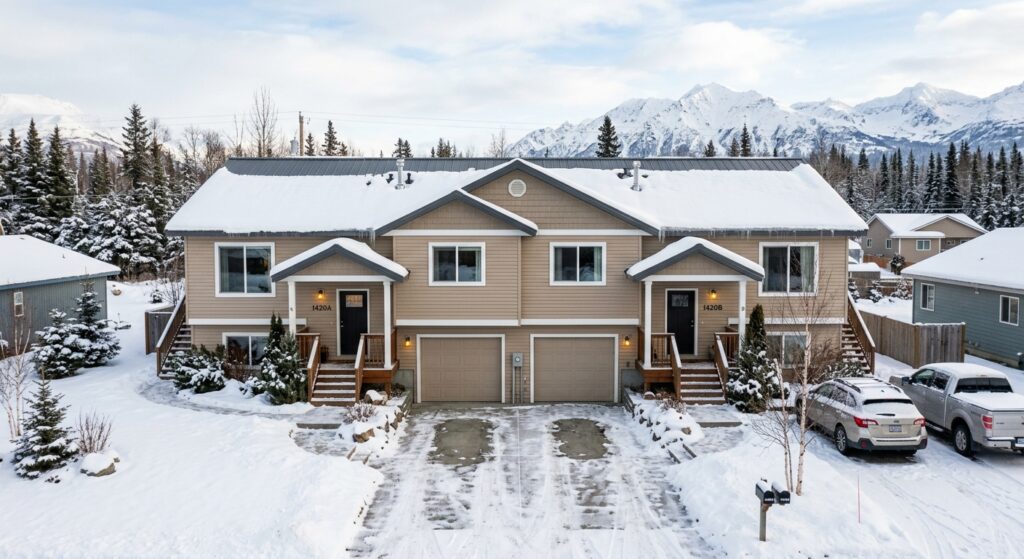
Wasilla Rental Property Taxes 2026: The Complete Tax Planning Guide for Alaska Real Estate Investors

Wasilla Rental Property Taxes 2026: The Complete Tax Planning Guide for Alaska Real Estate Investors
Owning Wasilla rental property taxes can create significant federal tax obligations, but strategic planning can dramatically reduce what you owe. For the 2026 tax year, Alaska real estate investors benefit from federal tax deductions that can shelter rental income through depreciation, operating expenses, and passive activity loss rules. This guide reveals exactly which deductions apply, how to claim them correctly, and the advanced strategies that can save you thousands annually while keeping you audit-proof.
Table of Contents
- Key Takeaways
- What Federal Deductions Apply to Rental Properties?
- How Does Depreciation Work as a Tax Strategy?
- What Are Passive Activity Loss Limitations?
- How Do Self-Employment Taxes Apply to Rental Property Income?
- Why Does Alaska’s No-Income-Tax Status Matter?
- Can You Use 100% Bonus Depreciation on 2026 Purchases?
- Uncle Kam in Action
- Next Steps
- Frequently Asked Questions
Key Takeaways
- Rental property owners can deduct 100% of operating expenses including mortgage interest, repairs, utilities, insurance, and property management fees.
- Depreciation deductions shelter rental income for 27.5 years, creating significant tax breaks even when properties are cash-positive.
- The 100% bonus depreciation rule allows immediate deduction of building improvements placed in service after December 31, 2024.
- Alaska’s zero income tax status means federal taxes are your only state income tax burden, but self-employment taxes still apply.
- Passive activity loss rules limit deductions to $25,000 annually for active investors earning under $100,000-$150,000.
What Federal Deductions Apply to Rental Properties?
Quick Answer: For 2026, rental property owners can deduct all ordinary and necessary business expenses including mortgage interest, property taxes, insurance, repairs, maintenance, utilities, property management fees, advertising, homeowners association dues, and depreciation.
The IRS allows rental property investors to deduct every legitimate expense related to operating and maintaining their investment. These deductions directly reduce your taxable rental income dollar-for-dollar. Unlike the standard deduction that applies to W-2 income, rental deductions are separate and can create significant tax savings even for high-income professionals.
For Wasilla rental property owners, this means you can write off weather-related repairs (crucial in Alaska’s harsh winters), snow removal costs, heating bills that exceed normal homeowner expenses, and Alaska-specific insurance premiums. The IRS distinguishes between improvements (which you depreciate over time) and repairs (which you deduct immediately in the year incurred).
The Most Commonly Overlooked Deductions
Many Wasilla property owners leave thousands of dollars in tax savings on the table by not tracking these deductible expenses:
- Travel expenses for property management (viewing the property, meeting contractors, attending investor meetings)
- Office supplies and accounting software for tracking rental business expenses
- Professional fees for accountants, attorneys, and tax preparation services related to rental activities
- Half of self-employment taxes paid on rental business income (if structured as a business)
- Equipment and tools (with cost basis under $2,500) for property maintenance
- Cleaning and pest control services between tenants
According to IRS Publication 527, property owners must keep detailed records documenting when expenses were incurred, what was purchased, and how it benefits the rental business. The IRS audits rental property returns at higher rates than typical individual returns, making documentation essential for audit defense.
Mortgage Interest vs. Principal: Which Is Deductible?
This distinction costs many investors thousands annually. You can deduct 100% of mortgage interest paid on rental property loans, but mortgage principal payments are not deductible. This matters significantly in early years when most payments go toward interest. For example, on a $200,000 mortgage at 6.5% interest, the first-year interest portion could exceed $12,000—all deductible.
Pro Tip: Request an amortization schedule from your lender showing exactly how much interest you paid in 2026. Use this figure to verify the mortgage interest deduction on your tax return. Many investors underreport this deduction, missing thousands in legitimate tax savings.
How Does Depreciation Work as a Tax Strategy?
Quick Answer: For 2026, rental property owners can claim annual depreciation deductions that recover the building cost (not land) over 27.5 years, meaning you deduct approximately 3.6% of the building value annually, creating substantial tax shelters even when cash flow is positive.
Depreciation is one of real estate investing’s most powerful tax tools because it’s a “non-cash” deduction. You claim a deduction without spending money in that year, which means you can offset rental income without reducing your actual cash flow. This allows real estate investors to have positive monthly cash flow while showing losses on their tax return.
To calculate depreciation for your Wasilla rental property, you must separate the building value from the land value. The IRS requires you to use the purchase price allocation, which your real estate agent or title company can provide. Typically, land represents 15-25% of total purchase price for residential rentals; the remaining amount is the depreciable building value.
For example, if you purchased a $300,000 Wasilla rental property and $50,000 is allocated to land, your depreciable basis is $250,000. Divided by 27.5 years, that’s $9,091 in annual depreciation deduction. This deduction reduces your taxable income regardless of how much rent you collect.
Cost Segregation: The Advanced Depreciation Strategy
Sophisticated investors in Wasilla use cost segregation studies to accelerate depreciation deductions. A cost segregation analysis allocates building components to shorter depreciation periods (5, 7, or 15 years instead of 27.5 years). Carpet becomes 5-year property, appliances become 7-year property, certain improvements become 15-year property.
Using the same $300,000 property example, cost segregation might reclassify $30,000 of components into shorter depreciation periods. This generates $2,000-$4,000 in additional depreciation deductions in early years. For a $500,000 property, cost segregation can create $10,000-$15,000 in accelerated first-year deductions. The cost segregation study itself (typically $2,500-$5,000) is deductible, making this strategy viable for higher-value properties.
Recapture Tax: Understanding the Long-Term Cost
When you sell your Wasilla rental property, you must recapture all depreciation claimed at a 25% tax rate (higher than long-term capital gains rates of 15-20%). This means depreciation deductions create tax savings today but increase taxes when you sell. Understanding this tradeoff is critical: if you plan to hold the property long-term, the upfront tax savings usually exceed the future recapture tax because you defer and reduce taxes for decades.
What Are Passive Activity Loss Limitations?
Quick Answer: For 2026, if you’re not a real estate professional, you can deduct only $25,000 in rental losses annually (phasing out at incomes above $100,000-$150,000), meaning excess losses carry forward to future years.
The passive activity loss (PAL) limitation is the IRS rule that prevents investors from using rental losses to offset W-2 income. Without this rule, high-income professionals could have massive deductions wiping out their tax bills. Instead, the IRS created a $25,000 annual loss allowance for active real estate investors who materially participate in property management.
Here’s how it works: if your depreciation and operating expenses create a $35,000 loss on your Wasilla rental property, but you only earned $50,000 in salary that year, you can only use $25,000 of the rental loss to reduce your W-2 income. The remaining $10,000 loss carries forward indefinitely, reducing future rental income or eventually reducing gains when you sell.
Material Participation and Active Investor Status
To claim the $25,000 loss allowance, you must materially participate in managing the rental property. The IRS defines this as spending at least 100 hours annually in property-related activities (management decisions, maintenance oversight, tenant communications, lease negotiations). For IRS Publication 925, keeping a log of all rental property activities is essential for audit defense.
If you use a property manager for your Wasilla rental, you can still qualify for active investor status if you maintain decision-making authority (approving repairs, setting rent, approving tenants). However, you must document this involvement with contemporaneous records.
Real Estate Professional Status: Unlimited Loss Deductions
The ultimate strategy for active real estate investors is qualifying for real estate professional (REP) status. REP status requires spending more than half your working hours in real estate activities and materialparticipating in all your rental properties. Once qualified, you have unlimited loss deductions—all rental losses offset your W-2 income without the $25,000 annual cap.
Pro Tip: REP status requires meticulous documentation. Track hours spent on real estate activities separately from your W-2 employment. The IRS audits REP status claims extensively, so contemporaneous time logs and detailed real estate business documentation are non-negotiable.
How Do Self-Employment Taxes Apply to Rental Property Income?
 Free Tax Write-Off Finder
Quick Answer: For 2026, passive rental income is generally not subject to the 15.3% self-employment tax (12.4% Social Security + 2.9% Medicare). However, if you actively manage properties without a manager or qualify as REP, you may owe self-employment tax on net profit.
This distinction is crucial: most Wasilla rental income escapes self-employment taxes entirely. Passive rental income reported on Schedule E does not generate self-employment tax liability. You only pay income tax on the net rental income (total rents minus deductions). This is substantially different from 1099 self-employed income, which is subject to 15.3% self-employment tax on top of income tax.
However, if you have significant depreciation losses converting your rental income to a paper loss, you’ll still have no self-employment tax obligation on that loss. This is the advantage of depreciation—it reduces both income tax and self-employment tax exposure.
When Rental Income Becomes Subject to Self-Employment Tax
The IRS treats certain rental income as “business income” subject to self-employment tax. This occurs when you provide substantial services beyond typical property management (short-term rental operations with maid service, furnished rental with daily housekeeping, rental of parking spaces with valet service, or operating the property as a hotel-like business). If your Wasilla rental qualifies as short-term rental (less than 30-day average lease terms), evaluate whether you’re providing significant services that trigger self-employment tax. For traditional long-term residential rentals with arms-length management, self-employment tax is not a concern. Calculate your 2026 rental obligations using our Self-Employment Tax Calculator if your situation is complex.
Why Does Alaska’s No-Income-Tax Status Matter?
Quick Answer: Alaska has zero state income tax, meaning Wasilla rental property owners pay only federal taxes on rental income and no state income tax, creating a substantial tax advantage compared to other states.
Alaska is one of only nine states with no income tax. For Wasilla rental property owners, this creates an enormous advantage over investors in high-tax states like California (13.3%), New York (8.82%), or Massachusetts (9%). If you earned $50,000 in net rental income, California would impose approximately $6,650 in state taxes. Alaska imposes zero state income taxes on that same income.
This advantage compounds over decades of property ownership. An investor who defers $8,000 annually in Alaska state taxes across a 25-year hold period saves $200,000 in state taxes alone—money that can be reinvested in additional rental properties or compound through market growth.
Still Subject to Federal Taxes and Property Taxes
However, Alaska’s lack of income tax does not eliminate all tax obligations. You still pay federal income taxes on net rental income. Additionally, Wasilla property owners must pay local property taxes assessed by the Matanuska-Susitna Borough. These property taxes (typically 1-1.5% of assessed value) are fully deductible against rental income, reducing your overall tax burden.
Can You Use 100% Bonus Depreciation on 2026 Purchases?
Quick Answer: Yes. For the 2026 tax year, 100% bonus depreciation is available for qualified property (buildings and improvements) placed in service after December 31, 2024, allowing immediate deduction of the full cost in the year purchased.
The One Big Beautiful Bill Act (OBBBA), enacted July 4, 2025, restored 100% bonus depreciation permanently. This is a game-changing provision for Wasilla investors. Instead of depreciating building improvements over 27.5 years, you can deduct 100% of the cost immediately in the year placed in service. This applies to renovations, appliance replacements, roof repairs classified as improvements, and building systems replaced in 2026.
For example, if you purchased a Wasilla rental property and spent $40,000 renovating the kitchen and bathrooms in 2026, you could deduct the full $40,000 in 2026 rather than spreading it over 27.5 years. This creates massive first-year tax benefits that can generate losses offsetting other income (subject to PAL limits).
Section 179 Expensing: Even Better for Smaller Improvements
Beyond bonus depreciation, Section 179 expensing allows you to immediately deduct the cost of equipment and machinery placed in service. For 2026, the Section 179 limit is $2.5 million, with phaseout beginning at $4 million in qualifying purchases. This means you can immediately deduct appliances, HVAC systems, roof materials, and flooring for your Wasilla rental property instead of depreciating them over time.
Combined, bonus depreciation and Section 179 expensing allow investors to recover the cost of major Wasilla rental property renovations entirely in the year incurred. This creates substantial immediate tax benefits that shelter other income.
Pro Tip: Track all 2026 property improvements separately from repairs. Repairs are deducted immediately anyway, but improvements (new HVAC, new roof, adding insulation) qualify for bonus depreciation. Your contractor should itemize work as “repairs” vs. “improvements” to maximize deductions. Have your tax strategist review contractor invoices before paying to ensure proper classification.

Uncle Kam in Action: How Marcus Saved $18,500 on Wasilla Rental Taxes
Marcus purchased a $380,000 rental duplex in Wasilla in early 2025 and managed it himself. His first-year situation was typical for many Alaska investors:
- Gross rental income: $48,000 annually ($4,000/month per unit)
- Mortgage principal and interest: $28,000 ($18,000 interest, $10,000 principal)
- Property taxes, insurance, utilities, maintenance: $12,000
- Depreciation basis: $300,000 (80% of purchase price)
Without tax planning, Marcus’s 2025 return would show $8,000 in taxable income ($48,000 rent minus $18,000 mortgage interest minus $12,000 operating expenses minus $10,000 depreciation). At 24% federal tax bracket, this created $1,920 in federal tax liability.
However, Marcus worked with Uncle Kam’s real estate tax strategists and made a critical decision: he completed $25,000 in building improvements in 2025 before year-end, classifying them as depreciable improvements rather than repairs. Using bonus depreciation, the full $25,000 was deducted in 2025. Combined with standard depreciation ($10,909), Marcus’s total depreciation jumped to $35,909, creating a $27,909 rental loss for 2025. After applying the $25,000 passive loss allowance against his W-2 income, Marcus eliminated his entire rental tax liability and carried forward $2,909 of losses to future years. The improvement actually increased his property value while creating $6,000 in immediate federal tax savings (at his 24% bracket). Over his seven-year ownership projection, this same strategy would save Marcus approximately $18,500 in federal taxes while the property appreciates.
Next Steps
Start protecting your Wasilla rental property income today:
- Gather Documentation: Collect all rental property expenses from 2026: mortgage statements, property tax bills, insurance declarations, repair invoices, and utility bills. Document all time spent managing the property to establish active investor status.
- Classify Improvements: Review any renovations completed in 2026. Separate repairs (immediately deductible) from improvements (eligible for bonus depreciation). Consult your accountant on borderline items before filing.
- Analyze Your Situation: Determine if you’re a candidate for real estate professional status, cost segregation, or other advanced strategies. Schedule a consultation with a Wasilla tax specialist to evaluate your specific scenario.
- Plan for Recapture: If selling in near term, calculate the depreciation recapture tax liability to understand your true after-tax proceeds. This impacts 1031 exchange or reinvestment decisions.
- Document Everything: Create a filing system (digital or physical) organizing 2026 rental property receipts by category. IRS audits rental properties at higher rates—contemporaneous records are your best defense.
Frequently Asked Questions
Can I deduct mortgage principal on my Wasilla rental property?
No. Only mortgage interest is deductible. Principal payments build your equity but do not reduce taxable income. Approximately 70% of early-year mortgage payments are interest (deductible), while 30% is principal (not deductible). This ratio reverses over time as you pay down the loan. Track your annual mortgage interest statement carefully—use the exact amount shown on Form 1098 for accuracy.
What if my rental losses exceed the $25,000 annual limit?
Excess losses (over $25,000) carry forward indefinitely as suspended losses. When you eventually sell the property or achieve real estate professional status, you can claim all accumulated losses. Additionally, when passive rental income eventually exceeds losses in future years, suspended losses offset that income. Essentially, you never “lose” the deduction—it’s just deferred. Maintain detailed records of suspended losses year-by-year to ensure accuracy when claiming them later.
Is depreciation recapture tax on sale unavoidable?
Yes, depreciation recapture is generally unavoidable when you sell. However, a 1031 like-kind exchange can defer recapture tax indefinitely by reinvesting sale proceeds into another investment property. Additionally, your heirs receive a “stepped-up basis” if you hold until death, eliminating accumulated depreciation recapture entirely. A Wasilla tax strategist can evaluate whether these strategies align with your overall wealth plan.
Can I deduct losses on a property I haven’t rented yet?
No. The IRS requires property to generate rental income (or be held for rental income) to claim rental deductions. Carrying costs on a vacant property waiting for a tenant are generally not deductible. However, once you begin holding the property for rental—even if currently vacant—expenses become deductible in the year you acquire tenants. Avoid long vacancy periods; actively market your property to establish rental income quickly and begin deduction claims.
Do I need to file quarterly estimated tax payments on rental income?
If your rental income (after deductions) creates more than $1,000 in federal tax liability, you should make quarterly estimated payments to avoid penalties. However, if you have W-2 employment withholding sufficient to cover your total tax liability (W-2 plus rental income), you might avoid quarterlies. This calculation is complex; consult your accountant before April 15th each year to avoid April surprise tax bills.
Does Alaska’s zero income tax eliminate all tax obligations?
No. Alaska’s lack of income tax only affects state taxes. You still owe federal income taxes on net rental income. Additionally, you pay property taxes to the Matanuska-Susitna Borough and self-employment taxes if applicable. However, the absence of state income tax creates a significant advantage compared to out-of-state investors—mathematically, a Wasilla investor saves 8-13% in state taxes versus California, New York, or Massachusetts investors.
Should I form an LLC to hold my Wasilla rental property?
Entity selection (sole proprietor, LLC, S-Corp, or C-Corp) depends on your liability exposure, income level, and state tax situation. For single properties with liability concerns, an LLC offers protection without additional tax burden (pass-through taxation). For multiple properties or significant income, consulting an entity specialist helps optimize taxes while protecting assets. Alaska’s lack of state income tax simplifies entity decisions compared to other states, but federal tax implications remain critical.
What records should I keep for IRS rental property audits?
The IRS recommends keeping all rental property records for at least three years (six years if income underreporting is suspected). Essential documents include: mortgage statements showing interest paid, property tax bills, insurance declarations, repair receipts and invoices, utility bills, property management contracts, lease agreements, and documentation of management activities. Maintain separate bank accounts for rental income and expenses; commingled accounts make audits far more complicated. Digital record-keeping systems with photo documentation of repairs strengthen audit defense significantly.
Related Resources
- IRS Publication 527: Residential Rental Property
- IRS Publication 925: Passive Activity and At-Risk Rules
- Real Estate Investor Tax Strategies
- Comprehensive Tax Strategy Planning
- Complete Tax Planning Guides and Resources
Last updated: March, 2026
Compliance Notice: This information is current as of 3/30/2026. Tax laws change frequently. Verify all information with the IRS or a qualified tax professional before implementing strategies. This article provides general tax information and does not constitute tax advice for your specific situation.

