
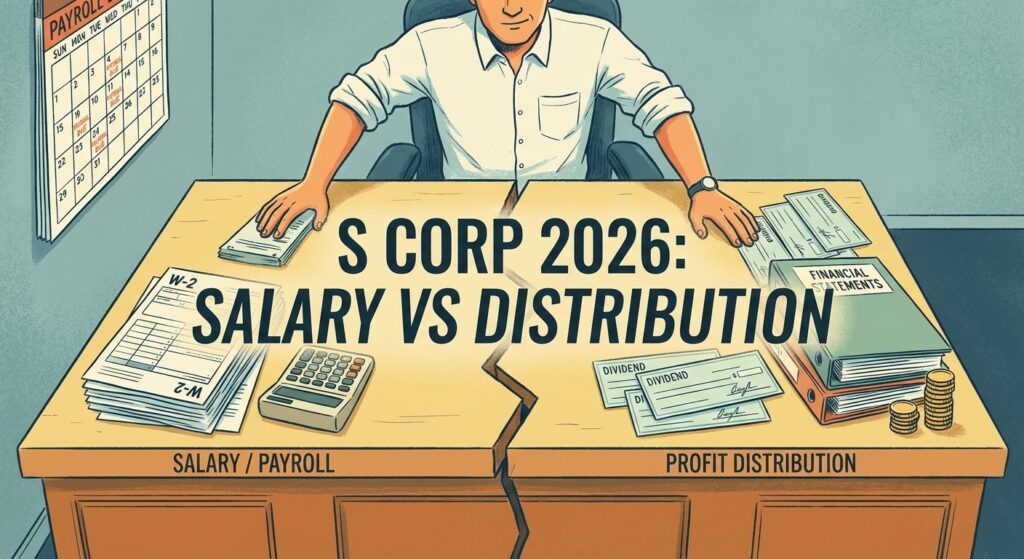
S Corp Salary vs. Distribution: What Every Business Owner Needs to Know for 2026
If you own a small business or are considering changing your business structure, understanding the difference between S Corporation salary and distributions is essential — especially for tax season 2026. With the IRS intensifying compliance measures and new thresholds on the horizon, now is the time for business owners to ensure they are paying themselves in a strategic, compliant way. In this guide, we break down what salary vs. distributions mean for S Corps, how the IRS evaluates “reasonable compensation,” common mistakes, actionable examples, and what you can do to minimize risk while maximizing benefits.
Table of Contents
- What Is an S Corp Salary?
- What Is an S Corp Distribution?
- IRS Rules and Reasonable Compensation Explained (2026)
- Salary vs. Distribution: Examples and 2026 Tax Impact
- Key FAQs and Common Mistakes to Avoid
- How to Calculate the Right Salary in 2026
- Key Takeaways
- Next Steps and Resources
What Is an S Corp Salary?
An S Corporation salary is the taxable wage a shareholder-employee is paid for services actually performed for the company. This salary is subject to payroll taxes (Social Security and Medicare, totaling 15.3%), federal and state income tax, and unemployment taxes. The IRS requires S Corp owners who work in the business to pay themselves a “reasonable salary” for the work they perform.
- Salaries must be processed through payroll with withholdings.
- You must issue W-2s at year end for all employees, including yourself.
- Taking a low or zero salary is a red flag for IRS audits.
What Is an S Corp Distribution?
A distribution is the portion of S Corporation profits paid to shareholders after reasonable salaries have been paid. Distributions are not subject to employment (FICA) taxes, but are reported on Schedule K-1 and flow through to your individual tax return. Distributions must be proportional to each owner’s share in the company.
- Distributed profits may be taken at any point in the year (usually quarterly or annually).
- They are taxed as ordinary income but do not incur self-employment/social security taxes.
- Distributions should only occur if the S Corp has adequate profit after all necessary business expenses and reasonable salaries.
IRS Rules and Reasonable Compensation Explained (2026)
The IRS requires that S Corporation owner-employees be paid a “reasonable compensation” for services provided before taking any distributions. In 2026, as in previous years, this is a frequent audit trigger. Reasonable salary is evaluated based on:
- Industry standards and job roles
- Geographic location
- The time and effort devoted to the business
- Economic realities of your business
The IRS uses Form 1120-S and payroll filings to evaluate if S Corp owners are under-reporting their salary to avoid payroll taxes. If caught, substantial back taxes, penalties, and interest may be owed (IRS S Corp Guidance).
Table 1: Example of Reasonable Salary by Industry (2026 Estimates)
| Industry | Role | Typical Salary |
|---|---|---|
| Professional Services | CPA/Accountant | $80,000 – $140,000 |
| IT/Consulting | Senior Consultant | $100,000 – $170,000 |
| Construction | Project Manager | $65,000 – $120,000 |
Source: Bureau of Labor Statistics, 2026 projections
Salary vs. Distribution: Examples and 2026 Tax Impact
Let’s look at a real-world example for 2026:
- Total S Corp profit: $120,000
- Owner’s reasonable salary: $80,000
- Available distribution: $40,000
Table 2: 2026 Payroll vs. Distribution Tax Summary
| Type | Amount | Subject to Payroll Taxes? |
|---|---|---|
| Salary (W-2) | $80,000 | Yes (~15.3%) |
| Distribution | $40,000 | No |
If the owner had paid a lower salary (e.g., $30,000) and took a $90,000 distribution, the IRS may penalize the owner and reclassify part of the distribution as unpaid salary — leading to back taxes and fines.

Key FAQs and Common Mistakes to Avoid
- What happens if I don’t take a salary?
- The IRS will likely penalize you and require payment of back payroll taxes, plus significant penalties and interest.
- Can I split salary and distributions however I want?
- No. You must first pay a reasonable salary before taking distributions. All distributions must be proportional to ownership shares.
- Are distributions ever tax-free?
- If distributions exceed your basis (usually total contributions plus profits not previously withdrawn), the excess is taxable as capital gains. See IRS Pub 542.
- How do I prove a salary is reasonable?
- Document your job responsibilities, industry salary surveys, hours worked, and market conditions. Consult an accountant if unsure.
How to Calculate the Right Salary in 2026
Steps to determine reasonable salary for your S Corp:
- Research what someone in your role and industry earns using BLS.gov.
- Consider company size and profitability.
- Assess the scope of your involvement (hours, duties, expertise).
- Document your analysis and keep it with your tax records.
- Consult CPA or specialized S Corp tax advisor if unsure.
Make adjustments each year to reflect changes in your business, labor markets, and IRS guidance. For more, see our Ultimate 2026 S Corp Salary Guide.
Key Takeaways
- S Corp owners must pay themselves a fair, reasonable salary before taking any distributions.
- Distributions save on payroll taxes, but aggressive splits can trigger audits and penalties.
- Document your salary calculations and update them regularly.
- Stay updated with IRS and state tax changes for 2026.
Next Steps and Resources
- Assess your 2026 compensation and run scenarios with a tax professional.
- Review the IRS S Corporation Center.
- Read our in-depth guides:
Additional External Resources
- SBA Guide: Paying Yourself
- National Association of Tax Professionals
- SCORE Small Business Help
- IRS Publication 535 – Business Expenses
For personalized advice for your situation, schedule a consultation with Uncle Kam’s team of tax experts today!

