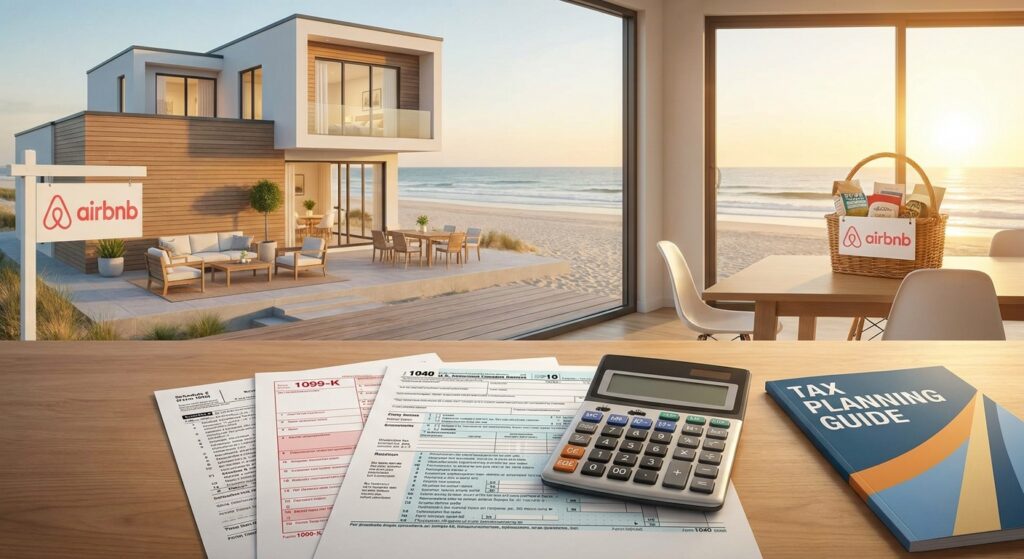
Myrtle Beach Airbnb Taxes 2026: Complete Guide for Property Owners & Investors
Hosting an Airbnb property in Myrtle Beach can generate substantial income, but myrtle beach airbnb taxes create real complexity for property owners. For the 2026 tax year, short-term rental hosts must navigate self-employment taxes, Schedule C reporting, quarterly estimated payments, and detailed deduction tracking. The 2026 FIFA World Cup expected to boost bookings across the US also means increased scrutiny from tax authorities on rental income. Understanding your full tax obligations now will protect you from costly penalties and missed deductions. This information is current as of April 27, 2026. Tax laws change frequently. Verify updates with the IRS or a tax professional if reading this later.
Table of Contents
- Key Takeaways
- Are Airbnb Earnings Taxable in Myrtle Beach?
- How Much Self-Employment Tax Will You Owe?
- What Forms Must You File?
- When Are Quarterly Estimated Taxes Due?
- What Expenses Can You Deduct?
- Tax Reduction Strategies for Myrtle Beach Hosts
- Uncle Kam in Action
- Next Steps
- Frequently Asked Questions
Key Takeaways
- Airbnb income is fully taxable; you must report even small amounts on Schedule C.
- Self-employment tax for 2026 totals 15.3% on net rental income above $400.
- Quarterly estimated taxes are due April 15, June 16, September 15, and January 15, 2027.
- You can deduct mortgage interest, property taxes, utilities, repairs, and cleaning costs.
- A Solo 401(k) can cut your tax bill by up to $24,500 annually in 2026.
Are Airbnb Earnings Taxable in Myrtle Beach?
Quick Answer: Yes. Every dollar earned from Airbnb rentals in Myrtle Beach is taxable income, regardless of amount. The IRS requires reporting even if you earn under $1,000 annually.
There is no minimum income threshold for Airbnb tax reporting. Whether you rented your Myrtle Beach property for 10 days or 200 days in 2026, the IRS expects you to report that income. The IRS defines short-term rental income as income from renting real property for periods of less than 15 days or more if not furnished by the taxpayer.
Federal Reporting Requirements
Airbnb and other platforms issue Form 1099-K when your rental transactions exceed certain thresholds. The IRS receives a copy of this form. If you fail to report the income on your tax return, the IRS will likely notice the discrepancy during processing and send you a notice.
South Carolina State Tax Obligations
South Carolina does not have a state-specific short-term rental tax, but you must report rental income on your state tax return. South Carolina applies income tax at rates between 0% and 7% depending on your overall income. As a Myrtle Beach host, you’ll file Form SC 1040 (state version of your federal 1040) alongside your federal return.
How Much Self-Employment Tax Will You Owe?
Quick Answer: For 2026, self-employment tax is 15.3% on net rental income: 12.4% for Social Security (up to $184,500) and 2.9% for Medicare (no cap).
Unlike W-2 employees who split payroll taxes with employers, self-employed Airbnb hosts pay both the employee and employer portions. On $100,000 in net rental income, you’ll owe roughly $15,300 in self-employment taxes alone, plus regular federal income tax.
Calculating Your Exact Self-Employment Tax Liability
Use our self-employment tax calculator to estimate your 2026 obligation based on your projected rental income. The calculation requires:
- Your net profit from Schedule C (gross rental income minus expenses)
- Deductible home office or business expenses
- Any W-2 income from other employment
Pro Tip: You can deduct half of your self-employment tax on your 1040. On a $15,300 SE tax bill, that’s a $7,650 deduction that lowers your taxable income and federal income tax liability.
Hosts earning above the $184,500 Social Security wage cap will see lower SE taxes on income beyond that threshold because Medicare tax (2.9%) applies but not Social Security tax (12.4%).
What Forms Must You File?
Quick Answer: All Myrtle Beach Airbnb hosts must file Schedule C with Form 1040. If you owe self-employment tax above $1,000, also file Schedule SE.
Schedule C (Profit or Loss from Business)
This is your primary tax form for Airbnb income. Schedule C requires you to list gross rental income, itemize deductible expenses, and calculate net profit. Rental income includes all payments from guests minus refunds or chargebacks. You’ll also report depreciation if you claim it as a deduction.
Schedule SE (Self-Employment Tax Calculation)
Schedule SE automatically calculates your self-employment tax based on your Schedule C net profit. You’re required to file SE if your net self-employment income exceeds $400 for the year. The form accounts for the allowable deduction of half your SE tax.
State Tax Forms
South Carolina requires Form SC 1040 (state income tax return) and Schedule SC C (South Carolina business income schedule) if you file a federal Schedule C. These mirror federal reporting but apply South Carolina tax rates.
Pro Tip: Keep detailed records of all rental income and expenses throughout 2026. Airbnb and property management platforms provide year-end summaries, but your personal records are what the IRS wants to see if audited.
When Are Quarterly Estimated Taxes Due?
Quick Answer: Estimated taxes are due April 15, June 16, September 15, and January 15, 2027. Missing a deadline triggers IRS penalties and interest.
Because Airbnb hosts don’t have taxes withheld like W-2 employees, you must make quarterly Form 1040-ES estimated tax payments. These payments cover both income tax and self-employment tax obligations.
How to Calculate Quarterly Payments
Estimate your total annual rental profit, multiply by your expected tax rate (roughly 25–30% for most hosts including federal, self-employment, and state taxes), then divide by four. If you expect $100,000 in net rental income and a 28% total tax rate, you’d owe about $7,000 per quarter.
| Quarter | Due Date | Tax Period |
|---|---|---|
| Q1 2026 | April 15, 2026 | January 1 – March 31 |
| Q2 2026 | June 16, 2026 | April 1 – May 31 |
| Q3 2026 | September 15, 2026 | June 1 – August 31 |
| Q4 2026 | January 15, 2027 | September 1 – December 31 |
Payment Methods
You can pay estimated taxes electronically via IRS.gov, by phone, or by mail using Form 1040-ES. Electronic payment is fastest and provides confirmation of receipt, protecting you if a deadline issue arises later.
What Expenses Can You Deduct?
 Free Tax Write-Off Finder
Quick Answer: Ordinary and necessary business expenses reduce your taxable profit. Common deductions include mortgage interest, property taxes, utilities, repairs, insurance, and cleaning.
The key test for any expense: Is it ordinary for Airbnb hosting, and is it necessary to operate your rental business? Deductible expenses directly reduce your Schedule C net profit, lowering both income tax and self-employment tax.
Major Deductible Categories for Myrtle Beach Hosts
- Mortgage Interest: Only the interest portion (not principal) on loans for the Myrtle Beach property is deductible.
- Property Taxes: All local property taxes on the Airbnb property qualify.
- Utilities and Insurance: Electric, water, gas, internet, cable, and landlord insurance.
- Repairs and Maintenance: Fixing broken appliances, painting, landscaping, and seasonal maintenance.
- Cleaning and Laundry: Professional cleaning between guests and laundry service costs.
- Depreciation: The IRS lets you deduct a portion of the building cost over 27.5 years (not land).
- Supplies and Equipment: Linens, towels, kitchen items (under $2,500), and furniture replacements.
- Professional Services: Accountant, tax prep, property management fees, and legal advice.
Pro Tip: Depreciation is a powerful deduction even though you never pay it in cash. On a $300,000 property purchased in 2026, you can deduct roughly $10,900 annually for 27.5 years, reducing taxes without reducing your cash flow.
Expenses You Cannot Deduct
Personal capital improvements (like a new roof or HVAC system) must be depreciated over time, not deducted immediately. Meals and entertainment are not deductible. Principal payments on mortgages are personal debt reduction, not business expenses. Personal use of the property eliminates deductions for time periods when you occupy it.
Tax Reduction Strategies for Myrtle Beach Hosts
Quick Answer: A Solo 401(k) allows you to save up to $24,500 annually in pre-tax contributions, cutting your 2026 tax bill by thousands while building retirement savings.
Beyond maximizing deductions, Myrtle Beach Airbnb hosts can implement structured strategies to legitimately reduce self-employment and income tax obligations. These strategies work within IRS rules and are audited frequently, so proper documentation is essential.
Strategy 1: Solo 401(k) for Self-Employed Hosts
If you’re the only owner and employee of your Airbnb hosting business, a Solo 401(k) offers powerful tax benefits. In 2026, you can contribute up to $24,500 as an employee, plus up to 25% of net self-employment income as an employer contribution (limited by a $360,000 annual compensation cap). Combined, this could reduce your taxable income by $40,000–$50,000 or more, saving thousands in taxes.
Strategy 2: SEP-IRA Alternative
A Simplified Employee Pension (SEP-IRA) lets you contribute up to 25% of net self-employment income, capped at $72,000 annually. It’s simpler to set up than a Solo 401(k) but offers lower contribution limits. For hosts earning $150,000+, a Solo 401(k) typically saves more in taxes.
Strategy 3: Home Office Deduction
If you maintain a dedicated office in your home for managing your Airbnb business (booking, accounting, guest communication), you can deduct that space. Using the simplified method, you claim $5 per square foot (maximum 300 sq ft or $1,500 per year). Using the actual expense method, you calculate the percentage of your home’s mortgage interest, utilities, insurance, and repairs that apply to your office.

Uncle Kam in Action: How Sarah Saved $8,400 on 2026 Airbnb Taxes
Sarah, a real estate investor, purchased a beachfront condo in Myrtle Beach in early 2025 with plans to operate it as an Airbnb. In 2026, she generated $120,000 in rental income. Without proper tax planning, her tax bill would have been substantial.
Working with Uncle Kam’s tax advisory team, Sarah implemented three key strategies. First, she opened a Solo 401(k) and contributed $30,000 (combining employee and employer contributions). Second, she meticulously documented $32,000 in deductible expenses including mortgage interest ($18,000), property taxes ($6,500), utilities ($3,500), and repairs ($4,000). Third, she used the simplified home office deduction for her 200-square-foot study where she managed bookings and finances, adding $1,000 to deductions.
Her calculations: Gross income of $120,000 minus $63,000 in total deductions (Solo 401(k) + documented expenses + home office) = $57,000 taxable profit. At a combined federal, self-employment, and state tax rate of roughly 33%, her 2026 tax liability was approximately $18,800. Without these strategies, her liability would have exceeded $27,200. Sarah saved $8,400 in federal and state taxes while building retirement savings of $30,000.
See more real client results and how strategic tax planning transforms short-term rental ownership.
Next Steps
Take these actions before the 2026 tax year ends to optimize your Myrtle Beach Airbnb tax situation:
- Open a dedicated business bank account and track all rental income and expenses in real time.
- Calculate and pay your Q3 (September 15) and Q4 (January 15) estimated taxes to avoid penalties.
- Review Myrtle Beach tax preparation services options to ensure compliance and maximize deductions.
- Evaluate a Solo 401(k) or SEP-IRA before year-end if you haven’t opened one yet.
- Document all business expenses and keep receipts organized for tax filing and potential audits.
Frequently Asked Questions
Do I have to report small Airbnb income under $1,000?
Yes. The IRS expects all income to be reported, regardless of amount. Failure to report invites audits and penalties. Even $500 in rental income must appear on Schedule C.
Can I deduct losses from my Airbnb property?
Yes, but with limitations. If expenses exceed income, you report a business loss on Schedule C. However, the IRS scrutinizes rental properties showing losses year after year, viewing them as hobbies rather than businesses. Maintain clear documentation showing profit motive and legitimate business operations.
What happens if I miss an estimated tax payment deadline?
The IRS charges penalties and interest on underpayment. The penalty varies but typically runs 4–8% annually. If you miss a Q2 payment in June, you accrue penalties from June 16 through April 15 of the next year when taxes are filed. Paying late is better than not paying at all, as it shows good-faith effort.
Can I use a business entity like an LLC to reduce Airbnb taxes?
An LLC provides liability protection but does not automatically reduce taxes. A single-member LLC is treated as a disregarded entity by the IRS, meaning your Airbnb income still flows through your personal return on Schedule C. You’d need to elect S-Corp taxation through an LLC to see self-employment tax savings, which requires reasonable salary documentation and additional tax filings.
How does the 2026 World Cup impact my Airbnb taxes?
The 2026 FIFA World Cup (June–July 2026) is expected to drive massive booking surges in US host cities, but Myrtle Beach is not a host city. However, increased tourism nationwide may attract more visitors to Myrtle Beach from World Cup attendees. Higher bookings mean higher income and higher taxes. Ensure you’re making adequate quarterly estimated payments to avoid penalties on unexpected income spikes.
What records should I keep for an IRS audit?
Keep bank statements, credit card receipts, invoices, canceled checks, utility bills, property tax statements, mortgage statements, and Airbnb host statements for at least three years (seven years is safer). Maintain a rental log showing dates occupied, days rented, and use classification. Photograph major repairs and improvements with dates and costs.
Should I hire a tax professional for Airbnb tax planning?
Absolutely. A tax professional specializing in rental properties identifies deductions you’d miss, ensures proper quarterly payments, and structures retirement savings optimally. The fee ($1,500–$3,000 annually) is tax-deductible and typically saves far more than it costs through better planning and reduced audit risk.
Related Resources
- Myrtle Beach Tax Preparation Services
- Real Estate Investor Tax Strategies
- Self-Employed Tax Planning Guide
- IRS Publication 587: Business Use of Your Home
- IRS Schedule C Instructions
Last updated: April, 2026

