How to Reduce Taxes as an Uber Driver: Complete 2026 Tax Strategy Guide
As an Uber driver, reducing your tax liability requires a strategic approach beyond simply reporting your 1099 income. For the 2026 tax year, self-employed rideshare drivers face a 15.3% self-employment tax rate on net earnings, plus federal income tax. However, smart tax planning can save thousands annually.
Table of Contents
- Key Takeaways
- Understand How Uber Driver Taxes Work
- Maximize Your Uber Driver Deductions
- Mileage vs. Actual Expenses: Which Method Saves More?
- Should You Form an LLC or S-Corp as an Uber Driver?
- Plan Ahead with Quarterly Estimated Tax Payments
- Retirement Accounts: Your Secret Tax Weapon
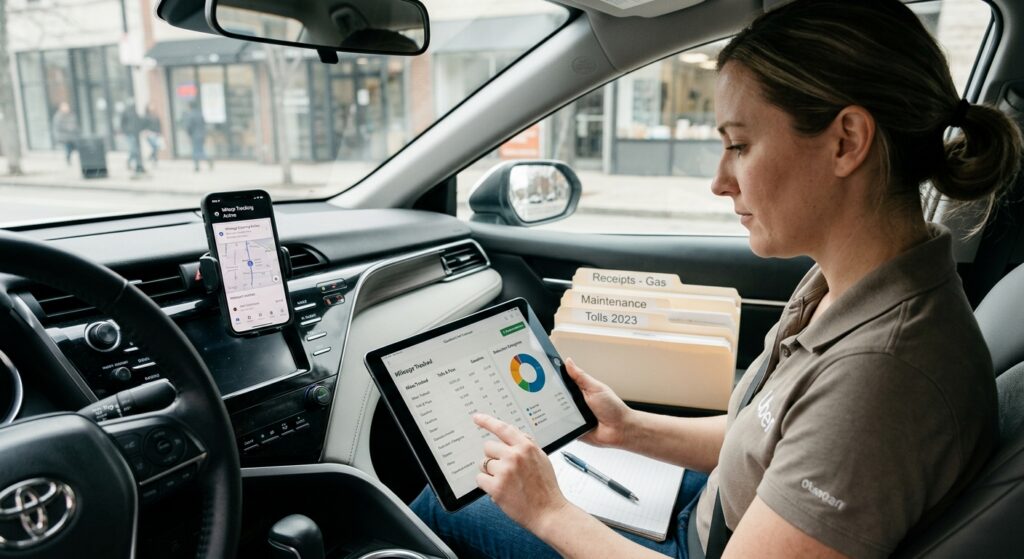
- Practical Record-Keeping Tips for Uber Drivers
- Uncle Kam in Action
- Next Steps
- Frequently Asked Questions
Key Takeaways
- Uber drivers pay 15.3% self-employment tax on net income, but smart deductions can significantly reduce your tax burden.
- Tracking mileage and maximizing Schedule C deductions is the first step toward serious tax savings.
- If your net income exceeds $50,000-$60,000 annually, an S-Corp election may save thousands in self-employment taxes.
- Contributing to a Solo 401(k) or SEP IRA can reduce your 2026 taxable income by up to $72,000.
- Quarterly estimated tax payments prevent penalties and keep your tax liability manageable throughout the year.
Understand How Uber Driver Taxes Work
Quick Answer: Uber drivers file Schedule C as self-employed contractors, pay 15.3% self-employment tax, and report income via 1099-K and 1099-NEC forms from Uber.
Unlike traditional employees, Uber drivers are classified as independent contractors. This means you receive a 1099-NEC (or 1099-K) instead of a W-2. Uber reports your gross earnings without withholding any taxes. For the 2026 tax year, this creates both challenges and opportunities.
Your primary tax obligation involves self-employment tax. This covers Social Security and Medicare taxes. For 2026, the rate is 12.4% for Social Security (on net earnings up to $184,500) plus 2.9% for Medicare (with no income cap), totaling 15.3%. On $100,000 of net income, you would owe approximately $15,300 in self-employment tax alone, before federal income tax.
What Makes Uber Driver Taxes Different?
Traditional W-2 employees split Social Security taxes with their employer—each pays 6.2%. Self-employed Uber drivers pay both halves. You’re responsible for the entire 12.4% on top of the 2.9% Medicare tax. This is the single largest tax burden for rideshare drivers.
The IRS does provide one deduction: you can deduct half of your self-employment tax as an above-the-line deduction. On $100,000 of net self-employment income, this deduction reduces your tax bill by approximately $7,650, lowering the effective cost to roughly $12,800. While helpful, this doesn’t eliminate the underlying problem.
Filing Schedule C: Your Foundation
All Uber drivers file Schedule C (Profit or Loss from Business) with their Form 1040. Your Schedule C shows your gross Uber income minus allowable deductions, resulting in your net profit. This net profit becomes the foundation for calculating self-employment tax and federal income tax.
The key insight: lowering your net profit through legitimate deductions is the most powerful lever for reducing taxes. Every dollar of deductions eliminates the need to pay 15.3% self-employment tax plus your federal income tax rate (typically 10-37%).
Maximize Your Uber Driver Deductions
Quick Answer: Uber drivers can deduct vehicle expenses, gas, insurance, phone/data, tolls, parking, maintenance, and home office costs. Choose between standard mileage or actual expenses to maximize your deduction.
Deductions are your first line of defense against high self-employment taxes. The IRS allows you to deduct all ordinary and necessary business expenses. For Uber drivers, this includes both your vehicle-related costs and operational expenses.
Common Uber Driver Write-Offs You Shouldn’t Miss
- Vehicle maintenance and repairs (oil changes, tire replacement, brake service).
- Car insurance (commercial rideshare coverage).
- Vehicle registration and licensing fees.
- Gas or fuel costs (if using actual expense method).
- Car wash and cleaning supplies.
- Phone plan and data for the Uber app.
- Tolls and parking fees incurred while driving.
- In-car supplies (bottled water, phone chargers, tissues).
- Home office deduction (if you use space for administrative work).
- Professional tax and accounting fees.
- Business-use vehicle depreciation or lease payments.
Pro Tip: Many Uber drivers forget to deduct in-car supplies and cleaning costs because they seem minor. However, these expenses add up throughout the year. Keep receipts for every business purchase, no matter how small.
The IRS scrutinizes rideshare driver deductions, so documentation is critical. Maintain detailed records of all business expenses, including dates, amounts, and business purpose. Use accounting apps designed for gig workers to simplify tracking.
Mileage vs. Actual Expenses: Which Method Saves More?
Quick Answer: Most Uber drivers save more using actual expenses because Uber involves high fuel consumption. Compare both methods to maximize your deduction.
The IRS offers two vehicle deduction methods for 2026: the standard mileage rate or actual expenses. Your choice significantly impacts your total tax savings.
Standard Mileage Rate Method
The standard mileage rate provides a fixed deduction per business mile. While the 2026 official rate hasn’t been published yet, the 2025 rate was $0.675 per mile. This rate typically increases annually. To use this method, simply multiply your business driving miles by the current rate.
Example: If you drove 30,000 business miles in 2026, your deduction would be approximately $20,250 (using estimated 2026 rate). This method is simple because you don’t need to track individual gas, maintenance, or repair expenses.
Actual Expense Method
With actual expenses, you deduct all vehicle costs: gas, insurance, repairs, maintenance, depreciation, and registration. For Uber drivers with high mileage and fuel consumption, this often yields larger deductions than the standard mileage rate.
Example: 30,000 miles driven, consuming roughly 1,000 gallons at $4/gallon ($4,000 gas) plus insurance ($1,200), maintenance ($1,500), and depreciation ($7,000) equals $13,700—before calculating the business-use percentage. If 90% is business use, your deduction would be $12,330.
| Method | 30,000 Business Miles | Best For |
|---|---|---|
| Standard Mileage (2025: $0.675/mile) | ~$20,250 | Simpler tracking; older vehicles |
| Actual Expenses (Gas + Insurance + Maintenance + Depreciation) | ~$12,330-$18,000 (varies) | Newer cars; detailed record keeping |
For most Uber drivers, the standard mileage rate yields a larger deduction. However, if you drive an expensive newer vehicle, calculate both methods to determine which saves more on your 2026 return.
Should You Form an LLC or S-Corp as an Uber Driver?
Quick Answer: If your net Uber income exceeds $50,000-$60,000 annually, an S-Corp election can save $4,000-$8,000+ in self-employment taxes. Below that threshold, a Solo 401(k) is more cost-effective.
Many Uber drivers ask whether forming an LLC or electing S-Corp status reduces taxes. The answer is nuanced. An LLC is primarily a liability protection structure, not a tax reduction tool. However, an LLC can elect to be taxed as an S-Corporation—which does create significant self-employment tax savings.
How S-Corp Election Reduces Self-Employment Tax
As a sole proprietor, 100% of your net Uber income is subject to the 15.3% self-employment tax. An S-Corp election allows you to split your income into two categories:
- Reasonable salary: Subject to 15.3% self-employment tax (and payroll taxes).
- Distributions: NOT subject to self-employment tax.
Example: $100,000 net Uber income. As a sole proprietor, you owe $15,300 in self-employment tax. As an S-Corp, pay yourself a reasonable salary of $60,000 (subject to $9,180 in combined payroll taxes) and take $40,000 in distributions (no self-employment tax). The savings on that $40,000 is $6,120 annually.
However, the IRS scrutinizes S-Corp salaries closely. The salary must reflect what you would pay someone else to do the same work. Uber drivers typically can justify salaries between $50,000-$70,000 depending on driving hours and local market rates.
S-Corp Costs and Complexity
S-Corp election requires additional accounting and compliance costs: quarterly payroll filings, corporate tax returns, and increased bookkeeping. Annual costs typically run $1,500-$3,000. Only pursue S-Corp status if the self-employment tax savings exceed these costs.
Pro Tip: Use our LLC vs S-Corp Tax Calculator for Astoria to estimate your exact tax savings before electing S-Corp status.
Plan Ahead with Quarterly Estimated Tax Payments
 Free Tax Write-Off Finder
Quick Answer: Estimate your 2026 net income, calculate total tax (self-employment + federal income tax), divide by four, and pay quarterly by April 15, June 15, Sept 15, and Jan 15 to avoid penalties.
Unlike W-2 employees who have taxes withheld continuously, Uber drivers must estimate taxes and pay quarterly. Missing quarterly payments triggers the Underpayment of Estimated Tax penalty—currently 8% annually. This adds unnecessary cost to your tax burden.
How to Calculate Quarterly Estimated Taxes
Step 1: Estimate your 2026 net profit. Based on current earnings, project annual net income after deductions.
Step 2: Calculate self-employment tax. Multiply net profit by 92.35% (to account for the SE tax deduction), then multiply by 15.3%.
Step 3: Estimate federal income tax. Use your expected tax bracket (10% for most drivers earning under $50,000; 12% for $50,000-$95,000).
Step 4: Total and divide by four. Add SE tax and income tax, then divide by four for quarterly payments.
Example: $60,000 estimated net income. Self-employment tax: $60,000 × 92.35% × 15.3% = $8,486. Federal income tax (12% bracket): $60,000 × 12% = $7,200. Total: $15,686. Quarterly payment: $3,921.
Quarterly Payment Deadlines for 2026
- Q1 (Jan-March): Due April 15, 2026
- Q2 (April-June): Due June 15, 2026
- Q3 (July-Sept): Due September 15, 2026
- Q4 (Oct-Dec): Due January 15, 2027
Pro Tip: Set aside 25-30% of your weekly Uber earnings in a separate high-yield savings account. This creates a quarterly tax fund that’s ready when payments are due, eliminating financial stress.
Retirement Accounts: Your Secret Tax Weapon
Quick Answer: For 2026, Uber drivers can contribute up to $72,000 to a SEP IRA or Solo 401(k), reducing taxable income dollar-for-dollar while building retirement savings.
Retirement account contributions offer the most powerful tax reduction for self-employed Uber drivers. Every dollar contributed reduces your taxable income immediately, lowering self-employment tax AND federal income tax.
Solo 401(k): Best for High-Earners
A Solo 401(k) allows contributions in two forms:
- Employee deferral: Up to $24,500 (or $32,500 if age 50+) in 2026.
- Employer contribution: Up to 25% of net self-employment income (after SE tax deduction).
Combined limit: $72,000 per year (or $80,000 if age 50+). For an Uber driver earning $80,000 net, you could contribute approximately $50,000 to a Solo 401(k), reducing taxable income by that amount.
SEP IRA: Simplest Option
A Simplified Employee Pension (SEP) IRA allows contributions of up to 25% of net self-employment income (after SE tax deduction), with a maximum of $72,000 in 2026. This is simpler than a Solo 401(k) because it requires minimal paperwork and no annual compliance filings.
Example: $60,000 net Uber income allows approximately $14,000 in SEP IRA contributions. This lowers your taxable income to $46,000, saving roughly $9,180 in combined self-employment and federal income taxes (assuming 12% bracket).
Traditional IRA: Supplemental Option
Even if you contribute to a SEP IRA, you can contribute $7,500 to a Traditional IRA for 2026 (or $8,600 if age 50+), provided your modified adjusted gross income stays below $153,000 (single) or $242,000 (married filing jointly).
Practical Record-Keeping Tips for Uber Drivers
Quick Answer: Use dedicated apps to track mileage, maintain expense spreadsheets, photograph receipts, and separate business and personal finances for IRS compliance.
The IRS expects self-employed workers to maintain detailed records. For Uber drivers, weak documentation is a red flag that invites audits. Implement these systems immediately.
Mileage Tracking Systems
Apps like Stride Tax, MileIQ, and TaxAct automatically track business mileage using your phone’s GPS. Start tracking at the beginning of each day, and these apps log your routes, distances, and timestamps. At year-end, you have comprehensive documentation ready for tax filing.
Alternative: Maintain a mileage log with start/end odometer readings, dates, purposes, and distances. Many successful drivers combine automatic tracking with backup logs for verification.
Expense Documentation
Create a spreadsheet tracking all business expenses by category: fuel, maintenance, insurance, tolls, parking, supplies. Use your phone camera to photograph receipts immediately after purchase. Store receipts in a folder (digital or physical) organized by month.
Accounting software like QuickBooks Self-Employed or Wave automates this process. These tools categorize expenses, create reports, and estimate your quarterly tax liability in real-time.
Bank Separation Strategy
Open a separate business checking account for Uber income and expenses. This eliminates mixing personal and business finances, making tax filing and audit defense straightforward. It also simplifies quarterly expense reconciliation.

Uncle Kam in Action: How Marcus Saved $8,400 as an Uber Driver
Client Profile: Marcus is a 42-year-old Uber driver in New York earning $85,000 gross annually from ride-sharing. He had been filing as a sole proprietor, claiming minimal deductions, and paying full self-employment tax on nearly all income.
The Challenge: Marcus was shocked when his 2025 tax bill exceeded $18,500. He felt trapped: driving more hours to earn money, only to send thousands to the IRS. He knew other drivers paying less tax but didn’t understand how.
Uncle Kam’s Solution:
First, we implemented a comprehensive mileage tracking system using a GPS app, revealing Marcus drove 32,000 business miles annually. This translates to roughly $21,600 in standard mileage deductions for 2026.
Second, we identified $6,200 in overlooked deductions: car insurance, phone/data plan, tolls, parking, and vehicle maintenance. Combined with the mileage deduction, his Schedule C profit dropped from $85,000 to approximately $57,000.
Third, we established a Solo 401(k) with a $42,000 contribution for 2026, reducing his taxable income to $15,000.
The Results:
- 2026 self-employment tax: Reduced from ~$13,005 to ~$2,297.
- Federal income tax: Reduced from ~$7,000 to ~$1,800 (10% bracket on $15,000).
- Total 2026 tax: ~$4,097 (vs. ~$18,500 previously).
- Tax savings: $8,400+
- Fee paid to Uncle Kam: $1,200.
- First-year ROI: 700%+
Marcus now views his taxes strategically, implementing monthly deduction tracking and quarterly payment planning. He’s reinvesting the $8,400 savings into vehicle maintenance, ensuring reliable service and longevity.
Next Steps
Start your tax reduction journey today with these actionable steps:
- Download a mileage tracking app this week. Begin logging every business mile driven to maximize your vehicle expense deduction.
- Create an expense spreadsheet or use QuickBooks Self-Employed. Start photographing receipts for all business purchases—fuel, maintenance, tolls, parking, insurance, and supplies.
- Calculate your estimated quarterly taxes and set up a tax reduction strategy with a tax professional. Missing quarterly payments triggers penalties.
- Evaluate retirement account options. If your net income exceeds $50,000, open a Solo 401(k) or SEP IRA before December 31, 2026 to reduce your 2026 taxable income.
- Consult a tax professional about S-Corp election if your net income consistently exceeds $60,000. We offer personalized tax advisory services for rideshare drivers.
Frequently Asked Questions
Can Uber drivers write off car payments?
No, car payments themselves are not deductible. However, depreciation on the vehicle is deductible if you use the actual expense method. Lease payments ARE deductible as an operating expense when using actual expenses. The standard mileage rate implicitly covers depreciation.
Is it better to take the standard mileage rate or actual expenses?
For most Uber drivers, the standard mileage rate yields larger deductions because you drive high volumes. Calculate both methods annually to verify. The standard mileage rate (estimated $0.675/mile in 2026) typically beats actual expenses for drivers with 25,000+ miles.
Do Uber drivers have to pay quarterly estimated taxes?
If you expect to owe $1,000+ in taxes for 2026, yes. Quarterly estimated tax payments are due April 15, June 15, September 15, and January 15. Failing to pay triggers the Underpayment of Estimated Tax penalty (currently 8% annually).
Does forming an LLC reduce Uber driver taxes?
An LLC by itself doesn’t reduce taxes—it’s primarily a liability shield. However, electing S-Corp tax status (available for LLCs) can save thousands in self-employment taxes if your net income exceeds $50,000-$60,000. Consult a tax professional to evaluate whether S-Corp is right for you.
What happens if I get audited as an Uber driver?
The IRS audits self-employed workers at higher rates than W-2 employees. Strong documentation is your defense: mileage logs, receipt photos, expense spreadsheets, and bank statements. A well-organized record-keeping system makes audits manageable.
Can I deduct car insurance as an Uber driver?
Yes. Commercial rideshare insurance is a legitimate business deduction. However, personal auto insurance is not. Ensure you carry proper commercial coverage and deduct only the rideshare-specific premium.
What about state and local taxes for Uber drivers?
State and local taxes vary significantly. Some states impose additional self-employment taxes or income taxes on gig workers. California drivers face state income tax on all earnings. Contact your state’s tax authority or consult a local tax pro to understand your obligations.
Should I hire a tax professional or do my taxes myself?
For simple solo driving with basic deductions, self-preparation may work. However, if your income exceeds $60,000, you’re considering S-Corp election, or you have multiple revenue streams, professional guidance typically saves more than it costs through optimization and error prevention.
Can Uber drivers deduct in-car supplies and snacks for passengers?
Yes, absolutely. Water bottles, phone chargers, tissues, gum, mints, and other amenities provided to passengers are deductible business expenses. Keep receipts and maintain documentation to support these deductions.
Related Resources
- Self-Employed Tax Strategies for 1099 Contractors
- Business Solutions: Bookkeeping & CFO Services
- Tax Advisory: Personalized Planning & Consulting
- Entity Structuring: LLC, S-Corp, C-Corp Setup
- Tax Prep & Filing: Schedule C & Self-Employment Returns
Last updated: April, 2026
This information is current as of 4/24/2026. Tax laws change frequently. Verify updates with the IRS or a tax professional if reading this later.

