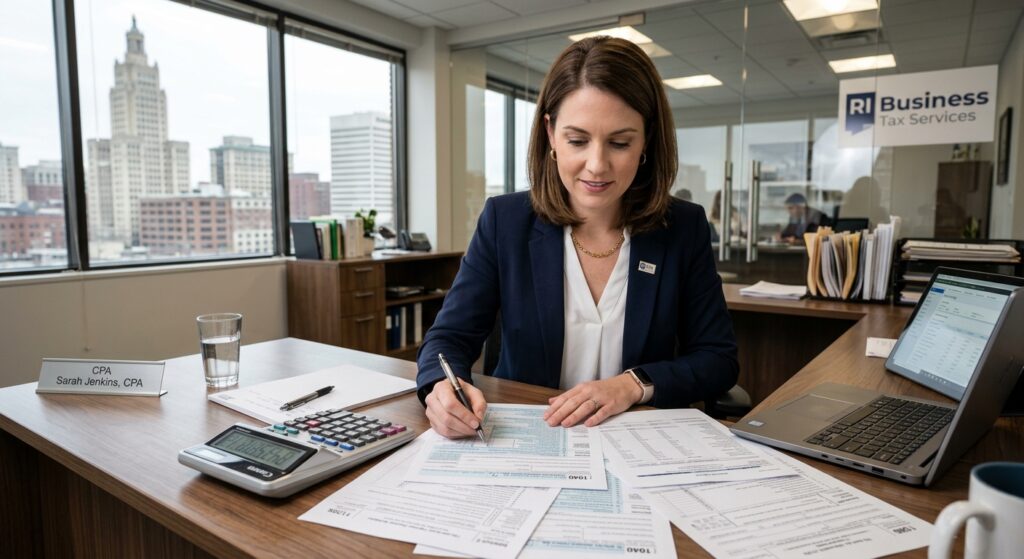
How Much Does a Small Business CPA Cost in Rhode Island for 2026?
If you’re running a small business in Rhode Island, understanding the cost of hiring a CPA is essential for budgeting and tax strategy. When you work with our Rhode Island tax preparation services, you’re investing in professional expertise that pays dividends through tax savings. For the 2026 tax year, small business CPA costs in Rhode Island typically range from $1,000 to $3,000 annually for basic accounting and tax preparation services, while more comprehensive packages including audit, consulting, and strategic planning can reach $3,000 to $7,000 or more. This article breaks down the actual costs you’ll face, what services are included, and how professional guidance delivers measurable return on investment.
Table of Contents
- Key Takeaways
- Typical Small Business CPA Fees in Rhode Island 2026
- What Factors Determine CPA Costs?
- Breaking Down CPA Service Packages by Price
- How CPA Services Generate Tax Savings
- What Are the Real Costs of Not Hiring a CPA?
- When Should Small Business Owners Hire a CPA?
- Uncle Kam in Action
- Next Steps
- Frequently Asked Questions
- Related Resources
Key Takeaways
- Basic CPA services for small businesses in Rhode Island cost $1,000–$3,000 annually in 2026.
- Comprehensive services including consulting can range from $3,000–$7,000+ per year.
- CPAs help unlock federal deductions like the 20% small business deduction available under current tax law.
- Rhode Island’s total tax burden is 9.29%, making professional tax planning critically important.
- CPA fees are often deductible business expenses, reducing your actual out-of-pocket cost.
What Are Typical Small Business CPA Fees in Rhode Island for 2026?
Quick Answer: Small business CPA costs in Rhode Island range from $1,000–$3,000 for basic services to $3,000–$7,000+ for comprehensive packages. Hourly rates typically run $50–$150 per hour depending on experience level.
When you’re looking to hire a CPA in Rhode Island, understanding the pricing structure is your first step. The cost varies significantly based on your business complexity, revenue size, and the specific services you need. For a basic tax return preparation and simple accounting, you can expect to pay on the lower end of the spectrum, around $1,000 to $2,500 annually.
However, if your business has multiple revenue streams, inventory, employees, or significant deductions, costs will climb toward the $3,000 to $5,000 range. This covers more detailed bookkeeping, quarterly tax planning, and more thorough return preparation.
The Fee Structure: Hourly vs. Flat-Fee Models
CPAs in Rhode Island use two primary pricing models. Hourly billing typically ranges from $50 to $150 per hour, depending on the CPA’s experience, credentials, and whether they work for a large firm or operate independently. Flat-fee arrangements are often more attractive for business owners because they provide budget certainty and eliminate the surprise of unexpected billable hours during busy tax season.
- Entry-level CPAs: $50–$75 per hour or $1,200–$2,500 annual flat fee
- Experienced CPAs: $75–$125 per hour or $2,500–$5,000 annual flat fee
- Specialist CPAs: $125–$150+ per hour or $5,000–$7,000+ annual flat fee
Pro Tip: Request a detailed proposal from potential CPAs that outlines flat-fee pricing for specific services. This eliminates billing surprises and allows you to compare multiple firms objectively.
What Factors Determine CPA Costs?
Quick Answer: Your business revenue, entity type, number of employees, complexity of deductions, and need for consulting services all directly impact CPA pricing in Rhode Island.
Not all small businesses are the same, and CPA pricing reflects that reality. Several key factors influence what you’ll actually pay when you hire an accountant in Rhode Island.
Business Revenue and Complexity
A sole proprietor with $50,000 in annual revenue will pay significantly less than a business owner with $500,000 in revenue. The difference isn’t just about the numbers—higher revenue typically means more transactions, multiple revenue streams, and more complex tax situations requiring additional CPA time and expertise.
Business Entity Type
Your business structure significantly affects CPA costs. A sole proprietorship requires a simple Schedule C attached to your personal return. An LLC may require a separate return depending on tax classification. An S-Corporation demands multi-form returns including corporate filings. The more complex your entity, the higher your CPA costs will be for the 2026 tax year.
Number of Employees and Payroll Complexity
If you have employees, your CPA must handle payroll processing, quarterly payroll taxes, and year-end W-2 reporting. Each employee adds complexity and cost to the engagement. Sole proprietors without employees face much simpler requirements.
Breaking Down CPA Service Packages by Price in Rhode Island 2026
Quick Answer: Budget-friendly packages cover tax prep only, while mid-tier options add bookkeeping, and premium packages include quarterly planning and strategy consulting.
Understanding what services fall into different price tiers helps you choose the right package for your business needs. Let’s break down what you can expect at each cost level.
| Service Package | Annual Cost (RI 2026) | What’s Included |
|---|---|---|
| Basic Tax Prep | $1,000–$1,500 | Business tax return preparation only; minimal bookkeeping; simple Schedule C filing |
| Standard Bookkeeping + Tax | $2,000–$3,000 | Monthly bookkeeping, expense categorization, quarterly tax estimates, tax return prep |
| Premium Planning + Compliance | $4,000–$5,500 | Quarterly tax planning calls, monthly bookkeeping, deduction optimization, strategic consulting |
| Full-Service Advisory | $6,000–$7,500+ | All above plus annual audit, financial statement analysis, business entity strategy, year-round advisory |
Hidden Costs to Understand
Beyond the advertised fee, be aware of potential add-on charges. Many CPAs charge extra for amended returns, state filing requirements, or complex audit situations. Rhode Island businesses may face additional state-specific compliance fees. Ask for a complete fee schedule upfront to avoid surprises.
How Do CPA Services Actually Generate Tax Savings?
Quick Answer: CPAs identify deductions you miss, optimize your business structure, leverage federal credits, and plan quarterly to minimize tax liability throughout the year.
This is the critical question every business owner asks: Does hiring a CPA actually save me money? The answer, for most businesses, is absolutely yes. Here’s how the math works for 2026.
Section 179 Expensing and Bonus Depreciation
For the 2026 tax year, small businesses can deduct up to $2.5 million in equipment and property through Section 179 expensing. Many business owners leave money on the table by not understanding these rules. A CPA helps you identify qualifying purchases—equipment, vehicles, technology—and properly deduct them in the year placed in service. This can save thousands in federal and state income taxes.
The 20% Small Business Deduction
Under current federal tax law, small business owners can deduct up to 20% of their qualified business income. This deduction is available to over 25.9 million small businesses nationwide. A knowledgeable CPA ensures your business qualifies and maximizes this benefit. For a business earning $100,000 in qualified income, this deduction could be worth $20,000 in deductible income reduction.
Optimization of Business Structure
A CPA helps you determine the most tax-efficient business structure. For many self-employed individuals, converting from sole proprietor to S-Corporation election can save thousands. The analysis considers your income level, deduction opportunities, and long-term business growth plans.
Did You Know? A CPA’s fee is itself deductible as a business expense on Schedule C. This means part of what you pay for professional tax guidance reduces your taxable income, lowering your actual cost.
What Are the Real Costs of Not Hiring a CPA?
 Free Tax Write-Off Finder
Quick Answer: Missing deductions, overpaying taxes, and IRS audit risk typically cost far more than professional CPA fees—often 5 to 10 times the investment.
Many small business owners hesitate to hire a CPA because of the upfront cost. This is actually backwards thinking. Consider what DIY tax preparation costs you in missed opportunities and potential penalties.
If you’re self-employed with significant business income, calculate your self-employment tax liability using our self-employment tax calculator to see exactly how much you owe. Many owners are shocked to discover they’re underpaying quarterly estimates, which triggers interest and penalties come April.
The Cost of Missed Deductions
The average small business owner misses 10–20% of available deductions. If your business income is $150,000 and you miss $20,000 in deductible expenses, you’ve just overpaid taxes on an additional $20,000. At a 24% effective tax rate, that’s $4,800 in unnecessary taxes paid. A CPA paying for itself is the understatement of the year.
Audit Risk and Penalties
DIY tax returns prepared by non-professionals carry significantly higher audit risk. If the IRS audits your return and finds errors, you’ll pay back taxes plus interest and penalties. A professionally prepared return represents you better in an audit, and the CPA’s work product carries more credibility with IRS examiners.
When Should Small Business Owners Hire a CPA?
Quick Answer: Hire a CPA when your business revenue exceeds $75,000–$100,000, you have employees, or your tax situation includes multiple income sources.
Not every business owner needs to hire a CPA immediately. Here are the clearest signals that it’s time to bring professional help onboard for the 2026 tax year.
- Your business revenue exceeds $75,000–$100,000 annually
- You have employees and manage payroll
- You’re considering entity conversion from sole proprietor to LLC or S-Corp
- You have investment income, rental properties, or multiple revenue streams
- You’ve been audited or received IRS correspondence
- You’re unsure about quarterly estimated tax payments
Pro Tip: Consider starting with a CPA consultation to assess your specific situation before committing to a full-service engagement. Many Rhode Island CPAs offer complimentary initial consultations.

Uncle Kam in Action: Sarah’s Construction Business Success
Sarah owned a small construction contracting business in Providence, Rhode Island. For three years, she managed her own bookkeeping and filed her taxes with a basic software program. Her annual revenue had grown to $280,000 by 2025.
When her tax bill arrived in April 2026, Sarah was shocked. She owed $52,000 in federal and state taxes. She suspected she was overpaying but didn’t know where to start fixing it. That’s when she reached out to Uncle Kam’s Rhode Island tax preparation team.
Our analysis revealed Sarah was missing critical deductions. She wasn’t properly accounting for vehicle depreciation on her company truck, hadn’t claimed her home office deduction, and was unaware of Section 179 expensing available for her equipment purchases. Additionally, we identified that converting from her current sole proprietor structure to an S-Corporation election would save her approximately $8,400 in self-employment taxes annually.
The Results: For a $3,500 annual engagement fee, Uncle Kam identified $36,000 in missed deductions and strategic planning opportunities. This reduced her 2026 tax liability by approximately $8,640 (assuming a 24% effective tax rate) in the first year alone. The S-Corp strategy will save her $8,400 every subsequent year. Sarah’s investment paid for itself in the first quarter of the following year, and she’s now saving over $16,000 annually through proper planning.
Return on Investment: 146% ROI in year one, with ongoing benefits exceeding $16,000 annually. Sarah is now working with us for quarterly planning calls to ensure we don’t miss any opportunities throughout 2026.
Next Steps
Ready to evaluate whether hiring a CPA is right for your Rhode Island small business? Here’s your action plan for the rest of 2026:
- Step 1: Schedule a complimentary 30-minute consultation with a Rhode Island CPA. Discuss your specific business situation and get a detailed proposal.
- Step 2: Gather your business financial records from 2025 and ask your CPA what deductions you might have missed. Look for quick wins.
- Step 3: Request quarterly planning engagement to stay ahead of 2026 taxes. This prevents year-end surprises and ensures proper estimated payments.
- Step 4: Connect with our business owner resources to access additional tax strategy guides and planning tools.
Frequently Asked Questions
How Much Do CPAs Typically Charge Per Hour in Rhode Island?
CPA hourly rates in Rhode Island range from $50 to $150 per hour depending on experience level. Entry-level CPAs charge $50–$75, experienced CPAs $75–$125, and specialists $125–$150+. For budget certainty, request a flat-fee proposal instead of hourly billing.
What’s the Minimum Business Income That Justifies Hiring a CPA?
Businesses with annual revenue of $75,000–$100,000 typically break even on CPA costs through tax savings and deduction optimization. Below this threshold, automated bookkeeping software combined with tax software may suffice. Above it, professional guidance usually generates measurable return.
Are CPA Fees Tax Deductible?
Yes. CPA fees are deductible as a business expense on your tax return. If you pay $3,000 in CPA fees and you’re in the 24% tax bracket, your actual cost is approximately $2,280 after the tax deduction. This makes professional guidance more affordable than it appears.
Should I Get Quarterly Tax Planning or Just Year-End Preparation?
Quarterly planning is worth the additional investment if you’re likely to owe estimated taxes. Meeting quarterly allows your CPA to identify planning opportunities throughout the year instead of scrambling in March. This prevents underpayment penalties and gives you time to implement deductions and strategies mid-year.
What Should I Look for When Choosing a CPA in Rhode Island?
Look for CPAs with specific experience in your industry. Ask about their approach to tax planning versus tax prep only. Request references from similar-sized businesses. Confirm they offer clear fee communication, likely quarterly availability, and willingness to discuss strategy beyond compliance. Verify they’re actively keeping up with 2026 tax law changes.
How Often Should I Meet with My CPA?
Minimum engagement is annual tax return preparation. Better practice is quarterly planning meetings, especially for businesses with variable income or significant tax obligations. Year-round advisory relationships cost more but prevent expensive mistakes and ensure you’re always tax-efficient. Your CPA should be a business advisor, not just a document preparer.
Related Resources
- Complete 2026 Tax Strategy Guide for Small Business Owners
- LLC vs. S-Corp Entity Structure Planning
- 2026 Federal and State Tax Filing Checklist
- Business Owner Tax Planning Center
- 2026 Self-Employment Tax Guide for 1099 Contractors
Last updated: April, 2026
This information is current as of 4/20/2026. Tax laws change frequently. Verify updates with the IRS or Rhode Island Division of Taxation if reading this later in 2026.

