
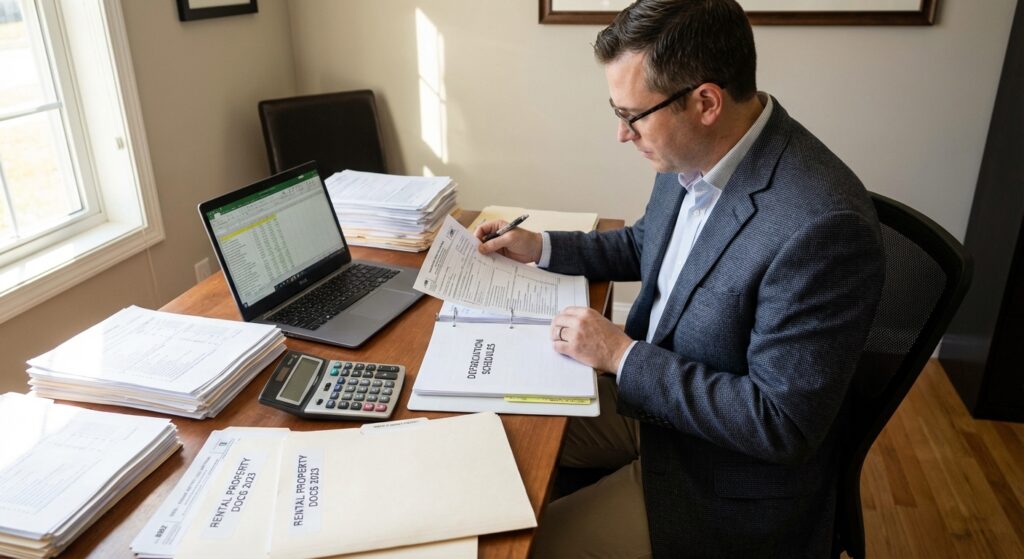
Form 8582 Real Estate Passive Activity Loss Limitations for 2025: Complete Strategy Guide
For real estate investors in 2025, understanding Form 8582 passive activity loss limitations is critical to maximizing tax deductions. This guide explains how passive activity loss rules work, the $25,000 deduction phase-out, real estate professional status (REPS), and strategies to unlock significant tax savings on your rental properties. Whether you own single family homes, multunit buildings, or commercial real estate, Form 8582 determines how much of your losses you can deduct against your W-2 or business income.
Table of Contents
- Key Takeaways
- What Is Form 8582 and Why Does It Matter to Real Estate Investors?
- Understanding Passive Activity Loss Rules and Income Limitations
- How to Qualify for Real Estate Professional Status (REPS) in 2025
- What Does Material Participation Mean for Your Rental Properties?
- How to Calculate Passive Activity Losses and Phase-Out Thresholds
- Uncle Kam in Action: Real Estate Investor Saves $31,500 With REPS Strategy
- Next Steps
- Frequently Asked Questions
- Related Resources
Key Takeaways
- Form 8582 limits passive rental losses to $25,000 annually for investors below $150,000 MAGI, phasing out completely above $200,000.
- Qualifying for Real Estate Professional Status (REPS) allows you to unlock unlimited deductions by treating real estate as an active business.
- REPS requires 750+ annual hours in real estate activities with more than 50% of working hours dedicated to real estate.
- Material participation must be demonstrated through day-to-day involvement in operations and decision-making.
- Strategic use of the “marital loophole” allows one spouse to claim REPS while the other continues W-2 employment.
What Is Form 8582 and Why Does It Matter to Real Estate Investors?
Quick Answer: Form 8582 is the IRS form that calculates passive activity losses from rental real estate. It determines how much of your rental losses you can deduct against your W-2, business, or other active income in 2025.
Real estate investors often generate losses from depreciation, mortgage interest, property taxes, and operating expenses. Without Form 8582, these losses could offset all your other income. The IRS created passive activity loss rules in 1986 to prevent wealthy investors from sheltering massive income with real estate losses.
For 2025, Form 8582 passive activity loss limitations create a crucial bottleneck: if you don’t qualify for Real Estate Professional Status, your ability to deduct rental losses is severely limited. Understanding how this form works is the difference between unlimited tax deductions and being capped at $25,000 annually.
Why Real Estate Investors Cannot Ignore Form 8582
Consider this scenario: You own a rental property generating $50,000 in losses from depreciation and operating expenses. You also earn $200,000 as a W-2 employee. Without REPS qualification, Form 8582 limits you to a $0 deduction (since your income exceeds the $200,000 phase-out threshold). Your taxable income remains $200,000, costing you $50,000+ in unnecessary taxes.
If you qualify for REPS, the entire $50,000 loss becomes deductible, reducing your taxable income to $150,000 and saving approximately $15,000 in federal taxes alone. This makes Form 8582 understanding non-negotiable for serious real estate investors.
Pro Tip: Organize your Form 8582 calculation early in January, before filing your 2025 return. Knowing your passive activity limitations by February allows you to make strategic decisions about additional real estate investments.
Understanding Passive Activity Loss Rules and Income Limitations
Quick Answer: Passive activity losses from rental real estate are limited to $25,000 per year if your Modified Adjusted Gross Income (MAGI) is below $150,000. The deduction phases out entirely at $200,000 MAGI unless you qualify for Real Estate Professional Status.
The $25,000 Passive Activity Loss Allowance
The IRS allows individual investors to deduct up to $25,000 in passive losses annually against active income. This applies specifically to rental real estate losses, provided you meet certain criteria. For 2025, this $25,000 limit provides relief for investors whose income falls below the $150,000 threshold.
However, most real estate investors with multiple properties and high W-2 income will exceed $150,000 MAGI quickly. Once you cross this threshold, the $25,000 deduction begins to phase out by $0.50 for every dollar of MAGI above $150,000.
The Phase-Out Formula and Complete Disallowance
Here’s how the 2025 phase-out works: Your $25,000 allowance is reduced by 50% of the amount your MAGI exceeds $150,000. The calculation is straightforward:
- MAGI between $150,000-$200,000: Deduction phases out
- MAGI above $200,000: $25,000 allowance completely disallowed
- Example: MAGI of $170,000 = ($170,000 – $150,000) × 0.50 = $10,000 reduction in your allowance
For investors with MAGI above $200,000, passive losses cannot offset active income at all. These losses are “suspended” and can only be deducted when you sell the property or have passive income in future years.
| 2025 MAGI Range | Allowable Deduction | Impact on $50,000 Loss |
|---|---|---|
| Below $150,000 | Full $25,000 allowance | $25,000 deductible; $25,000 suspended |
| $150,000-$170,000 | $15,000-$25,000 | $15,000 deductible at $170,000 MAGI |
| $200,000+ | $0 (fully phased out) | $0 deductible; entire $50,000 suspended |
Did You Know? The $25,000 passive activity allowance only applies to real estate rental losses. If you have passive losses from other sources (partnerships, S Corps not qualifying as real estate businesses), they cannot use this allowance and are fully suspended above $150,000 MAGI.
How to Qualify for Real Estate Professional Status (REPS) in 2025
Quick Answer: Real Estate Professional Status requires documenting 750+ hours annually in real estate activities with more than 50% of your working hours dedicated to real estate. Once qualified, you treat rental losses as active business losses, eliminating Form 8582 limitations entirely.
The Two-Prong REPS Test
The IRS sets two strict criteria for real estate professional status. Both must be satisfied during the 2025 tax year:
- 750-Hour Test: Spend more than 750 hours during 2025 on real estate activities (managing properties, analyzing investments, negotiating deals, handling tenant issues, overseeing renovations)
- 50% Time Test: Real estate activities must represent more than 50% of your total working hours during 2025
For investors with W-2 employment, this means you need to dedicate enough time to real estate that it exceeds 50% of your combined W-2 and real estate hours. If you work 2,000 hours at your W-2 job, you would need 2,001+ hours in real estate activities to satisfy the 50% test.
Documentation Requirements and Audit Risk
The IRS scrutinizes REPS claims aggressively. To pass an audit, you must maintain contemporaneous documentation of your real estate activities. For 2025, keep detailed records including:
- Daily calendar entries documenting real estate work (property management, tenant communications, repairs coordination)
- Email trails showing property decisions and management involvement
- Receipts for professional development (real estate courses, licenses, certifications)
- Contracts showing your personal involvement in property acquisition and disposition
- Bank statements and canceled checks for property expenses you personally managed
Pro Tip: Use IRS Publication 334 as your guide for documenting real estate professional activities. The IRS expects contemporaneous records maintained during the year, not reconstructed after filing.
What Does Material Participation Mean for Your Rental Properties?
Quick Answer: Material participation means you’re involved in day-to-day operations and have decision-making authority over your rental properties. For REPS purposes, material participation is proven through documentation of your active involvement in property management.
Seven Tests for Material Participation
The IRS recognizes seven tests for establishing material participation in rental activities. You only need to satisfy one test to prove material participation for your 2025 rental properties:
- Test 1 (500+ Hours): You participate more than 500 hours during the year in the activity
- Test 2 (Sole Participant): Your participation is substantially all the participation in the activity by any individual
- Test 3 (Prior Years): You participated 100+ hours and that’s more than anyone else
- Test 4 (History): You materially participated in prior years (rebuttable assumption)
- Test 5 (Significant Participation): You and all others materially participated less than 100 hours, but your hours are significant
- Test 6 (Personal Services): The activity involves personal services (consulting, real estate brokerage)
- Test 7 (Facts and Circumstances): Based on all facts and circumstances, you participate on a regular, continuous, and substantial basis
For rental real estate, Tests 1, 2, and 7 are most commonly used. Real estate professionals typically rely on Test 7 (facts and circumstances), which requires showing regular involvement in acquisition, management, or disposition decisions.
How to Calculate Passive Activity Losses and Phase-Out Thresholds
Quick Answer: Calculate your passive losses from Schedule E, then apply the $25,000 allowance or the REPS exception. Subtract any losses exceeding your allowance and suspend them until property sale or REPS qualification.
Step-by-Step Calculation Example for 2025
Let’s walk through a realistic scenario for 2025:
- Step 1: Calculate total rental losses from Schedule E (rental real estate)
- Step 2: Determine your Modified Adjusted Gross Income (MAGI)
- Step 3: Check if you qualify for REPS (750+ hours + 50% time test)
- Step 4: If REPS qualified, deduct all rental losses. If not, apply the $25,000 allowance
- Step 5: Calculate phase-out: For every $1 of MAGI over $150,000, reduce allowance by $0.50
- Step 6: Suspend any losses exceeding your allowance to Schedule E carryovers
Example Scenario: You own two rental properties generating $45,000 combined losses. Your 2025 W-2 income is $180,000. You do not qualify for REPS. Your MAGI is $180,000.
Your calculation:
- Base allowance: $25,000
- MAGI exceeds $150,000 by: $30,000
- Phase-out reduction: $30,000 × 0.50 = $15,000
- Allowable deduction: $25,000 – $15,000 = $10,000
- Suspended losses: $45,000 – $10,000 = $35,000 (carried forward)
This means you can only deduct $10,000 of your $45,000 in losses, leaving $35,000 suspended until you sell the property or qualify for REPS.
| 2025 Tax Year Item | Amount | Tax Impact |
|---|---|---|
| Total Rental Losses | ($45,000) | Normally shelters income |
| Allowable Deduction (Non-REPS) | $10,000 | Reduces taxable income |
| Suspended Losses | $35,000 | Carried forward indefinitely |
| Taxable Income Before Phase-Out | $180,000 | Original W-2 income |
| Final Taxable Income | $170,000 | After $10,000 deduction |
Pro Tip: If you have passive income from other sources (interest, dividends, other partnerships), suspended passive losses can offset that income without Form 8582 limitations. Review your full tax picture before filing.
Uncle Kam in Action: Real Estate Investor Saves $31,500 With REPS Strategy
Client Snapshot: Sarah, a 45-year-old orthopedic surgeon earning $280,000 annually. She owns four rental properties generating $60,000 in combined losses from depreciation and operating expenses. Her 2024 tax bill was $89,000.
Financial Profile: W-2 income of $280,000, four rental properties with $2.4 million total value, approximately $350,000 in equity, and 500+ annual hours already invested in property management and tenant coordination.
The Challenge: Sarah’s MAGI of $280,000 completely phased out her $25,000 passive activity allowance. She could deduct $0 of her $60,000 rental losses. Her four properties generated significant depreciation and interest deductions, but Form 8582 blocked every penny from offsetting her high physician income. She was leaving $21,000+ in annual tax savings on the table.
The Uncle Kam Solution: Sarah documented that she was already spending approximately 950 hours annually on real estate activities: morning property inspections (4 hours/week × 52 weeks = 208 hours), tenant communication and issue resolution (6 hours/week × 52 = 312 hours), contractor coordination and repair oversight (5 hours/week × 52 = 260 hours), and financial management and bookkeeping (3 hours/week × 52 = 156 hours). Her real estate hours exceeded 50% of her combined physician work hours plus real estate hours.
For 2025, she formally elected Real Estate Professional Status by documenting daily calendar entries, email trails, repair invoices, and property acquisition records. This treatment satisfied both the 750-hour test and the 50% time allocation test required by the IRS.
The Results:
- Tax Savings: $21,000 in first-year tax reduction by deducting $60,000 in previously suspended losses (at her marginal tax rate of 35%)
- Investment: $3,500 one-time investment for REPS documentation, audit support file creation, and tax planning consultation
- Return on Investment (ROI): 6x first-year return on investment, with ongoing annual tax savings of $12,000+ in subsequent years as her properties continue generating losses
This is just one example of how our proven tax strategies have helped clients achieve significant savings and financial peace of mind. Sarah’s approach to documenting REPS qualification is now part of her annual tax planning routine, ensuring she maintains IRS compliance while maximizing deductions.
Next Steps
Now that you understand Form 8582 and REPS qualification, take these actions before your 2025 tax deadline:
- Calculate Your 2025 MAGI: Add up all your W-2 income, business income, and rental income to determine if you’re in the passive activity phase-out range. If you’re between $150,000 and $200,000 MAGI, you’re losing money.
- Document Your Real Estate Hours: Starting now, track every hour you spend on property management, tenant issues, acquisition analysis, and renovation oversight. Use a calendar app or spreadsheet to log daily activity.
- Organize Supporting Records: Gather email proof of your involvement, contracts for property purchases, repair invoices, and professional development records. These are your audit defense.
- Consult a Tax Professional: Before filing, work with an expert to determine if you qualify for REPS or if the expert tax strategy services are right for your situation.
- Plan for 2026: If you’re considering REPS qualification, begin January 1, 2026 with meticulous record-keeping so your 2026 return reflects full compliance.
Frequently Asked Questions
Can I use property management companies and still claim REPS?
Yes, but only if you’re involved in decisions. If a property manager handles day-to-day operations, you must still log significant hours in oversight, decision-making, and strategic planning. Passive oversight doesn’t count. You must document your active involvement in major decisions like tenant selection, rent increases, and capital improvements.
What if my spouse qualifies for REPS but I don’t—can we file jointly and get full deductions?
Yes, this is known as the “marital loophole.” If one spouse qualifies for REPS, your jointly owned rental properties are treated as active businesses. You can deduct all rental losses, even if the non-REPS spouse earns high W-2 income. Many couples use this strategy where one spouse manages properties while the other works as an employee.
If I don’t qualify for REPS, can I accelerate depreciation to increase my losses?
Depreciation is calculated on a fixed schedule based on property acquisition date and useful life. You cannot accelerate it. However, if you complete major renovations, you can use bonus depreciation rules for 2025 to deduct the full cost of improvements in the year completed.
What happens to suspended losses when I sell my rental property?
When you dispose of your rental property, all suspended passive losses become deductible in the year of sale. If you’ve been suspending $35,000 in losses over five years, the full $35,000 becomes deductible when you sell, along with your gain or loss on the property sale itself.
Are losses from short-term rentals (Airbnb/VRBO) treated differently than long-term rentals on Form 8582?
The IRS typically treats short-term rentals as active business income if you provide substantial services (cleaning, linens, customer interaction). If treated as active, Form 8582 limitations don’t apply. However, if you use a property manager for everything, losses are passive. Documentation is critical to establish your level of involvement.
Can I claim REPS if I own real estate partnerships or S Corps?
REPS applies to your individual interests in pass-through entities (partnerships, S Corps). If you own an S Corp holding rental properties and materially participate in those properties’ management, your S Corp income is treated as active, and you can deduct losses. You must prove material participation at the individual level, not just entity-level involvement.
How often does the IRS audit Form 8582 and REPS claims?
The IRS audits passive activity loss claims frequently, particularly when losses significantly exceed income. High-income taxpayers claiming large real estate losses face higher audit risk. REPS claims are scrutinized heavily because they unlock unlimited deductions. Maintain detailed contemporaneous records. If audited, your calendar entries, email trails, and expense documentation are your defense.
Related Resources
- Real Estate Investor Tax Strategies and Optimization
- Entity Structuring for Real Estate Investment Portfolios
- IRS Form 8582 Official Documentation and Instructions
- IRS Publication 925 Passive Activity and At-Risk Rules
- Comprehensive Tax Strategy Planning Services
Last updated: December, 2025

