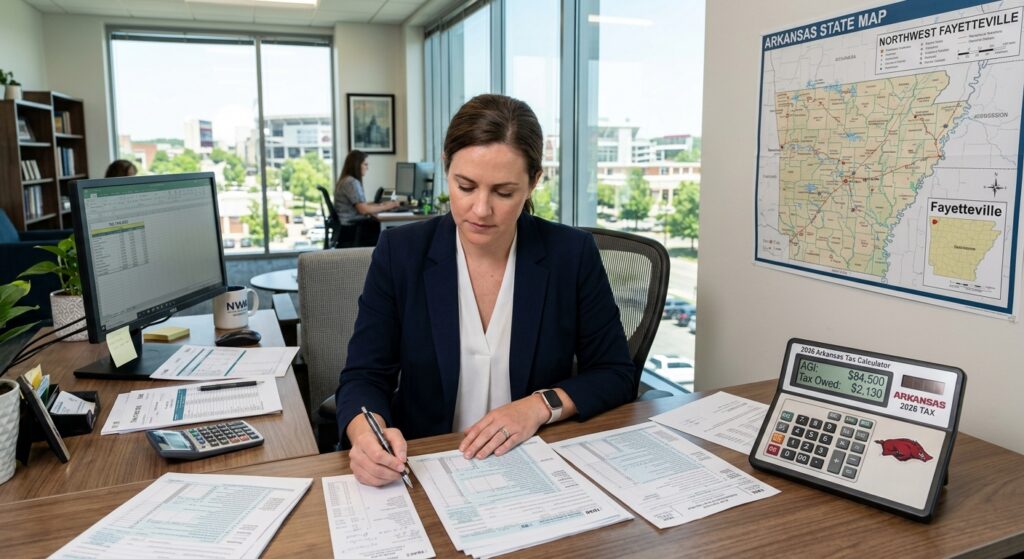
Find a Trusted Tax Preparer in Fayetteville: 2026 Tax Planning Guide for Arkansas Business Owners
For 2026, finding a qualified tax preparer in Fayetteville has become more critical than ever. The One Big Beautiful Bill Act, which took effect in 2025, introduced sweeping changes to federal tax rules. These changes affect how business owners calculate deductions, manage self-employment taxes, and plan for the year ahead. A skilled tax preparer helps you navigate these complexities while keeping more money in your pocket.
Table of Contents
- Key Takeaways
- Why Fayetteville Business Owners Need Professional Tax Help
- What Are the 2026 Tax Changes Affecting Arkansas Business Owners?
- How Can a Tax Preparer Help Reduce Your Self-Employment Tax Burden?
- What Should You Look for in a Fayetteville Tax Professional?
- How Much Does Professional Tax Preparation Cost?
- Frequently Asked Questions
- Related Resources
Key Takeaways
- A qualified tax preparer helps you maximize deductions under 2026 tax rules.
- Self-employed individuals pay 15.3% self-employment tax on net earnings up to $184,500 in 2026.
- The One Big Beautiful Bill Act created new deductions and compliance requirements for 2026.
- S-Corp election strategies can save thousands in self-employment taxes when done correctly.
- Strategic retirement contributions reduce both taxes and self-employment tax liabilities.
Why Do Fayetteville Business Owners Need a Professional Tax Preparer?
Quick Answer: Tax laws change yearly, and 2026 brings significant new rules that affect how you file, calculate deductions, and plan financially. A tax preparer ensures compliance while identifying tax-saving strategies specific to your business situation.
The tax landscape shifted dramatically when the One Big Beautiful Bill Act took effect. For the 2026 tax year, this legislation introduces new deductions, changes to how self-employment taxes work, and expanded compliance requirements. Fayetteville business owners face a choice: attempt to navigate these changes alone using generic online tools, or work with a tax preparer who specializes in local business taxation.
Tax preparation isn’t just about filing on time. It’s about strategic planning throughout the year. When you meet with a tax preparer in Fayetteville early, you gain access to year-end planning opportunities. A skilled professional identifies deductions you might miss, spots tax-saving strategies aligned with your business goals, and helps you avoid costly mistakes that trigger audits.
Pro Tip: Schedule a consultation with your tax preparer by September 2026 to discuss year-end strategies, maximizing retirement contributions, and timing business income or expenses for tax efficiency.
The Cost of DIY Tax Preparation Mistakes
Self-employed individuals and small business owners who file taxes themselves face significant risks. Missed deductions cost real money—potentially thousands annually. Errors in calculating self-employment tax, incorrectly applying new 2026 deductions, or failing to report income properly can result in audit notices, penalties, and interest charges that exceed the cost of professional preparation many times over.
The IRS specifically monitors certain business structures and deduction categories. When an S-Corp files incorrectly, the IRS notices. When someone claims aggressive deductions without proper documentation, an audit follows. A qualified tax preparer knows exactly which deductions hold up under IRS scrutiny and which ones trigger red flags.
Local Knowledge Matters
Fayetteville has a thriving business community with specific economic characteristics. Your local tax preparer understands the northwest Arkansas market, knows about business growth incentives, and stays current with local economic trends. This local knowledge, combined with federal tax expertise, creates a complete tax strategy tailored to your circumstances.
What Are the 2026 Tax Changes Affecting Arkansas Business Owners?
Quick Answer: The One Big Beautiful Bill Act introduced new deductions for seniors, tips, and overtime income. Self-employment tax rates remain at 15.3% for 2026, but new planning strategies emerged to reduce this burden.
Understanding 2026 tax changes is essential for effective planning. The One Big Beautiful Bill Act reshaped federal taxation with provisions affecting millions of taxpayers. For business owners and self-employed individuals, these changes create both opportunities and compliance challenges.
New 2026 Deductions Under the One Big Beautiful Bill Act
For the 2026 tax year, eligible taxpayers can claim new deductions that weren’t available in previous years. The senior deduction provides an additional standard deduction of $6,000 for single filers and $12,000 for married couples filing jointly. This benefits business owners aged 65 and above.
Additionally, workers with tip income can claim a deduction up to $25,000 for qualifying tips. Overtime workers benefit from deductions reaching $12,500 (single) or $25,000 (married filing jointly). For employees of your business or for self-employed individuals with multiple income streams, these deductions create meaningful tax relief.
| 2026 Deduction Type | Maximum Amount | Who Qualifies |
|---|---|---|
| Senior Deduction (Single) | $6,000 | Age 65+ |
| Senior Deduction (MFJ) | $12,000 | Both spouses 65+ |
| Tips Deduction | $25,000 | Eligible workers |
| Overtime Deduction (Single) | $12,500 | Qualifying employees |
| Overtime Deduction (MFJ) | $25,000 | Both spouses eligible |
Self-Employment Tax Implications for 2026
For the 2026 tax year, self-employed individuals continue paying 15.3% in self-employment taxes. This breaks down as 12.4% for Social Security (capped at $184,500 of net earnings) and 2.9% for Medicare with no cap. On $100,000 in net self-employment income, this means a $15,300 tax bill before any federal income tax is applied.
While the rate hasn’t changed, the impact on your bottom line remains substantial. This is where a skilled tax preparer adds tremendous value. They identify strategies to reduce your taxable self-employment income legally and effectively.
How Can a Tax Preparer Help Reduce Your Self-Employment Tax Burden?
Quick Answer: Tax preparers use three primary strategies: maximizing business deductions, establishing retirement accounts, and evaluating S-Corp election benefits for eligible businesses earning above $50,000-$60,000 annually.
Self-employment tax represents one of the largest expenses business owners face. Unlike W-2 employees who split Social Security taxes with employers, self-employed individuals pay the full amount. Your tax preparer in Fayetteville knows multiple approaches to reduce this burden while maintaining IRS compliance.
Strategy 1: Maximize Business Deductions
Every legitimate business expense you document reduces your net self-employment income, which directly lowers your self-employment tax. A tax preparer conducts a thorough review of your business operations to identify deductions you might have overlooked.
- Home office deduction (actual or simplified method)
- Vehicle and mileage expenses for business travel
- Professional services and consulting fees
- Office supplies, equipment, and technology costs
- Health insurance premiums (self-employed deduction)
- Business education and professional development
Strategy 2: Establish a Solo 401(k) or SEP-IRA
For 2026, self-employed individuals can contribute up to $24,500 to a Solo 401(k) plan as an employee, with additional catch-up contributions available for those aged 50-59 ($8,000 more) or 60-63 ($11,250 more). A $20,000 Solo 401(k) contribution saves roughly $2,480 in Social Security tax alone, on top of federal income tax savings.
Alternatively, a SEP-IRA allows contributions up to 25% of annual compensation with a 2026 maximum of $72,000. Your Fayetteville tax preparer helps you choose the right retirement account structure based on your income level and business needs. Use our small business tax calculator to estimate potential tax savings from retirement contributions.
Pro Tip: Establish your Solo 401(k) or SEP-IRA by December 31, 2026, to make contributions for that tax year. Your tax preparer can guide you through setup and contribution deadlines to maximize savings.
Strategy 3: Evaluate S-Corp Election Benefits
If your business generates consistent income above $50,000-$60,000 annually, electing S-Corp status becomes worth considering. An S-Corp allows you to split income between W-2 salary and distributions. Only the salary portion is subject to self-employment tax, while distributions avoid this tax entirely.
Example: On $100,000 in business income, you might pay yourself $60,000 as salary and take $40,000 as distributions. The $40,000 avoids self-employment tax, saving $4,960 annually in Social Security taxes alone. However, the IRS requires the salary to be “reasonable compensation” for the work performed. Your tax preparer ensures your salary structure withstands IRS scrutiny and maximizes legitimate tax savings.
What Should You Look for in a Fayetteville Tax Professional?
 Free Tax Write-Off Finder
Quick Answer: Choose a tax preparer with CPA or EA credentials, experience with self-employed clients, familiarity with Arkansas business law, and a proactive approach to tax planning rather than simple compliance filing.
Not all tax preparers are created equal. When you’re selecting a Fayetteville tax professional, certain qualifications and characteristics matter significantly.
Essential Credentials and Experience
Look for tax preparers who hold CPA (Certified Public Accountant) or EA (Enrolled Agent) credentials. Both certifications require passing rigorous exams and staying current with tax law changes. Your tax preparer should have specific experience serving self-employed individuals and small business owners, particularly those with similar business models to yours.
- CPA or EA credential (minimum requirement)
- 5+ years experience with business tax preparation
- Familiarity with S-Corp structures and strategies
- Knowledge of self-employment tax optimization
- Updated training on 2026 tax law changes
Year-Round Planning, Not Just Filing
The best tax preparers take a proactive approach. They schedule quarterly check-ins, discuss estimated tax payments, review year-end planning opportunities, and help you structure business decisions for tax efficiency. Avoid preparers who only contact you once per year around tax time. Real tax advisory involves ongoing communication and planning.
How Much Does Professional Tax Preparation Cost?
Quick Answer: Professional tax preparation for self-employed individuals ranges from $500-$2,500+ annually depending on complexity, business structure, and whether advisory services are included.
Cost concerns often prevent business owners from seeking professional tax help. However, comparing cost alone misses the value equation. A $1,200 investment in professional tax preparation that saves you $5,000 or more in taxes is an outstanding investment with a 4-to-1 return.
| Service Level | Typical Cost Range | What’s Included |
|---|---|---|
| Basic Tax Filing | $500-$800 | Return preparation and filing only |
| Standard Service | $800-$1,500 | Filing plus basic year-end planning |
| Advisory Package | $1,500-$2,500+ | Quarterly planning, strategy optimization, ongoing consultation |
Calculating Your ROI on Professional Preparation
A tax preparer earning their fee should identify at least one significant deduction or strategy you missed. Each overlooked $5,000 in deductions costs you roughly $1,500 in combined federal and self-employment taxes. Beyond deductions, strategies like S-Corp election, optimal retirement contributions, or income timing can save thousands. Even if your preparer costs $1,500 and saves $3,000, you’ve achieved a 2-to-1 return immediately.

Uncle Kam in Action: Sarah’s Self-Employment Tax Success
Sarah, a marketing consultant in Fayetteville, had been handling her own taxes for five years. Her 2025 self-employment income was $120,000. When she finally consulted with a tax professional in early 2026, she was shocked to learn she’d been leaving significant money on the table.
The tax preparer discovered three opportunities: First, Sarah had been deducting a partial home office, but she qualified for the full home office deduction based on her business setup—an immediate $3,200 annual deduction. Second, she wasn’t maxing out retirement contributions. By establishing a Solo 401(k), she immediately contributed $24,500, reducing her taxable income and self-employment tax base. Third, her income level and business stability suggested S-Corp election could be beneficial in future years.
The Results: The 2026 tax year planning immediately delivered $8,400 in tax savings through optimized deductions and retirement contributions. Sarah paid $1,200 for professional tax preparation and advisory services. Her return on investment exceeded 700%. Beyond the immediate tax savings, the tax preparer’s guidance positioned Sarah to evaluate S-Corp election when 2027 income projections exceeded her target threshold. Sarah now schedules quarterly check-ins to stay ahead of tax planning throughout the year.
Next Steps
Ready to take control of your 2026 taxes? Here’s what to do immediately:
- Schedule a consultation with a local Fayetteville tax preparer by September 2026 to discuss 2026 year-end planning.
- Gather documentation of all business deductions claimed in 2026 for your preparer’s review.
- Request a detailed fee schedule and service overview from potential tax preparers before committing.
- Ask about quarterly planning services if year-round tax strategy is important to your business.
- Ask your tax preparer about Solo 401(k) or SEP-IRA options to reduce 2026 self-employment taxes.
Frequently Asked Questions
Can I still file my own taxes if I’m self-employed?
Legally, yes. However, doing so means you miss professional optimization opportunities. Self-employed filers using online tax software often overlook valuable deductions, misunderstand new 2026 provisions, and pay more in taxes than necessary. The IRS targets self-filed returns at higher audit rates, and audit defense becomes your responsibility alone. Professional preparation isn’t required, but it provides peace of mind and typically pays for itself through tax savings.
What’s the difference between a CPA and an Enrolled Agent (EA)?
Both CPAs and Enrolled Agents are tax experts. CPAs (Certified Public Accountants) must pass a rigorous four-part exam and hold an accounting degree. Enrolled Agents pass a three-part IRS exam and don’t require a specific degree. For tax preparation, both are equally qualified. Choosing between them depends on your specific needs—CPAs may offer broader accounting services, while Enrolled Agents typically specialize in tax matters. Ask about their experience with your business type.
How much can I save with an S-Corp election?
Savings depend on your income level and business structure. For someone earning $100,000, electing S-Corp status and paying yourself a $60,000 reasonable salary while taking $40,000 in distributions saves approximately $4,960 annually in Social Security tax. Add federal income tax savings from self-employment tax reduction, and total savings often reach $6,000-$8,000 yearly. However, S-Corp election requires maintaining payroll, filing additional tax returns, and meeting IRS requirements. Your tax preparer calculates your specific savings to determine if S-Corp makes sense for your situation.
When should I establish a Solo 401(k)?
You must establish your Solo 401(k) by December 31, 2026, to make 2026 tax-year contributions. However, you can make contributions until your tax filing deadline (typically April 15, 2027). To avoid last-minute complications, establish your plan by November 2026. Your tax preparer guides you through the setup process with your chosen financial institution.
What happens if I get audited after professional tax preparation?
Many tax preparers provide audit support as part of their service or for an additional fee. If your return is audited, having a professional who prepared your return, understands your situation, and can represent you before the IRS is invaluable. Your preparer knows why each deduction was claimed, what documentation supports it, and how to respond effectively to audit inquiries. This protection alone justifies professional preparation costs.
Do I need to switch to a new tax preparer if my business changes?
Not necessarily, but consider it carefully. If your business grows significantly, transitions to S-Corp status, or becomes more complex, a preparer with specific expertise in your new structure becomes important. If your current preparer has expertise in S-Corps and has been planning for this transition, staying with them provides continuity. If not, switching to a specialist may be worth the transition effort.
Related Resources
- Fayetteville Tax Preparation Services
- Self-Employed Tax Strategies
- Business Owner Tax Planning
- LLC and S-Corp Election Guide
- Tax Preparation Services Overview
Last updated: April, 2026
This information is current as of 4/27/2026. Tax laws change frequently. Verify updates with a qualified tax professional if reading this later.

