
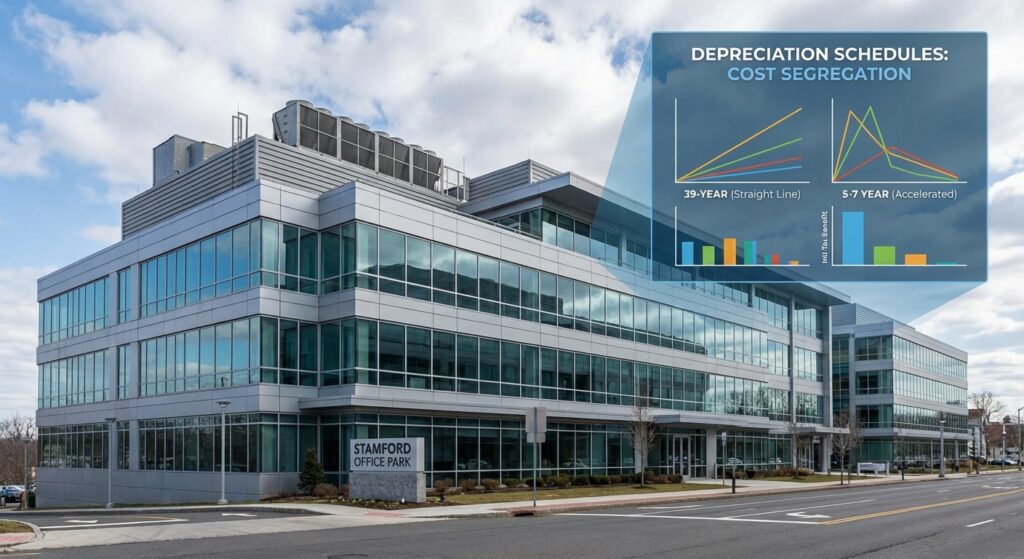
Cost Segregation Stamford: A 2026 Tax Strategy Guide for Commercial Property Owners
For the 2026 tax year, commercial property owners in Stamford can leverage cost segregation as a powerful depreciation strategy. Combined with the permanent 100% bonus depreciation enacted under the One Big Beautiful Bill Act (OBBBA), cost segregation studies can accelerate tax deductions, reduce taxable income significantly, and generate substantial cash flow benefits. Whether you own office buildings, industrial facilities, or mixed-use properties, understanding how cost segregation works in 2026 is essential for maximizing your tax position.
Table of Contents
- Key Takeaways
- What Is Cost Segregation and How Does It Work?
- Why Stamford Property Owners Should Prioritize Cost Segregation
- What Tax Benefits Does Cost Segregation Deliver in 2026?
- How Are Depreciation Schedules Accelerated Through Cost Segregation?
- How Does Bonus Depreciation Work With Cost Segregation in 2026?
- Who Qualifies for Cost Segregation Studies?
- How Do You Implement Cost Segregation for Your Property?
- Uncle Kam in Action: Cost Segregation Case Study
- Next Steps
- Frequently Asked Questions
Key Takeaways
- Cost segregation studies reclassify building components to accelerate depreciation from 39 years to 5-7 years or faster schedules.
- The OBBBA’s permanent 100% bonus depreciation amplifies savings when combined with cost segregation for 2026 and beyond.
- Stamford commercial property owners can generate immediate deductions worth 20-40% of property acquisition cost.
- Section 179 expensing limits increased to $2.5 million for 2026, complementing cost segregation strategies.
- Professional cost segregation studies are required to defend deductions in IRS audits and maximize tax compliance.
What Is Cost Segregation and How Does It Work?
Quick Answer: Cost segregation is a specialized analysis that reclassifies components of a building into shorter depreciation categories. Instead of depreciating an entire property over 39 years, components like equipment, fixtures, and certain systems are categorized to depreciate over 5, 7, or 15-year schedules, accelerating tax deductions.
Cost segregation involves a detailed engineering analysis of your commercial property. Professional cost segregation experts assess every component of your building—from HVAC systems to lighting, roofing, and interior finishes—to determine their appropriate depreciation classification under IRS tax code guidelines.
Under standard depreciation rules, commercial real property (buildings and structural components) depreciates over 39 years. However, many components within a building qualify for shorter depreciation periods under the Modified Accelerated Cost Recovery System (MACRS).
The Core Components of Cost Segregation Analysis
A professional cost segregation study examines three primary categories:
- 5-Year Property: Equipment, machinery, and certain special-purpose assets (e.g., restaurant equipment, manufacturing machinery)
- 7-Year Property: Office furniture, fixtures, specialized systems, and certain building components
- 15-Year Property: Land improvements, certain qualified restaurant property, and qualified leasehold improvements
By properly classifying these assets, you accelerate deductions significantly compared to standard 39-year depreciation.
How Cost Segregation Differs from Standard Depreciation
Without cost segregation, a $5 million commercial property acquisition is depreciated entirely over 39 years. With cost segregation, you might allocate $1.5 million to 5-year property, $800,000 to 7-year property, and the remaining balance to 39-year real property. This reclassification creates front-loaded deductions that significantly reduce taxable income in years 1-7.
Pro Tip: Cost segregation is particularly valuable when combined with Section 1031 exchange strategies. If you’ve recently acquired a replacement property in Stamford, a cost segregation study should be part of your tax planning immediately after closing.
Why Stamford Property Owners Should Prioritize Cost Segregation
Quick Answer: Stamford’s robust commercial real estate market, combined with 2026’s permanent 100% bonus depreciation, creates an unprecedented opportunity for significant tax savings. Property owners can reduce taxable income by 20-40% of acquisition costs, translating to six-figure deductions in many cases.
Stamford hosts a thriving commercial property market with office buildings, industrial facilities, and mixed-use developments. Whether you’ve recently acquired a property or purchased one within the past three years, cost segregation analysis delivers substantial benefits.
The Stamford Commercial Real Estate Advantage
Stamford’s properties—particularly recently acquired or renovated commercial spaces—contain significant components eligible for accelerated depreciation. From HVAC and electrical systems to parking facilities and tenant improvements, these assets qualify for 5-7 year depreciation rather than the standard 39-year schedule.
When combined with permanent 100% bonus depreciation, property owners can claim full deductions for qualifying assets in the year the property is placed in service—not over decades.
What Tax Benefits Does Cost Segregation Deliver in 2026?
Quick Answer: For 2026, cost segregation delivers accelerated depreciation deductions, reduced taxable income, lower federal income taxes, and improved cash flow. When paired with 100% bonus depreciation, qualifying assets can be fully deducted in year one.
The tax benefits of cost segregation in 2026 are substantial, particularly because of the OBBBA’s permanent 100% bonus depreciation provision.
Primary Tax Benefits for Stamford Property Owners
- Accelerated Deductions: Claim 20-40% of acquisition cost as deductions in years 1-7 instead of over 39 years
- Immediate Cash Flow: Reduced taxable income translates to lower tax bills and improved cash available for reinvestment
- Time Value of Money: Tax savings in year one are worth significantly more than the same deductions spread over 39 years
- Depreciation Recapture Planning: Strategic planning helps minimize recapture taxes upon future sale or disposition
- Section 179 Interaction: Works seamlessly with the 2026 $2.5 million Section 179 deduction limit for maximum impact
Did You Know? Businesses that implement cost segregation studies within three years of property acquisition can file amended tax returns to claim retroactive deductions. This provides a second opportunity to capture missed benefits if you didn’t pursue the strategy initially.
Real Dollar Example for Stamford Commercial Properties
Consider a $6 million commercial property acquisition in Stamford in 2025 or 2026:
| Depreciation Method | Year 1 Deduction | Years 1-5 Total Deductions |
|---|---|---|
| Standard 39-Year Depreciation (No Cost Segregation) | $153,846 | $769,231 |
| With Cost Segregation + 100% Bonus Depreciation | $1,800,000 | $2,200,000 |
| Additional Deductions Captured | $1,646,154 | $1,430,769 |
At a 24% federal tax rate (2026 rates), the additional deductions provide approximately $394,076 in federal tax savings in year one alone—funds available to reinvest in your business or other properties.
How Are Depreciation Schedules Accelerated Through Cost Segregation?
Quick Answer: Depreciation acceleration works by reclassifying building components from 39-year property into 5-year, 7-year, and 15-year categories under MACRS schedules, allowing deductions to be claimed much faster and in significantly larger amounts in early years.
Understanding depreciation schedules is central to cost segregation strategy. The IRS allows different asset classes to be depreciated at different rates based on their function and typical useful life.
MACRS Depreciation Schedules for Common Building Components
| Asset Category | Recovery Period | Year 1 Deduction Rate (SL) |
|---|---|---|
| HVAC Systems, Electrical, Plumbing | 7 years | 14.29% |
| Office Furniture & Fixtures | 7 years | 14.29% |
| Manufacturing Equipment | 5 years | 20% |
| Building Structure (39-year) | 39 years | 2.56% |
Notice the dramatic difference: 7-year property depreciates at 14.29% annually versus 2.56% for 39-year property. Professional cost segregation studies identify which components fall into each category, dramatically accelerating your total deduction.
How Does Bonus Depreciation Work With Cost Segregation in 2026?
Quick Answer: The OBBBA permanently restored 100% bonus depreciation for property placed in service on or after January 19, 2025. Combined with cost segregation, this allows full deduction of qualifying assets in year one, creating unprecedented tax savings.
Bonus depreciation is one of the most powerful tax incentives available to business owners. Under prior law, bonus depreciation was scheduled to phase out, eventually disappearing entirely. However, the OBBBA made 100% bonus depreciation permanent for qualifying property.
How 100% Bonus Depreciation Amplifies Cost Segregation Benefits
When you claim 100% bonus depreciation on cost-segregated assets, qualifying components identified as 5-year or 7-year property can be fully deducted in the year they are placed in service. This creates immediate tax savings rather than spreading deductions across multiple years.
For a property with $2 million in cost-segregated, 5-year property assets, you can deduct the entire $2 million in year one under 100% bonus depreciation, rather than deducting $400,000 per year for five years. The benefit compounds when you consider the time value of money—tax savings in year one are significantly more valuable than the same savings spread over multiple years.
Pro Tip: The OBBBA also introduced “qualified production property,” a new category that expands bonus depreciation rules to certain real property used in qualified manufacturing activities. Stamford manufacturers and industrial property owners should evaluate whether this provision applies to their facilities.
Who Qualifies for Cost Segregation Studies?
Quick Answer: Most commercial property owners are eligible for cost segregation studies. The strategy works best for properties acquired or significantly renovated within the past three years, with acquisition costs above $500,000.
Cost segregation is available to nearly all commercial property owners, from sole proprietors to large corporations. However, certain criteria make properties particularly strong candidates for cost segregation analysis.
Ideal Cost Segregation Candidates in Stamford
- Recently Acquired Properties: Properties purchased in 2023 or later are ideal, as more accelerated deductions remain available
- Recently Renovated Properties: Major renovations, expansions, or tenant improvements create significant cost segregation opportunities
- Higher Acquisition Cost: Properties with acquisition costs of $500,000 or more typically generate substantial tax benefits justifying study costs
- Complex Buildings: Mixed-use properties, industrial facilities, and specialized-use properties contain more cost-segregable assets
- High Depreciation Basis: Properties with significant asset components (HVAC, electrical, tenant improvements) maximize segregation benefits
Retroactive Study Opportunities
If you haven’t yet completed a cost segregation study for properties acquired in 2023 or later, you can still file amended tax returns to claim retroactive deductions. The IRS generally allows retroactive filing for up to three years of back taxes.
How Do You Implement Cost Segregation for Your Property?
Quick Answer: Implementation involves engaging a qualified cost segregation professional, commissioning a detailed engineering study, documenting asset classifications, and filing proper tax schedules. The process typically takes 60-90 days from project initiation to report delivery.
Implementing cost segregation requires professional expertise and careful documentation. Here’s the step-by-step process for Stamford property owners:
Step-by-Step Cost Segregation Implementation Process
- Step 1: Engage Qualified Professionals – Hire a cost segregation specialist with engineering credentials and IRS audit defense experience to conduct your study
- Step 2: Provide Documentation – Gather architectural drawings, construction documents, invoices, and property details for analysis
- Step 3: Site Assessment – The engineer conducts physical inspection and analysis of building components, mechanical systems, and finishes
- Step 4: Detailed Study Preparation – Professionals prepare comprehensive report with component breakdowns, depreciation calculations, and IRS-defensible documentation
- Step 5: Tax Return Integration – Work with your tax professional to file Form 4562 (Depreciation and Amortization) with cost segregation allocations
- Step 6: Audit Support – Maintain documentation and engage professionals for IRS audit defense if needed
Professional tax strategy services ensure proper documentation and compliance throughout this process, protecting your deductions in the event of an IRS audit.
Pro Tip: Don’t attempt cost segregation analysis without professional guidance. The IRS aggressively scrutinizes self-prepared cost segregation claims. Professional studies include detailed engineering reports, component listings, and valuation methodologies that withstand IRS audit challenges.
Documentation Requirements for IRS Compliance
The IRS expects detailed documentation supporting cost segregation claims. This includes:
- Professional cost segregation study with engineering analysis
- Detailed breakdown of cost allocations by asset class and recovery period
- Property acquisition documents and closing statements
- Photographs and physical inspection documentation
- Form 4562 filed with your tax return showing cost segregation allocations
- Communication records with your tax professional and cost segregation engineer
Uncle Kam in Action: Cost Segregation Saves a Stamford Real Estate Investor Over $400,000
Client Snapshot: Marcus, a Stamford-based real estate investor and business owner, acquired a $6.2 million mixed-use commercial property featuring office spaces, retail locations, and light manufacturing facilities in early 2025.
Financial Profile: Marcus generates approximately $950,000 in annual business income across multiple entities. His 2025 tax liability was projected at $285,000 before considering new strategies.
The Challenge: Marcus acquired the property using conventional financing, expecting to claim standard 39-year depreciation. However, he wasn’t maximizing the IRS’s 100% bonus depreciation allowance or the accelerated deductions available through cost segregation. His tax advisor recommended exploring cost segregation after the closing.
The Uncle Kam Solution: Marcus engaged Uncle Kam’s tax strategy specialists to conduct a comprehensive cost segregation study. Our team:
- Commissioned a detailed engineering analysis identifying $1.8 million in 5-year property (HVAC, electrical, manufacturing equipment)
- Allocated $950,000 to 7-year property (office fixtures, tenant improvements, specialized systems)
- Claimed 100% bonus depreciation on both categories for 2025 tax year
- Coordinated with his CPA to file amended Form 1040-X and supporting documentation
The Results:
- Tax Savings: $427,200 in federal income tax savings in 2025 ($2.75 million in deductions × 24% rate + state tax savings)
- Investment: One-time cost of $4,500 for cost segregation study and tax return amendments
- Return on Investment (ROI): 9,493% first-year ROI ($427,200 savings ÷ $4,500 investment)
This is just one example of how our proven tax strategies have helped clients achieve significant savings and financial success through advanced tax planning strategies.
Next Steps
Cost segregation is a time-sensitive strategy. Property owners who delay miss significant opportunities to claim retroactive deductions. Here’s your immediate action plan:
- Review Your Property Portfolio: Identify any commercial properties acquired or significantly renovated since 2023
- Calculate Potential Savings: Request a preliminary cost segregation analysis from a qualified professional
- Schedule Professional Consultation: Meet with a tax strategist to evaluate retroactive filing opportunities and claim 2025 deductions for recently acquired properties
Our tax strategy services specialize in identifying and implementing cost segregation opportunities for Stamford-area commercial property owners. We manage the entire process from initial analysis through IRS audit defense.
Frequently Asked Questions
What is the difference between cost segregation and standard depreciation?
Standard depreciation treats an entire commercial property as 39-year property, deducting only 2.56% annually. Cost segregation reclassifies components into 5-year, 7-year, and 15-year categories, allowing deductions of 14-20% annually on those portions. Over five years, cost segregation can generate 2-3 times more deductions than standard depreciation.
How long does a cost segregation study take?
A typical cost segregation study takes 60-90 days from initial engagement to final report delivery. The timeline depends on property complexity, document availability, and any scheduling requirements for site inspections. Stamford-area properties typically fall within this standard timeframe.
Can I conduct cost segregation on properties purchased several years ago?
Yes, cost segregation studies can be conducted on properties acquired up to three years in the past. You can then file amended tax returns to claim retroactive deductions for prior years. This provides a valuable second opportunity if you didn’t pursue cost segregation when you initially acquired the property.
What happens to depreciation recapture when I sell the property?
When you sell a property where you’ve claimed accelerated depreciation through cost segregation, the depreciation deductions are “recaptured” at a 25% tax rate. This means you’ll owe tax on the previously deducted amounts at a 25% rate rather than your ordinary income rate (which could be 37% federally). Professional tax planning can minimize recapture taxes through strategic disposition timing and reinvestment strategies like Section 1031 exchanges.
Does cost segregation work for residential rental properties?
Cost segregation is primarily designed for commercial properties. Residential rental properties have more limited cost segregation opportunities, though mixed-use properties with commercial components may qualify for partial analysis. Consult a tax professional about your specific residential property situation.
How much does a cost segregation study cost?
Cost segregation study fees typically range from $3,500 to $8,000 for commercial properties, depending on property complexity and value. The ROI on these studies is typically 9,000-15,000% when tax savings are considered, making the cost negligible compared to benefits.
What if the IRS audits my cost segregation deductions?
Professional cost segregation studies conducted by qualified engineers include detailed documentation, component breakdowns, and IRS-defensible analysis that withstands audit challenges. The study itself serves as your primary defense mechanism. Working with IRS-compliant professionals ensures your deductions can be fully supported if audited.
Is cost segregation available for properties in Connecticut?
Yes, cost segregation is a federal tax strategy available to all commercial property owners regardless of state. Connecticut does not have state-specific restrictions on cost segregation deductions. However, Connecticut’s tax rates and any state-specific depreciation rules should be considered in your overall tax planning strategy.
How does cost segregation interact with Section 1031 exchanges?
Cost segregation can be applied to replacement property acquired in a Section 1031 exchange. If you’ve recently completed a 1031 exchange in Stamford, commissioning a cost segregation study on your replacement property allows you to accelerate deductions while managing depreciation recapture taxes from your disposed property. These strategies work synergistically to optimize your tax position.
This information is current as of 01/02/2026. Tax laws change frequently. Verify updates with the IRS (IRS.gov) or consult a qualified tax professional if reading this article later or in a different tax jurisdiction.
Last updated: January, 2026

