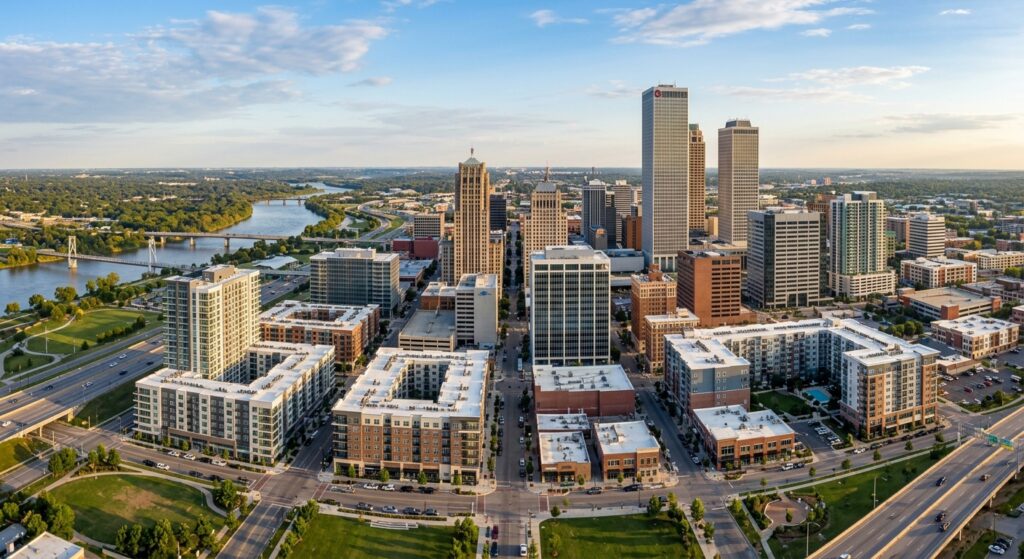
Best Entity for Tulsa Real Estate Investors 2026: LLC vs S Corp Tax Strategies
For Tulsa real estate investors deciding on the best entity for real estate investors in 2026, the choice between an LLC, S Corporation, C Corporation, or partnership structure can save tens of thousands in taxes annually. With the One Big Beautiful Bill Act (OBBBA) now in full effect for the 2026 tax year, real estate professionals in Oklahoma face new opportunities—and complexities—when structuring their investment properties. This comprehensive guide breaks down entity selection strategies tailored specifically to Tulsa investors, incorporating the latest 2026 tax rules, depreciation benefits, and self-employment tax optimization.
Table of Contents
- Key Takeaways
- Why Entity Structure Matters for Tulsa Real Estate Investors
- Should You Choose an LLC for Tulsa Real Estate Investment?
- What Are the Tax Benefits of S Corp Status for Real Estate?
- How Self-Employment Tax Affects Your Entity Choice
- How to Maximize Depreciation Deductions Across Entity Types
- What Is the Best Strategy for Multi-Property Tulsa Real Estate Investors?
- Uncle Kam in Action
- Next Steps
- Frequently Asked Questions
Key Takeaways
- For 2026, Tulsa real estate investors can save 15.3% self-employment tax by electing S Corp status on an LLC.
- Depreciation deductions remain available across all entity types, with accelerated depreciation available for qualified property.
- Multi-property investors benefit from different entity structures for different assets (e.g., S Corp for cash-flowing properties, LLC for development).
- Oklahoma’s favorable pass-through taxation makes LLCs and S Corps more attractive than C Corporations for most Tulsa investors.
- The OBBBA Act expanded 1031 exchange options and Qualified Opportunity Zone benefits effective in 2026.
Why Entity Structure Matters for Tulsa Real Estate Investors
Quick Answer: Your entity choice determines whether you pay self-employment tax, how much income you can shelter, liability protection level, and whether you’re eligible for major deductions like depreciation and cost segregation.
Real estate investing in Tulsa generates two types of income: active rental income from properties and passive appreciation. The best entity for real estate investors depends on which type dominates your portfolio and your overall income level.
For the 2026 tax year, the self-employment tax rate remains at 15.3% (12.4% for Social Security and 2.9% for Medicare). This applies to net income from self-employment when you operate as a sole proprietor or partnership. However, when you structure your Tulsa real estate business as an optimized business entity, you can eliminate up to 50% of this tax burden through reasonable salary planning and profit distributions.
Real estate investors also benefit from depreciation deductions—the ability to deduct the cost of buildings and improvements over 27.5 years (residential) or 39 years (commercial). This deduction is available regardless of entity type, but the *structure* determines how and when you claim it.
The Three Main Entities Tulsa Investors Use
- LLC (Limited Liability Company): Flexible taxation, liability protection, pass-through income.
- S Corporation: Same as LLC but with self-employment tax optimization through salary/distribution splits.
- Partnership or Tenancy in Common (TIC): Multiple owners, simplified structure, but higher self-employment tax exposure.
Pro Tip: Many Tulsa investors don’t realize that forming an LLC and then electing S Corp tax status costs only an additional $600–$1,200 annually in payroll processing but can save $10,000–$50,000 per year in self-employment taxes for higher-income investors.
Should You Choose an LLC for Tulsa Real Estate Investment?
Quick Answer: An LLC is ideal for Tulsa real estate investors who want liability protection and flexibility without complex payroll requirements, especially if you’re not currently earning enough to justify S Corp tax savings.
A Limited Liability Company (LLC) is the default entity choice for most Tulsa real estate investors. It provides strong liability protection (shielding personal assets from property-related lawsuits) and offers taxation flexibility. An LLC can be taxed as a sole proprietorship, partnership, or S Corporation—you choose.
Advantages of an LLC for Real Estate
- Liability protection separates personal and business assets in Tulsa courts.
- Flexible profit distributions don’t require formal board meetings or corporate documentation.
- Pass-through taxation means LLC income flows to your personal return, avoiding double taxation.
- Oklahoma LLCs have low formation and annual filing costs ($52 formation fee, $25 annual report).
- Multi-member LLCs allow partnerships while maintaining liability protection for each partner.
Disadvantages of LLC Taxed as Sole Proprietorship
- All net income is subject to 15.3% self-employment tax (as of 2026).
- For a Tulsa investor earning $100,000 from rental income, self-employment tax costs $15,300—avoidable with S Corp.
- No salary/distribution split means you’re not taking advantage of 2026 tax law opportunities.
When to Use LLC: Start here if you’re earning under $60,000 annually from Tulsa real estate, want maximum simplicity, or are just beginning your investment portfolio. You can always convert to S Corp status later when income grows.
What Are the Tax Benefits of S Corp Status for Real Estate?
Quick Answer: S Corp status allows you to split your real estate income into a reasonable W-2 salary (subject to 15.3% self-employment tax) and distributions (subject only to 2.9% Medicare tax), saving approximately 12.4% on the distribution portion.
An S Corporation election is a tax classification, not a separate business entity. You form an LLC in Oklahoma, then file Form 2553 with the IRS to be taxed as an S Corporation. This is the single best tax strategy for most Tulsa real estate investors.
How S Corp Tax Savings Work in 2026
Under S Corp taxation, your LLC’s net income is split into two buckets:
- Reasonable Salary: You pay yourself as an employee. This salary is subject to full self-employment tax (15.3%), but you can deduct the employer portion.
- Profit Distribution: Remaining profit is distributed to you as dividends. This is subject ONLY to the 2.9% Medicare tax, not the 12.4% Social Security component.
Example Calculation for Tulsa Investor:
| Scenario | LLC (Default) | LLC Taxed as S Corp | Tax Savings |
|---|---|---|---|
| Net Income from Rental Properties | $100,000 | $100,000 | — |
| Self-Employment Tax at 15.3% | $15,300 | $7,650* | $7,650 |
| *Assumes $50,000 W-2 salary + $50,000 distribution |
The “Reasonable Compensation” Rule
The IRS requires that your W-2 salary be “reasonable” for the work you perform. For Tulsa real estate investors, reasonableness is based on comparable roles—property management, leasing, maintenance oversight. The IRS scrutinizes S Corps that pay zero salary and distribute all income as dividends.
A safe approach: Pay yourself a W-2 salary of 40–60% of net income, distribute the remainder. The IRS rarely challenges this split for passive real estate investors.
Pro Tip: Real estate investors who elect S Corp status in early 2026 can implement the salary/distribution strategy retroactively for the full year, maximizing 2026 tax savings.
How Self-Employment Tax Affects Your Entity Choice
 Free Tax Write-Off Finder
Quick Answer: The 2026 self-employment tax rate of 15.3% is the primary reason to elect S Corp status, especially for Tulsa investors earning over $60,000 annually from rental properties.
Self-employment tax is calculated on Schedule SE and covers Social Security (12.4% on income up to $168,600 for 2026) and Medicare (2.9% on all income). For most sole proprietors and partnerships, this is unavoidable.
However, strategic tax planning through an S Corp structure allows Tulsa real estate investors to eliminate the 12.4% Social Security tax on passive rental income while maintaining the 2.9% Medicare tax (a reasonable trade-off).
For a Tulsa investor earning $100,000 annually from rental properties, selecting S Corp status saves $12,400 in Social Security tax alone—more than enough to justify the additional accountant fees and payroll processing costs.
Using the Self-Employment Tax Calculator for Projections
Tulsa real estate investors should use a self-employment tax calculator to model both scenarios (LLC sole proprietor vs. S Corp) and determine the breakeven point. For most investors, that point is $50,000–$75,000 in annual net rental income.
How to Maximize Depreciation Deductions Across Entity Types
Quick Answer: Depreciation deductions are available under all entity types, but S Corps and LLCs allow more strategic allocation across multiple properties, maximizing the benefit for Tulsa investors.
Real estate depreciation is one of the most valuable deductions available. For a Tulsa rental property purchased for $300,000 (with 80% attributable to the building), you can deduct $8,727 annually for 2026 (27.5-year residential depreciation). This is a “paper loss” that reduces taxable income without a corresponding cash outlay.
Cost Segregation and Accelerated Depreciation (2026)
Tulsa investors with significant real estate holdings should explore cost segregation studies. These specialized analyses break down property costs into components with shorter depreciation periods (5–15 years instead of 27.5 years), accelerating deductions.
For example, appliances, flooring, and fixtures can be depreciated over 5 years. A $300,000 property might include $50,000 in accelerated property, generating an additional $10,000 annual deduction for the first 5 years.
Bonus Depreciation Available in 2026
Under OBBBA, bonus depreciation remains available for qualified property. Tulsa investors should consult with tax advisors about whether newly acquired properties in 2026 qualify for accelerated deductions.
| Depreciation Type | Time Period | Available in 2026 |
|---|---|---|
| Standard Residential Depreciation | 27.5 years | Yes |
| Cost Segregation (Accelerated) | 5–15 years | Yes |
| Bonus Depreciation | First year (100%) | Yes (if qualified) |
| Qualified Opportunity Zone | 15 years (0% tax) | Yes (enhanced 2026) |
Did You Know: Depreciation deductions can offset income from other sources (wages, business income) for 2026, reducing your overall tax liability far beyond the Tulsa properties themselves.
What Is the Best Strategy for Multi-Property Tulsa Real Estate Investors?
Quick Answer: Sophisticated Tulsa investors use multiple entities: an S Corp LLC for income-producing properties, separate LLCs for development/flipping, and partnerships for co-investments.
Real estate investors with multiple properties in Tulsa or across Oklahoma often benefit from using separate entities for different property types and strategies. This approach provides liability isolation and tax optimization.
The Multi-Entity Framework for Tulsa Investors
- Operating Company (S Corp LLC): Holds 1–3 rental properties generating stable cash flow. Elects S Corp status to minimize self-employment tax.
- Development Company (Standard LLC): Holds properties under development or flip projects. Uses depreciation and cost segregation for short-term tax benefits.
- Land Holding Company (LLC or Partnership): Separates land (non-depreciable) from improved properties, allowing independent 1031 exchanges.
- Opportunity Zone Fund (Special Purpose LLC): For Tulsa properties in designated Opportunity Zones, uses specific tax-deferred growth benefits.
This structure requires more accounting and state filings but provides significant tax advantages for investors with $500,000+ in real estate assets.
For business optimization and structuring assistance, Tulsa investors should work with tax professionals who understand both federal and Oklahoma state tax rules.

Uncle Kam in Action: Tulsa Real Estate Investor Case Study
Client Profile: James is a Tulsa real estate investor with four residential rental properties (two in downtown Tulsa, two in midtown suburbs). Total annual rental income: $180,000. Mortgage payments, property taxes, insurance, and maintenance: $95,000. Net income before entity optimization: $85,000.
Initial Situation: James operated his properties under a basic LLC taxed as a sole proprietorship. His 2025 tax return showed $85,000 in net rental income, on which he paid $13,005 in self-employment tax (15.3% × 85,000), plus $17,000 in federal income tax. Total tax burden: $30,005 on $85,000 income—a 35.3% effective rate.
The Uncle Kam Strategy: In early 2026, Uncle Kam’s tax strategist recommended that James elect S Corp status on his existing LLC. The plan: James pays himself a W-2 salary of $50,000 (reasonable compensation for property management oversight) and takes a $35,000 dividend distribution.
2026 Results: On the $50,000 W-2 salary, James pays $7,650 in self-employment tax (split with his “business”). The $35,000 distribution is subject only to the 2.9% Medicare tax ($1,015). Total self-employment tax: $8,665 (down from $13,005). Additionally, James implements cost segregation on one property, generating an extra $8,000 depreciation deduction that offsets other income.
2026 Tax Savings:
- Self-employment tax reduction: $4,340
- Cost segregation deduction (at 32% bracket): $2,560
- Increased depreciation benefit: $1,200
- Total Tax Savings: $8,100
Investment: Accounting fees and payroll processing: $1,500 annually.
Return on Investment (ROI): 540% first-year ROI ($8,100 savings ÷ $1,500 cost = 5.4x payback).
Ongoing Benefit: For every year James operates as an S Corp, he saves approximately $4,300 in self-employment tax alone, with depreciation benefits compounding annually.
Next Steps
- Analyze your current Tulsa real estate income and entity structure using the self-employment tax calculator above.
- If earning over $60,000 annually, calculate your potential S Corp tax savings for 2026.
- Schedule a consultation with an Oklahoma tax advisor to review depreciation and cost segregation opportunities.
- If you have multiple properties, develop a multi-entity strategy to maximize liability protection and tax deductions.
- File Form 2553 (S Corp election) by March 15, 2026 to lock in full-year 2026 benefits for Tulsa real estate businesses.
Frequently Asked Questions
Can I Convert My Existing Tulsa LLC to S Corp Status in 2026?
Yes. File Form 2553 with the IRS by March 15, 2026 (for full-year 2026 treatment) or within 2 months and 15 days of your chosen effective date. Many tax professionals recommend doing this in January or early February to capture the full year’s self-employment tax benefits.
What Is a “Reasonable Salary” for S Corp Real Estate Investors?
The IRS defines reasonable compensation as what you’d pay someone to perform the services you’re providing (management, leasing, maintenance oversight). For passive Tulsa investors with stable properties, 40–60% of net income is typically safe. For active investors managing development or major renovations, 60–75% is more defensible. Work with your tax advisor to document the basis for your salary determination.
Are 1031 Exchanges Available Under OBBBA for Tulsa Properties?
Yes. OBBBA did not eliminate 1031 exchanges. Tulsa investors can still defer capital gains by exchanging one rental property for another like-kind property. However, the holding period rules and documentation requirements have become stricter, so professional guidance is essential for 2026 exchanges.
Can I Use Cost Segregation on My Tulsa Rental Property?
Yes, but it requires a formal study conducted by a qualified appraiser. Cost segregation studies cost $2,500–$5,000 but can generate $5,000–$15,000 in accelerated deductions for properties worth $200,000+. For Tulsa investors with significant holdings, this ROI is compelling. The deductions are claimed over 5–15 years instead of 27.5 years.
What Are the Qualified Opportunity Zone Benefits for Tulsa in 2026?
OBBBA enhanced Qualified Opportunity Zones (QOZs), making them more attractive for Tulsa investors. If you invest in a designated Opportunity Zone area in Tulsa and hold for 15 years, capital gains on the investment become 0% taxable. Additionally, you defer tax on the original investment gain. However, qualification requirements and investment structures are complex—consult a tax professional before investing.
Do I Need a Separate Entity for Each Tulsa Rental Property?
Not necessarily. One LLC can hold multiple properties for tax purposes. However, separate entities provide better liability isolation. If one property faces a lawsuit, creditors cannot easily reach other properties held in separate entities. For Tulsa investors with 3+ properties, the liability benefits of separate entities outweigh the additional accounting costs.
Can I Deduct Mortgage Interest on My Tulsa Real Estate?
Yes. Mortgage interest on rental properties is fully deductible on Schedule E regardless of your entity type. This is separate from depreciation and is one of the most valuable deductions for leverage-heavy real estate investors. All Tulsa investors should track mortgage interest carefully for tax documentation.
How Do Passive Activity Loss Rules Affect My Entity Choice?
Passive activity rules limit how much you can deduct rental property losses against active income. However, if you’re a “real estate professional” under IRS definitions, these rules don’t apply, and you can deduct unlimited losses. For Tulsa investors, this classification is crucial. Consult a tax professional about whether you qualify, as the determination affects your entire deduction strategy.
Last updated: April, 2026

