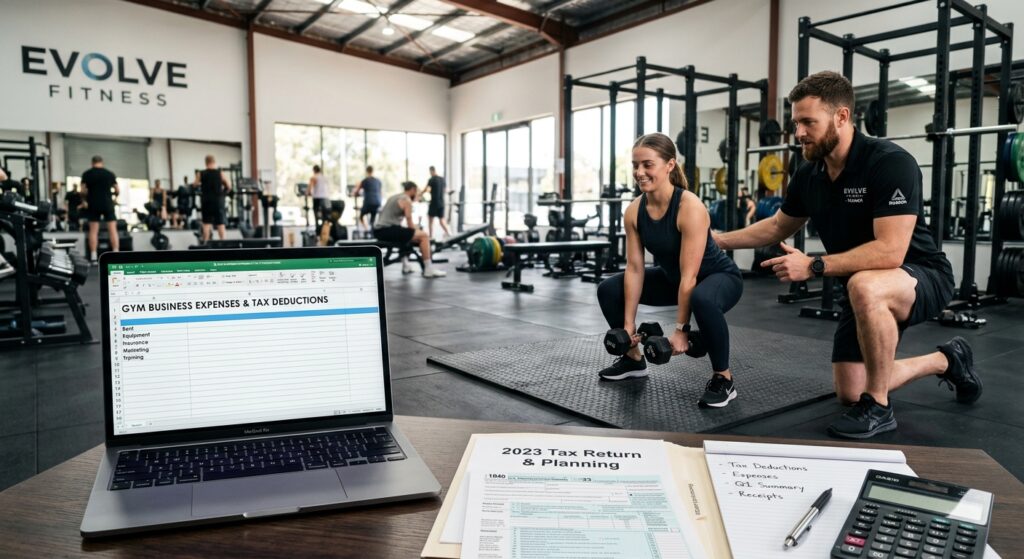
2026 Trainer Wages, 1099 Contractor Costs & Staff Payroll Deduction Requirements: The Complete Guide

2026 Trainer Wages, 1099 Contractor Costs & Staff Payroll Deduction Requirements: The Complete Guide
For personal trainers, fitness coaches, gym owners, and businesses that employ contractors, understanding trainer wages, 1099 contractor costs & staff payroll deduction requirements is essential for maximizing tax savings in 2026. The IRS finalized groundbreaking rules this April that fundamentally reshape how trainers and contractors report income and claim deductions. This comprehensive guide explores every tax strategy available to business owners, including the new $25,000 tips deduction for qualifying workers, self-employment tax obligations, and proven methods to legitimately reduce your tax burden through proper entity selection and meticulous documentation. Whether you’re a gym owner managing multiple trainers, a freelance fitness professional receiving compensation from clients, or a small business relying on independent contractors, this article provides actionable strategies backed by 2026 IRS guidance to keep more of what you earn.
Table of Contents
- Key Takeaways
- What Is the New $25,000 Tips Deduction for Trainers?
- How Do Self-Employment Taxes Work for 1099 Contractors?
- What Are the Payroll Requirements for Trainer Wages?
- What Entity Structure Maximizes Deductions for Business Owners?
- How Do I Document Contractor Expenses and Stay Audit-Proof?
- Uncle Kam in Action: Gym Owner Success Story
- Next Steps
- Frequently Asked Questions
Key Takeaways
- Personal trainers and fitness coaches can now deduct up to $25,000 in qualified tips for 2026, regardless of itemizing deductions.
- Self-employed contractors pay a total 15.3% self-employment tax (12.4% Social Security + 2.9% Medicare) on net business income.
- Employers must issue W-2 forms to employees and 1099-NEC forms to independent contractors, with specific documentation requirements for both.
- LLC or S-Corp election can significantly reduce self-employment taxes when properly structured with reasonable W-2 wages.
- Quarterly estimated tax payments are mandatory for contractors; failure to pay results in penalties up to 8% on underpayments.
What Is the New $25,000 Tips Deduction for Trainers?
Quick Answer: The IRS finalized rules in April 2026 allowing qualified workers—including personal trainers—to deduct up to $25,000 in tips from taxable income for tax years 2025 through 2028, regardless of filing status or itemization.
On April 10, 2026, the IRS released final regulations (RIN: 1545-BR63) outlining one of the most significant tax breaks for service workers in decades. Personal trainers, fitness instructors, yoga teachers, and exercise coaches now qualify to deduct up to $25,000 in qualified tips per tax return. This provision applies retroactively to 2025 and remains in effect through 2028 under the One Big Beautiful Bill Act signed into law July 4, 2025.
The deduction works independently of your filing status or whether you take the standard deduction. Unlike many tax breaks that require itemization, eligible trainers can claim the tips deduction while using the standard deduction for other income—a significant advantage. The deduction appears on the IRS’s new Schedule 1-A, and you simply report tips as income on line 1 (if W-2 wages) or Schedule C (if self-employed).
Defining Qualified Tips Under 2026 IRS Rules
Not all compensation counts as qualifying tips. The IRS distinguishes between genuine tipped income and other payments. Qualified tips must meet strict criteria established in the final regulations. Tips must be paid in cash or cash-equivalent (including credit card, debit card, or digital payment platforms like Venmo when received voluntarily). Tips must come directly from clients or through a tip pool arrangement—you cannot claim the deduction on tips pooled by management or employer withheld amounts.
Most importantly, tips must be voluntary. Automatic service charges, mandatory gratuities, or fees added by the gym or studio do not qualify. Only truly voluntary customer payments count toward the $25,000 limit. The tips must be properly reported to the IRS on your Form W-2, Form 1099, or Form 4137, depending on your employment classification.
Income Phase-Out Limitations for High Earners
The tips deduction is not unlimited for high-income earners. For 2026, the deduction phases out at specific Modified Adjusted Gross Income (MAGI) thresholds. Single filers lose the deduction once MAGI exceeds $150,000, while married couples filing jointly begin the phase-out at $300,000 MAGI. The phase-out means the benefit gradually disappears as income rises above these thresholds.
For self-employed trainers operating as sole proprietors or through a trade or business, an additional limitation applies under section 224(c). The tips deduction cannot exceed the gross income from your fitness business, minus business deductions allocable to that business. If your fitness business operates at a loss, the tips deduction effectively disappears since you can’t exceed business income.
Pro Tip: Married couples can claim up to $25,000 combined on a jointly filed return, not $25,000 each. Both spouses must include their Social Security numbers on the return to claim the deduction, and the benefit is unavailable to married couples filing separately.
How Do Self-Employment Taxes Work for 1099 Contractors?
Quick Answer: Independent contractors pay 15.3% self-employment tax (12.4% Social Security + 2.9% Medicare) on net business income, plus income tax. W-2 employees split this burden with employers, but 1099 contractors pay the full amount themselves.
Understanding self-employment taxes is critical for any 1099 contractor or independent personal trainer. The self-employment tax rate for 2026 is 15.3%, consisting of 12.4% for Social Security and 2.9% for Medicare. This is calculated on your net business income (gross revenue minus deductible business expenses) and is separate from federal income tax on your income bracket.
The key difference between W-2 employees and 1099 contractors is burden-sharing. When you’re a W-2 employee at a fitness facility, your employer withholds approximately half the self-employment tax (7.65%) from your paycheck, and the employer pays the other half. As a 1099 contractor, you pay the entire 15.3% yourself because you are both employee and employer for tax purposes.
Calculating Your Self-Employment Tax Obligation
Self-employment tax is calculated on Schedule SE using net profit from Schedule C. If you earned $100,000 in gross training revenue and had $25,000 in deductible business expenses (equipment, gym rental, marketing, supplies), your net business income would be $75,000. Your self-employment tax would be approximately $11,475 (15.3% × $75,000). This tax sits on top of federal income tax, not instead of it.
You can deduct half of your self-employment tax on your tax return (Schedule 1), providing modest relief. In the example above, you’d deduct $5,737.50 from your adjusted gross income. However, this modest deduction does not eliminate the significant burden that 1099 contractors face.
Quarterly Estimated Tax Payments and Penalties
The IRS expects independent contractors to pay taxes quarterly throughout the year using Form 1040-ES. Estimated tax payments are due on April 15, June 15, September 15, and January 15 (of the following year). These dates are non-negotiable—missing them triggers penalties.
The IRS underpayment penalty for 2026 is approximately 6-8% based on the federal short-term interest rate plus 3%. You can avoid this penalty if you owe less than $1,000 at filing or if you paid at least 90% of your current year tax obligation during the year. Most tax professionals recommend paying 100% of last year’s tax or 90% of current year tax, whichever is greater, to stay safe from penalties.
Pro Tip: Use IRS Form 1040-ES to calculate quarterly payments, or work with a CPA to establish automatic payment schedules. Even if cash flow is tight, making token payments demonstrates good faith and can reduce penalty assessments significantly.
What Are the Payroll Requirements for Trainer Wages?
 Free Tax Write-Off Finder
Quick Answer: Gym owners and fitness businesses must issue Form W-2 to W-2 employees and Form 1099-NEC to independent contractors, with specific filing deadlines, wage documentation, and payroll tax withholding requirements.
Fitness business owners who employ personal trainers face critical payroll compliance obligations. The first step is correctly classifying workers as either employees (W-2) or independent contractors (1099). The IRS uses a 20-factor test to determine classification, weighing factors like behavioral control, financial control, and the nature of the relationship. Misclassification carries severe penalties—back taxes, penalties up to 75% of unpaid taxes, and potential criminal liability.
Generally, if you control how the work is performed, provide equipment and facilities, and maintain an ongoing relationship, the trainer is likely a W-2 employee. If the trainer sets their own schedule, uses their own marketing, provides their own equipment, and serves multiple gyms, they’re likely an independent contractor.
Form W-2 Requirements for Employee Trainers
If trainers are classified as employees, you must issue Form W-2 annually by January 31, reporting their wages, federal income tax withholding, Social Security tax, and Medicare tax. You’re responsible for calculating and remitting payroll taxes quarterly to the IRS using Form 941 (Employer’s Quarterly Federal Tax Return).
Wage documentation must include gross wages, tips reported by the employee, state income tax withholding (if applicable), and local taxes. Maintain detailed time records showing hours worked, hourly rates or salaries, bonuses, and any expense reimbursements. These records protect you during IRS audits and ensure accurate Form W-2 reporting.
Form 1099-NEC Requirements for Independent Contractors
If trainers are independent contractors, issue Form 1099-NEC by January 31 if you paid them $600 or more in a calendar year. Unlike W-2 forms, 1099s don’t include tax withholding because contractors are responsible for their own estimated taxes. You file 1099s with the IRS and provide copies to contractors for their records.
For 1099 contractors, maintain invoices, payment records, contracts defining the engagement, and documentation of expenses you reimburse. If a trainer receives tips directly from clients, properly report those tips on the 1099 if they exceed $600, as tips are taxable income.
| Classification | Form Required | Tax Withholding | Deadline |
|---|---|---|---|
| W-2 Employee | Form W-2 | Yes (employer withholds) | January 31 |
| 1099 Contractor | Form 1099-NEC | No (contractor’s responsibility) | January 31 |
Pro Tip: Consult with a tax professional about worker classification before hiring. Misclassification creates massive liability, and the IRS scrutinizes this heavily in service industries like fitness.
What Entity Structure Maximizes Deductions for Business Owners?
Quick Answer: S-Corp election can save 15.3% in self-employment taxes by splitting income into W-2 wages and distributions, but requires reasonable W-2 compensation and careful compliance with IRS rules.
Business structure selection profoundly impacts your tax obligation. Sole proprietors pay self-employment tax on all net business income. LLC owners who haven’t elected S-Corp status also pay self-employment tax on all profits. However, S-Corp election allows you to split income into W-2 wages (subject to payroll taxes) and distributions (avoiding self-employment tax), potentially saving thousands annually.
Imagine a personal trainer earning $150,000 in net business income. As a sole proprietor, the trainer pays $22,950 in self-employment tax (15.3% × $150,000). With S-Corp election, the trainer might pay themselves a reasonable W-2 salary of $100,000 (subject to 15.3% payroll tax = $15,300), then take $50,000 in distributions (avoiding self-employment tax). The S-Corp election saves $7,650 in taxes ($22,950 – $15,300).
Reasonable Compensation Requirements
The IRS carefully monitors S-Corp distributions to prevent abuse. The key requirement is paying yourself reasonable W-2 compensation for the work you perform. Reasonable compensation typically means what other trainers doing comparable work earn. If you’re a highly skilled trainer with premium certification, generate significant revenue, and work full-time, reasonable compensation might be $80,000-$120,000 depending on your market and experience.
The IRS has disallowed S-Corp elections when business owners paid themselves minimal W-2 wages (like $20,000) while distributing $100,000+ in profits. Penalties include back taxes, accuracy-related penalties (20%), and potentially fraud penalties. Use our LLC vs S-Corp Tax Calculator for Riverdale to model your specific situation and confirm reasonable compensation before election.
S-Corp Compliance and Ongoing Obligations
S-Corp election creates compliance obligations: You must file Form 1120-S (S Corporation Income Tax Return) annually, issue yourself a W-2 for W-2 wages (with payroll tax deposits), and file Schedule K-1 showing your allocable share of S-Corp income. You must maintain a corporate record book, run payroll quarterly even if it’s just yourself, and separate personal and business finances meticulously.
Filing deadlines are tight: payroll taxes due quarterly (April 15, June 15, September 15, January 15), corporate tax return due March 15 (with extensions), and W-2s due January 31. Missing any deadline triggers penalties. The complexity is worth it for significant tax savings, but only if you maintain meticulous documentation and reasonable compensation.
How Do I Document Contractor Expenses and Stay Audit-Proof?Quick Answer: Maintain contemporaneous records (receipts, invoices, contracts, time logs) demonstrating business purpose, amount, date, and place of expense to substantiate deductions during IRS audits.
Quick Answer: Maintain contemporaneous records (receipts, invoices, contracts, time logs) demonstrating business purpose, amount, date, and place of expense to substantiate deductions during IRS audits.
Documentation is your strongest defense during IRS audits. The IRS operates under a presumption that undocumented deductions don’t exist. You bear the burden of proving expense legitimacy through contemporaneous records—ideally created at or near the time of the expense, not reconstructed months later.
Essential Documentation for Trainer and Contractor Expenses
For each contractor payment or trainer wage expense, maintain: (1) Original receipts or invoices showing amount, date, payee name, and business purpose; (2) Contracts or agreements defining the relationship, compensation, and contractor status; (3) Payment records (bank statements, canceled checks, payment app records like Venmo or PayPal); (4) Time tracking for W-2 trainers showing hours worked and rates paid; (5) Tip documentation for trainers receiving tips—daily tip logs or point-of-sale records showing tips collected.
Use accounting software like QuickBooks or Xero to centralize documentation, categorize expenses, and generate audit-ready reports. Attach photos of large equipment purchases with receipts. For recurring expenses (rent, utilities), maintain a file organized by month. The IRS appreciates systems—disorganized shoe boxes of receipts undermine your credibility.
1099 vs W-2 Deduction Differences
W-2 employees have limited deduction options. They can claim a standard deduction or itemized deductions on Schedule A, but trainer wages themselves are not deductible to employees. However, unreimbursed work expenses (continuing education, professional licensing, uniforms) may qualify as miscellaneous deductions if you exceed 2% of AGI, though the Tax Cuts and Jobs Act suspended this deduction for 2026.
1099 contractors have robust deduction opportunities. All ordinary and necessary business expenses reduce your Schedule C profit. This includes gym facility rental, equipment, marketing, insurance, continuing education, software subscriptions, vehicle expenses (using mileage method or actual method), home office deduction (if you maintain a dedicated office), meals with clients (50% deductible), and health insurance premiums.
| Expense Category | Deductible for W-2s? | Deductible for 1099s? |
|---|---|---|
| Professional Licensing | Limited (over 2% AGI threshold) | Yes (100%) |
| Equipment & Supplies | No | Yes (100%) |
| Facility Rental | No | Yes (100%) |
| Vehicle Expenses (mileage) | No | Yes (100%) |
| Home Office Deduction | No | Yes (if applicable) |
Pro Tip: Implement a receipt capture system. Use apps like Expensify or your phone camera to photograph receipts immediately. Email receipts to a business email account with a category notation. This system creates contemporaneous documentation that strengthens your audit defense dramatically.
Uncle Kam in Action: Gym Owner Success Story
Client Profile: Marcus, a 38-year-old gym owner in New York, built a successful fitness studio with eight full-time trainers earning combined $480,000 annually in W-2 wages, plus independent contractors earning $120,000. Marcus himself earned $200,000 in personal training revenue. His business generated $800,000 in annual revenue.
The Challenge: Marcus structured his LLC as a sole proprietor, paying self-employment tax on all $200,000 personal income ($30,600) while also managing $7,680 in payroll taxes for his W-2 trainers. More critically, three of his trainers collected tips directly from clients ($15,000 combined), but he wasn’t documenting these for the new $25,000 tips deduction. His accounting system was disorganized, mixing personal and business expenses, creating audit risk.
The Uncle Kam Solution: We implemented three strategic changes. First, we elected S-Corp status for Marcus’s LLC, establishing his W-2 salary at $120,000 (reasonable for his role and market) with $80,000 in distributions. This reduced his self-employment tax from $30,600 to $18,360—a $12,240 annual savings. Second, we implemented QuickBooks accounting with category codes, required all tip-receiving trainers to maintain daily tip logs, and documented $12,500 of the $15,000 in tips as qualifying under the new Schedule 1-A deduction. Third, we restructured his W-2 trainer compensation as a mix of base wages and bonuses tied to client retention and revenue, maximizing deductible compensation while maintaining reasonable pay structures.
The Results: Marcus’s first-year tax savings: $12,240 from S-Corp election, $1,875 from tips deduction (($12,500 × 15% effective rate), and an additional $8,000 from properly documenting equipment and facility expenses he’d previously overlooked. Total first-year tax savings: approximately $22,115 against Uncle Kam’s planning fee of $2,500—a 783% ROI. In year two and beyond, Marcus continues realizing the annual S-Corp savings, making this a multi-year 5-figure benefit. Marcus’s accountant now receives organized documentation, dramatically reducing audit risk. His trainers understand the tips deduction rules and maintain compliant records. Most importantly, Marcus kept nearly $23,000 in the first year that would have gone to the IRS.
Next Steps
Now that you understand the complete landscape of trainer wages, contractor costs, and payroll deductions for 2026, take action immediately. First, audit your current business structure—are you in a sole proprietorship or non-S-Corp LLC when S-Corp election could save thousands? Second, implement documentation systems. Download receipt capture software, establish expense categories in QuickBooks, and audit your trainers’ tip records for the $25,000 deduction qualification. Third, review worker classification—are your trainers properly classified as W-2 or 1099, or are you exposed to IRS reclassification risk?
Finally, schedule a consultation to discuss your gym owner or trainer tax strategy with a specialized tax advisor. The mistakes discovered in these first steps often cost more than professional planning. For immediate quarterly planning, set up estimated tax payments using Form 1040-ES if you’re self-employed, or ensure W-2 trainer withholding is accurate if you employ staff. The 2026 tax year offers unprecedented opportunities for trainers and fitness business owners—seize them now before tax season pressure arrives.
Frequently Asked Questions
Can I claim the $25,000 tips deduction if I earn more than $300,000?
No, the deduction phases out beginning at MAGI of $300,000 for married couples filing jointly (or $150,000 for single filers). As income rises above these thresholds, the available deduction shrinks proportionally. The benefit completely disappears at specific MAGI limits. If you’re above these thresholds, work with a tax advisor to explore other deduction strategies available to high-income trainers.
What happens if I don’t pay quarterly estimated taxes?
The IRS assesses an underpayment penalty of 6-8% on the unpaid amount for each quarter it was underpaid. The penalty accrues interest, compounding your liability. You can avoid the penalty entirely if you owe less than $1,000 at filing or if you paid 90% of current-year tax (or 100% of prior-year tax). Even token quarterly payments reduce penalty exposure significantly, so don’t skip payments entirely.
Can W-2 employees deduct tips as well?
Yes, W-2 trainers earning qualifying tips can claim the $25,000 deduction if tips are properly reported to the employer on Form 4137 or shown on the W-2. The deduction is not limited to 1099 contractors. However, tips must be documented and reported on the Form 4137, and the W-2 must reflect them. Work with your employer’s payroll department to ensure tips are properly documented.
How do I know if I’m paying reasonable W-2 compensation for S-Corp?
Reasonable compensation is typically what others doing similar work earn in your geographic market. For personal trainers, research local salary surveys for comparable experience and credentials. General industry guidance suggests 50-80% of S-Corp net income should be W-2 wages, with 20-50% in distributions, but exact percentages vary by business and market. Consult a tax professional in your region to benchmark your compensation against comparable trainers.
Can I deduct trainer wages if I’m a sole proprietor personal trainer?
No, sole proprietors cannot deduct their own wages (that’s your profit). However, sole proprietors can deduct the wages of employees they hire. If you employ an assistant trainer, those W-2 wages are fully deductible business expenses on Schedule C. This is one advantage of hiring staff—their wages reduce your taxable profit and, importantly, you only pay payroll tax on their wages (not self-employment tax), unlike distributions to yourself.
Do I need separate business accounting records to claim business deductions?
Absolutely. Mixing personal and business expenses creates audit risk and makes deduction substantiation difficult. Maintain a separate business checking account (deposits from training go here, business expenses paid from here). Use accounting software to categorize all expenses. If audited, the IRS expects to see organized records that clearly identify business vs personal transactions. Disorganized records undermine your deduction claims even if the underlying expenses are legitimate.
This information is current as of 4/14/2026. Tax laws change frequently. Verify updates with the IRS or a tax professional if reading this later.
Last updated: April, 2026

