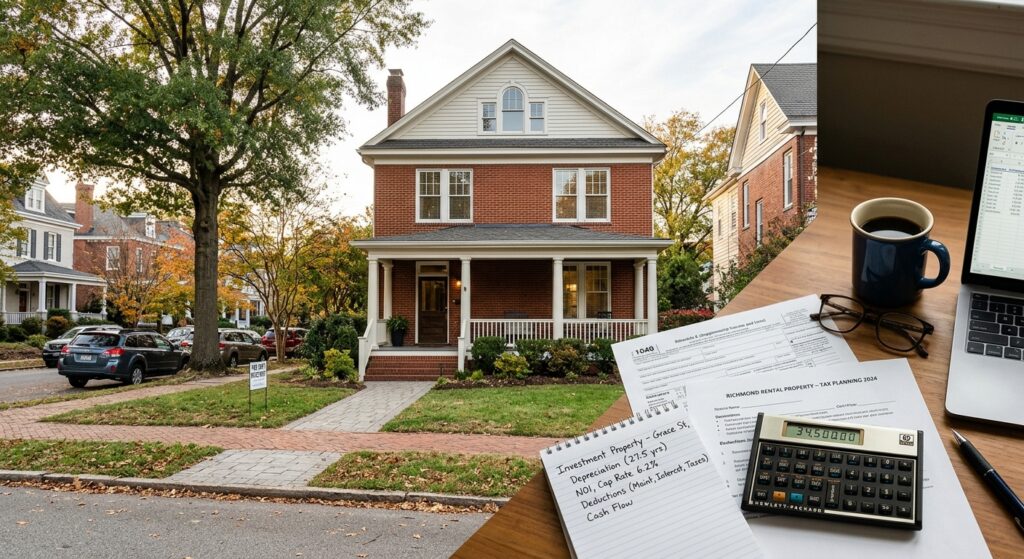
2026 Richmond Investment Property Taxes: Complete Tax Planning Guide for Real Estate Investors
For the 2026 tax year, understanding Richmond investment property taxes is critical for maximizing returns on your real estate portfolio. Richmond investors face unique local tax challenges alongside federal opportunities, making strategic tax planning essential. Our Richmond tax preparation specialists help real estate investors navigate these complexities while positioning them to capture every available tax advantage.
Table of Contents
- Key Takeaways
- How Richmond Property Taxes Work in 2026
- What Deductions Can You Claim on Richmond Investment Properties?
- How Does 2026 Bonus Depreciation Benefit Richmond Investors?
- What Impact Will the Proposed 1% Sales Tax Referendum Have?
- Can You Use 1031 Exchanges to Optimize Your Richmond Property Portfolio?
- Uncle Kam in Action: Richmond Investor Success Story
- Next Steps
- Frequently Asked Questions
Key Takeaways
- Richmond investment property owners can deduct mortgage interest, property taxes, insurance, maintenance, repairs, and depreciation against rental income in 2026.
- IRS Notice 2026-11 clarifies 100% bonus depreciation rules, allowing substantial first-year deductions on new property acquisitions and improvements.
- A proposed 1% sales tax referendum for Richmond schools could generate $45 million annually if approved, potentially increasing operating costs for investors.
- 1031 exchanges remain a powerful strategy to defer capital gains taxes when selling investment properties and reinvesting proceeds in Richmond or elsewhere.
- Strategic tax planning now positions Richmond investors to minimize 2026 tax liability while maintaining strong portfolio fundamentals.
How Richmond Property Taxes Work in 2026
Quick Answer: Richmond investment properties are subject to local real estate assessment and millage rates. Property tax bills are calculated by multiplying assessed property value by the local tax rate. Rising home values have increased tax burdens across Virginia, with 2026 showing national property tax increases averaging 3% from 2025.
Property taxes in Richmond are calculated through a straightforward formula. Your assessed property value multiplies by the city’s millage rate to determine your annual tax obligation. Richmond investors must understand that assessment values can change significantly year to year, especially as property values appreciate.
The assessment process begins with the city reassessing property values periodically. As a Richmond investor, you have the right to challenge your property assessment if you believe it’s inflated. Understanding Richmond’s assessment procedures protects your bottom line.
Recent Property Tax Trends in Richmond
Richmonders pay some of the region’s highest taxes overall, especially when combining real estate assessments with car and meals taxes. While specific 2026 property tax rates require consultation with Richmond’s Department of Finance, national data shows the average single-family home tax bill reached $4,400 in 2025, up 3% from 2024.
For investment property owners, these rising assessments directly impact cash flow. A 3% annual increase compounds significantly over time. Strategic depreciation deductions and expense optimization become increasingly important to offset these climbing tax burdens.
Understanding Mill Rates and Assessment Ratios
Richmond’s property tax system uses assessed values based on property type and location. Investment properties may be assessed differently than primary residences. Understanding how your property’s assessed value compares to fair market value ensures you’re not overpaying. Many Richmond investors successfully challenge assessments when comparable properties show lower valuations.
Pro Tip: Track your property assessment notices carefully. Virginia law requires municipalities to provide assessment information, and you typically have 30 days to file a formal appeal if you disagree with the assessed value.
What Deductions Can You Claim on Richmond Investment Properties?
Quick Answer: For 2026, Richmond investment property owners can deduct rental operating expenses including mortgage interest, property taxes, insurance, maintenance, repairs, property management fees, utilities, advertising, and depreciation. These deductions reduce taxable rental income.
Real estate has long been recognized for generous tax treatment. When you earn rental income from an investment property, the IRS allows you to claim deductions for a wide range of expenses. For 2026, maximizing these Richmond investment property tax deductions is essential to reducing your taxable income.
Direct Operating Deductions for Richmond Properties
Your mortgage interest payments (not principal) are fully deductible. Richmond investment property taxes paid to the city are deductible. Homeowners and liability insurance protecting your investment property is deductible. Maintenance and routine repairs keep the property in operating condition and are entirely deductible.
Property management fees, advertising for tenants, legal and accounting services related to your rental activity, and utilities you pay are all deductible. Our tax strategy team helps Richmond investors capture every legitimate deduction.
Capital Improvements vs. Repairs: Critical Distinctions
Understanding the difference between deductible repairs and capital improvements significantly impacts your 2026 tax position. Repairs restore property to original condition and are immediately deductible. Capital improvements add value, prolong asset life, or adapt property to new use. Capital improvements must be depreciated over time rather than deducted immediately.
For a Richmond investment property, replacing a broken window is a repair (immediately deductible). Replacing all windows with energy-efficient versions that extend property life is a capital improvement (depreciated). This distinction affects when you claim deductions and how they impact your tax liability.
Strategic planning aligns capital improvement timing with your overall tax picture. Our entity structuring specialists help Richmond investors structure property ownership to maximize depreciation benefits across multiple properties.
Pro Tip: Keep meticulous records of all expenses. The IRS scrutinizes rental property deductions closely. Document every repair with photos, receipts, and contractor invoices. Detailed records defend your position if audited and substantiate deductions claimed on Schedule E.
Use our Small Business Tax Calculator to estimate your 2026 tax savings from various deduction scenarios and identify optimization opportunities.
How Does 2026 Bonus Depreciation Benefit Richmond Investors?
Quick Answer: IRS Notice 2026-11 clarifies that 100% bonus depreciation applies to qualified property. Richmond investors acquiring new rental properties or making substantial improvements in 2026 can immediately deduct the full cost, creating significant first-year tax deductions.
Depreciation is a non-cash tax deduction that recognizes the gradual wear and tear of property over time. For Richmond investment properties, depreciation is one of the most powerful tax tools available. IRS Notice 2026-11 provides critical guidance for maximizing these deductions in 2026.
Understanding 100% Bonus Depreciation
Bonus depreciation allows immediate deduction of qualified asset costs. For residential rental properties placed in service during 2026, 100% bonus depreciation creates substantial tax deductions in the year of acquisition or improvement. This accelerated deduction significantly reduces taxable income, lowering your overall tax burden.
Qualified improvement property, equipment, and furnishings in Richmond rental units qualify for bonus depreciation. If you renovated a Richmond property in 2026 or acquired one with capital improvements, you may claim substantial depreciation deductions on Schedule E.
Depreciation Schedules and Cost Basis Allocation
Depreciation calculations require precise cost basis allocation. Your property purchase price includes the building but not the land (land doesn’t depreciate). Separating building cost from land value, then allocating building cost to components with different depreciation periods, maximizes deductions.
Residential rental property generally depreciates over 27.5 years. However, certain improvements may depreciate over 15 years or 5-7 years. Sophisticated cost segregation studies allocate purchase price among components with different depreciation periods, accelerating deductions for Richmond investors with significant acquisitions.
| Property Component | Depreciation Period | 2026 Application |
|---|---|---|
| Building Structure | 27.5 years | Standard residential depreciation |
| Land | Non-depreciable | Never deductible |
| Qualified Improvements | 15 years (with bonus) | 100% first year with Notice 2026-11 |
| Personal Property/Furnishings | 5-7 years | 100% first year with bonus |
For Richmond investors acquiring properties in 2026, consulting with a tax professional about bonus depreciation strategies ensures you capture maximum deductions while maintaining IRS compliance.
What Impact Will the Proposed 1% Sales Tax Referendum Have?
 Free Tax Write-Off Finder
Quick Answer: A proposed 1% sales tax referendum for Richmond school funding could generate $45 million annually if approved. While targeted at schools, this tax would increase overall Richmond operating costs, potentially affecting both personal and business expenses for investors.
As of April 2026, Richmond faces a proposal for a 1% local sales tax increase to fund school construction. This referendum, if approved, would generate approximately $45 million annually for school projects. For Richmond investment property owners, this development carries important implications for operating costs and overall economic conditions.
Understanding Virginia’s Dillon’s Rule and Local Tax Authority
Virginia operates under Dillon’s Rule, which strictly limits local government taxing authority. Localities cannot raise sales taxes without state legislative approval. Currently, only nine rural Virginia localities hold permission for 1% school tax. Richmond’s proposal would require state approval if it survives local budget discussions.
The referendum status remains uncertain as state lawmakers reconvene to finalize the budget. Richmond Mayor Avula has signaled support for a potential referendum, but final outcomes depend on legislative action. For 2026 planning, monitor state legislative developments as May approaches.
Potential Investor Impact from Sales Tax Changes
If approved, a 1% sales tax increase affects both personal and business spending. When purchasing supplies, repairs materials, or equipment for Richmond properties, additional sales tax increases costs. Landlords can often deduct these costs as operating expenses, offsetting some tax impact.
Richmond already pays some of Virginia’s highest overall taxes. The combination of property, vehicle, and meals taxes makes Richmond’s tax environment challenging. A sales tax referendum would further increase costs for property management activities and capital improvements.
Pro Tip: Monitor Richmond city council and Virginia legislative updates closely during April and May 2026. If the sales tax referendum appears likely to pass, accelerate property improvements and equipment purchases to lock in costs before potential tax increases become effective.
Can You Use 1031 Exchanges to Optimize Your Richmond Property Portfolio?
Quick Answer: 1031 exchanges allow Richmond investors to defer capital gains taxes when selling investment property and reinvesting proceeds. By exchanging one property for another of equal or greater value, investors continue wealth building without immediate tax liability.
A 1031 exchange is one of the most powerful tax-deferral tools available to real estate investors. When structured correctly, it allows you to sell a Richmond investment property and reinvest proceeds into another property without paying capital gains taxes.
How 1031 Exchanges Work for Richmond Investors
When you sell investment property at a gain, you typically owe capital gains tax. A 1031 exchange defers this tax if you reinvest sale proceeds in another investment property of equal or greater value. The key requirement is timing: you have 45 days to identify replacement properties and 180 days to close.
Richmond investors selling multi-unit buildings or commercial properties can exchange into different property types, different locations, or different price ranges. The flexibility allows strategic portfolio repositioning while deferring taxes.
Strategic 1031 Exchange Planning
Sophisticated Richmond investors use 1031 exchanges as part of comprehensive wealth-building strategies. Consolidating multiple small properties into one larger property, diversifying into commercial real estate, or moving capital to lower-tax states all become possible through 1031 exchanges.
Working with tax advisors experienced in 1031 exchanges ensures compliance with strict timing requirements and proper documentation. One mistake—missing the identification deadline or purchasing non-qualified property—terminates 1031 treatment and triggers immediate tax liability.
Our real estate investor tax planning team guides Richmond property owners through 1031 exchanges while optimizing overall tax positions.

Uncle Kam in Action: The Richmond Investor Who Cut Tax Liability by $28,000
Client Profile: David, a Richmond-based investor, owned four single-family rental properties valued at $1.2 million combined. Annual rental income totaled $72,000. David paid significant taxes annually because he wasn’t capturing available depreciation and operating expense deductions.
The Challenge: David reported his rental income on his personal return but took minimal deductions. He didn’t understand depreciation benefits or how to properly separate repairs from capital improvements. His accountant prepared basic returns without strategic tax planning. Consequently, David paid approximately $18,000 in federal taxes annually on his rental income.
Uncle Kam’s Strategy: Our tax strategy team conducted a comprehensive property analysis. We implemented a detailed depreciation schedule across all four properties, identifying $340,000 in depreciable basis. We documented all repairs separately from capital improvements, capturing $8,500 in previously overlooked deductions. We restructured one property ownership into an LLC to optimize liability protection while maximizing tax efficiency.
For David’s 2026 planning, we implemented cost segregation analysis on his most recent property acquisition, identifying components depreciable over 5-7 years instead of 27.5 years. We established a system for tracking operating expenses, maintenance costs, and capital improvement timing to optimize deduction sequencing.
The Results: David’s first year federal tax liability on rental income dropped from $18,000 to approximately $7,000—a $11,000 reduction. Over five years, depreciation deductions and optimized expense tracking saved David over $28,000 in cumulative federal taxes. His properties generated more wealth while his tax burden shrank dramatically.
More importantly, David now understands his depreciation schedule, tracks expenses systematically, and plans improvements strategically. He’s confident his tax position reflects legitimate deductions and IRS-compliant reporting. His rental business became more profitable simply by implementing proper tax planning.
This case illustrates how strategic tax planning transforms investment returns for Richmond property owners.
Next Steps for Your 2026 Richmond Investment Property Tax Planning
- Conduct a property-by-property analysis of current depreciation schedules. Are you capturing all available deductions? Our tax preparation specialists review prior returns to identify missed opportunities.
- Implement systematic expense tracking for all Richmond properties. Document repairs, maintenance costs, and operating expenses with photos and receipts.
- Evaluate 1031 exchange opportunities if you’re considering property sales. Timing exchanges strategically can defer significant taxes.
- Monitor the Richmond sales tax referendum status through May 2026. If likely to pass, accelerate property improvements to lock in current costs.
- Schedule a comprehensive tax review with our tax strategy team to optimize your complete real estate and business tax position for 2026.
Frequently Asked Questions
Can I deduct losses from Richmond rental properties against other income?
Rental property losses have limitations for high-income earners. If your modified adjusted gross income exceeds $150,000 (single) or $200,000 (married filing jointly), the passive activity loss limitation may restrict deductions. However, real estate professionals meeting specific criteria can deduct full losses. Determining your status requires detailed analysis of income sources and real estate involvement hours.
What’s the difference between Schedule C and Schedule E for real estate income?
Schedule C (Profit or Loss from Business) applies when you’re actively managing rental properties as a business, materially participating in operations. Schedule E (Supplemental Income and Loss) applies to passive rental activity. Most landlords use Schedule E. Active real estate businesses or property management companies may use Schedule C. This classification affects self-employment tax liability and loss limitation rules.
How does depreciation recapture affect my taxes when selling Richmond properties?
When you sell rental property, depreciation deductions you claimed reduce your cost basis, increasing capital gain. The gain receives preferential long-term capital gains tax treatment (currently 0%, 15%, or 20% depending on income). However, depreciation recapture is taxed at 25% maximum. A 1031 exchange defers this tax entirely if you reinvest in another property.
What happens if the 1% sales tax referendum passes in Richmond?
A 1% sales tax becomes effective on qualifying purchases in Richmond. While primarily targeting schools, the tax increases costs for property-related purchases. Repairs, supplies, and equipment used in maintaining Richmond rental properties become subject to the additional tax. As operating expenses, these costs become deductible against rental income, offsetting some tax impact.
Should I incorporate or create an LLC for my Richmond rental properties?
Entity structure decisions depend on liability protection needs, tax goals, and operational complexity. LLCs offer liability protection while allowing pass-through taxation (avoiding corporate-level tax). S Corporations can reduce self-employment taxes for some investors. C Corporations create double taxation. Multi-property portfolios may benefit from different entities for different properties or property types. Detailed analysis of your situation determines optimal structure.
Can I offset rental losses against w-2 income if I’m a real estate professional?
Yes. Real estate professionals—individuals spending more than 750 hours annually on real property business activities—can fully deduct rental losses against other income. The definition is strict: you must spend more hours on real estate than any other occupation, and more than half your personal service hours must be in real estate. Meeting these requirements requires careful documentation and planning.
What should I do if I overlooked depreciation deductions in prior years?
You can file amended returns (Form 1040-X) for up to three prior years to claim missed depreciation deductions. The IRS allows refunds for depreciation you failed to claim, even if unintentional. Filing amended returns triggers potential audits, making professional guidance important. Consulting a tax professional before amending prior returns prevents mistakes and maximizes your recovery.
This information is current as of 4/20/2026. Tax laws change frequently. Verify updates with the IRS or consult a tax professional if reading this later.
Related Resources
- Real Estate Investor Tax Services
- Tax Strategy Services for Business Owners
- Entity Structuring for Tax Optimization
- High-Net-Worth Tax Planning
- Comprehensive Tax Planning Guides
Last updated: April, 2026

