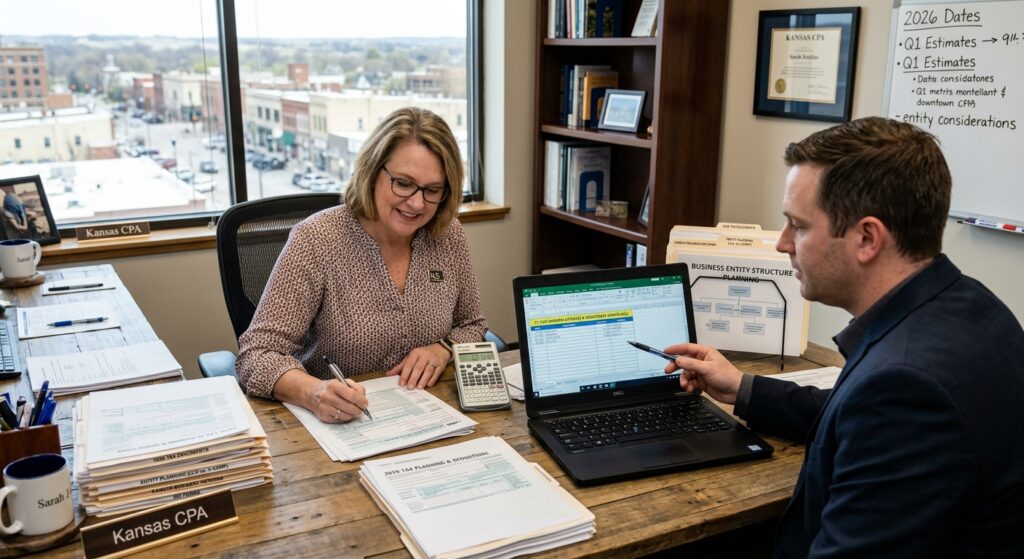
2026 Tax Changes Kansas: Complete Guide for Business Owners & Self-Employed
For Kansas business owners, farmers, real estate investors, and self-employed professionals, understanding 2026 tax changes kansas is critical to maximizing deductions and minimizing tax liability. The One Big Beautiful Bill Act, signed into law in July 2025, introduced sweeping federal tax reforms that took effect in the 2026 tax year, creating significant new opportunities for tax savings. This comprehensive guide explores the changes that matter most to Kansas taxpayers and how to leverage them for maximum benefit.
Table of Contents
- Key Takeaways
- What Changed in the Federal Tax Landscape for 2026?
- How Does the Doubled Standard Deduction Affect Your 2026 Tax Bill?
- What Are the New Section 179 Expensing Limits and Depreciation Rules?
- What Is the Best Business Entity Structure for Kansas Business Owners in 2026?
- How Can Self-Employed Kansas Professionals Reduce Self-Employment Tax?
- What Are the New 1099 Reporting Thresholds and How Do They Impact Kansas Businesses?
- What Are the Kansas-Specific Tax Impacts for 2026?
- Uncle Kam in Action
- Next Steps
- Frequently Asked Questions
Key Takeaways
- The 2026 standard deduction is permanently doubled: $27,100 for married filing jointly, $13,550 for single filers.
- Section 179 expensing limits increased to $2.5 million, allowing Kansas business owners to deduct more equipment purchases immediately.
- Self-employment tax rate remains 15.3%, but strategic business structuring can reduce tax burden significantly.
- 1099 reporting thresholds increased to $2,000 and $20,000, reducing paperwork burden for small businesses.
- Kansas farmers face 5% projected decline in net farm income for 2026 due to reduced government payments.
What Changed in the Federal Tax Landscape for 2026?
Quick Answer: The One Big Beautiful Bill Act, signed July 4, 2025, permanently doubled the standard deduction, increased Section 179 expensing limits to $2.5 million, and raised 1099 reporting thresholds. These changes directly benefit Kansas business owners, farmers, and self-employed professionals filing 2026 tax returns.
The One Big Beautiful Bill Act represents the most comprehensive federal tax overhaul for business owners since the Tax Cuts and Jobs Act of 2017. For the 2026 tax year, these changes create substantial opportunities for Kansas business owners to reduce their tax burden and reinvest savings back into their businesses. The law applies for tax years 2025 through 2028, giving you a multi-year window to plan strategically around these new provisions.
The Doubled Standard Deduction Impact
One of the most significant changes for 2026 is the permanent doubling of the standard deduction. This means most Kansas taxpayers will no longer need to itemize deductions to receive substantial tax relief. For married couples filing jointly, the 2026 standard deduction reaches $27,100—a doubling from prior years. Single filers benefit from a $13,550 standard deduction, while heads of household receive $19,900. This enhancement applies to all taxpayers, regardless of income level or filing status.
For Kansas business owners who take a W-2 salary from their business, this deduction significantly reduces taxable income. Combined with business expense deductions and depreciation strategies, the doubled standard deduction creates a powerful foundation for tax planning. Real estate investors in Kansas will also benefit when they have personal income outside their rental operations that falls below this higher threshold.
Enhanced Business Tax Credits and Deductions
Beyond the standard deduction, the One Big Beautiful Bill Act expanded numerous business-specific deductions. Over 105 million taxpayers claimed the permanently doubled standard deduction in the first filing season, and more than 34 million families claimed the enhanced Child Tax Credit. These provisions provide Kansas business owners with immediate cash flow relief that can be reinvested into operations.
How Does the Doubled Standard Deduction Affect Your 2026 Tax Bill?
Quick Answer: The doubled 2026 standard deduction reduces your taxable income immediately, potentially saving thousands in federal taxes. For a Kansas business owner with $150,000 in net business income, this deduction saves approximately $7,480 in federal taxes (at the top federal rate).
To understand the impact on your specific situation, consider a concrete example. A Kansas business owner married filing jointly with $150,000 in business net income would apply the $27,100 standard deduction in 2026, reducing taxable federal income to $122,900. This is a direct, first-dollar reduction in tax liability that doesn’t require itemizing deductions or meeting complex requirements.
| Filing Status | 2026 Standard Deduction | Tax Savings at 24% Federal Rate |
|---|---|---|
| Married Filing Jointly | $27,100 | $6,504 |
| Single | $13,550 | $3,252 |
| Head of Household | $19,900 | $4,776 |
Combining Standard and Business Deductions
Many Kansas business owners benefit most by combining the doubled standard deduction with legitimate business expense deductions. If you’re self-employed and file Schedule C, you can deduct 100% of legitimate business expenses—office supplies, equipment, vehicle expenses (business portion), home office deductions, professional development, health insurance premiums, and more. These business deductions reduce net profit first, and then the standard deduction further reduces your taxable income. This two-layer approach is why business owners often pay significantly less tax than W-2 employees earning the same gross income.
Pro Tip: Track every business expense carefully throughout 2026. The combination of a $27,100 standard deduction (MFJ) plus legitimate business deductions can reduce your effective federal tax rate to single digits. Keep detailed records, including receipts and mileage logs, to maximize your deductions during the filing process.
What Are the New Section 179 Expensing Limits and Depreciation Rules?
Quick Answer: Section 179 expensing limits increased to $2.5 million for 2026—double the previous $1.25 million limit. This allows Kansas business owners to immediately deduct major equipment purchases rather than depreciating them over years, accelerating tax deductions.
Section 179 is a powerful tool that many Kansas business owners underutilize. Under traditional depreciation rules, when you purchase equipment like machinery, vehicles, or computers, you must spread the deduction over many years (typically 5-7 years for most equipment). Section 179 allows you to deduct the entire purchase price in the year it’s placed in service, subject to the annual limit. For 2026, you can deduct up to $2.5 million of qualifying property purchases.
Practical Application for Kansas Business Owners
Imagine a Kansas manufacturing business planning to purchase $500,000 in new equipment in 2026. Under traditional depreciation, this might create a $70,000 annual deduction over seven years. With Section 179, you can deduct the entire $500,000 in 2026, potentially reducing taxable income by half a million dollars in that single year. At a 24% federal tax rate, this creates a $120,000 tax savings. The business can use these cash savings to pay down debt, invest in more equipment, or strengthen working capital.
Bonus depreciation is also reinstated under the One Big Beautiful Bill Act, which provides an additional deduction of 50-100% for certain qualified property. Combined with Section 179, these provisions create substantial opportunities for Kansas businesses to recover capital investments quickly and reduce tax liability in high-income years.
Planning Strategy: Timing Equipment Purchases
Smart Kansas business owners use Section 179 strategically by timing major equipment purchases to years when they have high income. If your business had a strong 2025 and expects lower income in 2027, consider accelerating equipment purchases into 2026 to maximize Section 179 deductions while you’re in a higher tax bracket. Conversely, if you anticipate higher income in 2027, you might defer equipment purchases to claim Section 179 deductions in 2027 instead.
What Is the Best Business Entity Structure for Kansas Business Owners in 2026?
Quick Answer: For 2026, the optimal business structure depends on your income level, risk tolerance, and growth plans. S Corporations offer significant self-employment tax savings for higher-income Kansas business owners. Our LLC vs S-Corp Tax Calculator for Kansas can analyze your specific situation and show exact tax savings potential.
The business entity you choose—sole proprietorship, LLC, S Corporation, or C Corporation—directly impacts your 2026 tax liability. This decision is especially critical for Kansas business owners because entity choice interacts with the 15.3% self-employment tax on net business income. Self-employed individuals pay this tax on all net self-employment income, but S Corporation shareholders who pay themselves a reasonable W-2 salary only pay self-employment tax on their salary, not on distributions. For a Kansas business owner with $200,000 in net income, choosing an S Corporation could save $10,000-$20,000 annually in self-employment taxes.
S Corporation Strategy for Kansas Business Owners
Kansas S Corporation owners must balance two competing interests: minimizing self-employment taxes and satisfying IRS “reasonable compensation” rules. The IRS requires S Corporation shareholders to pay themselves a reasonable salary for services rendered before taking distributions. This reasonable salary is subject to self-employment tax (15.3%), but distributions above the salary are not. The tax savings come from converting a portion of business income from self-employment income to distributions, which saves the 15.3% tax.
LLC vs. S Corporation Analysis for 2026
A typical scenario: Kansas business owner earns $150,000 net. As a sole proprietor or LLC taxed as a sole proprietor, all $150,000 is subject to 15.3% self-employment tax, creating a $22,950 tax bill. If structured as an S Corporation with a $80,000 reasonable salary and $70,000 distribution, the owner pays self-employment tax only on the $80,000 salary ($12,240), saving nearly $11,000 in self-employment taxes. This savings makes the S Corporation structure highly attractive for Kansas business owners with net income above $75,000.
How Can Self-Employed Kansas Professionals Reduce Self-Employment Tax?
 Free Tax Write-Off Finder
Quick Answer: Beyond entity structuring, self-employed Kansas professionals can reduce self-employment tax through strategic deductions, health insurance premium deductions, SEP-IRA contributions, and solo 401(k) plans that reduce net self-employment income directly.
Self-employment tax represents a significant burden for Kansas freelancers, consultants, and independent contractors. The 15.3% rate—12.4% for Social Security and 2.9% for Medicare—applies to 92.35% of net self-employment income. For a Kansas self-employed professional earning $80,000 net, this creates a $11,361 self-employment tax bill on top of federal income tax. Understanding strategies to reduce this burden is essential for 2026 tax planning.
Maximizing Business Expense Deductions
The first and most direct way to reduce self-employment tax is to maximize business expense deductions. Every dollar deducted as a business expense reduces net self-employment income dollar-for-dollar. For a self-employed Kansas professional in the 24% federal tax bracket, a $1,000 business expense creates $243 in total tax savings ($153 federal + $90 self-employment tax). Common self-employment deductions include home office expense (if you have dedicated office space), internet and phone, professional development and education, vehicle expenses (actual or mileage), equipment and supplies, professional liability insurance, and business equipment depreciation through Section 179.
Health Insurance and Retirement Planning
Kansas self-employed professionals can deduct 100% of health insurance premiums paid for themselves and their families as a business expense, reducing self-employment income directly. For a freelancer paying $500 monthly in health insurance premiums, this creates $6,000 in annual deductions, saving $921 in combined federal and self-employment taxes. Additionally, solo 401(k) contributions and SEP-IRA contributions directly reduce net self-employment income, creating double savings through reduced federal tax and reduced self-employment tax.
What Are the New 1099 Reporting Thresholds and How Do They Impact Kansas Businesses?
Quick Answer: For 2026, the federal 1099-K threshold is $20,000 (previously threatened at $600), and the 1099-MISC/1099-NEC threshold increased to $2,000. These higher thresholds reduce reporting burden for Kansas businesses and contractors using payment platforms.
The One Big Beautiful Bill Act included significant changes to 1099 reporting requirements that directly benefit Kansas small business owners and contractors. For years, there was uncertainty about whether the threshold for 1099-K reporting would drop to $600, creating overwhelming paperwork burden for small businesses. The Act resolved this by establishing a clear $20,000 threshold and 200 transaction minimum for 1099-K reporting. This means Kansas businesses won’t receive 1099-K forms for payment card sales or third-party network transactions (Venmo, PayPal, Square) unless they exceed $20,000 and 200 transactions.
Impact on Kansas Independent Contractors
The 1099-MISC and 1099-NEC threshold increased to $2,000 for 2026. This means Kansas businesses don’t need to file 1099-NEC forms for contractor payments below $2,000 in a calendar year, significantly reducing paperwork. A Kansas business owner using multiple freelance contractors for occasional projects now only files 1099-NEC forms for contractors paid $2,000 or more, streamlining year-end tax reporting.
What Are the Kansas-Specific Tax Impacts for 2026?
Quick Answer: Kansas farmers face a 5% projected decline in net farm income for 2026 due to a 63% reduction in emergency program payments. However, real estate investors and business owners benefit from new federal deductions and the doubled standard deduction.
While the One Big Beautiful Bill Act provides substantial federal tax relief for all Kansas taxpayers, the state faces unique economic challenges in 2026. Kansas farmers, who comprise a significant portion of the state’s economy, face headwinds. The USDA projects a 5% decline in Kansas farm income for 2026, primarily driven by a 63% reduction in government emergency program payments. This represents a shift from 2025, when strong government payments boosted farm income significantly. Kansas farmers should prepare for tighter margins in 2026 and focus on cost management, yield optimization, and strategic marketing to protect profitability.
Kansas Real Estate Investors and 2026 Opportunities
For Kansas real estate investors and landlords, 2026 presents more favorable conditions. The increased Section 179 expensing limits allow investors to immediately deduct significant property improvements rather than depreciating them over decades. The doubled standard deduction provides relief for investors with limited deductions. Kansas real estate investors should evaluate cost segregation studies, which break down property into component parts with different depreciation schedules, maximizing annual deductions.

Uncle Kam in Action: Kansas Business Owner Saves $18,500 Through Strategic 2026 Tax Planning
Jennifer, a Kansas consulting business owner, was operating as a sole proprietor with $180,000 in annual net income. Her tax situation exemplified the challenges many Kansas business owners face without strategic planning. She paid approximately $27,540 in self-employment tax (15.3% on $180,000) plus federal income tax of $36,500, for a total tax bill of $64,040. She had no significant business expense deductions beyond basic supplies, and she hadn’t considered her business entity choice.
Working with Uncle Kam’s tax strategists, Jennifer made three strategic moves for 2026. First, she elected S Corporation treatment for her LLC, allowing her to pay herself a $95,000 reasonable salary (based on comparable consulting services) and take $85,000 in distributions. This immediately reduced self-employment tax from $27,540 to $14,535 (15.3% on salary only), saving $13,005 in self-employment tax. Second, she invested $15,000 in professional development courses and certification programs that were deductible business expenses, further reducing net income. Third, she set up a solo 401(k) with a $20,000 employee deferrals plus employer contributions of approximately $8,050 (limited by self-employment income), reducing her taxable income further.
The cumulative impact: Jennifer’s taxable income dropped from $180,000 to approximately $136,950 after business deductions and 401(k) contributions. Her federal income tax decreased from $36,500 to approximately $26,250. Combined with the $13,005 self-employment tax savings, Jennifer saved $18,500 in total federal taxes in 2026—a 28.9% reduction in her tax burden. More importantly, she now has a plan for 2027 and beyond, positioning her consulting business for long-term tax efficiency and sustainable growth. Investment fee: $2,400; Tax savings in year one: $18,500; ROI: 770%.
Next Steps
Now that you understand the major 2026 tax changes affecting Kansas business owners, farmers, and self-employed professionals, take action to implement strategies:
- Evaluate your current business entity structure and calculate potential self-employment tax savings from an S Corporation election at our Kansas tax planning center.
- Conduct a comprehensive business expense audit to maximize deductions for 2026 and reduce both self-employment tax and federal income tax.
- Schedule a tax planning consultation to discuss Section 179 strategy, equipment purchases, and retirement plan optimization tailored to your Kansas business situation.
- Document all business expenses meticulously throughout 2026 with receipts, mileage logs, and supporting documentation to support deductions during filing.
Frequently Asked Questions
How much tax can I save with the doubled 2026 standard deduction as a Kansas business owner?
The tax savings depend on your filing status and federal tax bracket. For married couples filing jointly, the $27,100 standard deduction saves approximately $6,504 in federal taxes (at the 24% bracket). Single filers save approximately $3,252. These savings are automatic for all taxpayers and don’t require itemizing deductions or meeting complex requirements. Many Kansas business owners benefit further by combining this standard deduction with business expense deductions that reduce net business income.
Should I elect S Corporation treatment for my Kansas LLC in 2026?
S Corporation election is advantageous when your business net income exceeds approximately $75,000 annually. For higher-income Kansas business owners, the self-employment tax savings typically justify the additional administrative costs and accounting fees. However, this depends on your specific situation, including business type, income level, and whether you can justify a reasonable W-2 salary. Use our LLC vs. S-Corp calculator to analyze your specific scenario and determine if an election makes financial sense.
What Section 179 deductions can I claim on Kansas farm equipment in 2026?
Kansas farmers can claim Section 179 deductions on qualifying farm equipment including tractors, combines, harvesting equipment, irrigation systems, grain bins, and other machinery placed in service during 2026. The $2.5 million limit applies, but farmers with multiple equipment purchases can spread them across years. Vehicles, land, and structures generally don’t qualify for Section 179, though some building components may qualify for bonus depreciation instead. Consult with a tax professional about your specific equipment purchases to maximize deductions.
Can I deduct my home office expense if I work from home as a Kansas freelancer?
Yes, if you have a dedicated office space in your home used exclusively for business. You can use either the simplified method ($5 per square foot, up to 300 sq ft) or the actual expense method (calculating a percentage of your home’s mortgage, rent, utilities, insurance, and maintenance). Many Kansas freelancers find the actual expense method provides larger deductions. You’ll need to calculate the percentage of your home used for business and apply it to your total home expenses. Keep detailed records of square footage and business use percentage.
How do the new 1099 thresholds affect my Kansas business’s reporting obligations in 2026?
If you use payment processors like Square, PayPal, or Stripe for customer payments, you’ll only receive 1099-K forms if your credit card and third-party network transactions exceed $20,000 AND 200 transactions in a calendar year. If you pay contractors, you only file 1099-NEC forms for contractors paid $2,000 or more. These higher thresholds significantly reduce paperwork for small Kansas businesses. However, you must still report all business income to the IRS, even if you don’t receive a 1099 form. Maintain your own records of all payments received and payments made to contractors.
What specific 2026 tax deductions should Kansas real estate investors prioritize?
Kansas real estate investors should prioritize property depreciation (including bonus depreciation and Section 179 on building components), mortgage interest deductions, property tax payments, insurance premiums, property management fees, maintenance and repair expenses, and utilities. Consider a cost segregation study to break down property into components with shorter depreciation periods, accelerating deductions. Depreciation is a non-cash deduction that reduces taxable income without affecting cash flow, making real estate particularly tax-efficient. Track all expenses meticulously and separate capital improvements (depreciated) from repairs (deducted immediately).
How can I prepare for the 5% decline in farm income projected for Kansas in 2026?
Kansas farmers should focus on margin management, cost reduction, and strategic decision-making. Review equipment purchase timing to maximize Section 179 deductions in lower-income years. Consider diversification into value-added agricultural products or agritourism. Evaluate crop insurance and commodity hedging strategies to manage price risk. Implement precision agriculture techniques to optimize yield per acre and reduce input costs. Consider consulting with an agricultural tax specialist who understands Kansas-specific challenges and opportunities for tax optimization in a challenging income environment.
Related Resources
- 2026 Tax Strategy Planning for Business Owners
- LLC vs. S Corporation Structure Analysis
- Self-Employment Tax Planning Strategies
- Real Estate Investment Property Tax Optimization
Last updated: April, 2026
This information is current as of 4/18/2026. Tax laws change frequently. Verify updates with the IRS or a qualified tax professional if reading this later. The specific tax impact calculations are examples based on 2026 federal tax rates and may vary based on individual circumstances, Kansas state taxes, and other factors.

