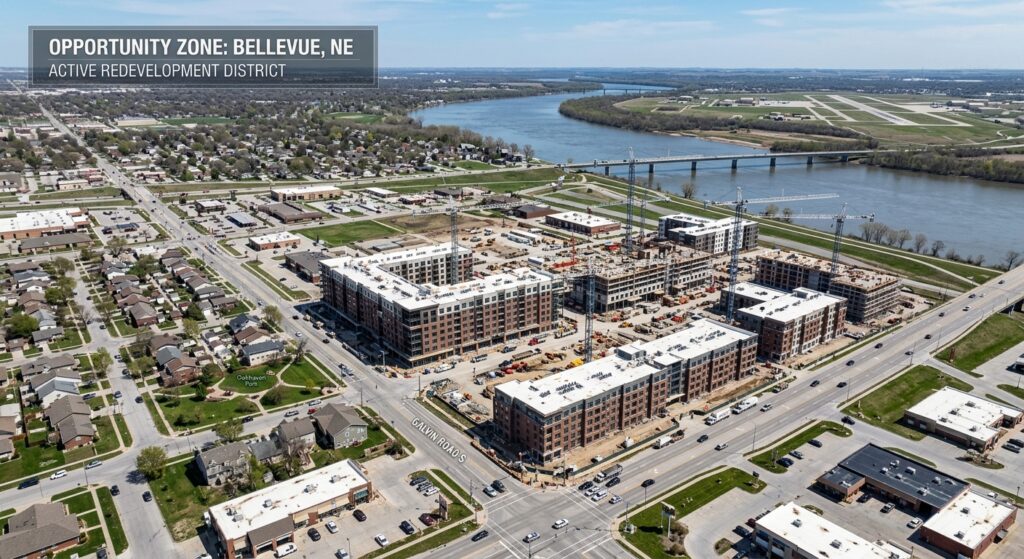
Bellevue Opportunity Zone Deferral: How to Reduce Capital Gains Taxes in 2026
If you have large capital gains and live, work, or invest near Bellevue, Nebraska, you may be looking for ways to reduce the tax hit coming in 2026. One strategy worth understanding is the Opportunity Zone deferral—especially if you are a real estate investor or business owner open to long-term investments in designated areas.
This article gives a practical overview of how Opportunity Zone deferral works, how it can apply to Bellevue-area investors, and what steps you can take if you are considering this strategy.
What is an Opportunity Zone Deferral?
An Opportunity Zone (OZ) is a geographic area designated by the federal government to encourage long-term private investment in economically distressed communities. Investors who reinvest eligible capital gains into a Qualified Opportunity Fund (QOF) can receive specific tax benefits.
The core concept of Opportunity Zone deferral is simple:
- You realize a capital gain from selling an asset (such as real estate, stock, or a business).
- Within a set timeframe, you reinvest that gain (not the entire sales proceeds, just the gain portion) into a Qualified Opportunity Fund.
- By doing so, you may be able to defer recognizing that gain for federal tax purposes until a future date, and potentially reduce or eliminate some tax on the new investment’s appreciation.
Why 2026 Matters for Opportunity Zone Deferral
Under current law, deferred capital gains invested into a QOF are generally recognized by the earlier of:
- The date you sell or otherwise dispose of your interest in the QOF, or
- December 31, 2026, when remaining deferred gains become taxable.
That means investors who used Opportunity Zone deferral in past years will likely face a concentrated tax bill in 2026. At the same time, some investors are still asking whether new investments today can make sense when the automatic recognition date is approaching.
If you are planning around 2026, it is useful to understand both:
- How existing OZ deferrals will be taxed then, and
- What benefits still exist for long-term growth inside a Qualified Opportunity Fund, especially if you can hold a new investment for 10 years or more.
How Bellevue, Nebraska Fits into Opportunity Zones
Several census tracts in Nebraska were designated as Opportunity Zones, including some within the greater Omaha–Council Bluffs–Bellevue area. These zones were chosen based on economic data such as income levels and poverty rates. While designations are federal, the real impact is local—specific neighborhoods and business districts where new capital is encouraged.
For Bellevue-focused investors, this means there may be projects or funds targeting:
- Residential and mixed-use real estate development or redevelopment,
- New or expanding local businesses that meet Opportunity Zone requirements,
- Infrastructure or community-focused projects that seek both returns and local impact.
The key is that the investment must be made through a Qualified Opportunity Fund, and that fund must follow strict rules about how and where it deploys capital.
Basic Mechanics of Opportunity Zone Deferral
If you are considering using an Opportunity Zone investment to defer gains, here are the core mechanics to understand.
1. You need an eligible capital gain
To use Opportunity Zone deferral, you must have a gain from a qualifying transaction—commonly:
- Sale of real estate (rental property, land, commercial buildings),
- Sale of stocks or other securities,
- Sale of a business or business interest,
- Certain other capital assets.
Only the gain portion is eligible for deferral, not your entire sale proceeds. Ordinary income portions of a transaction are not deferrable under OZ rules.
2. You must meet the 180-day investment window
After realizing a capital gain, you generally have 180 days to reinvest that gain into a Qualified Opportunity Fund. The start date for this 180-day clock can vary depending on the type of taxpayer and transaction, so it is important to confirm timing with a tax professional.
3. You invest in a Qualified Opportunity Fund (not directly in property)
You cannot simply buy a property in an Opportunity Zone and claim the deferral. The investment must be made into a Qualified Opportunity Fund, which then invests in qualifying property or businesses located in Opportunity Zones.
QOFs can be structured in various ways—some focus on real estate, others on operating businesses, and some combine both. Many are regional, so you may find funds that specifically target Bellevue-area or Nebraska projects.
4. Tax deferral and potential long-term benefits
The tax benefits fall into two broad categories:
- Deferral of original gain: You delay paying tax on the eligible gain until the earlier of selling your QOF interest or December 31, 2026.
- Potential exclusion of new appreciation: If you hold your QOF investment at least 10 years, you may be able to exclude some or all of the gain on the sale of your QOF investment itself, depending on current law when you exit.
Because the automatic recognition date is approaching, new investments made closer to 2026 may get less value from deferring the original gain, but can still potentially benefit from long-term tax treatment of new appreciation.
Key Questions Bellevue Investors Should Ask
Before using an Opportunity Zone deferral strategy, consider these questions:
- Is my gain large enough that deferral meaningfully affects my cash flow in 2026?
- Am I comfortable locking up capital in a long-term, relatively illiquid investment?
- Does the specific Bellevue-area project or fund have solid fundamentals apart from the tax benefits?
- How does the OZ strategy compare with other ways to manage my tax exposure?
Tax savings alone rarely justify a poor investment. The underlying project or business should make sense on its own merits, especially in a local market like Bellevue where supply, demand, and growth prospects can vary by neighborhood.
Bellevue Opportunity Zone Deferral vs. Other Strategies
 Free Tax Write-Off Finder
Investors planning for 2026 often compare OZ deferral with other tax strategies. While specifics depend on your situation, here are a few points of contrast:
| Strategy | Main Benefit | Key Trade-Off |
|---|---|---|
| Opportunity Zone Deferral | Defers current gain; potential long-term exclusion of new OZ investment gains. | Requires long-term, often illiquid investment in specific geographic areas. |
| 1031 Exchange (real estate) | Defers gain by rolling into like-kind real estate. | Generally limited to real property; strict timing and replacement rules. |
| Charitable Strategies | Potentially reduce or offset gains via charitable deductions. | Involves giving up some or all of the asset’s value. |
| Installment Sales | Spreads gain over payment period. | Requires buyer agreement; may involve default risk and lower total price. |
Often, investors use a combination of approaches to manage risk, liquidity, and tax exposure.
Practical Steps to Explore Bellevue Opportunity Zone Investments
If you are considering using Opportunity Zone deferral in or around Bellevue, here is a practical sequence to follow:
1. Clarify your gains and timing
Start by understanding the nature and size of your potential or realized gains, and when they occur. You may find it useful to run estimates using a general IRS capital gains resource or a Nebraska Department of Revenue reference to see how federal and state taxes apply.
2. Evaluate whether OZ deferral aligns with your goals
Ask whether a long-horizon investment in designated zones aligns with your:
- Liquidity needs,
- Risk tolerance,
- Interest in real estate or local businesses,
- Desire to support Bellevue-area economic development.
3. Research Qualified Opportunity Funds with Bellevue exposure
Some QOFs may focus specifically on Nebraska or the greater Omaha–Bellevue area, while others have broader regional or national strategies that include local projects. For any fund you consider, review:
- Investment strategy and targeted zones,
- Track record and experience of the sponsor,
- Fee structure and anticipated holding period,
- Exit strategy and projected timelines.
You can also look at U.S. Census Bureau tract data to better understand demographics and trends in the zones where the fund invests.
4. Coordinate with your tax and legal advisors
Before committing capital, involve your:
- Tax professional (CPA or enrolled agent),
- Business or real estate attorney, if applicable,
- Financial planner or investment advisor.
They can help you confirm eligibility, evaluate how the deferral affects your overall tax picture for 2026 and beyond, and ensure that your documentation and elections are handled correctly.
5. Plan for the 2026 recognition event
Even if you invest in a QOF and defer your gain, you should still plan for the tax impact when the deferred gain becomes taxable—currently at the end of 2026 unless there are changes in law. Some investors set aside a portion of cash flow, maintain a reserve, or plan liquidity events timed to cover that liability.
Risks and Considerations
Like any investment, Opportunity Zone strategies involve risk. A few notable considerations include:
- Market risk: Projects in designated zones may have higher volatility or slower appreciation than other areas.
- Illiquidity: Many QOFs anticipate holding investments for 10 years or longer, limiting your ability to exit early.
- Compliance risk: Funds must follow complex IRS rules. If a fund fails to comply, some or all tax benefits could be jeopardized.
- Legislative risk: Future law changes could affect how OZ investments are treated, though changes typically apply prospectively.
Because of these factors, Opportunity Zone deferral is usually more appropriate for investors who:
- Have meaningful capital gains,
- Can tolerate long holding periods,
- Are comfortable with real estate or private business risk,
- Value the potential community impact of investing in designated areas.

Frequently Asked Questions about Bellevue Opportunity Zone Deferral
Can I use Opportunity Zone deferral if I already live in Bellevue?
Yes. Your personal residence location does not prevent you from using Opportunity Zone rules. What matters is that you reinvest an eligible capital gain into a Qualified Opportunity Fund that invests in designated zones, which may include parts of Bellevue and nearby communities.
Do I have to invest directly in Bellevue properties?
No. Many QOFs invest across multiple zones or states. If you want a local focus, you can seek funds that specifically target Bellevue or Nebraska projects, but the federal rules do not require you to invest only in your city.
What happens to my deferral in 2026?
Under current law, any remaining deferred gain becomes taxable on December 31, 2026, even if you still hold your QOF investment. You may still receive long-term benefits for appreciation after you invested in the QOF if you hold long enough, but the original deferred gain will generally be recognized then.
Can small investors use Opportunity Zone deferral?
Yes, although minimum investment amounts vary by fund. Some QOFs are designed for institutional investors, while others are open to individuals with smaller capital gains. It is important to read the fund’s offering materials and confirm minimums and suitability.
Does Nebraska tax treatment match federal Opportunity Zone rules?
State tax treatment varies, and Nebraska’s conformity to federal OZ incentives can change. You should confirm current rules with a Nebraska-focused tax professional or review guidance from the Nebraska Department of Revenue.
When an Opportunity Zone Deferral May Make Sense
Using a Bellevue Opportunity Zone deferral strategy may be worth deeper consideration if:
- You are facing a large capital gain from a sale or other transaction,
- You are comfortable with 10-year or longer investment horizons,
- You want to diversify into real estate or private business investments,
- You are interested in supporting development in specific communities.
On the other hand, if liquidity and flexibility are top priorities, or if your gain is relatively modest, simpler strategies may be more appropriate.
Next Steps for Bellevue Investors
If you are evaluating whether to use an Opportunity Zone deferral strategy for gains that will affect your 2026 tax bill, consider the following next steps:
- List out your expected capital gains over the next few years.
- Speak with a qualified tax professional about your options, including OZ deferral and alternatives.
- Research Qualified Opportunity Funds that match your risk tolerance and geographic preferences.
- Build a plan to manage the 2026 tax recognition event even if you do invest in a QOF.
With careful planning and professional guidance, Bellevue-area investors can decide whether Opportunity Zone deferral is an appropriate part of their strategy for managing upcoming capital gains taxes.

