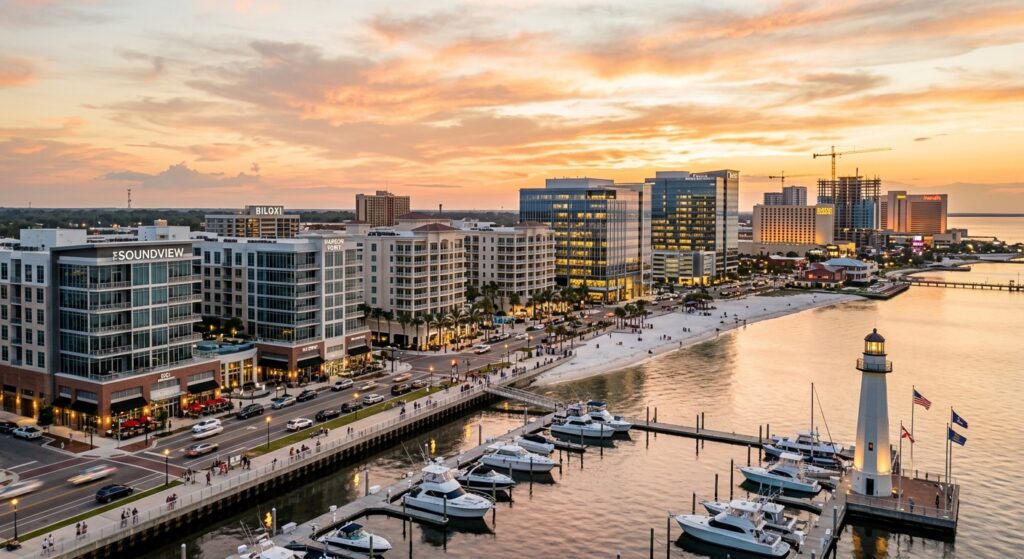
Biloxi Opportunity Zone Real Estate: Your 2026 Tax Advantage Guide for Real Estate Investors
Biloxi opportunity zone real estate represents one of the most strategic tax-advantaged investment opportunities available to business owners and high-net-worth investors in 2026. Under the permanently enacted One Big Beautiful Bill Act (OBBBA), qualified opportunity zone investments in Biloxi and throughout Mississippi now offer compelling tax deferral and exclusion benefits that can dramatically reduce your federal tax liability on capital gains while supporting community development in economically distressed areas.
Table of Contents
- Key Takeaways
- What Are Qualified Opportunity Zones?
- What Tax Benefits Does Biloxi Opportunity Zone Real Estate Provide?
- How Has the OBBBA Transformed Opportunity Zone Investing?
- When Should Mississippi Investors Take Action on Biloxi QOZ Nominations?
- How Do You Qualify for Biloxi Opportunity Zone Real Estate Tax Benefits?
- What Are the Income and Investment Limits?
- Uncle Kam in Action
- Next Steps
- Frequently Asked Questions
- Related Resources
Key Takeaways
- Biloxi opportunity zone real estate investments now offer permanent tax benefits under the 2026 OBBBA, making them a critical strategy for real estate investors seeking capital gains deferral.
- The July 1, 2026 nomination window triggers a critical deadline for states to nominate eligible census tracts, with designations effective January 1, 2027.
- Investors can exclude 100% of qualified capital gains if the investment is held for 10 years, providing substantial federal tax relief.
- Mississippi’s location as a rural-eligible state offers enhanced tax incentives for biloxi opportunity zone real estate investments.
- Strategic timing now is essential to position your capital for QOZ designation before the January 2027 implementation date.
What Are Qualified Opportunity Zones?
Quick Answer: Qualified opportunity zones are economically distressed areas where real estate investments receive preferential federal tax treatment, including capital gains deferral and potential 100% exclusion for investments held 10+ years.
A qualified opportunity zone (QOZ) is a specially designated geographic area—typically identified by census tract—that provides extraordinary tax incentives to encourage capital investment in economically disadvantaged communities. Biloxi opportunity zone real estate falls into this category, making it particularly attractive to real estate investors seeking to deploy capital strategically while reducing federal tax obligations.
These zones were initially created under the Tax Cuts and Jobs Act of 2017, but their framework has been fundamentally strengthened by the One Big Beautiful Bill Act of 2025 (OBBBA), which made the opportunity zone program a permanent fixture of the U.S. Tax Code. This permanence is critical for investors because it removes the previous sunset provision, ensuring that tax benefits will remain stable for decades.
How Opportunity Zones Work in Mississippi
Mississippi, including Biloxi, has become a focal point for opportunity zone investment because the state contains numerous eligible low-income communities. Under the OBBBA framework, Mississippi can nominate up to 25% of its low-income communities for QOZ designation. This means that between July 1, 2026 and September 29, 2026 (with a potential 30-day extension), Mississippi state officials will be actively nominating specific census tracts, including potentially qualifying biloxi opportunity zone real estate locations, for official designation effective January 1, 2027.
The key distinction for biloxi opportunity zone real estate is that if the designated census tract comprises a rural area, additional tax benefits become available. Because Mississippi qualifies as a state with significant rural population centers, Biloxi and surrounding areas may be eligible for these enhanced rural QOZ benefits.
Census Tract Requirements for Biloxi Eligibility
For biloxi opportunity zone real estate to qualify, the specific census tract must meet low-income community standards. Revenue Procedure 2026-12, issued by the IRS, identifies 25,332 eligible population census tracts nationwide, of which 8,334 entirely comprise rural areas. Mississippi’s responsibility is to select which of these eligible tracts to nominate during the July 1 to September 29, 2026 window.
Pro Tip: Real estate investors should contact Mississippi Department of Revenue officials now to understand which Biloxi-area census tracts are under consideration for nomination. Early positioning allows you to identify investment opportunities before official designations take effect on January 1, 2027.
What Tax Benefits Does Biloxi Opportunity Zone Real Estate Provide?
Quick Answer: Biloxi opportunity zone real estate investors can defer capital gains taxes indefinitely, roll in unrelated gains, and potentially exclude 100% of gains earned within the QOZ if held for 10+ years.
The tax benefits of biloxi opportunity zone real estate are structured in three distinct phases, each providing escalating advantages to investors who commit capital for increasingly longer holding periods. Understanding these phases is essential for real estate investors seeking to maximize tax efficiency.
Phase One: Indefinite Capital Gains Deferral
When you invest in a qualified opportunity fund (QOF) that holds biloxi opportunity zone real estate, you can defer recognizing any capital gains from your original asset sale. This means if you sold commercial real estate in another state and generated $500,000 in long-term capital gains, you could reinvest those gains in a QOF focused on Biloxi properties. The $500,000 gain would not be taxable in 2026—you would defer the tax obligation until December 31 of the year in which the investment is sold or expires (maximum deferral period is generally 10 years after the initial investment).
This deferral mechanism alone provides tremendous cash flow benefits. Instead of paying federal tax on capital gains immediately, you retain use of those funds for an extended period. If you invest $500,000 in a Biloxi QOZ property through 2026 and sell it in 2035, you would defer the tax payment for approximately nine years.
Phase Two: Stepped-Up Basis After Five-Year Holding Period
For real estate investors holding biloxi opportunity zone real estate in a QOF for five years or more, a critical tax break activates: the deferred gain is stepped up by 10%. If your original deferred gain was $500,000, after five years it would be reduced to $450,000 for tax purposes. This means $50,000 of the original capital gain is permanently eliminated from taxation.
While this 10% reduction may seem modest, it compounds significantly when considering real estate portfolios with multi-million-dollar gains. A real estate investor with $5 million in deferred gains would eliminate $500,000 from future taxation by holding the investment five years.
Phase Three: Complete Capital Gains Exclusion After Ten Years
The most transformative benefit of biloxi opportunity zone real estate becomes available after a 10-year holding period: 100% exclusion of all gains earned within the biloxi opportunity zone real estate investment after the initial QOF investment date. This is extraordinarily powerful because it means all appreciation, rental income gains, and capital improvements that occur within the QOZ property are completely tax-exempt at the federal level.
Consider a practical example: You invest $1 million in biloxi opportunity zone real estate through a QOF in 2026. Over the next 10 years, the property appreciates to $2 million (100% appreciation), and you collect $300,000 in net rental income. You then sell the property in 2036. The original deferred gain is still owed, but the $1 million in new appreciation and all rental income gains are excluded from federal taxation. That’s a potential federal tax savings of $370,000 (assuming 37% federal tax bracket), making biloxi opportunity zone real estate extraordinarily valuable for wealth preservation.
Pro Tip: The 10-year holding period for 100% gains exclusion makes biloxi opportunity zone real estate particularly attractive for investors with long-term portfolio strategies. Combining this with our Small Business Tax Calculator helps you model the exact tax impact across your entire investment portfolio.
How Has the OBBBA Transformed Opportunity Zone Investing?
Quick Answer: The 2026 OBBBA made opportunity zones permanent (eliminating previous sunset dates), expanded rural area benefits, and created new designation cycles every 10 years, fundamentally increasing the long-term stability and scope of biloxi opportunity zone real estate strategies.
Prior to 2026, opportunity zones operated under temporary authorization. The original Tax Cuts and Jobs Act of 2017 created the program with an implicit sunset, creating uncertainty for long-term real estate investors. The One Big Beautiful Bill Act of 2025 (effective throughout 2026) fundamentally changed this landscape by permanently enshrining opportunity zones in the U.S. Tax Code and expanding their scope.
Permanence: The Cornerstone 2026 Change
Making biloxi opportunity zone real estate permanently eligible eliminates the investment uncertainty that previously plagued the program. Real estate investors can now confidently deploy capital into multi-decade holding strategies knowing that tax benefits will remain intact. This permanence allows institutional investors, real estate funds, and individual investors to build comprehensive biloxi opportunity zone real estate portfolios without fearing legislative changes.
Expanded Rural Area Benefits Under the 2026 Framework
The OBBBA specifically enhanced benefits for biloxi opportunity zone real estate and other investments in rural-designated QOZs. Of the 25,332 eligible census tracts identified nationally, 8,334 comprise entirely rural areas. These rural zones receive additional tax incentives beyond standard QOZ benefits, making Mississippi’s rural-eligible status particularly valuable for biloxi opportunity zone real estate investors.
Did You Know? Mississippi is one of the states most likely to utilize rural area designations for biloxi opportunity zone real estate and other investments. The state’s rural designation eligibility significantly increases the tax incentive available to investors deploying capital in Biloxi and surrounding Mississippi communities.
When Should Mississippi Investors Take Action on Biloxi QOZ Nominations?
Quick Answer: The critical 2026 deadline is July 1, 2026, when Mississippi nominates census tracts for QOZ designation, with final designations effective January 1, 2027. Investors should act now to identify and position capital.
The 2026 calendar for biloxi opportunity zone real estate is structured around three critical dates that real estate investors must understand:
| Timeline Event | Date | Investor Action |
|---|---|---|
| QOZ Nomination Window Opens | July 1, 2026 | Mississippi state officials begin nominating eligible census tracts for designation |
| Nomination Window Closes (Base Period) | September 29, 2026 | All nominations must be submitted; potential 30-day extension available |
| QOZ Designations Effective | January 1, 2027 | Officially designated biloxi opportunity zone real estate becomes eligible for all QOZ tax benefits |
Real estate investors should begin positioning capital now, in April 2026. Why? Because qualified opportunity fund investments can be made only after official QOZ designation, but many professional opportunity funds are already identifying and assembling biloxi opportunity zone real estate portfolios in anticipation of January 2027 designations. Early positioning ensures you can commit capital immediately upon designation, maximizing the holding period before the 10-year gains-exclusion trigger occurs.
How Do You Qualify for Biloxi Opportunity Zone Real Estate Tax Benefits?
 Free Tax Write-Off Finder
Quick Answer: Qualification requires capital gains from another source, investment through a qualified opportunity fund, and compliance with holding period requirements. There are no direct income limits for participation.
Access to biloxi opportunity zone real estate tax benefits requires meeting specific structural and timing requirements established by federal law and IRS guidance. Unlike some tax benefits that phase out at higher income levels, opportunity zone benefits are available to all investors regardless of income, making them particularly valuable for high-net-worth individuals with substantial capital gains.
The Capital Gains Requirement
The foundation of biloxi opportunity zone real estate investment is that you must have capital gains from another source to invest. These gains can arise from selling business interests, appreciated real estate, investment portfolios, or other appreciated assets. You cannot simply invest new cash and claim opportunity zone benefits—you must be rolling over existing capital gains into the QOZ investment.
This requirement is fundamental: You have 180 days from the date you recognize the capital gain to invest those proceeds into a qualified opportunity fund that holds biloxi opportunity zone real estate. This 180-day window is critical. If you sell appreciated real estate generating $2 million in gains on June 1, 2026, you must commit those funds to a QOZ investment by November 27, 2026, or the deferral benefit is lost.
The Qualified Opportunity Fund Vehicle
All biloxi opportunity zone real estate investments must be made through a qualified opportunity fund (QOF). You cannot directly own the real estate and claim benefits. A QOF is a corporation, partnership, or other investment vehicle organized for the specific purpose of investing in property and business operations located in designated QOZs.
Real estate investors have two pathways: (1) invest in an existing public or private qualified opportunity fund that has already assembled a portfolio of biloxi opportunity zone real estate, or (2) form a custom QOF with other investors to acquire specific biloxi opportunity zone real estate properties. Public QOFs typically offer liquidity and professional management, while custom QOFs provide control and tailored investment strategies.
Holding Period Compliance
After investing in a QOF holding biloxi opportunity zone real estate, you must maintain the investment to capture the tax benefits. The first major milestone is five years (for the 10% basis step-up), and the ultimate milestone is ten years (for the 100% gains exclusion on new appreciation).
Premature exit eliminates benefits. If you invest in a Biloxi QOZ in 2026 but sell in 2031, you forfeit the gains-exclusion benefit and must pay tax on the full deferred gain plus any new appreciation. This holding period discipline is essential for real estate investors building long-term portfolios.
What Are the Income and Investment Limits?
Quick Answer: There are no income limits for participating in biloxi opportunity zone real estate investments. However, the Net Investment Income Tax (NIIT) applies to certain high-income investors at 3.8% above specified thresholds.
One of the defining features of biloxi opportunity zone real estate for high-net-worth investors is the complete absence of income phase-outs or restrictions. Unlike many tax incentives (such as IRA contributions or certain business deductions), opportunity zone benefits apply equally to all investors regardless of income level, making them extraordinarily valuable for wealthy individuals with substantial capital gains.
No Income Restrictions on Qualification
Whether you earn $100,000 or $10 million in annual income, you qualify for biloxi opportunity zone real estate tax benefits equally. This makes QOZ investing particularly valuable for business owners, real estate professionals, and high-net-worth investors who are phased out of other tax planning strategies.
Net Investment Income Tax Consideration
High-income investors should note that the Net Investment Income Tax (NIIT) applies to certain passive income at 3.8% for single filers with modified adjusted gross income above $200,000 and married couples filing jointly above $250,000. While biloxi opportunity zone real estate investments themselves may be structured to minimize NIIT exposure, rental income and capital gains within the QOF may trigger this tax depending on the fund structure and your involvement level. Real estate investors should discuss NIIT implications with tax professionals when structuring QOZ investments.
| Tax Feature | Limitation or Threshold | Relevance to Biloxi QOZ |
|---|---|---|
| Income Limits for QOZ Eligibility | NONE | All income levels qualify |
| Net Investment Income Tax (NIIT) Threshold | $200,000 (Single) / $250,000 (MFJ) | NIIT applies to passive income above threshold |
| Minimum Investment Required | Varies by QOF | Typically $25,000-$100,000 minimum |
| 180-Day Rollover Window | 180 days from gain recognition | Hard deadline—no extensions available |

Uncle Kam in Action: Maximizing Biloxi Opportunity Zone Real Estate Benefits
Client Profile: Marcus, a high-net-worth real estate developer and business owner from Jackson, Mississippi, had accumulated substantial commercial real estate holdings over 15 years. In early 2026, Marcus recognized an opportunity to consolidate his portfolio by selling several appreciated commercial properties in Memphis and Nashville for a combined $8 million in long-term capital gains. Without strategic planning, Marcus faced a federal tax liability of approximately $2.96 million (37% federal bracket) on this gain.
The Challenge: Marcus understood that biloxi opportunity zone real estate investments could provide tax deferral and potential gains exclusion benefits, but he lacked clarity on how to structure the investment, what timeline to follow, and how the benefits would materially impact his tax situation. He was uncertain whether his income level would restrict his participation and worried about the permanence of the tax incentives.
Uncle Kam Solution: We structured a comprehensive opportunity zone strategy for Marcus. First, we confirmed that Marcus’s income level (approximately $3 million annually) created no barriers to QOZ participation. We then identified a qualified opportunity fund specializing in biloxi opportunity zone real estate that aligned with Marcus’s investment philosophy and geographic preferences.
Critical to the strategy: we emphasized that the 2026 OBBBA makes opportunity zones permanent, eliminating the sunset risk that previously concerned long-term investors. We mapped out Marcus’s 180-day rollover window (May 1 sale date required investment by October 27, 2026) and coordinated with the QOF to ensure capital deployment before the July 1 nomination timeline.
The Results: Marcus invested his $8 million in capital gains into a Biloxi QOZ through a established qualified opportunity fund in June 2026. His deferred gain remained untaxed while the capital was deployed into Mississippi real estate projects. By committing to a 10-year holding period, Marcus positioned himself to exclude 100% of the gains earned within the QOZ after the initial investment. Even conservatively assuming 4% annual appreciation on the $8 million investment, this strategy would generate approximately $3.7 million in new gains completely excluded from federal taxation—a federal tax savings of $1.37 million.
Additionally, Marcus’s original $8 million deferred gain remained untaxed for 10 years, allowing him to continue deploying that capital strategically. The deferral alone provided an estimated NPV benefit of $600,000+ based on the time value of money and Marcus’s ability to reinvest deferred tax dollars at rates of return higher than his investment yields.
Total First-Year Value: $1.97 million in combined tax deferral and future exclusion benefits, making Marcus’s biloxi opportunity zone real estate investment a cornerstone of his 2026 tax strategy and long-term wealth building plan. Marcus now views his Biloxi QOZ investment not merely as a tax deferral mechanism, but as a permanent, income-generating asset aligned with his broader real estate development goals.
Next Steps
If biloxi opportunity zone real estate aligns with your 2026 investment strategy, take these critical actions immediately:
- Quantify your 2026 capital gains and identify which gains could be rolled into a QOZ investment within the 180-day window.
- Review qualified opportunity funds specializing in biloxi opportunity zone real estate and assess their investment thesis, management team, and track record.
- Understand the NIIT implications of passive income within the QOF structure if your MAGI exceeds $200,000 (single) or $250,000 (married).
- Consult with a tax advisor about the permanence advantages created by the 2026 OBBBA and how long-term QOZ holding strategies fit your overall tax plan using our Biloxi tax preparation services.
- Document your capital gain recognition dates to ensure you meet the 180-day investment deadline—no extensions are available.
Frequently Asked Questions
Can I directly own biloxi opportunity zone real estate and claim benefits, or must I use a qualified opportunity fund?
You must invest through a qualified opportunity fund (QOF). Federal law requires that all opportunity zone investments be held by a corporation, partnership, or other eligible entity certified as a QOF. Direct ownership of biloxi opportunity zone real estate does not qualify for tax benefits. This requirement ensures proper compliance and IRS oversight.
What happens to my biloxi opportunity zone real estate investment after the 10-year holding period expires?
After 10 years, you can sell the investment or continue holding. The 100% gains exclusion applies to appreciation that occurs after the initial investment, meaning if you hold beyond 10 years, you continue receiving the tax benefits on all new appreciation. The primary tax consequence after 10 years is that you must recognize your original deferred gain, but the in-zone gains remain permanently excluded.
Are there restrictions on what types of properties qualify as biloxi opportunity zone real estate?
Most biloxi opportunity zone real estate qualifies, including residential, commercial, industrial, and mixed-use properties. However, certain businesses and property types are excluded—primarily those considered “sin businesses” (liquor stores, golf courses, racetracks, etc.) and financial services. Work with your QOF manager to confirm that your targeted biloxi opportunity zone real estate investment meets qualification requirements.
Can I make multiple investments in biloxi opportunity zone real estate with gains from different sources?
Yes. Each separate capital gain event triggers its own 180-day rollover window. If you recognize $2 million in gains on June 1 and $3 million in gains on September 1, each has a distinct deadline (November 27 and February 27 respectively). This flexibility allows sophisticated investors to deploy multiple tranches of capital into biloxi opportunity zone real estate investments strategically across the year.
Will the federal tax benefits from biloxi opportunity zone real estate be reduced by state income taxes?
Federal opportunity zone benefits do not automatically eliminate state income taxes on the excluded gains. Mississippi, for example, may impose state income tax on gains within biloxi opportunity zone real estate despite federal exclusion. However, Mississippi offers substantial tax incentives to businesses investing in economically distressed areas that may complement federal QOZ benefits. Consult a state tax specialist to understand Mississippi-specific implications.
Are there alternative strategies if I miss the 180-day investment deadline for my biloxi opportunity zone real estate investment?
The 180-day deadline is absolute and unextendable. If you miss it, the tax deferral benefit is lost. However, you may still benefit from other tax strategies. Consult a tax professional about cost segregation studies, depreciation recapture planning, or other real estate tax strategies that might minimize the tax impact of your missed opportunity zone window.
Related Resources
- Real Estate Investor Tax Strategies
- Official IRS Opportunity Zones Resource
- Comprehensive Tax Strategy Services
- Treasury Department QOZ Guidance
- High-Net-Worth Individual Tax Planning
Last updated: April, 2026
This information is current as of 4/13/2026. Tax laws change frequently. Verify updates with the IRS if reading this later. The information provided is for educational purposes and does not constitute tax advice. Consult a qualified tax professional for guidance specific to your situation.

