2026 LLC Series LLC Formation Benefits Guide
For the 2026 tax year, business owners gain access to powerful new asset protection strategies through Series LLC structures. Florida’s groundbreaking Series LLC law takes effect July 1, 2026, making it the 25th U.S. jurisdiction to offer this innovative business formation tool. Series LLCs provide horizontal liability protection while dramatically reducing administrative costs compared to maintaining multiple standalone entities.
Table of Contents
- Key Takeaways
- What Is a Series LLC and How Does It Work in 2026?
- What Are the Tax Benefits of 2026 LLC Series LLC Formation?
- How Much Can You Save With Series LLC Formation in 2026?
- Who Benefits Most From Series LLC Structures?
- Delaware vs Florida: Which State Should You Choose in 2026?
- How to Form a Series LLC in 2026: Step-by-Step Process
- Uncle Kam in Action: Real Estate Portfolio Series LLC Success
- Next Steps
- Frequently Asked Questions
- Related Resources
Key Takeaways
- Florida’s Series LLC law becomes effective July 1, 2026, offering advanced asset protection for business owners.
- Series LLCs create horizontal liability shields between individual series within a single parent entity.
- Businesses save thousands annually on filing fees, registered agent costs, and compliance expenses.
- Each series can maintain separate assets, liabilities, members, and potentially different tax structures.
- Delaware remains the gold standard, but Florida offers competitive advantages for certain business models.
What Is a Series LLC and How Does It Work in 2026?
Quick Answer: A Series LLC is a specialized business structure allowing multiple protected divisions (series) under one parent LLC. Each series operates independently with separate assets and liabilities while sharing a single legal filing.
The 2026 LLC Series LLC formation benefits begin with understanding the fundamental structure. Delaware pioneered this innovative model in 1996, and now Florida becomes the 25th jurisdiction to adopt it effective July 1, 2026. This expansion provides business owners with strategic entity structuring options previously unavailable in many states.
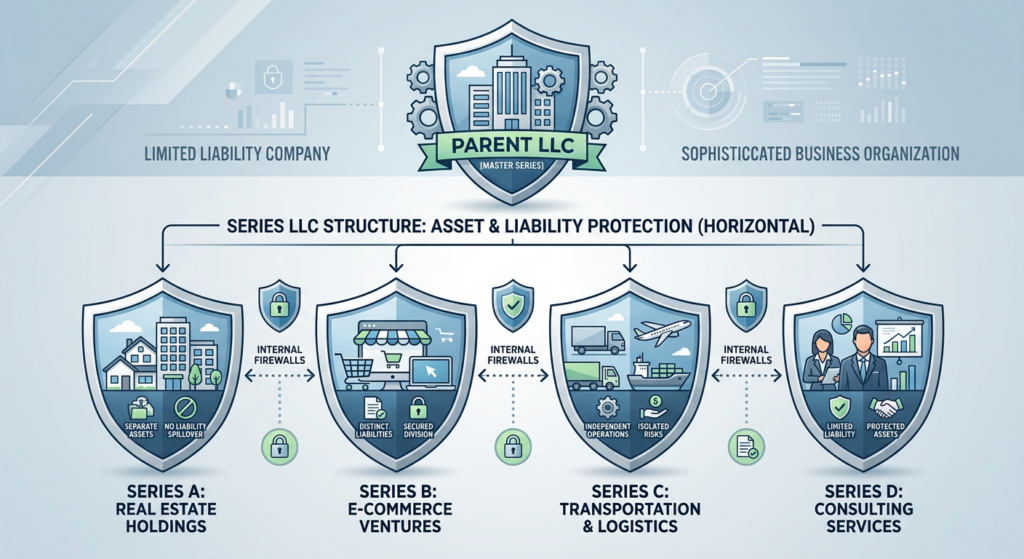
A Series LLC functions as an umbrella organization housing multiple protected divisions. Imagine a parent company with several subsidiaries, but without the administrative burden of maintaining separate corporate entities. Each series operates as its own unit with distinct assets, debts, members, and business purposes.
The Horizontal Shield Concept
The defining feature of Series LLC structures is horizontal liability protection. This means liabilities in Series A cannot pierce through to attack assets held in Series B. Furthermore, obligations of Series B remain isolated from Series C, and so on.
This horizontal shield provides significant advantages over traditional holding company arrangements. Instead of creating multiple LLCs (each requiring separate filing fees, registered agents, and annual reports), you establish one parent LLC with multiple protected series underneath.
Key Structural Components
Series LLCs consist of three primary elements:
- Parent LLC: The master entity that holds the Series LLC designation and files with the state
- Individual Series: Separate divisions with distinct assets, liabilities, and potentially different members or managers
- Operating Agreement: Comprehensive document establishing rules for the parent and each series, including liability segregation provisions
Pro Tip: Meticulous recordkeeping is mandatory to maintain liability protection. Each series must have separate bank accounts, accounting records, and clearly documented transactions. Commingling assets between series can jeopardize your entire structure.
2026 Legislative Developments
Florida’s Series LLC statute represents a significant expansion for business owners seeking flexible corporate structures. The law allows both domestic Series LLCs formed in Florida and foreign Series LLCs created in other states to register and conduct business in Florida starting July 1, 2026.
According to legal analysis from Hinshaw & Culbertson, Florida’s adoption aims to attract businesses by providing competitive advantages over traditional holding company models. The timing coincides with growing demand for sophisticated asset protection strategies among real estate investors and multi-location franchise operators.
What Are the Tax Benefits of 2026 LLC Series LLC Formation?
Quick Answer: Series LLCs offer flexible tax treatment options for 2026. Each series can elect separate tax classifications, potentially allowing some series to be taxed as partnerships while others elect S Corp status.
The 2026 LLC Series LLC formation benefits include powerful tax planning flexibility. While the IRS has not issued comprehensive Series LLC guidance as of March 2026, practitioners utilize established principles from partnership and entity taxation to structure advantageous arrangements.
Flexible Tax Classification Options
One of the most significant advantages involves tax classification flexibility. The parent Series LLC can elect to be taxed as a partnership, disregarded entity, or corporation. More importantly, individual series within the structure may qualify for separate tax elections.
Consider this scenario: You operate a real estate portfolio with both rental properties and a property management company. You could structure separate series where rental properties maintain partnership taxation for passive income treatment, while the management company elects S Corporation taxation to reduce self-employment taxes on active business income.
Administrative Cost Savings
Beyond direct tax savings, Series LLCs deliver substantial administrative cost reductions. Instead of filing separate tax returns for multiple entities, you may consolidate reporting depending on your structure. This reduces accounting fees, preparation time, and ongoing compliance expenses.
For the 2026 tax year, businesses filing partnership returns (Form 1065) by the March 16 deadline should consult IRS Form 1065 instructions for specific reporting requirements applicable to Series LLC arrangements.
Pass-Through Taxation Benefits
Most Series LLCs benefit from pass-through taxation, avoiding the double taxation trap that corporations face. Income, deductions, and credits flow through to the owners’ personal returns where they’re taxed at individual rates.
For the 2026 tax year, high-income business owners should explore qualified business income (QBI) deduction strategies which may apply to pass-through income from Series LLC operations. While the One, Big, Beautiful Bill Act modified certain deductions for 2025 returns filed in 2026, QBI provisions remain valuable planning tools.
Pro Tip: Document your tax elections carefully. File Form 8832 (Entity Classification Election) for each series requiring classification different from the default treatment. Maintain copies in both parent LLC and individual series files.
Allocation of Income and Deductions
Series LLC structures enable sophisticated income and deduction allocation strategies. You can allocate income and losses among series members based on customized formulas reflecting economic reality rather than rigid ownership percentages.
This flexibility proves particularly valuable when series have different risk profiles, investment timelines, or capital contribution patterns. However, allocations must satisfy IRS substantial economic effect requirements outlined in Treasury Regulations Section 1.704-1.
| Tax Benefit | Series LLC | Multiple Standalone LLCs |
|---|---|---|
| Annual Tax Returns | 1-2 returns (depending on structure) | One return per LLC |
| Flexible Tax Elections | Yes, by series | Yes, by entity |
| Pass-Through Treatment | Available | Available |
| Administrative Complexity | Lower (single entity framework) | Higher (multiple entities) |
| Accounting Fees (Annual) | $2,500-$5,000 | $1,500-$2,500 per LLC |
How Much Can You Save With Series LLC Formation in 2026?
Quick Answer: Business owners typically save $5,000-$15,000 annually by using Series LLCs instead of multiple standalone entities. Savings come from reduced filing fees, registered agent costs, and annual report requirements.
The 2026 LLC Series LLC formation benefits deliver measurable financial advantages. Let’s examine specific cost comparisons for a business operating five distinct divisions or property holdings.
Formation Costs Comparison
Initial formation costs vary by state, but Series LLC structures provide immediate savings. In Delaware, forming a Series LLC requires one filing fee for the parent entity plus minimal additional fees to establish each series. Compare this to forming five separate LLCs, each requiring full filing fees.
For Florida entities formed after July 1, 2026, business owners should verify current filing fees with the Florida Division of Corporations. While specific 2026 fee schedules await publication, the structure inherently reduces duplicate administrative expenses.
| Cost Category | Series LLC (5 Series) | 5 Standalone LLCs | Annual Savings |
|---|---|---|---|
| State Filing Fees | $300-$500 | $1,500-$2,500 | $1,200-$2,000 |
| Registered Agent | $100-$300 | $500-$1,500 | $400-$1,200 |
| Annual Reports | $200-$400 | $1,000-$2,000 | $800-$1,600 |
| Accounting/Tax Prep | $2,500-$5,000 | $7,500-$12,500 | $5,000-$7,500 |
Long-Term Wealth Accumulation
The compounding effect of annual savings proves substantial. Investing $10,000 saved annually over ten years at a conservative 7% return generates approximately $138,000 in additional wealth. These savings flow directly to your bottom line rather than administrative overhead.
Moreover, Series LLC efficiency allows business owners to redirect time and energy from administrative tasks to revenue-generating activities. The opportunity cost of managing five separate LLCs—maintaining separate bank accounts, filing multiple reports, coordinating with multiple registered agents—cannot be understated.
Pro Tip: Calculate your specific savings potential before forming. If you currently operate three or more separate entities, Series LLC conversion likely generates positive ROI within the first year when considering all direct and indirect costs.
Hidden Cost Advantages
Beyond obvious fee reductions, Series LLCs deliver additional financial benefits:
- Simplified Banking: One primary business account with sub-accounts for each series reduces monthly fees and minimum balance requirements
- Insurance Efficiency: Umbrella policies covering the Series LLC structure often cost less than separate policies for multiple entities
- Reduced Complexity: Fewer entities mean fewer opportunities for late filings, missed deadlines, or compliance penalties
- Streamlined Reporting: Consolidated financial reporting provides clearer visibility into overall business performance
Who Benefits Most From Series LLC Structures?
Quick Answer: Real estate investors with multiple properties, franchise operators with multiple locations, and businesses managing diverse asset portfolios gain the greatest advantages from 2026 LLC Series LLC formation benefits.
While Series LLCs offer universal benefits, certain business models maximize the structure’s advantages. Understanding which profiles benefit most helps you determine whether Series LLC formation aligns with your 2026 business strategy.
Real Estate Investors
Real estate investors represent the ideal Series LLC use case. Consider an investor owning five rental properties across different neighborhoods. Traditional wisdom suggests placing each property in a separate LLC to prevent liability from one property affecting others.
With a Series LLC, you achieve identical liability protection while dramatically reducing overhead. Each property occupies its own series with segregated assets and liabilities. However, you maintain only one parent LLC entity, file potentially one consolidated tax return (depending on structure), and pay one set of annual state fees.
For the 2026 tax year, real estate investors should explore cost segregation studies and bonus depreciation strategies within Series LLC structures. These advanced techniques can generate substantial tax deductions when properly implemented.
Franchise Operators
Multi-unit franchise operators face unique challenges. Franchisors often require separate legal entities for each location to protect the brand from location-specific liabilities. Series LLCs satisfy these requirements while minimizing administrative burden.
A restaurant franchise owner operating four locations traditionally forms four LLCs. Each requires separate filings, accounting, insurance, and compliance monitoring. The Series LLC structure provides identical isolation between locations with significantly reduced overhead.
Additionally, franchise operators can structure one series to hold intellectual property (recipes, processes, branding) while operating series manage individual locations. This arrangement provides enhanced asset protection by segregating valuable IP from operational risks.
Entertainment and Intellectual Property
Businesses managing intangible assets benefit significantly from Series LLC structures. Music catalogs, patent portfolios, literary works, and software copyrights can each occupy separate series, isolating liability while maintaining centralized management.
Consider a music producer owning rights to 50 songs across different albums. Traditionally, sophisticated asset protection might require 50 separate LLCs or complex trust arrangements. A Series LLC achieves comparable protection with one parent entity and 50 protected series—each holding rights to individual songs or albums.
Investment Funds and Joint Ventures
Series LLCs provide elegant solutions for investment funds managing multiple projects or joint ventures. Each investment or project occupies its own series with distinct investors, capital accounts, and profit-sharing arrangements.
This structure proves particularly valuable when investors participate in some projects but not others. Series A might include investors 1, 2, and 3, while Series B includes investors 2, 4, and 5. Each series maintains separate capital accounts and distributions without requiring separate entity formations.
Pro Tip: Series LLCs work best when you need liability isolation between similar assets or operations. If you’re managing completely different business types (e.g., restaurant + real estate + consulting), traditional separate LLCs might provide better organizational clarity despite higher costs.
 Free Tax Write-Off Finder
Delaware vs Florida: Which State Should You Choose in 2026?
Quick Answer: Delaware offers established legal precedent and business-friendly courts, while Florida (starting July 1, 2026) provides advantages for businesses with Florida operations or seeking to avoid Delaware’s franchise tax.
With Florida joining the Series LLC landscape in 2026, business owners face strategic decisions about formation jurisdiction. Both states offer compelling advantages, but the optimal choice depends on your specific circumstances.
Delaware: The Established Leader
Delaware pioneered Series LLCs in 1996 and maintains significant advantages. The state’s Court of Chancery has developed substantial case law interpreting Series LLC statutes, providing clarity on liability protection, creditor rights, and operational requirements. This legal certainty proves invaluable during disputes or litigation.
The Delaware Division of Corporations offers efficient processing, sophisticated online systems, and responsive support. For businesses seeking venture capital or planning eventual sale, Delaware formation often provides credibility with investors and acquirers familiar with Delaware corporate law.
However, Delaware charges annual franchise taxes based on authorized shares or assumed par value capital method. For large Series LLCs or those with significant capitalization, these fees can become substantial.
Florida: The New Competitor
Florida’s Series LLC statute effective July 1, 2026, offers compelling advantages for specific situations. If your business operates primarily in Florida, forming there eliminates the need to register as a foreign entity—saving annual foreign qualification fees and simplifying compliance.
Florida charges no state income tax on pass-through entities, making it attractive for Series LLCs taxed as partnerships or disregarded entities. The state’s business-friendly reputation and growing tech and real estate sectors position it as a serious Delaware alternative.
The primary disadvantage involves limited case law. As a new Series LLC jurisdiction, Florida courts haven’t yet established extensive precedent interpreting the statute. This legal uncertainty could prove problematic in complex disputes, though Florida likely will follow Delaware’s well-developed legal frameworks.
| Factor | Delaware | Florida (Effective July 1, 2026) |
|---|---|---|
| Series LLC Available Since | 1996 (28 years of precedent) | 2026 (new statute) |
| Legal Precedent | Extensive case law and established interpretations | Limited (will develop over time) |
| Court System | Specialized Court of Chancery | General jurisdiction business courts |
| State Income Tax | None on pass-through entities | None on pass-through entities |
| Annual Franchise Tax | Yes (can be substantial) | Flat annual report fee |
| Best For | National businesses, VC-backed companies, complex structures | Florida-based operations, real estate investors, cost-conscious businesses |
Interstate Recognition Issues
A critical consideration involves interstate recognition. Not all states recognize Series LLC liability protections established in other jurisdictions. If you form a Delaware Series LLC but conduct substantial business in a state that doesn’t recognize Series LLCs, courts might not enforce the horizontal liability shield.
As of 2026, 25 jurisdictions recognize Series LLCs, but 25 do not. When operating across state lines, consult with legal counsel experienced in multi-state entity structuring to ensure your protections remain effective everywhere you do business.
How to Form a Series LLC in 2026: Step-by-Step Process
Quick Answer: Series LLC formation requires filing articles of organization designating Series LLC status, drafting comprehensive operating agreements, establishing separate series, and maintaining meticulous records to preserve liability protections.
Forming a Series LLC in 2026 involves specific steps beyond traditional LLC creation. Proper formation and ongoing compliance prove essential to maintaining the liability protections that make Series LLCs valuable.
Step 1: Choose Your Formation Jurisdiction
Select between Delaware, Florida (after July 1, 2026), or another jurisdiction offering Series LLC structures. Consider factors including:
- Primary business location and where you conduct substantial operations
- State filing fees, franchise taxes, and annual compliance costs
- Legal precedent and court system sophistication
- Interstate operations and recognition in states where you do business
Step 2: File Articles of Organization
Prepare and file articles of organization (or certificate of formation) with your chosen state. The filing must explicitly designate the entity as a Series LLC. Standard LLC articles will not suffice—you must use Series LLC-specific language.
Include provisions stating the LLC has the power to establish series, that series may have separate assets and liabilities, and that debts of one series do not create claims against other series. Most states provide Series LLC formation templates on their Secretary of State websites.
Step 3: Draft Comprehensive Operating Agreement
Create a detailed operating agreement governing the parent LLC and establishing the framework for individual series. This document represents the most critical component of Series LLC formation. It should address:
- Parent LLC governance structure and decision-making authority
- Procedures for establishing new series
- Asset segregation requirements and accounting procedures
- Liability limitation provisions between series
- Management structure for individual series
- Capital contribution and distribution mechanisms
- Transfer restrictions and buy-sell provisions
Step 4: Establish Individual Series
Create each series according to procedures outlined in your operating agreement. Most states don’t require separate state filings for individual series—they’re established through internal LLC action. However, document each series establishment with:
- Written resolution or certificate establishing the series
- Series-specific operating agreement or series supplement
- Initial capital contribution documentation
- Designation of series managers or managing members
Step 5: Obtain EIN and Open Bank Accounts
Apply for an Employer Identification Number (EIN) for the parent LLC through the IRS online application. Depending on your tax structure, you may need separate EINs for individual series that elect different tax classifications.
Open separate bank accounts for each series to maintain asset segregation. Account names should clearly identify both the parent LLC and specific series (e.g., “ABC Holdings LLC – Series 1” and “ABC Holdings LLC – Series 2”). Commingling funds between series can jeopardize liability protection.
Step 6: File Tax Elections
Determine tax classification for the parent LLC and each series. File Form 8832 (Entity Classification Election) with the IRS for any entity requiring classification different from default treatment. Consider consulting tax preparation specialists familiar with Series LLC structures to optimize your tax strategy.
Step 7: Implement Compliance Systems
Establish robust accounting and recordkeeping systems. Each series must maintain:
- Separate financial records and accounting books
- Distinct bank and investment accounts
- Clear documentation of all transactions, especially between series
- Annual meeting minutes or resolutions
- Updated ownership and capital account records
Pro Tip: Treat each series as if it were a completely separate LLC for recordkeeping purposes. If you wouldn’t commingle assets between two standalone LLCs, don’t commingle them between series. Courts scrutinize Series LLC structures closely, and failure to maintain separation can result in losing liability protection.

Uncle Kam in Action: Real Estate Portfolio Series LLC Success
Marcus Chen built a thriving real estate portfolio in South Florida, owning seven rental properties across Miami, Fort Lauderdale, and West Palm Beach. By 2025, he was operating seven separate LLCs—one for each property—following traditional asset protection advice. However, the administrative burden was overwhelming him.
Marcus paid $2,100 annually in Florida LLC filing fees ($300 per entity). His registered agent charged $875 per year ($125 per LLC). Annual accounting costs reached $14,000 because his CPA charged $2,000 per LLC for tax return preparation. Total administrative overhead exceeded $17,000 annually—not including his time managing seven separate entities.
When Florida’s Series LLC law took effect July 1, 2026, Marcus contacted Uncle Kam to explore consolidation options. Our team designed a comprehensive restructuring strategy. We formed a Florida Series LLC with seven protected series—one for each property. The parent LLC held no assets directly, serving purely as the organizational umbrella.
Each property transferred into its designated series through carefully documented conveyances. We established separate operating agreements for each series, specifying asset segregation requirements and establishing clear accounting protocols. Marcus opened sub-accounts at his bank for each series while maintaining the primary parent LLC account.
The results proved dramatic. Marcus now pays one Florida LLC annual report fee of $138.75 instead of seven separate fees totaling $2,100—saving $1,961.25 annually. His registered agent charges $150 for the single entity versus $875 previously—saving $725 annually. Most significantly, his CPA consolidated tax preparation into one partnership return for $3,500 instead of seven returns at $14,000—saving $10,500 annually.
Total annual administrative savings: $13,186. Additionally, Marcus elected S Corporation taxation for the series managing his property management activities, reducing self-employment taxes by an additional $8,200 annually through proper salary structuring.
Marcus paid Uncle Kam $8,500 for the Series LLC restructuring, entity formation, operating agreement drafting, and tax strategy implementation. His first-year return on investment exceeded 250% when combining direct cost savings and tax reduction strategies. Moreover, he reclaimed approximately 15 hours monthly previously spent on administrative tasks—time he now dedicates to acquiring additional properties.
“The Series LLC restructuring transformed my business,” Marcus shared. “I maintain identical liability protection but with a fraction of the administrative headaches. The Uncle Kam team handled everything seamlessly, and I’m now expanding my portfolio knowing the structure scales efficiently. Learn more about our client success stories and real-world results.”
Next Steps
Ready to explore 2026 LLC Series LLC formation benefits for your business? Take these concrete actions:
- Calculate your current annual costs for maintaining multiple entities including filing fees, registered agents, accounting, and compliance.
- Evaluate whether your business operates in Series LLC-friendly jurisdictions or conducts substantial business in states that don’t recognize Series structures.
- Schedule a consultation with Uncle Kam’s tax advisory team to discuss Series LLC formation and restructuring strategies.
- Review your current operating agreements and entity structures with legal counsel to identify consolidation opportunities.
- If you operate in Florida, mark July 1, 2026, as the date when Series LLC formations become available in your home state.
Frequently Asked Questions
Are Series LLCs recognized in all states in 2026?
No. As of 2026, only 25 U.S. jurisdictions recognize Series LLC structures. If you form a Series LLC in Delaware but conduct business in a non-recognizing state, courts there may not enforce the horizontal liability shield between series. This represents a significant risk requiring careful planning with experienced legal counsel.
Can I convert my existing standalone LLCs into a Series LLC structure?
Yes. You can restructure existing entities into a Series LLC through asset transfers, mergers, or conversions depending on state law. The process requires careful documentation, proper valuations, and attention to tax consequences. Consult with business structuring professionals to ensure the conversion preserves liability protection while minimizing tax impact.
How does IRS tax treatment work for Series LLCs in 2026?
The IRS has not issued comprehensive Series LLC guidance as of March 2026. Most practitioners treat the parent LLC as the primary entity for tax purposes, with individual series either disregarded or potentially eligible for separate tax elections. Tax treatment depends on your specific structure, member arrangements, and classifications elected via Form 8832.
What happens if I fail to maintain proper separation between series?
Failure to maintain proper separation can result in courts “collapsing” the Series LLC structure, eliminating liability protection between series. This is similar to piercing the corporate veil with traditional LLCs. Maintain separate bank accounts, accounting records, and clear documentation for all transactions—especially those between series.
Can I use Series LLCs for my retirement account investments?
Yes, self-directed IRA custodians often allow retirement accounts to invest in Series LLC structures. This arrangement provides checkbook control over retirement funds while maintaining required asset segregation. However, IRS prohibited transaction rules still apply, and structure complexity requires specialized expertise.
How long does it take to form a Series LLC in 2026?
Formation timelines vary by state. Delaware typically processes filings within 24-48 hours with expedited service. Florida’s timeline for Series LLC formations starting July 1, 2026, will depend on adoption of expedited processing systems. Budget 2-4 weeks for complete formation including articles filing, operating agreement preparation, EIN acquisition, and account establishment.
What insurance considerations apply to Series LLCs?
Each series should maintain appropriate insurance coverage for its specific assets and operations. However, umbrella policies covering the entire Series LLC structure often cost less than separate policies for multiple standalone LLCs. Work with commercial insurance brokers experienced in Series LLC structures to ensure adequate coverage without gaps.
Can creditors pierce the Series LLC protection in 2026?
Creditors can challenge Series LLC protections through veil-piercing arguments similar to traditional LLC challenges. Courts examine whether you maintained proper formalities, segregated assets appropriately, and avoided fraudulent transfers. Meticulous compliance with operating agreement provisions and state law requirements provides the strongest defense against creditor attacks.
Related Resources
- Entity Structuring Services: LLC, S Corp, and Holding Company Formation
- Tax Strategies for Real Estate Investors
- Uncle Kam Tax Strategy Blog
- The MERNA Method: Uncle Kam’s Proven Tax Strategy Framework
- Comprehensive Tax Planning Guides
This information is current as of 3/11/2026. Tax laws change frequently. Verify updates with the IRS or state authorities if reading this later.
Last updated: March, 2026

