
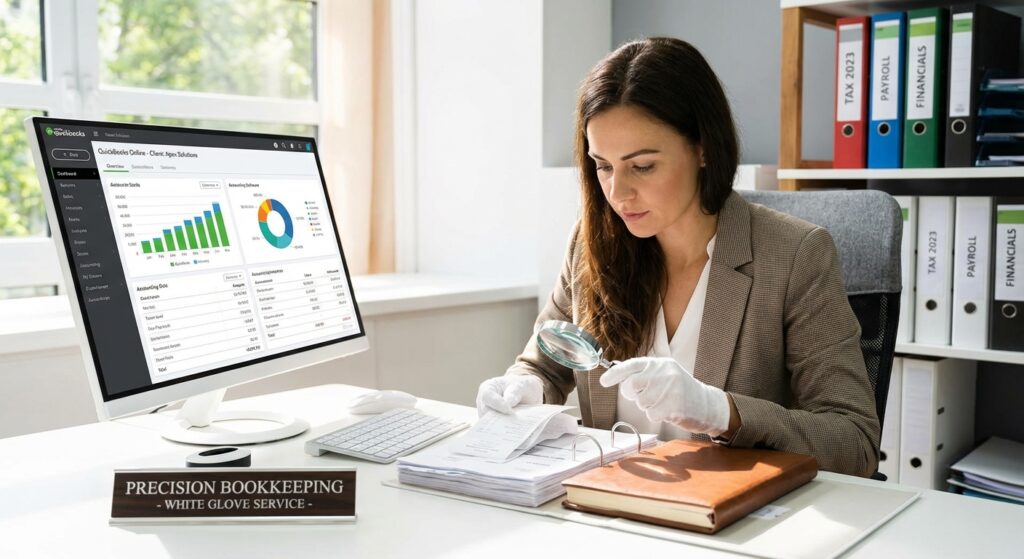
White-Glove Bookkeeping for Business Owners: 2026 Tax Strategy Guide
White-glove bookkeeping for business owners represents the gold standard in financial management. It goes beyond basic record-keeping to provide comprehensive, meticulous tracking of every transaction, deduction, and credit your business earns. For 2026, implementing white-glove bookkeeping practices has become more critical than ever. The One Big Beautiful Bill Act (OBBBA), signed into law on July 4, 2025, has permanently changed the tax landscape for business owners, introducing new deductions, raising contribution limits, and fundamentally altering how you should approach your financial strategy. This comprehensive guide will walk you through the 2026 tax changes and show you exactly how proper bookkeeping can save you thousands in taxes while keeping your business fully compliant.
Table of Contents
- Key Takeaways
- What Is White-Glove Bookkeeping for Business Owners?
- Why Must Business Owners Separate Personal and Business Finances?
- What Major Tax Changes Affect Business Owners in 2026?
- How Should You Structure Your Chart of Accounts?
- What Documentation Practices Protect Your Deductions?
- Uncle Kam in Action
- Next Steps
- Frequently Asked Questions
Key Takeaways
- White-glove bookkeeping for business owners eliminates tax errors and maximizes deductions, potentially saving thousands annually in 2026.
- The 2026 Section 179 deduction limit has increased to $2.5 million, allowing immediate expensing of qualifying equipment purchases.
- Separating business and personal finances is non-negotiable for maintaining audit defensibility and claiming legitimate business deductions.
- A properly designed chart of accounts streamlines tax preparation and ensures every deduction is captured and documented.
- IRS staffing shortages in 2026 mean selective enforcement—meticulous documentation is your best defense against audit scrutiny.
What Is White-Glove Bookkeeping for Business Owners?
Quick Answer: White-glove bookkeeping means comprehensive, meticulous financial tracking that ensures every transaction is documented, categorized, and ready for tax preparation or audit defense.
White-glove bookkeeping for business owners goes far beyond simply recording income and expenses. It represents a comprehensive approach to financial management where every transaction receives careful attention. This method ensures that your books are not only accurate but also audit-ready at all times. Unlike basic bookkeeping, white-glove bookkeeping provides a complete audit trail, proper categorization of expenses, and clear documentation supporting every deduction you claim. For business owners aiming to maximize profitability while minimizing tax liability, this level of detail is essential.
The Core Elements of White-Glove Bookkeeping
Proper white-glove bookkeeping includes three essential components. First, every business transaction receives immediate documentation with supporting receipts, invoices, or proof of payment. Second, expenses are categorized into a strategic chart of accounts designed to minimize tax liability. Third, regular reconciliation ensures your books match your bank statements and credit card statements, eliminating discrepancies before they become problems.
- Real-time transaction entry: Record every business expense as it occurs, not weekly or monthly.
- Supporting documentation: Maintain both physical and digital records of all receipts and invoices.
- Monthly reconciliation: Verify that your books match your bank and credit card statements within 48 hours of month-end.
- Strategic categorization: Use your chart of accounts to highlight deductions and minimize tax exposure.
Why Technology Matters in White-Glove Bookkeeping
In 2026, accounting software has become non-negotiable for white-glove bookkeeping. The IRS has begun requiring electronic payments and refunds, making digital bookkeeping systems essential. Modern accounting software automatically categorizes transactions, flags duplicate entries, generates tax reports, and provides audit-ready documentation. For business owners who want white-glove bookkeeping without manual spreadsheets, cloud-based solutions offer real-time access to financial data from any location.
Pro Tip: The 2026 IRS filing season will see electronic-only refunds and payments. Implement cloud-based accounting software now to meet this requirement and improve your bookkeeping accuracy simultaneously.
Why Must Business Owners Separate Personal and Business Finances?
Quick Answer: Separating finances protects your business liability, ensures audit defensibility, and allows you to claim all legitimate deductions without IRS challenge.
The foundation of white-glove bookkeeping for business owners is the complete separation of business and personal finances. This separation serves multiple critical purposes beyond simple organization. When your business and personal accounts are intermingled, the IRS views questionable transactions with suspicion. Auditors cannot easily distinguish legitimate business expenses from personal spending. Most importantly, mixing finances jeopardizes the liability protection that your business structure—whether LLC, S Corporation, or sole proprietorship—is designed to provide.
How to Establish Proper Financial Separation
- Open a dedicated business bank account: Use this account exclusively for business income and authorized business expenses.
- Obtain a business credit card: Use only for business purchases to create a clear audit trail.
- Never use personal funds for business expenses: If you do, document it as a capital contribution or formal loan to your business.
- Record owner compensation separately: Pay yourself through regular payroll or owner distributions, not ad-hoc transfers.
When business and personal finances are properly separated, your bookkeeping becomes dramatically simpler. Every transaction in your business account is presumed to be business-related. When audited, you can quickly demonstrate which expenses support your business operations. This clarity saves time during tax preparation and provides ironclad defense during IRS examination. For business owners pursuing white-glove bookkeeping practices, proper account separation is the critical first step.
What Major Tax Changes Affect Business Owners in 2026?
Quick Answer: The 2026 tax year features major changes from the OBBBA, including increased 401(k) limits to $24,500, higher Section 179 expensing limits to $2.5 million, and permanent tax rate reductions for business owners.
The One Big Beautiful Bill Act (OBBBA) was signed on July 4, 2025, making it effective for the 2026 tax year. These changes represent the most significant tax legislation for business owners since 2017. White-glove bookkeeping becomes even more important in this new environment, as proper documentation helps you maximize benefits from these expanded deductions and strategies. Understanding these changes allows your bookkeeper to implement the right accounting structure and ensure zero tax dollars are wasted.
2026 Tax Changes for Business Owners
| Tax Provision | 2025 Limit | 2026 Limit | Change |
|---|---|---|---|
| 401(k) Contribution Limit | $23,500 | $24,500 | +$1,000 |
| 401(k) Catch-up (age 50+) | $7,500 | $8,000 | +$500 |
| IRA Contribution Limit | $7,000 | $7,500 | +$500 |
| Section 179 Expensing Limit | $1,160,000 | $2,500,000 | +$1,340,000 |
| Business Mileage Rate | 70¢ per mile | 72.5¢ per mile | +2.5¢ |
| SALT Deduction Cap | $10,000 | $40,400 | +$30,400 |
The Section 179 Expensing Game-Changer
Perhaps the most significant change for 2026 is the increase in the Section 179 deduction limit to $2.5 million. This allows business owners to immediately deduct the full cost of qualifying equipment purchases instead of depreciating them over multiple years. For a business purchasing $2 million in equipment in 2026, this creates $2 million in immediate deductions that reduce 2026 taxable income.
Example calculation: A business owner buys $2 million in manufacturing equipment in 2026. Under Section 179, they can deduct the entire $2 million in the year of purchase. If they are in the 32% federal tax bracket plus 9.3% state tax (for example), they save approximately $828,600 in taxes ($2,000,000 × 41.3%). White-glove bookkeeping ensures that every equipment purchase is properly documented and categorized to capture this substantial deduction.
Did You Know? The Section 179 increase applies to equipment purchased for tax years starting after 2024. If you are planning equipment purchases in 2026, the timing matters. Consult your tax strategist before year-end to maximize this benefit. The higher limit is one of the most valuable tax provisions for business owners in 2026.
How Should You Structure Your Chart of Accounts?
Quick Answer: Your chart of accounts should categorize income and expenses strategically to maximize deductions, simplify tax preparation, and provide clear financial insights for business decision-making.
The chart of accounts is the organizational backbone of white-glove bookkeeping for business owners. This strategic categorization system determines how easily you can identify deductions, prepare tax returns, and understand your business’s financial performance. A poorly organized chart of accounts forces you to search through hundreds of transactions to find deductible expenses. A strategically designed chart of accounts makes every deduction immediately visible and tax-ready.
Core Categories for Business Expense Accounts
- Salaries and Wages: Employee compensation, payroll taxes, and benefits. For 2026, tracking separately ensures compliance with evolving Roth contribution rules for high earners.
- Office and Administration: Rent, utilities, office supplies, phones, and internet used for business operations.
- Professional Services: Accounting, legal, consulting, and bookkeeping fees. Proper categorization supports your deduction claims during audit.
- Vehicle and Travel Expenses: Business mileage (72.5 cents per mile for 2026), fuel, maintenance, and business travel. Track mileage separately to capture the new 2026 rate increases.
- Equipment and Depreciation: Distinguish between Section 179-eligible equipment (immediate deduction to $2.5 million) and other assets requiring depreciation.
- Research and Development: Track separately for Form 6765 compliance. The IRS has delayed 2026 reporting requirement changes, so proper categorization now prevents future problems.
Strategic Account Naming and Numbering
Accounting software requires a numbered chart of accounts. Modern software allows filtering and reporting by account number. Numbering conventions typically group similar accounts. For example, numbers 4000-4999 might represent income accounts, 5000-5999 might represent cost of goods sold, and 6000-6999 might represent operating expenses. Within operating expenses, sub-numbering organizes related expenses together. This structure allows your accountant to instantly locate all deductible expenses when preparing your tax return.
White-glove bookkeeping requires that your chart of accounts matches your business structure. An LLC, S Corporation, and sole proprietorship may need slightly different account structures. A business with multiple locations may need location-specific accounts. Your bookkeeper should design the chart of accounts specifically for your business model to ensure that every dollar of deduction is captured and tax-ready.
What Documentation Practices Protect Your Deductions?
Quick Answer: Contemporaneous documentation—receipts, invoices, and contemporaneous records—provides the legal foundation for every deduction and protects against IRS audit risk.
White-glove bookkeeping for business owners is incomplete without rigorous documentation practices. The IRS does not accept bookkeeper assertions about expenses. Instead, the IRS requires contemporaneous documentation proving that every deduction is legitimate, business-related, and properly calculated. In 2026, IRS staffing shortages mean that the agency will rely more heavily on technology to identify audit targets. When selected for examination, businesses with meticulous documentation escape with minimal adjustments, while businesses with poor records face substantial additional tax bills.
Five Documentation Requirements for Every Deduction
- Receipt or invoice: Paper or digital proof that the expense was incurred. Digital receipts from credit card statements or email confirmations are acceptable.
- Business purpose documentation: Notes explaining why the expense was necessary for your business. For meals or entertainment, include the attendees and business discussed.
- Amount and date: Clear documentation of what was paid and when. Your accounting software should timestamp every transaction automatically.
- Payee identification: Know who you paid and maintain documentation confirming the vendor’s identity and contact information.
- Organized retention: Store original receipts in labeled folders, either physical or digital, organized by month or category. Cloud-based storage allows immediate retrieval during audit.
Mileage Documentation for the 2026 Tax Year
Business mileage is one of the most heavily audited deductions. The IRS requires contemporaneous mileage logs documenting the date, destination, business purpose, and miles driven. The new 2026 rate of 72.5 cents per mile makes mileage tracking even more valuable. A business owner driving 20,000 miles annually saves an additional $500 in 2026 compared to 2025 (20,000 miles × 2.5 cents increase). However, the IRS audits businesses claiming substantial mileage deductions far more frequently than other deductions. White-glove bookkeeping for business owners includes automatic mileage tracking via smartphone apps that create audit-ready logs without manual entry.
Uncle Kam in Action: Manufacturing Business Owner Saves $67,500 with Strategic White-Glove Bookkeeping
Client Snapshot: Marcus was a manufacturing business owner in his mid-forties, running a mid-sized fabrication company with $1.2 million in annual revenue and twelve employees. His business provided precision metal components to regional industrial clients. Marcus had always done basic bookkeeping himself using spreadsheets, tracking income and general expenses without strategic categorization.
Financial Profile: Annual business revenue of $1.2 million. Personal income from the business averaged $180,000 annually. The business held approximately $350,000 in equipment that was being depreciated over standard useful lives rather than deducted immediately.
The Challenge: Marcus was paying an estimated $240,000 in annual federal and state income taxes. He knew other business owners paying less, but did not understand how they were minimizing their tax liability. His spreadsheet bookkeeping was time-consuming and error-prone. During a conversation with a peer, Marcus learned about white-glove bookkeeping and the 2026 Section 179 increase to $2.5 million. He realized he was leaving substantial tax deductions on the table.
The Uncle Kam Solution: Uncle Kam’s team implemented comprehensive white-glove bookkeeping for Marcus’s manufacturing business. First, they opened a dedicated business bank account and moved all business transactions away from Marcus’s personal account. Second, they designed a strategic chart of accounts that categorized equipment separately, capturing the 2026 Section 179 increase opportunity. Third, they implemented cloud-based accounting software with automatic receipt capture and mileage tracking. Fourth, they advised Marcus to purchase $1.8 million in manufacturing equipment in Q4 of 2026—equipment he had been planning to buy anyway but was delaying.
Using the 2026 Section 179 increase, Marcus deducted the entire $1.8 million equipment cost in 2026 instead of depreciating it over five years. They also identified $80,000 in previously missed business deductions across twelve months of business operations. These deductions included vehicle mileage that Marcus had been tracking manually without capitalizing on the rate increase, professional services that were being recorded in the wrong account, and a home office deduction that was completely undocumented.
The Results:
- Tax Savings in 2026: $67,500. This consisted of $1.8 million in Section 179 deductions at a blended tax rate of 37.5% federal and state, plus $80,000 in recovered deductions. ($1,800,000 × 37.5%) + ($80,000 × 37.5%) = $67,500.
- Investment with Uncle Kam: A one-time strategic planning engagement costing $8,500, plus monthly bookkeeping services of $800 annually ($9,600 for the year), totaling approximately $18,100.
- Return on Investment (ROI): 3.73x return in the first year alone. Marcus saved $67,500 in taxes for a $18,100 investment, representing a $49,400 net profit from implementing white-glove bookkeeping practices.
This is just one example of how our proven white-glove bookkeeping practices have helped clients achieve significant tax savings and financial peace of mind. The 2026 Section 179 increase is temporary, but the bookkeeping discipline Marcus established will provide ongoing benefits for years to come.
Next Steps
Implementing white-glove bookkeeping for business owners requires specific actions. Begin by auditing your current financial setup. Do you have a dedicated business bank account separate from personal finances? Are your expenses categorized strategically, or are they dumped into generic categories? Do you have organized documentation for every deduction? Next, consider implementing or upgrading your accounting software. Cloud-based solutions like QuickBooks Online provide automatic receipt capture, real-time financial reporting, and audit-ready documentation. Finally, schedule a consultation with a tax strategist who specializes in business bookkeeping optimization. The 2026 tax year offers unprecedented opportunities for business owners willing to implement rigorous bookkeeping practices. Waiting until April 2027 to organize your finances means losing substantial 2026 tax opportunities that cannot be recovered.
Frequently Asked Questions
Can I implement white-glove bookkeeping if I have been doing basic bookkeeping for years?
Absolutely. A transition to white-glove bookkeeping begins with a comprehensive audit of your current books. A professional bookkeeper can identify missing documentation, correct categorization errors, and organize prior-year records. However, the most important time to start is immediately. Going forward, implement the practices described in this guide. Your bookkeeper may be able to recover some prior-year deductions through amended returns, but the primary benefit of white-glove bookkeeping is future tax optimization. Start today, and your 2026 tax return will reflect years of disciplined bookkeeping practices.
How much does white-glove bookkeeping cost compared to basic bookkeeping?
White-glove bookkeeping typically costs 30-50% more than basic bookkeeping because it includes strategic account design, proactive tax planning, and comprehensive documentation organization. However, the cost is easily recovered through tax deductions that basic bookkeeping misses. A $200-per-month white-glove bookkeeper ($2,400 annually) who identifies $10,000 in previously missed deductions saves approximately $3,700 in taxes (at 37% combined rate), resulting in a $1,300 net profit in the first year alone. The investment pays for itself many times over.
What happens if I get audited after implementing white-glove bookkeeping?
White-glove bookkeeping includes contemporaneous documentation for every deduction, placing you in the strongest possible position during IRS examination. Businesses with meticulous documentation typically resolve audits within 60 days with minimal adjustments. The IRS sees business owners with poor records as higher-risk taxpayers. By implementing white-glove bookkeeping now, you transform your audit profile from high-risk to low-risk. Additionally, if the auditor requests documentation for a specific expense, you can instantly retrieve it from your organized files, increasing your credibility.
Can accounting software replace a professional bookkeeper for white-glove bookkeeping?
Accounting software is essential infrastructure, but it cannot replace the strategic thinking that defines white-glove bookkeeping. Software can record transactions automatically, but it cannot design a strategic chart of accounts, identify missed deductions, or provide tax planning guidance. A professional bookkeeper uses accounting software as a tool to implement white-glove practices more efficiently. Software reduces the cost of white-glove bookkeeping by automating routine data entry, making professional bookkeeping more affordable for small businesses.
How quickly will I see tax savings from white-glove bookkeeping?
Immediate benefits include reduced time spent searching for receipts during tax preparation and reduced stress about missing documentation. Direct tax savings appear on your 2026 tax return if you implement white-glove bookkeeping by December 2026. Many of these benefits compound over time. Organizing your bookkeeping infrastructure in 2026 creates ongoing savings for 2027, 2028, and beyond. The compounding benefit means that white-glove bookkeeping becomes increasingly valuable as your business matures.
Are there any risks to claiming deductions discovered through white-glove bookkeeping?
The only risk is claiming deductions that are not actually business expenses or lack proper documentation. White-glove bookkeeping specifically includes verification that every deduction is legitimate and fully documented. The bookkeeper’s role includes reviewing expenses to confirm they meet IRS requirements before they are claimed on your tax return. This verification process eliminates the risk of audit adjustments. Businesses operating without white-glove bookkeeping take far greater risk because they lack documentation and may be claiming questionable deductions unknowingly.
This information is current as of 1/4/2026. Tax laws change frequently. Verify updates with the IRS if reading this later.
Related Resources
- Comprehensive Business Bookkeeping and Financial Management Services
- Advanced Tax Strategy Planning for Business Owners
- Dedicated Tax Solutions for Small Business Owners
- Real Business Owner Success Stories and Tax Savings Results
- IRS Form 1120-S Information and Filing Requirements
Last updated: January, 2026

