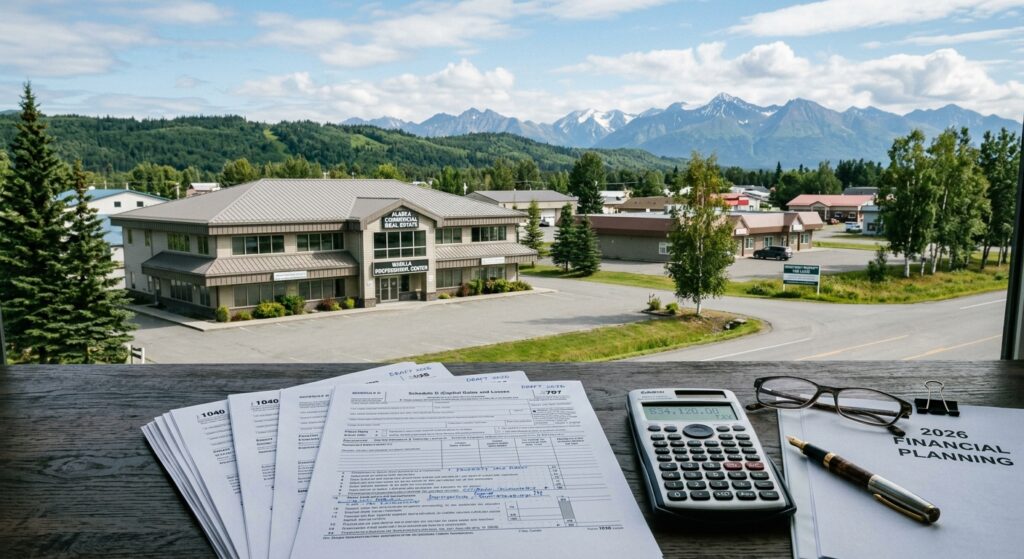
Wasilla Capital Gains Taxes: A 2026 Guide for Alaska Investors and Business Owners
For Wasilla residents, understanding Wasilla capital gains taxes is essential to maximizing investment returns. In 2026, long-term capital gains in the federal system are taxed at preferential rates of 0%, 15%, or 20%, depending on your income bracket. The great news for Alaska investors? Alaska imposes no state capital gains tax, meaning Wasilla property owners and business investors only face federal taxation. This guide covers the 2026 tax brackets, strategies, and planning tips to help you navigate capital gains taxation effectively.
Table of Contents
- Key Takeaways
- What Are Capital Gains and How Are They Taxed in 2026?
- What Are the Federal Capital Gains Tax Rates for 2026?
- How Do Short-Term and Long-Term Capital Gains Differ?
- What Is Alaska’s Capital Gains Tax Advantage?
- How Can You Minimize Wasilla Capital Gains Taxes?
- Uncle Kam in Action: Alaska Real Estate Investor Success Story
- Next Steps
- Frequently Asked Questions
Key Takeaways
- Federal long-term capital gains are taxed at 0%, 15%, or 20% based on income in 2026.
- Alaska has no state capital gains tax, a major advantage for Wasilla investors.
- Holding investments over one year qualifies you for preferential long-term rates.
- Strategic timing and tax-loss harvesting can reduce your effective tax burden.
- Proper business structure (LLC, S Corp) can defer or optimize capital gains taxation.
What Are Capital Gains and How Are They Taxed in 2026?
Quick Answer: Capital gains are profits from selling assets like real estate, stocks, or business interests. In 2026, they’re taxed federally at rates between 0%-37%, depending on holding period and income. Alaska adds no additional tax.
A capital gain occurs when you sell an asset for more than you paid for it. The difference between your original purchase price (called your “basis”) and the sale price is your taxable gain. For Wasilla residents, understanding how these gains are taxed at the federal level is critical because Alaska imposes no state tax on them.
The IRS Publication 550 defines two categories of capital gains: long-term and short-term. Long-term capital gains (assets held over one year) receive preferential tax treatment. Short-term gains (assets held one year or less) are taxed like ordinary income, which can be significantly higher. For Wasilla investors, this distinction alone can save thousands in taxes.
How Capital Gains Are Calculated
The calculation is straightforward: Sale Price minus Adjusted Basis equals Taxable Gain. Your basis includes your original purchase price plus improvements, while also accounting for depreciation taken (especially relevant for Wasilla rental property owners). If you sell a property for $500,000 that you purchased for $300,000, your capital gain is $200,000. That $200,000 is subject to federal taxation.
Why Wasilla Capital Gains Taxes Matter More to Investors
Real estate investors and business owners in Wasilla often realize substantial capital gains. Whether you’re selling rental properties, commercial buildings, or business interests, the tax burden can significantly impact your net proceeds. Strategic planning before selling can result in substantial savings. Alaska’s lack of state tax means Wasilla investors already have an advantage over those in states like California (13.3% state tax) or New York (8.82%).
What Are the Federal Capital Gains Tax Rates for 2026?
Quick Answer: Federal long-term capital gains rates are 0%, 15%, or 20% based on taxable income. Single filers at $0-$48,350 pay 0%; those from $48,351-$533,400 pay 15%; over $533,400 pays 20%. Married couples have higher thresholds.
For the 2026 tax year, federal long-term capital gains follow a tiered system. Understanding these brackets is essential for Wasilla capital gains taxes planning. Most high-income investors will fall into the 15% or 20% bracket, but lower-income years (or strategic income management) might allow you to access the 0% rate.
| 2026 Long-Term Capital Gains Tax Brackets (Federal Only) | Single Filers | Married Filing Jointly |
|---|---|---|
| 0% Rate | $0 – $48,350 | $0 – $96,700 |
| 15% Rate | $48,351 – $533,400 | $96,701 – $600,050 |
| 20% Rate | Over $533,400 | Over $600,050 |
These thresholds apply specifically to long-term capital gains held over one year. The rates remain stable through 2026, based on the 2025 One Big Beautiful Bill Act (OBBBA) legislation. For Wasilla business owners planning to sell, understanding which bracket you’ll fall into is crucial for tax strategy.
Using the 0% Rate Strategically
The 0% bracket is incredibly valuable. A single filer can realize $48,350 in long-term gains tax-free in 2026. Married couples can have up to $96,700. If you have the ability to spread gains across multiple years or time sales strategically, accessing this bracket can result in significant tax savings. For example, a Wasilla real estate investor realizing a $100,000 gain might structure it as a partial sale in one year and a second sale in the following year to minimize tax impact.
Pro Tip: Year-end tax planning is critical for Wasilla investors. If your income is unusually low in 2026, consider realizing capital gains in that year to access lower rates. Conversely, if you expect a major income event in 2027, defer gains to spread the tax impact.
How Do Short-Term and Long-Term Capital Gains Differ?
Quick Answer: Short-term gains (assets held under one year) are taxed like ordinary income at rates up to 37%. Long-term gains (over one year) get preferential 0%, 15%, or 20% rates. The difference can be significant.
The distinction between short-term and long-term capital gains is perhaps the most important tax planning consideration for Wasilla investors. Short-term gains are taxed at ordinary income tax rates, which in 2026 reach a top federal rate of 37% for high earners. This is substantially higher than the 20% maximum on long-term gains.
The One-Year Holding Period Rule
Assets must be held for more than one year to qualify for long-term capital gains treatment. The holding period clock starts on the date you acquire the asset and ends on the date you sell it. For Wasilla real estate investors, this means a property purchased on January 15, 2025, becomes long-term as of January 16, 2026. Missing this deadline by a single day can cost significant taxes.
Consider a practical example: A Wasilla investor buys a rental property for $400,000 and sells it 11 months later for $425,000. The $25,000 gain is short-term and taxed at ordinary income rates. If they waited just one month, that same $25,000 would be taxed at preferential long-term rates, potentially saving $5,000-$7,500 in federal taxes alone.
Short-Term Capital Gains Tax Brackets for 2026
Short-term gains follow the standard federal income tax brackets. For high-net-worth investors in Wasilla, this means short-term gains are taxed at 37% (for income over $640,600 for single filers, $768,700 for married filers). This dramatically illustrates why holding periods matter for wealth preservation.
What Is Alaska’s Capital Gains Tax Advantage?
 Free Tax Write-Off Finder
Quick Answer: Alaska imposes no state capital gains tax, making Wasilla a favorable jurisdiction for investors. You only pay federal taxes, unlike states that add 5%-13%+ on top of federal rates.
Real estate investors and business owners throughout the country seek tax advantages, and Wasilla offers a significant one: Alaska has no state capital gains tax. This is a major competitive advantage compared to other regions. Washington state, for example, imposes a 7% capital gains tax. California adds 13.3% state tax. New York adds up to 8.82%.
For Wasilla residents, this means a $500,000 capital gain is taxed only at the federal level. If that same investor lived in California and realized the same gain, they’d pay an additional $66,500 in state taxes. Alaska’s favorable treatment is one reason many investors relocate to or base operations in Wasilla.
Alaska Tax Residency Implications
To benefit from Alaska’s no capital gains tax, you must be an Alaska tax resident. The IRS considers multiple factors: state residency, domicile, primary residence location, and business presence. If you’re a Wasilla resident conducting substantial business there, you qualify. However, if you’re relocating specifically for tax purposes, you must establish genuine residency (driver’s license, voter registration, primary residence) to avoid IRS challenges.
Pro Tip: If you’re considering a major business sale or real estate liquidation, consulting with a tax professional before selling is essential. Establishing Alaska residency legitimately before realizing gains can provide substantial tax savings.
How Can You Minimize Wasilla Capital Gains Taxes?
Quick Answer: Minimize taxes by holding assets long-term, timing sales strategically, using tax-loss harvesting, considering business structures, and managing annual income to optimize tax brackets.
Tax minimization strategies are essential for serious Wasilla investors. The difference between an unplanned sale and a strategically timed transaction can easily be $10,000-$100,000+ in federal taxes saved. Use our LLC vs S-Corp Tax Calculator to model how business structure affects your capital gains taxation.
Strategy 1: Tax-Loss Harvesting
Tax-loss harvesting means strategically selling underperforming investments to offset capital gains. If you have a stock portfolio with $50,000 in losses and realized $50,000 in real estate gains, the losses offset the gains completely, eliminating tax liability for that year. Wasilla investors can also carry forward excess losses (up to $3,000 annually) to future years, reducing taxes across multiple years.
Strategy 2: Installment Sales
Rather than a lump-sum sale, structure the transaction as an installment sale. This spreads gains across multiple tax years, potentially allowing you to access lower tax brackets in each year. A Wasilla business owner selling a $500,000 property for $1,000,000 could receive payments over five years, reporting $100,000 in gains annually rather than $500,000 in a single year.
Strategy 3: Timing Sales to Optimize Income
Coordinate major gains with years of lower income. If you have a sabbatical year, early retirement, or a planned low-income year, realize capital gains then. The reverse is also true: defer gains if you’re expecting major income events like bonuses, business sales, or retirement account distributions.
For example, if you retire in December 2026 and will have minimal income that year, realizing capital gains in 2026 (rather than 2025 or 2027) could save substantially. Your gain might qualify for the 0% or 15% bracket instead of the 20% bracket.
Strategy 4: Business Structure Optimization
The entity holding your assets affects capital gains taxation. S Corporations, LLC structures, and partnerships have different implications for capital gains recognition. Some structures allow for basis step-ups at death; others allow for deferred gain recognition through like-kind exchanges (for real estate under Section 1031).

Uncle Kam in Action: Alaska Real Estate Investor Success Story
Client Profile: Sarah, a Wasilla real estate investor, owned five rental properties purchased over the past decade. She operated under a single LLC and held properties valued at approximately $2.5 million with a combined basis of $1.2 million. Her portfolio generated steady rental income of $120,000 annually, but the aging properties required significant maintenance.
The Challenge: Sarah wanted to liquidate her portfolio and redeploy capital into larger, newer properties. However, she was facing a $1.3 million capital gain across five properties. At the 15% federal long-term capital gains rate, this would result in approximately $195,000 in federal taxes. She also had concerns about timing—she wasn’t sure when to sell to optimize her tax situation.
The Uncle Kam Solution: Our team implemented a multi-year capital gains management strategy:
- Restructured Sarah’s portfolio into separate LLCs for each property to allow selective disposition.
- Identified $150,000 in capital losses from previous underperforming investments to harvest against gains.
- Staggered property sales across 2026 and 2027, allowing gains to be recognized in lower-income years.
- Coordinated the sale strategy with her anticipated retirement timing to access the 0% capital gains bracket for partial gains.
The Results: Through strategic planning, Sarah paid approximately $145,000 in federal capital gains taxes instead of $195,000. Her savings: $50,000 in federal taxes, or nearly 26% reduction. Additionally, because Alaska has no state capital gains tax, she avoided an additional $39,000 in state taxation that would have applied in other jurisdictions. Sarah’s total tax savings exceeded $89,000. She then reinvested her proceeds strategically into larger properties, using installment sale strategies to further optimize taxation across the new portfolio.
Key Takeaway: Proactive tax planning around capital gains can save hundreds of thousands of dollars. Sarah’s ability to spread gains across years, harvest losses, and coordinate with business income saved her nearly $90,000—money she kept to grow her real estate portfolio further.
Next Steps
If you’re a Wasilla investor planning to realize capital gains, take these actions immediately:
- Review your holdings: Identify assets with significant gains and their holding periods.
- Calculate your tax brackets: Determine what tax rate your gains will be subject to based on 2026 income.
- Identify tax-loss opportunities: Look for investments you can harvest losses from to offset gains.
- Model timing scenarios: Project how different sale timing affects total tax liability.
- Consult a Wasilla tax professional: Before executing any major transaction, professional guidance ensures optimal structure.
Frequently Asked Questions
What If I Sell a Property I’ve Held for Exactly One Year?
The holding period must exceed one year. If you purchased on January 1, 2025, you must wait until January 2, 2026, to sell and qualify for long-term treatment. The additional day matters. However, if you sell on January 1, 2026, exactly one year later, that’s still short-term. Consult your IRS guidance or a tax professional to confirm the exact date calculation.
Can I Avoid Capital Gains Tax by Giving Assets to Charity?
Yes. Donating appreciated assets to qualified charities allows you to deduct the full fair-market value without paying capital gains tax on the appreciation. For a Wasilla investor with a $200,000 gain on stock, donating it avoids $30,000 in federal taxes (at 15% rate) while also providing a charitable deduction. This strategy works particularly well for investors with substantial gains and charitable intentions.
Do I Need to Report Capital Gains Immediately After Selling?
Capital gains must be reported on your tax return for the year in which the sale occurred. If you sell in 2026, you report the gain on your 2026 tax return (filed in 2027). Form 8949 is used to report capital gains and losses, and it flows into Schedule D of your 1040 tax return.
What Happens to My Basis if I Inherit Property in Wasilla?
Inherited assets receive a “step-up” in basis to their fair-market value at the date of death. If your parent purchased Wasilla real estate for $300,000 and it’s worth $600,000 when they pass, your new basis is $600,000. If you sell immediately for $600,000, there’s no gain. This is one reason proper estate planning is valuable for high-net-worth individuals.
Can I Use a Section 1031 Exchange to Defer Wasilla Capital Gains?
Yes. Under Section 1031 of the tax code, you can exchange real property for “like-kind” property and defer capital gains taxation indefinitely. A Wasilla rental property can be exchanged for another investment property in Alaska or anywhere in the US. You have 45 days to identify replacement property and 180 days to complete the exchange. This strategy is powerful for real estate investors who want to continuously reinvest proceeds without paying capital gains taxes until eventual sale outside an exchange.
Are Net Investment Income Taxes an Additional Burden on Wasilla Capital Gains?
Yes, potentially. The Net Investment Income Tax (NIIT) adds a 3.8% tax on capital gains for high-income earners. If your modified adjusted gross income exceeds $200,000 (single) or $250,000 (married), you may owe an additional 3.8% on capital gains. This means a high-net-worth Wasilla investor in the 20% federal bracket plus NIIT could face an effective 23.8% federal rate on capital gains. This makes tax planning even more critical for successful investors.
What Records Do I Need to Document My Capital Gains?
Maintain detailed records showing: original purchase date and price, all improvements and additions to basis, depreciation claimed, sale date, and sale price. For real estate, keep title documents, closing statements, and receipts for capital improvements. The IRS may request these during an audit, and poor documentation can result in disallowed loss deductions or adjusted gains.
Last updated: March, 2026

