Top Tax Deductions for Orthodontist: Complete 2026 Guide for Maximum Savings
For 2026, orthodontists operating as self-employed professionals have more tax deduction opportunities than ever before. The top tax deductions for orthodontist practices include everything from equipment depreciation to new vehicle write-offs available under 2026 tax legislation. Understanding which deductions apply to your practice can save you thousands of dollars when you file on April 15, 2026.
Table of Contents
- Key Takeaways
- What Orthodontic Equipment and Depreciation Deductions Can You Claim?
- How Do Office and Practice Expense Deductions Work?
- What Vehicle and Transportation Deductions Are Available?
- Which Professional Service and Licensing Deductions Apply?
- What About Home Office and Continuing Education Deductions?
- How Can You Maximize Health Insurance and Retirement Deductions?
- What New 2026 Tax Deductions Should Orthodontists Know?
- Uncle Kam in Action
- Next Steps
- Frequently Asked Questions
Key Takeaways
- Equipment purchased in 2026 qualifies for 100% bonus depreciation through 2028.
- Section 179 expensing allows up to $2.5 million in annual deductions for qualifying purchases.
- Vehicle loan interest deductions of up to $10,000 annually are available in 2026.
- Self-employed health insurance premiums are fully deductible for orthodontists.
- Qualified Business Income (QBI) deductions allow up to 20% of qualified business income.
What Orthodontic Equipment and Depreciation Deductions Can You Claim?
Quick Answer: Orthodontists can deduct 100% of equipment costs through bonus depreciation for 2026. This includes chairs, digital imaging systems, and sterilization equipment purchased after January 19, 2025.
One of the most significant tax deductions for orthodontists involves equipment. For the 2026 tax year, the IRS has restored 100% bonus depreciation for qualifying business property acquired and placed in service after January 19, 2025. This provision remains in effect through 2028.
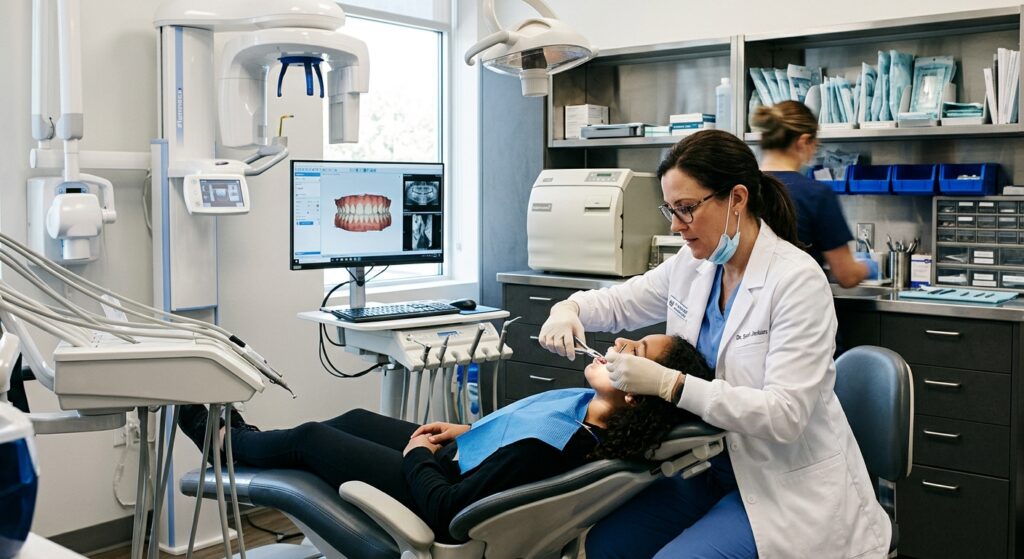
Your orthodontic practice likely invests significantly in specialized equipment. Digital imaging systems, high-speed handpieces, bracket systems, and chair units all qualify for these valuable deductions. Rather than spreading the cost over several years through traditional depreciation, you can expense the entire purchase price in the year acquired.
Bonus Depreciation vs. Section 179 Expensing
While bonus depreciation is automatic, Section 179 expensing offers additional flexibility. For 2026, the Section 179 expensing limit increased to $2.5 million, with the phase-out threshold beginning at $4 million in qualifying purchases. This means you can elect to deduct up to $2.5 million of equipment costs immediately rather than depreciating them.
Example: If you purchase a $45,000 digital cone-beam CT scanner in 2026, you can immediately deduct the full amount under Section 179 or bonus depreciation, reducing your taxable income for that year. This is especially beneficial if you’re planning a practice expansion or equipment upgrade.
Pro Tip: Keep detailed records of all equipment purchases. Document acquisition dates, costs, and placement-in-service dates. Our Small Business Tax Calculator helps estimate depreciation impacts on your tax liability.
Leasehold Improvements and Office Build-Outs
If you lease your orthodontic office space, improvements you make to that space can qualify for accelerated deductions. Office renovations, lighting upgrades, flooring, and specialty installations (like pediatric waiting areas or treatment room modifications) are deductible. These qualify for 15-year straight-line depreciation under standard rules, but may qualify for bonus depreciation if they’re rooted property.
How Do Office and Practice Expense Deductions Work?
Quick Answer: All routine practice expenses are deductible on Schedule C, including supplies, utilities, software, and materials used directly in patient care.
As an orthodontist filing Schedule C (Form 1040), you can deduct a wide range of routine business expenses. These expenses reduce your taxable income dollar-for-dollar, making them essential to capture on your return.
Supplies and Materials Used in Patient Care
- Orthodontic brackets, wires, and elastics
- Bonding agents and cements
- Sterilization supplies and infection control materials
- Impression materials and trays
- Office supplies (paper, pens, filing systems)
These consumable items are deducted in the year purchased. Maintain organized expense tracking through your business accounting system to substantiate these deductions during an audit.
Utilities and Facility Expenses
Monthly utilities (electricity, water, natural gas), internet and telecommunications, rent (or mortgage interest if you own), property taxes, and property insurance are all deductible. These represent substantial expenses for a practice and should never be overlooked when calculating your deductions.
Pro Tip: Create separate accounts for business and personal expenses. The IRS is more likely to audit mixed expense accounts. Establish a dedicated business credit card and bank account to simplify documentation and substantiation.
What Vehicle and Transportation Deductions Are Available?
Quick Answer: Orthodontists can deduct vehicle expenses using the standard mileage rate or actual expenses. New in 2026: vehicle loan interest deductions up to $10,000 annually.
Vehicle expenses present a major deduction opportunity for orthodontists. You have two methods to claim these deductions: the standard mileage method or actual expense deduction. For 2026, the IRS standard mileage rate for business use is subject to annual adjustments.
Standard Mileage vs. Actual Expenses
The standard mileage method simplifies tracking. You multiply your business miles by the IRS rate. Actual expenses include depreciation, gas, insurance, maintenance, repairs, and registration fees. Track all business-related driving: patient consultations at referral offices, continuing education courses, and dental conferences.
Actual expenses typically provide larger deductions if your vehicle is relatively new or heavily used. However, you cannot claim both methods for the same vehicle in subsequent years without reconsidering your approach. Choose wisely based on your annual mileage and vehicle condition.
New Vehicle Loan Interest Deduction for 2026
A significant new provision for 2026 allows orthodontists to deduct up to $10,000 in qualified auto loan interest. This applies to loans for new vehicles (final assembly in the United States) that started after December 31, 2024, used more than 50% for personal reasons.
Example: If you purchased a new practice vehicle in 2025 with a $120,000 loan at 5.5% interest, your first-year interest payment would be approximately $6,600. You can deduct this entire amount, providing meaningful tax savings.
This deduction is available through 2028, making it an important consideration if you’re planning vehicle purchases.
Which Professional Service and Licensing Deductions Apply?
Quick Answer: License renewals, professional organization memberships, legal and accounting fees, and specialty consultant fees are all fully deductible business expenses.
Professional expenses unique to orthodontists are entirely deductible. These include all costs necessary to maintain your practice’s professional standing and expertise.
Licensing and Regulatory Costs
- State dental board license renewal fees
- DEA registration and renewal (if applicable)
- OSHA and HIPAA compliance training and documentation
- Continuing education requirements
Professional Organizations and Memberships
Membership dues to the American Association of Orthodontists (AAO), state dental associations, and specialty orthodontist groups are deductible. These memberships provide access to continuing education, networking, and professional development resources that directly support your practice.
Professional consulting fees—whether for treatment planning software, practice management advice, or legal consultation regarding contract negotiations—are fully deductible business expenses.
What About Home Office and Continuing Education Deductions?
 Free Tax Write-Off Finder
Quick Answer: Home office deductions require a dedicated business space. Continuing education directly related to your orthodontic practice is 100% deductible.
Home Office Deduction: Simplified Method
If you maintain a home office—such as administrative space for patient records, treatment planning, or scheduling—you can claim a deduction. The simplified method allows $5 per square foot of dedicated office space (maximum 300 square feet). For a 150-square-foot home office, this means a $750 annual deduction.
Alternatively, the actual expense method deducts a percentage of your mortgage interest (or rent), utilities, insurance, and repairs based on office square footage divided by total home square footage. This requires more detailed record-keeping but often yields larger deductions.
Pro Tip: The space must be used regularly and exclusively for business. A guest bedroom occasionally used for paperwork doesn’t qualify. Define the boundary clearly and maintain consistent business use to withstand IRS scrutiny.
Continuing Education and Professional Development
All continuing education directly related to your orthodontic practice is deductible. This includes conference registration fees, travel, lodging, and meals during educational events. Courses in advanced orthodontic techniques, practice management, clinical training, and regulatory updates all qualify.
Educational materials—textbooks, journals, online courses, and specialty training programs—are deductible. These investments in professional development directly support your ability to provide quality patient care and remain competitive in your market.
How Can You Maximize Health Insurance and Retirement Deductions?
Quick Answer: Self-employed health insurance premiums are above-the-line deductible. Retirement contributions through Solo 401(k) or SEP IRA offer substantial tax reduction opportunities.
Self-Employed Health Insurance Deduction
One of the most valuable deductions for self-employed orthodontists is the health insurance premium deduction. You can deduct 100% of health insurance premiums paid for yourself, your spouse, and your dependents. This includes medical, dental, and vision coverage premiums.
Example: If you pay $24,000 annually for family health insurance coverage, you can deduct the entire amount directly from your self-employment income before calculating self-employment tax. This deduction is taken “above the line,” reducing both your income tax and self-employment tax liability.
Retirement Plan Contributions
Self-employed orthodontists can establish Solo 401(k) or SEP IRA plans. For 2026, Solo 401(k) contributions allow combined employee and employer contributions up to $69,000 (with catch-up contributions increasing this limit for those 50+). A SEP IRA allows up to 25% of your net self-employment income, capped at $69,000.
These contributions reduce your taxable income dollar-for-dollar while building retirement savings. For an orthodontist earning $200,000 in net self-employment income, contributing the maximum to a Solo 401(k) provides approximately $20,700 in tax savings (at a 30% combined tax rate).
What New 2026 Tax Deductions Should Orthodontists Know?
Quick Answer: For 2026, Qualified Business Income (QBI) deduction up to 20%, vehicle loan interest deduction ($10,000 limit), and Section 179 expensing ($2.5 million limit) offer new savings opportunities.
Qualified Business Income (QBI) Deduction
The QBI deduction allows eligible self-employed orthodontists to deduct up to 20% of qualified business income. This is a significant deduction that can substantially reduce your tax liability. While orthodontics is generally considered a “specified service trade or business,” many orthodontists qualify for the full 20% deduction if their income falls below the threshold limits for 2026.
Example: An orthodontist with $250,000 in qualified business income can potentially deduct up to $50,000 (20% of $250,000), provided they meet the income thresholds and other requirements.
Section 179 and Bonus Depreciation for 2026
The 2026 limits represent favorable changes for small business owners. The Section 179 expensing limit of $2.5 million (up from previous years) means orthodontists undertaking significant equipment purchases can immediately deduct costs rather than depreciating them over years. Combined with 100% bonus depreciation, equipment investments deliver rapid tax benefits.
Important Change: IRS Direct File Discontinuation
A notable change for 2026 is the IRS discontinuation of its Direct File program. This free government filing service is no longer available. Self-employed orthodontists will need to use commercial tax software or professional tax preparers. This emphasizes the importance of comprehensive record-keeping and working with qualified tax professionals to ensure all deductions are captured.
Pro Tip: With Direct File discontinued, hiring a qualified tax professional becomes increasingly important. The cost of professional tax preparation is itself deductible as a business expense, often paying for itself through deductions and credits you might miss.

Uncle Kam in Action: Dr. Sarah’s Orthodontic Practice Tax Strategy
Dr. Sarah Johnson is a solo orthodontist operating her practice in Broken Arrow, Oklahoma. After five years in practice, she was leaving substantial tax deductions on the table. Her practice generated approximately $300,000 in annual net income, but she was unsure which expenses qualified for deduction.
Here’s what she discovered working with Uncle Kam’s small business tax planning services: Dr. Johnson had purchased $65,000 in orthodontic equipment in 2025 but only depreciated it over five years, missing the full Section 179 deduction opportunity. She also failed to deduct her $28,000 annual health insurance premiums as an above-the-line deduction and wasn’t properly tracking mileage to multiple referral offices.
After implementing comprehensive deduction strategies, Dr. Johnson’s taxable income was reduced by approximately $95,000 through proper equipment depreciation, health insurance deductions, identified business mileage, and retirement plan contributions. At a combined federal and state tax rate of 35%, this translated to $33,250 in immediate tax savings for a single year.
The professional tax consultation fee of $2,500 paid for itself nearly 14 times over. More importantly, Dr. Johnson now has systematic deduction tracking for future years, ensuring continuous tax savings and proper compliance. Her ROI in year one alone exceeded 1,200%, with sustainable benefits in subsequent years.
Next Steps
Take these actions immediately to maximize your 2026 tax deductions as an orthodontist:
- Establish separate business and personal bank accounts and credit cards immediately if you haven’t already.
- Implement mileage tracking for all business-related driving. Use mobile apps or a detailed log to document dates, distances, and trip purposes.
- Review your 2025 equipment purchases to determine if Section 179 or bonus depreciation were properly claimed.
- Consult with a tax strategist about retirement plan options for 2026 and beyond.
- Schedule a comprehensive tax review by April 15, 2026, to identify any missed deductions from 2025 tax filings.
The earlier you address these issues, the more deductions you can capture and the greater your tax savings will be.
Frequently Asked Questions
Can Orthodontists Deduct the Cost of Expensive Equipment?
Yes. Orthodontic equipment is a deductible business expense. For 2026, you can immediately expense equipment costs through Section 179 expensing (up to $2.5 million) or claim bonus depreciation (100% through 2028). This includes chairs, digital imaging systems, sterilization equipment, and instruments. Keep detailed receipts and document when equipment is placed in service for your practice.
Are Car Payments Deductible for Orthodontists?
Car payments themselves are not deductible, but the depreciation component through the actual expense method is. However, the 2026 “No Tax on Car Loan Interest” provision allows you to deduct up to $10,000 in annual interest on qualifying vehicle loans (new U.S.-manufactured vehicles with loans starting after December 31, 2024). Using the standard mileage method is often simpler and may provide greater deductions if your vehicle is used primarily for business.
What Percentage of My Home Office Can I Deduct?
Home office deductions are based on the percentage of your home devoted to business use. Calculate this as office square footage divided by total home square footage. For example, a 200-square-foot home office in a 2,000-square-foot home is 10% of your home. You can deduct 10% of rent (or mortgage interest), utilities, property taxes, insurance, and repairs. The simplified method allows $5 per square foot (maximum 300 square feet), providing a simpler $750 annual deduction for a 150-square-foot office.
Are Professional Membership Dues Deductible?
Yes. Membership dues to the American Association of Orthodontists and state dental associations are fully deductible business expenses. These professional organizations provide continuing education, networking, and practice management resources directly supporting your business. Including these deductions ensures you’re not overpaying your tax liability.
Can I Deduct Continuing Education Expenses?
Absolutely. All continuing education directly related to your orthodontic practice is deductible. This includes conference registration fees, travel expenses (flights, hotels, meals), course materials, textbooks, and online training programs. The education must maintain or improve skills directly used in your practice. Self-development education that could lead to a new profession isn’t deductible, but advanced orthodontic techniques and practice management courses clearly qualify.
What Is the Qualified Business Income (QBI) Deduction?
The QBI deduction allows eligible self-employed orthodontists to deduct up to 20% of qualified business income. For a $300,000 practice income, this could mean a $60,000 deduction. However, dentistry and orthodontics are considered specified service trade or business (SSTB) occupations, which have income phase-out limitations. For 2026, if your taxable income (before the QBI deduction) exceeds certain thresholds, the deduction may be reduced or eliminated. Consult a tax professional to determine your specific eligibility and deduction amount.
Should I Form an LLC or S-Corp for Tax Purposes?
Entity selection depends on your specific situation, income level, and state tax considerations. An S-Corp election can reduce self-employment tax by allowing you to take a reasonable salary and distribute remaining profits as dividends (not subject to self-employment tax). However, this requires payroll processing and additional filing complexity. An LLC taxed as an S-Corp might be optimal for practices generating $150,000+ in net income. Consult with a tax strategist to calculate the potential savings specific to your circumstances.
What Records Do I Need to Keep for Deductions?
The IRS requires supporting documentation for all claimed deductions. Maintain receipts, invoices, canceled checks, credit card statements, mileage logs, and appointment calendars for at least three years (six years if you underreport income by 25%). For equipment, keep acquisition documents, invoices, and depreciation schedules. For vehicle expenses, document business versus personal use. Organized record-keeping protects you in an audit and ensures accurate tax filing.
When Should I File My 2026 Tax Return?
For the 2025 tax year (filed in 2026), the deadline is April 15, 2026. Filing early provides several advantages: faster processing, earlier refunds, reduced likelihood of IRS contact, and time to address any questions. If you can’t meet the deadline, file Form 4868 to request an extension, giving you until October 15, 2026. However, estimated taxes are still due by April 15. Consider filing by mid-March to allow time for any adjustments or corrections before the deadline.
This information is current as of April 1, 2026. Tax laws change frequently. Verify updates with the IRS or a qualified tax professional if reading this later.
Related Resources
- Tax Strategy for Self-Employed Professionals
- Entity Structuring for Small Business Owners
- Tax Planning for Business Owners
- Comprehensive Tax Guides and Resources
- IRS Schedule C Form (Self-Employment Income)
Last updated: April, 2026

