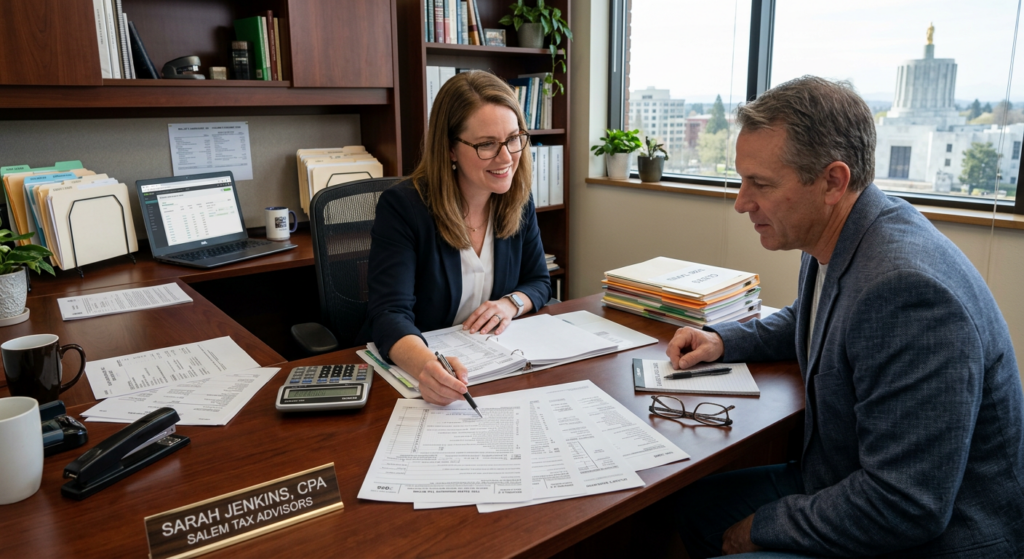
Salem CPA Guide: 2026 Tax Strategies for Business Owners & Self-Employed Professionals
Finding the right Salem CPA can transform your business finances and unlock substantial tax savings for 2026. Whether you’re a self-employed contractor, small business owner, or managing multiple revenue streams, professional tax guidance has never been more critical. The One Big Beautiful Act (OBBBA), enacted in 2025, introduced sweeping changes that directly impact how you file taxes and calculate deductions this year.
Table of Contents
- Key Takeaways
- Why Hire a Salem CPA for 2026 Tax Planning?
- What Are the Key 2026 Tax Deductions for Your Business?
- How Does the 20% Qualified Business Income (QBI) Deduction Work?
- How Can You Leverage the Expanded SALT Deduction Limit in 2026?
- How to Find and Evaluate the Right CPA in Salem
- Uncle Kam in Action
- Next Steps
- Frequently Asked Questions
Key Takeaways
- The 2026 standard deduction is $25,000 for married couples filing jointly and $12,500 for single filers.
- The permanent 20% QBI deduction applies to pass-through entities and self-employed businesses through 2029.
- SALT deduction limits expanded to $40,000 for married couples (up from $10,000).
- New deductions for overtime, tips, car loan interest, and seniors provide additional tax relief.
- Hiring a qualified Salem CPA helps navigate these complex rules and maximize savings.
Why Hire a Salem CPA for 2026 Tax Planning?
Quick Answer: A qualified Salem CPA ensures you claim every available deduction, navigate new tax laws, and optimize your business structure for maximum 2026 tax savings.
The tax landscape changed dramatically with the 2025 One Big Beautiful Act. For business owners and self-employed professionals in Salem, navigating these changes alone creates significant risk. A professional Salem CPA brings expertise in federal regulations, Oregon-specific tax requirements, and strategic planning that translates directly into lower tax bills.
Beyond simple compliance, the right CPA helps you understand opportunities like the expanded SALT deduction, the permanent QBI deduction, and new deductions for overtime compensation. They work with you to structure your business strategically, ensuring every transaction maximizes tax efficiency.
The 2026 CPA Talent Landscape and New Licensing Pathways
The accounting profession is undergoing significant changes. Nevada recently implemented new CPA licensure pathways (effective February 27, 2026) featuring a bachelor’s degree plus two years of experience plus the CPA Exam. West Virginia and Nebraska followed with similar reform legislation. These changes reflect a nationwide push to address the CPA talent shortage and expand access to qualified professionals.
When evaluating a Salem CPA, ensure they stay current with these regulatory changes and understand how alternative pathways are improving access to quality tax services. This demonstrates their commitment to professional development and ability to serve your evolving needs.
Pro Tip: Ask your potential Salem CPA about their continuing education hours specifically related to 2026 tax law changes and the One Big Beautiful Act provisions affecting your industry.
How a Salem CPA Protects Your Business and Maximizes Refunds
Professional tax preparation services provide multiple layers of protection. A Salem CPA conducts comprehensive tax planning reviews, identifies deductions you might miss, and ensures accurate reporting that minimizes audit risk. Early 2026 filing data shows average refunds are up 10.6% compared to 2025, reflecting the impact of new deductions and expanded standard deductions.
Your CPA also provides strategic advice on entity structure optimization, helping you determine whether your current business structure (sole proprietorship, LLC, S-Corp, C-Corp) delivers maximum tax efficiency. This proactive planning often saves significantly more than the cost of professional services.
What Are the Key 2026 Tax Deductions for Your Business?
Quick Answer: For 2026, you can claim the permanent 20% QBI deduction, new deductions for overtime ($12,500 individual / $25,000 MFJ) and tips, expanded SALT limits ($40,000 MFJ), and traditional business deductions including our Small Business Tax Calculator to estimate deductions and liability.
The 2026 tax year introduces a historic combination of expanded deductions and credits. Understanding these opportunities separates savvy business owners from those leaving money on the table. The One Big Beautiful Act permanently established several deductions that provide substantial savings for self-employed professionals and small business operators.
Business Expense Deductions You Cannot Miss
Standard business deductions form the foundation of your tax strategy. These include home office expenses (if you qualify), equipment and supplies, vehicle expenses, meals and entertainment (with limitations), professional services, insurance premiums, and employee salaries. Oregon business owners benefit from the state’s extended SALT cap workaround for pass-through entities, providing additional deduction opportunities when filing 2026 returns.
- Home office deduction: up to $5 per square foot for simplified method or actual expenses
- Vehicle expenses: either standard mileage rate ($0.67 per mile in 2026) or actual expenses
- Professional development and training related to your business
- Business insurance, including liability and professional coverage
- Software subscriptions, technology, and tools for business operations
New 2026 Deductions from the One Big Beautiful Act
The One Big Beautiful Act introduced several new deductions specifically designed to provide relief to working professionals and business owners. These temporary and permanent deductions create significant planning opportunities for 2026.
Overtime Deduction: Employees and self-employed workers earning qualified overtime compensation can deduct up to $12,500 annually (or $25,000 if married filing jointly). This deduction applies to overtime required under the Fair Labor Standards Act. Critically, self-employed individuals must reduce this deduction by Schedule C expenses, the deductible portion of self-employment tax, self-employed health insurance, and retirement plan contributions.
Tips Deduction: Workers receiving qualified tips can deduct up to $25,000 annually with a phase-out beginning at modified adjusted gross income (MAGI) above $150,000 (or $300,000 for married filing jointly). Married couples must file jointly to claim this benefit.
Car Loan Interest Deduction: A new deduction for qualified passenger vehicle loan interest became available. This applies to U.S.-made vehicles and applies whether you take the standard deduction or itemize.
Senior Citizen Enhanced Deduction: Taxpayers born before January 2, 1961, qualify for an enhanced deduction up to $6,000 per person (or $12,000 for married couples filing jointly). This additional deduction provides meaningful tax relief for older business owners and professionals still working in 2026.
Did You Know? The IRS updated Schedule 1-A instructions about one month into the 2026 filing season, changing how self-employed workers calculate the overtime deduction. This change potentially reduced benefits for some gig-economy workers. Your Salem CPA monitors these updates to ensure your return reflects current guidance.
 Free Tax Write-Off Finder
How Does the 20% Qualified Business Income (QBI) Deduction Work?
Quick Answer: The 20% QBI deduction allows pass-through business owners to deduct up to 20% of qualified business income from their taxable income. Made permanent by the One Big Beautiful Act, this deduction applies through 2029 without sunset provisions.
The Qualified Business Income deduction represents one of the most significant tax benefits available to business owners and self-employed professionals. This deduction allows you to reduce your taxable income by 20% of your qualifying business income, directly lowering your tax liability.
Understanding QBI Deduction Eligibility and Limitations
The QBI deduction applies to income from pass-through entities including sole proprietorships, partnerships, S-Corporations, and LLCs. It also applies to self-employed individuals filing Schedule C. To calculate your QBI deduction, you take your qualified business income and multiply by 20%.
Certain limitations apply based on your total taxable income and the nature of your business. Service businesses in fields like health, law, accounting, and consulting face additional restrictions when income exceeds specified thresholds. Your Salem CPA helps determine your specific eligibility and maximizes deduction benefits within applicable limitations.
| Business Type | QBI Deduction Applicability | 2026 Considerations |
|---|---|---|
| Sole Proprietorship | Full 20% deduction available on Schedule C income | Most straightforward calculation; permanent through 2029 |
| LLC (Pass-Through) | 20% deduction on qualified business income | Subject to W-2 wage limitations depending on income |
| S-Corporation | 20% deduction on income after reasonable salary | Requires IRS Form 1120-S filing; subject to wage/property limits |
| Service Business (High Income) | Potential limitations if income exceeds thresholds | Complex calculations; professional guidance essential |
Real-World QBI Deduction Example
Consider a Salem-based consulting LLC with $150,000 in qualified business income. The 20% QBI deduction would be $30,000. This deduction reduces taxable income from $150,000 to $120,000, potentially saving $7,200-$11,100 in federal taxes depending on your tax bracket.
How Can You Leverage the Expanded SALT Deduction Limit in 2026?
Quick Answer: For 2026, the SALT deduction cap increased to $40,000 for married couples filing jointly (and $20,000 for married filing separately), up from the previous $10,000 limit. This quadrupling of the cap creates substantial planning opportunities for business owners and high-income professionals.
The State and Local Tax (SALT) deduction expansion represents one of the most impactful changes from the One Big Beautiful Act. This deduction allows you to deduct state and local property taxes, state income taxes, or state sales taxes (your choice) from your federal taxable income.
Maximizing SALT Benefits for Oregon Business Owners
Oregon business owners benefit from extended SALT workarounds for pass-through entities. These provisions allow business structures to pass through SALT deductions to owners despite federal limitations. Oregon lawmakers extended this workaround through 2027, providing continued planning opportunities.
If you own commercial real estate or operate a business paying significant property taxes, itemizing deductions with the expanded SALT limit likely provides better tax results than claiming the standard deduction. A Salem CPA performs this analysis, comparing itemized deductions to the standard deduction ($25,000 for married couples in 2026) to determine your optimal filing strategy.
For example, if you pay $30,000 in Oregon state income taxes plus $20,000 in property taxes ($50,000 total SALT), you exceed the $40,000 deduction cap by $10,000. However, the $40,000 SALT deduction plus other itemized deductions (mortgage interest, charitable contributions) likely exceeds your $25,000 standard deduction, justifying itemization.
Pro Tip: Consider timing of estimated tax payments. Making January estimated tax payments in December (if beneficial) or accelerating business income into higher-deduction years optimizes your SALT deduction and overall tax liability.
How to Find and Evaluate the Right CPA in Salem
Quick Answer: Evaluate Salem CPAs based on industry experience, 2026 tax law knowledge, client references, fee structure transparency, and proactive tax planning philosophy rather than reactive year-end filing only.
Selecting your Salem CPA represents a crucial business decision impacting your financial health for years. The right professional guides you through complex tax planning, protects you from compliance errors, and identifies opportunities you’d otherwise miss.
Essential Qualifications and Credentials to Verify
Begin by verifying your potential CPA holds proper credentials. The CPA (Certified Public Accountant) designation requires passing the CPA Exam, meeting education requirements, and fulfilling experience standards. You can verify credentials through the Oregon Board of Accountancy. As of February 27, 2026, Nevada implemented new alternative CPA pathways (bachelor’s degree plus two years experience plus CPA Exam), with similar reforms in West Virginia and Nebraska. Understanding these changes demonstrates your CPA’s commitment to professional standards.
- Verify CPA license and standing through Oregon Board of Accountancy
- Check continuing education in 2026 tax law changes and OBBBA provisions
- Review industry-specific experience matching your business type
- Confirm membership in AICPA or state CPA society (demonstrates professional engagement)
- Ask about proactive tax planning versus reactive compliance focus
Questions to Ask During Your CPA Consultation
Preparation is essential for your initial CPA consultation. Strategic questioning reveals whether a Salem CPA focuses on tax avoidance, planning, and proactive strategies versus simple compliance filing.
- “How do you approach the 20% QBI deduction for my specific business structure?”
- “What new 2026 deductions might apply to my situation?”
- “Do you recommend strategic year-end planning, and how would that work?”
- “What’s your experience with business structure optimization (sole proprietor vs LLC vs S-Corp)?”
- “How will you help me stay compliant with Oregon tax requirements while optimizing federal deductions?”
- “What services do you include in your annual fee versus additional charges?”

Uncle Kam in Action: The Small Business Owner Who Saved $18,500
Meet Sarah, a Salem-based marketing consultant operating as an LLC with approximately $120,000 in annual qualifying business income. When she came to Uncle Kam’s tax team in early 2026, Sarah was planning to file her own taxes using basic software. She believed her situation was straightforward and would net minimal tax savings from professional help.
After a comprehensive discovery meeting, the Uncle Kam team identified three critical planning opportunities Sarah had completely missed. First, her business structure analysis revealed that converting her LLC to a treated S-Corporation election would save approximately $9,200 annually through self-employment tax optimization (15.3% savings on reasonable business profits after paying a W-2 salary).
Second, Sarah qualified for the new overtime deduction through consulting work involving extra hours. After calculating her eligible overtime compensation and applying the $12,500 individual deduction (reduced by applicable limitations), this generated an additional $3,100 in tax savings at her effective tax rate.
Third, the team reviewed her itemization analysis. Sarah owned investment property with $28,000 in annual property taxes. Combined with $22,000 in state income taxes, her SALT deductions totaled $50,000 but were capped at the new $40,000 limit. However, when analyzed against her standard deduction of $12,500 (as a single filer), itemizing saved her an additional $6,200 in taxes.
Total first-year tax savings: $18,500. Uncle Kam’s fee for the S-Corp setup, tax planning, and professional return preparation: $2,200. Return on investment: 842% in the first year alone, with continued S-Corp savings in future years.
This case demonstrates why working with a qualified Salem CPA isn’t an expense—it’s an investment that typically pays for itself many times over through tax optimization and strategic planning.
Next Steps
Taking action now positions you to maximize 2026 tax savings. Complete these steps to get your Salem tax preparation services properly structured:
- Schedule a discovery meeting with a qualified Salem CPA focusing on 2026 tax planning and structure optimization
- Gather 2025 tax returns and current business financial statements to discuss at your consultation
- Ask specifically about QBI deduction maximization, SALT strategy, and any new 2026 deductions you might qualify for
- Implement any recommended business structure changes before year-end to capture full-year 2026 benefits
Frequently Asked Questions
Can I deduct the cost of hiring a CPA from my business taxes?
Yes. Professional tax preparation and accounting services represent legitimate business deductions on Schedule C (for sole proprietors) or as business expenses for other entity types. The cost of hiring a qualified Salem CPA is a deductible business expense, meaning your tax savings effectively reduce the net cost of professional services.
What’s the difference between the standard deduction and itemized deductions for 2026?
For 2026, the standard deduction is $25,000 for married couples filing jointly and $12,500 for single filers. Itemized deductions include SALT (up to $40,000), mortgage interest, charitable contributions, and other qualifying expenses. You claim whichever is larger. With the expanded SALT limit, more business owners now benefit from itemizing rather than claiming the standard deduction.
Does the 20% QBI deduction expire after 2026?
No. The One Big Beautiful Act made the 20% QBI deduction permanent through 2029 and eliminated previous sunset provisions that created planning uncertainty. This permanence allows confident long-term tax planning and business structure optimization decisions.
How does converting from an LLC to an S-Corporation affect my taxes?
S-Corporation election requires paying yourself a reasonable W-2 salary subject to payroll taxes (15.3% self-employment tax). However, you can distribute remaining business profits as dividends, which avoid the 15.3% self-employment tax. For business owners with net income above approximately $60,000, S-Corp status typically saves substantial self-employment taxes. Your Salem CPA calculates your specific savings scenario.
What’s the deadline for filing 2026 business tax returns?
Partnership and S-Corporation returns (Forms 1065 and 1120-S) are due March 16, 2026. Individual income tax returns and sole proprietor returns (1040 with Schedule C) are due April 15, 2026. These deadlines can be extended by six months upon filing Form 4868 for individuals or Form 7004 for businesses.
Are the new 2026 deductions (overtime, tips, car loan interest) permanent?
The overtime, tips, and car loan interest deductions are currently temporary provisions under the One Big Beautiful Act. While the QBI deduction is permanent through 2029, these specific deductions should be carefully monitored for future legislation. Your Salem CPA keeps you informed of any changes affecting your 2026 deduction eligibility.
Can my business deduct home office expenses if I work from home part-time?
Yes, if your home office is used regularly and exclusively for business purposes. The IRS allows either a simplified method ($5 per square foot) or actual expense method. A 10×12 foot home office could generate approximately $600 annual deduction under the simplified method, or more under the actual expense calculation including utilities, insurance, and depreciation. Your CPA determines which method provides maximum benefit.
Related Resources
- Comprehensive 2026 Tax Strategy Planning
- Tax Solutions for Business Owners
- Self-Employed Professional Tax Planning
- Business Entity Structure Optimization
- Professional Tax Preparation and Filing Services
Last updated: March, 2026
This information is current as of 3/9/2026. Tax laws change frequently. Verify updates with the IRS or Oregon Department of Revenue if reading this later. The content provides general guidance and should not replace professional tax advice from a qualified Salem CPA familiar with your specific situation.

