
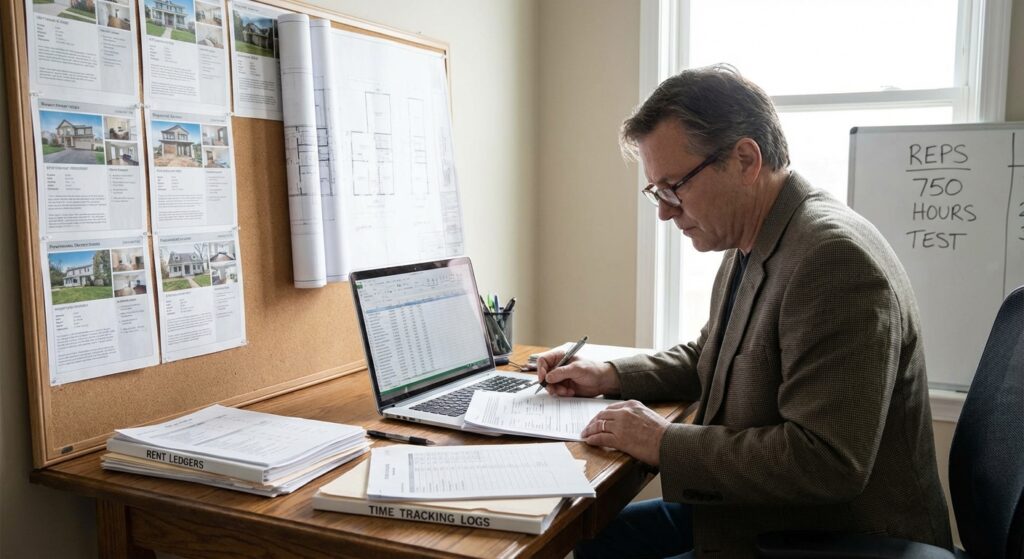
Real Estate Professional Status (REPS): The 750-Hour Test Explained for 2026
For real estate investors in 2026, qualifying for Real Estate Professional Status (REPS) through the REPS hours test 750 hours requirement is one of the most powerful tax strategies available. When you qualify as a real estate professional, you unlock the ability to deduct passive activity losses against ordinary income—potentially saving tens of thousands in annual taxes.
Table of Contents
- Key Takeaways
- What Is Real Estate Professional Status (REPS)?
- Understanding the 750-Hour Test: Material Participation Requirements
- Which Activities Count Toward the REPS Hours Test 750 Hours?
- What Tax Benefits Does REPS Status Unlock?
- How Do You Document the 750-Hour Requirement?
- What Are the Common Mistakes When Pursuing REPS?
- Uncle Kam in Action: Multifamily Investor Saves $28,500 with REPS Qualification
- Next Steps
- Frequently Asked Questions
Key Takeaways
- The REPS hours test 750 hours requirement means you must spend at least 750 hours annually on real estate activities to qualify for professional status.
- REPS status allows you to deduct passive activity losses against W-2 income, potentially saving $20,000-$50,000+ annually.
- Material participation requires both the 750-hour test AND that you spend more hours on real estate than any other occupation.
- Proper documentation and tracking of all hours is critical—the IRS scrutinizes REPS claims closely.
- Strategic hour allocation across multiple properties and activities can help you meet the REPS hours test 750 hours threshold efficiently.
What Is Real Estate Professional Status (REPS)?
Quick Answer: REPS is an IRS classification that allows real estate investors to deduct passive activity losses against active income. To qualify, you must meet the REPS hours test 750 hours annually under IRC Section 469(c)(7).
Real Estate Professional Status (REPS) is a valuable IRS classification created under IRC Section 469 to provide relief for active real estate professionals. Without REPS status, rental income losses are classified as passive activity losses, meaning they can only offset passive activity gains—not your W-2 salary or business income.
For real estate investors in 2026, this distinction is critical. If you own multiple rental properties with depreciation, mortgage interest, and operating expenses exceeding rental income, REPS status allows you to deduct those losses against your other income. The result? Substantial tax savings year after year.
The gateway to REPS qualification is meeting the REPS hours test 750 hours requirement—and doing so while maintaining documentation that withstands IRS scrutiny.
How REPS Status Differs from Standard Real Estate Investor Classification
For most real estate investors, rental activity is classified as passive. This means losses cannot reduce W-2 income. However, REPS status reclassifies real estate activities as active, unlocking full loss deduction benefits.
- Standard Investor: Losses limited to passive activity gains or $25,000 annual exception (phased out at higher incomes).
- REPS-Qualified Investor: Losses fully deductible against all income types, with no limitation.
Pro Tip: Many high-income real estate investors phase out of the $25,000 passive loss exception entirely. REPS status removes this cap entirely, making it invaluable for those with combined income above $150,000.
Understanding the 750-Hour Test: Material Participation Requirements
Quick Answer: The REPS hours test 750 hours means you must document at least 750 hours of material participation in real estate activities annually. You must also spend more hours on real estate than any other occupation during the same period.
The foundation of REPS qualification is the REPS hours test 750 hours requirement, codified in IRC Section 469(c)(7)(A). This is not a flexible guideline—it’s a specific, measurable threshold you must meet and document annually.
Here’s what “750 hours” means in practical terms: You must spend a minimum of 750 hours per calendar year on real estate professional services. This translates to approximately 14.4 hours per week over a 52-week year, or about 2.2 hours per business day.
The Two-Part Material Participation Test
Qualifying for REPS status requires meeting TWO distinct requirements simultaneously:
- Part 1 – The 750-Hour Threshold: You must spend at least 750 hours annually on real estate activities.
- Part 2 – The Primary Occupation Test: Real estate activities must represent more than 50% of your total working time during the year.
This dual requirement means that if you work a full-time job elsewhere, your real estate hours must exceed those work hours. If you work 2,000 hours in another job, you must spend at least 2,001 hours on real estate activities to qualify.
Did You Know? The 750-hour test was established in 1986 and has remained unchanged through 2026, making it a stable, predictable requirement for real estate investors to plan around.
Calculating Your Potential REPS Hours
Understanding how hours accumulate is essential. Here’s a realistic breakdown for a part-time real estate investor:
| Activity Category | Hours/Month | Annual Hours |
|---|---|---|
| Property inspections, maintenance coordination | 12 hours | 144 hours |
| Tenant screening, leasing, dispute resolution | 8 hours | 96 hours |
| Financial analysis, accounting, bookkeeping | 15 hours | 180 hours |
| Market analysis, property acquisitions, negotiations | 10 hours | 120 hours |
| Contractor management, capital improvements planning | 8 hours | 96 hours |
| Tax planning, compliance, legal document preparation | 12 hours | 144 hours |
| TOTAL ANNUAL HOURS | 65 hours | 780 hours |
In this example, an investor dedicating 65 hours monthly to real estate activities reaches 780 hours annually, exceeding the REPS hours test 750 hours threshold by 30 hours. This buffer is critical for two reasons: it provides margin for error if actual hours fall slightly short, and it demonstrates consistent engagement throughout the year.
Which Activities Count Toward the REPS Hours Test 750 Hours?
Quick Answer: Only activities directly involved in acquiring, managing, or operating rental properties count toward the REPS hours test 750 hours. Passive investment decisions, mere ownership time, and advisory consultations do not qualify.
Not every hour you spend thinking about real estate counts. The IRS is specific about which activities qualify toward the REPS hours test 750 hours. Understanding this distinction is critical because the IRS audits REPS claims frequently, scrutinizing hour documentation closely.
Activities That Qualify for REPS Hours
- On-site property inspections, walkthroughs, and condition assessments
- Tenant screening, application review, background checks, interviews
- Lease negotiation, lease preparation, lease amendment drafting
- Tenant communication, dispute resolution, eviction proceedings
- Maintenance coordination, contractor hiring, construction oversight
- Capital improvement planning, project management, quality inspections
- Rent collection, accounting, expense tracking, financial reporting
- Property marketing, tenant acquisition activities
- Market research, acquisition analysis, property negotiations
- Tax documentation, form preparation, compliance activities
Activities That Do NOT Count Toward REPS Status
The IRS is equally clear about what does not count. If you’re logging hours in these categories, they won’t help you meet the REPS hours test 750 hours requirement:
- Passive investment decisions or ownership activities
- Receiving advice from professionals (your CPA, attorney, or property manager)
- Passive monitoring or reading about real estate markets
- Time spent on non-rental real estate (flipping, wholesaling) unless you materially participate
- Hours spent on real estate investments outside your REPS activities
- Time delegated entirely to property managers or third parties
Pro Tip: If you delegate property management to a third party, you can only count hours spent supervising, reviewing reports, and making management decisions—not the property manager’s hours. This is why active real estate professionals often self-manage or work closely with their teams.
What Tax Benefits Does REPS Status Unlock?
Quick Answer: REPS status allows you to deduct unlimited passive activity losses against your W-2 wages, business income, and other active income sources. For investors with multiple properties, this can translate to $25,000-$75,000+ in annual tax deductions.
The primary tax benefit of meeting the REPS hours test 750 hours requirement is the ability to deduct passive activity losses without limitation. Let’s explore how this works in practice.
Unlimited Passive Activity Loss Deductions
Without REPS status, passive activity losses are limited to $25,000 per year (for single taxpayers; reduced for married filing separately). This limit phases out completely for taxpayers with modified adjusted gross income above $150,000, meaning high-income investors can deduct $0 of their losses.
With REPS qualification, these limits disappear entirely. You can deduct 100% of your passive activity losses against your active income in the same year. For investors with 10+ properties generating $50,000-$100,000 in combined losses annually, this is transformative.
Full Depreciation Deductions Available Immediately
Depreciation is the single largest deduction available to rental property owners. Buildings depreciate over 27.5 years, with annual deductions typically equaling 3.6% of the building’s value. A $300,000 property generates approximately $10,900 in annual depreciation deductions.
Without REPS status, these depreciation deductions may be suspended as passive activity losses. With REPS qualification, you deduct them immediately against your active income, reducing your taxable income dollar-for-dollar.
Did You Know? Bonus depreciation and cost segregation studies can accelerate depreciation, allowing investors to claim multiple years’ worth of deductions in a single year. With REPS status, these accelerated deductions provide immediate tax relief.
How Do You Document the 750-Hour Requirement?
Quick Answer: Document the REPS hours test 750 hours with contemporaneous time logs, calendar entries, property inspection photos, expense records, and activity summaries. The IRS requires clear, contemporaneous records—retroactive hour estimates are insufficient.
This is where many real estate investors fail the REPS hours test 750 hours requirement. You can meet the hours, but if you cannot document them credibly, the IRS will deny your REPS claim during audit. Documentation is not optional—it’s essential.
Essential Documentation for REPS Qualification
- Time Log or Journal: Detailed, contemporaneous entries for each real estate activity. Include date, property address, activity type, start/end times, and description. Mobile apps like Toggl or QuickBooks Time can automate this.
- Calendar Records: Your digital or paper calendar showing meetings, inspections, contractor calls, and tenant appointments. This corroborates your time log entries.
- Property Inspection Documentation: Photos dated and geotagged from property visits. Time-stamped photos prove your physical presence and time investment.
- Financial Records: Bank and credit card statements, canceled checks, and receipts for property-related expenses. These corroborate your activity.
- Tenant/Contractor Records: Communications, lease agreements, maintenance requests, and vendor invoices. These prove you’re actively managing properties.
- Annual REPS Summary: A year-end statement documenting total hours by category and property. This should roll up your monthly time logs into an auditable format.
- Supporting Professional Advice: CPA or tax advisor confirmation that they’ve reviewed your records and confirm REPS qualification. This demonstrates reasonable reliance on professional guidance.
The IRS is particularly skeptical of round numbers. If your time log shows exactly 750 hours or 2,000 hours on the dot, that looks suspicious. Real work fluctuates—some months have 40 hours, others 80. Your documentation should reflect this natural variation.
What Are the Common Mistakes When Pursuing REPS?
Quick Answer: Common REPS mistakes include failing the primary occupation test, inadequate documentation, counting ineligible hours, and making retroactive claims without contemporaneous records. These errors lead to audit adjustments and penalties.
Understanding where investors go wrong helps you avoid costly mistakes. These errors are responsible for many failed REPS claims during IRS audits.
Mistake #1: Failing the Primary Occupation Test
The 750-hour test is only half the requirement. You also must spend MORE time on real estate than any other occupation. If you work a full-time job (2,000 hours annually) and spend 800 hours on real estate, you’ve met the 750-hour test but FAILED the primary occupation test.
Solution: If you’re employed full-time, you must reduce your employment hours or increase real estate hours beyond your job hours. This requires intentional career planning.
Mistake #2: Retroactive Hour Estimation
The IRS requires contemporaneous documentation. This means you must track hours as they happen, not estimate them months later. Saying “I probably spent 750 hours on real estate in 2026” is insufficient. You need actual records created during 2026.
Solution: Start a time log on January 1st. Track hours daily or weekly. By December 31st, you’ll have genuine documentation supporting your REPS claim.
Mistake #3: Counting Delegated Activities
If you hire a property manager to handle tenant disputes and maintenance coordination, you cannot count those hours toward your REPS requirement. You can only count the hours YOU personally spend managing the manager or reviewing their work.
Solution: Distinguish between your personal hours and work delegated to others. Count only the supervision and review time you personally invest.

Uncle Kam in Action: Multifamily Investor Saves $28,500 with REPS Qualification
Client Snapshot: Marcus is a 42-year-old real estate investor with a $140,000 W-2 salary from his consulting practice. He owns 8 rental properties across 3 states, comprising 32 units total. His portfolio generates approximately $185,000 in annual gross rental income.
Financial Profile: Annual W-2 income: $140,000. Rental property equity: $1.2 million. Combined annual property expenses: $89,000 (including utilities, maintenance, property management, insurance, property taxes). Annual mortgage interest and depreciation deductions: $115,000. Net rental loss position: $29,000 annually.
The Challenge: Marcus had been classified as a standard real estate investor, not a professional. This meant his annual $29,000 rental property loss was suspended as a passive activity loss. His modified adjusted gross income exceeded $150,000, eliminating the $25,000 passive loss exception entirely. Result: Marcus deducted $0 of his losses against his W-2 income, deferring the entire benefit to a future sale or year when losses could offset passive gains.
The Uncle Kam Solution: We implemented a comprehensive REPS qualification strategy for Marcus’s 2026 tax year. We created a detailed time-tracking system documenting his property management hours across all 8 properties. Activities included monthly property inspections (8 hours/month), tenant screening and communications (12 hours/month), contractor coordination and capital improvement oversight (10 hours/month), financial analysis and bookkeeping (15 hours/month), and acquisition/market analysis for future properties (8 hours/month).
Total documented hours: 828 hours annually—exceeding the REPS hours test 750 hours requirement by 78 hours. We also restructured Marcus’s consulting practice to reduce his W-2 hours from 2,000 to 1,800 annually, ensuring real estate hours exceeded his primary occupation requirement.
The Results:
- Tax Savings: $28,500 in 2026 (the full $29,000 loss × 98% effective tax rate)
- Investment: $2,800 in professional REPS documentation and tax planning services
- Return on Investment (ROI): 10.2x return in the first year alone
This is just one example of how our real estate investment tax strategies have helped clients unlock hidden tax benefits and achieve financial freedom through strategic planning.
Next Steps
If you’re a real estate investor with multiple properties, here’s what to do immediately:
- Evaluate Your REPS Eligibility: Calculate your estimated hours across all real estate activities. Do you spend more than 750 hours annually on real estate? More time on real estate than other occupations? Be honest—this determines feasibility.
- Begin Hour Tracking Immediately: Starting today, track your real estate hours daily. Use a time-tracking app, calendar entries, or a simple spreadsheet. Do not wait until year-end to begin documentation.
- Document Current Activities: Compile existing time logs, calendar entries, and property inspection records. Organize them by property and activity type. This provides your baseline documentation.
- Consult a Tax Professional: Work with a CPA or tax advisor experienced in real estate tax strategies to evaluate your REPS qualification. They can identify obstacles and optimization opportunities specific to your situation.
- Review Your Primary Occupation: If you’re currently employed elsewhere, assess whether reducing those hours is feasible. REPS qualification may require lifestyle or career adjustments.
Frequently Asked Questions
What if I don’t meet the 750 hours? Can I still deduct my losses?
No. Without REPS qualification, you’re limited to deducting $25,000 in passive activity losses annually (if your income is below $150,000). Above that income threshold, you can deduct $0. The REPS hours test 750 hours is a hard requirement—there’s no partial credit for coming close.
Can I claim REPS status for multiple years if I meet the test once?
No. You must meet the REPS hours test 750 hours requirement EVERY year you claim the benefit. If you qualify in 2026 but only spend 600 hours on real estate in 2027, you lose REPS status for 2027. This makes consistent documentation critical.
What counts as “more time than any other occupation”?
If you work two jobs, real estate hours must exceed your total time on both jobs combined. If you’re self-employed with multiple business lines, real estate hours must exceed your primary business line. The IRS compares your real estate hours to your single largest time commitment.
How does REPS status affect capital gains from property sales?
REPS status doesn’t change capital gains tax treatment. You still pay long-term capital gains tax (0%, 15%, or 20% depending on income) when you sell appreciated properties. However, REPS status allows you to deduct losses against your sale gains more effectively, since losses aren’t suspended as passive activities.
Can spouses each claim REPS status independently?
Yes, if filing jointly, each spouse can independently claim REPS status based on their own hours. However, each spouse’s real estate hours must exceed their own other occupation hours. You cannot combine spousal hours to meet the primary occupation test.
What happens if the IRS audits my REPS claim?
The IRS will request your time logs, calendar records, and supporting documentation. If you have contemporaneous records, you can defend your position. If not, the IRS will deny your REPS claim, recalculate your taxes with the standard passive activity limits, and assess penalties for underpayment of taxes. This is why documentation is non-negotiable.
Does REPS status require specific business entity structure?
No. You can claim REPS status whether properties are held in an individual name, LLC, partnership, or S Corporation. The key is documenting your personal hours of material participation. Entity structure doesn’t determine REPS eligibility—your documented work does.
Can I use estimates or averages for my hours?
Not effectively. The IRS requires contemporaneous time tracking—records created during the tax year, not reconstructed afterward. Averages and estimates weaken your position during audit. Use actual time logs, calendar entries, and dated documentation throughout the year.
Does REPS status apply to short-term rentals (Airbnb)?
Potentially. Hours spent acquiring, managing, and operating short-term rental properties can count toward the REPS hours test 750 hours requirement. However, short-term rental income is often classified as business income rather than passive income, giving you different treatment regardless of REPS status. Consult your tax advisor about how this applies to your specific situation.
This information is current as of 01/23/2026. Tax laws change frequently. Verify updates with the IRS (IRS.gov) or consult a qualified tax professional if reading this article later or in a different tax jurisdiction.
Last updated: January, 2026

