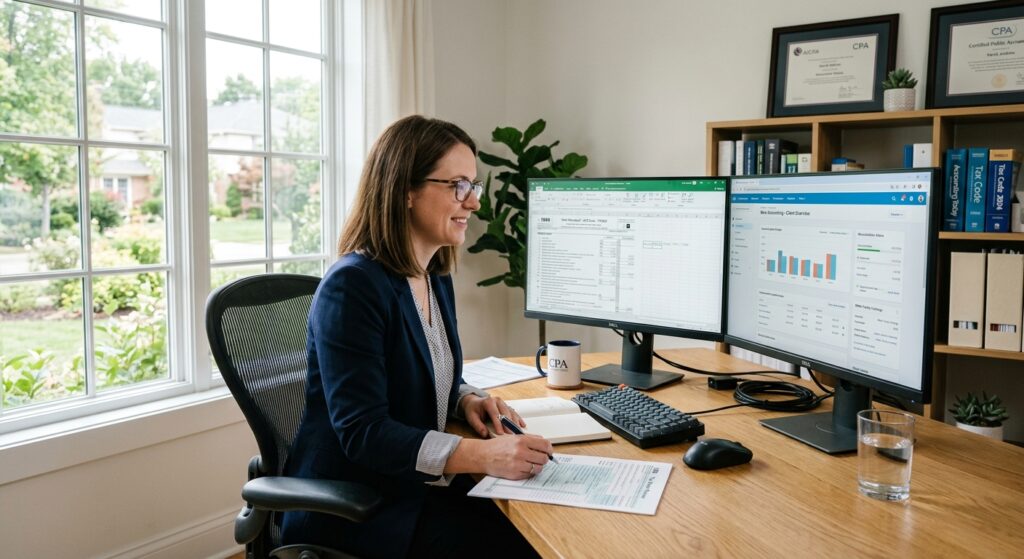
Remote Accounting Jobs: 2026 Guide for Tax Professionals
Remote accounting jobs have fundamentally transformed the tax profession in 2026. With over 200,000 unfilled CPA positions and AI adoption reaching 40% across accounting firms, tax professionals face unprecedented opportunities in virtual practice environments. The One Big Beautiful Bill Act (OBBBA) introduced sweeping compliance changes requiring specialized expertise that remote accountants now deliver nationwide.
Table of Contents
- Key Takeaways
- What Drives Demand for Remote Accounting Jobs in 2026?
- How Has AI Transformed Remote Tax Work?
- What Are the 2026 Compliance Requirements Tax Professionals Must Master?
- What Salary Expectations Exist for Remote Accounting Jobs?
- How Can Professionals Transition to Remote Accounting Roles?
- What Technology Infrastructure Is Required for Remote Tax Practice?
- Uncle Kam in Action: CPA Firm Triples Client Capacity Through Remote Model
- Next Steps
- Frequently Asked Questions
- Related Resources
Key Takeaways
- Over 200,000 CPA positions remain unfilled nationwide in 2026, creating high demand for remote professionals
- AI adoption reached 40% across accounting firms, fundamentally changing how remote work operates
- OBBBA compliance requires new expertise in tip reporting, overtime deductions, and vehicle interest rules
- Remote tax professionals command competitive salaries while reducing overhead for employers
- Continuous tax planning has replaced annual filing cycles for advanced practitioners
What Drives Demand for Remote Accounting Jobs in 2026?
Quick Answer: The profession faces a critical shortage exceeding 200,000 positions. Remote work solves geographic constraints while firms adopt AI tools requiring fewer but highly skilled professionals.
The accounting profession entered 2026 with structural challenges that remote work directly addresses. According to Accounting Today’s analysis of Top 100 Firms, senior executives identified staffing as their primary concern. The pipeline problem stems from insufficient accounting degree enrollments and high attrition rates among licensed professionals.
Remote accounting jobs offer solutions by expanding talent pools beyond local markets. A firm in New York can now hire CPAs from lower-cost regions while those professionals enjoy geographic flexibility. This model has become essential as comprehensive tax advisory services grow more complex and require specialized expertise.
The Economic Pressure Creating Opportunities
Bankruptcy filings surged 14% year-over-year in Q1 2026, reaching 150,009 total filings according to data from Epiq AACER. This economic distress drives demand for specialized accounting services. Businesses facing financial restructuring need cash flow analysis, creditor negotiations, and compliance support that remote accountants deliver efficiently.
Furthermore, the 2026 job market shows hiring freezes across many sectors. Employers added 178,000 positions in March 2026, yet unemployment rose to 4.4% as labor force participation declined. However, accounting remains insulated due to regulatory complexity and persistent demand for tax compliance expertise.
Geographic Flexibility and Lifestyle Benefits
Remote accounting jobs enable professionals to relocate to more affordable cities while maintaining competitive salaries. Migration patterns in 2026 show accountants moving to Charleston, South Carolina and St. Petersburg, Florida for improved quality of life. These professionals continue serving clients nationwide through cloud-based platforms and virtual meeting technology.
Pro Tip: Tax professionals can reduce living expenses by 30-40% relocating from major metros while maintaining six-figure remote salaries with national firms.
How Has AI Transformed Remote Tax Work?
Quick Answer: AI adoption reached 40% across firms in 2026, automating compliance tasks while elevating tax professionals to advisory roles requiring strategic thinking.
The 2026 Thomson Reuters AI in Professional Services Report documented that organization-wide AI use nearly doubled to 40% this year. This shift fundamentally changed what remote accounting jobs entail. Manual data entry, bank reconciliations, and basic compliance tasks now happen through automated workflows, freeing professionals for higher-value advisory work.
Remote work and AI form a powerful combination. Professionals working from home leverage AI tools to handle client bases that would require three to four traditional accountants. The IRS itself deployed AI for audit selection after workforce reductions of approximately 25%, demonstrating technology’s capacity to offset staffing constraints.
The Shift to Always-On Tax Planning
Traditional annual tax planning cycles have given way to continuous advisory relationships. AI platforms instantly surface planning opportunities when clients’ financial circumstances change. Therefore, remote accounting jobs increasingly focus on proactive strategy rather than reactive compliance. Firms offering comprehensive tax strategy services require professionals who can interpret AI-generated insights and translate them into actionable client recommendations.
Critical Thinking Becomes The Differentiator
While AI handles routine tasks, professional judgment remains irreplaceable. Deloitte’s 2026 Global Human Capital Trends report found only 14% of leaders feel adept at managing human-AI collaboration. Consequently, remote accountants who master this balance command premium compensation. They use AI for data processing while applying expertise to complex scenarios like multi-state compliance or intricate entity structures.
| Task Type | Pre-AI (2024) | 2026 with AI | Time Savings |
|---|---|---|---|
| Bank Reconciliation | 2-3 hours | 15 minutes | 90% |
| Expense Categorization | 4-5 hours | 30 minutes | 87% |
| Tax Return Preparation | 6-8 hours | 2-3 hours | 65% |
| Tax Planning Analysis | 3-4 hours | 45 minutes | 75% |
Did You Know? The IRS now uses AI to score millions of returns simultaneously for audit potential. Remote tax professionals must stay ahead by using similar tools to identify client risks proactively.
What Are the 2026 Compliance Requirements Tax Professionals Must Master?
Quick Answer: OBBBA introduced major changes including new W-2 tip reporting, overtime deductions up to $25,000 for joint filers, and vehicle interest deductions up to $10,000.
The One Big Beautiful Bill Act, enacted July 4, 2025, created the most significant compliance changes since the Tax Cuts and Jobs Act. Remote accounting jobs in 2026 require mastery of these provisions to serve clients effectively. According to Thomson Reuters’ analysis, tax return complexity increased substantially for the 2026 filing season.
New Form W-2 Reporting Requirements
Beginning with the 2026 tax year, employers must separately report qualified tips and overtime compensation on Form W-2. This change forces businesses to upgrade payroll systems and creates advisory opportunities for remote accountants helping clients implement compliant processes. Over 20 states introduced varying legislation on tip and overtime treatment, creating a patchwork of compliance obligations.
Major New Deduction Opportunities
Tax professionals specializing in business owner tax planning must navigate several new deductions:
- Overtime Pay Deduction: Up to $12,500 for single filers, $25,000 for married filing jointly
- Vehicle Loan Interest: Up to $10,000 for new vehicles with U.S. final assembly, used personally over 50% of the time
- Enhanced Senior Deduction: Additional $6,000 per person with complex phase-out thresholds
- Charitable Deduction for Non-Itemizers: Up to $1,000 single, $2,000 married filing jointly
These provisions create planning complexity requiring continuous education. Remote accounting jobs increasingly involve specialized knowledge areas where professionals develop deep expertise in specific OBBBA provisions.
Multi-State Compliance Challenges
Remote work enables professionals to serve clients across multiple states, but this creates complex compliance obligations. States vary in their treatment of OBBBA provisions, particularly regarding tip income and overtime deductions. Some states conform to federal law while others require add-backs on state returns.
| OBBBA Provision | Federal Treatment | Common State Variations |
|---|---|---|
| Overtime Deduction | Up to $12,500/$25,000 | Some states require add-back |
| Tip Income Exclusion | Qualified tips exempt | Mixed conformity |
| Vehicle Interest | Up to $10,000 | Most states conform |
Pro Tip: Remote accountants serving multi-state clients should invest in professional tax software with automatic state conformity tracking for OBBBA provisions.
What Salary Expectations Exist for Remote Accounting Jobs?
Quick Answer: Remote CPAs with 3-5 years experience command $75,000-$95,000 base salaries. Senior professionals with AI expertise earn $120,000-$160,000 plus performance bonuses.
Compensation for remote accounting jobs remains competitive with traditional in-office roles while offering geographic arbitrage opportunities. The talent shortage means employers compete aggressively for qualified professionals. According to industry reports, firms are prioritizing retention through enhanced compensation packages and flexible arrangements.
Experience-Based Compensation Ranges
Entry-level remote accountants with their CPA license typically start at $60,000-$70,000 annually. Mid-level professionals handling complex returns and advisory work earn $85,000-$110,000. Senior tax managers and directors in remote roles command $130,000-$180,000 depending on specialization and client base size.
Specialists focusing on high-net-worth tax planning or complex business structures often exceed these ranges. Professionals with expertise in international taxation, estate planning, or advanced entity structuring can earn $200,000+ in fully remote positions.
The AI Premium
Tax professionals demonstrating AI proficiency earn 15-20% premiums over peers with similar experience but traditional skill sets. Firms seek accountants who can leverage automation tools to increase client capacity while maintaining quality. This premium reflects the value of professionals who bridge technical tax knowledge and technological capability.
Geographic Arbitrage Opportunities
Remote accounting jobs enable professionals to earn major-metro salaries while living in lower-cost areas. A CPA earning $120,000 remotely for a New York firm can relocate to Charleston or St. Petersburg where living costs are 35-40% lower. This creates significant wealth-building opportunities not available to location-dependent professionals.
| Position Level | Base Salary Range | With AI Premium | Total Comp (incl. bonus) |
|---|---|---|---|
| Entry-Level CPA | $60,000-$70,000 | $69,000-$84,000 | $75,000-$92,000 |
| Senior Accountant | $85,000-$110,000 | $98,000-$132,000 | $110,000-$150,000 |
| Tax Manager | $130,000-$160,000 | $150,000-$192,000 | $170,000-$220,000 |
| Director/Partner | $180,000-$250,000 | $207,000-$300,000 | $250,000-$400,000+ |
How Can Professionals Transition to Remote Accounting Roles?
 Free Tax Write-Off Finder
Quick Answer: Build specialized expertise in high-demand areas, develop AI proficiency, create a professional online presence, and target firms with established remote infrastructures.
Transitioning to remote accounting jobs requires strategic positioning. The shortage of qualified professionals means opportunities exist, but competition for the best roles remains intense. Successful transitions involve demonstrating both technical competence and remote work capability.
Develop High-Demand Specializations
Firms offering entity structuring services seek professionals with niche expertise. Focus areas with strong remote demand include:
- Multi-state tax compliance and nexus planning
- OBBBA provision expertise (tips, overtime, vehicle interest deductions)
- Real estate professional tax strategies and cost segregation
- S corporation reasonable compensation and distribution planning
- High-income retirement tax optimization strategies
Master AI and Automation Tools
Proficiency with platforms like UltraTax CS, Thomson Reuters CoCounsel Tax, and cloud-based practice management systems has become essential. Employers seek professionals who can leverage AI for efficiency while applying judgment to complex scenarios. Invest time learning how to prompt generative AI tools for tax research and how to validate AI-generated analysis.
Build Your Professional Brand
Remote accounting jobs often come through professional networks rather than traditional job boards. Develop thought leadership by publishing articles on tax planning topics, participating in professional forums, and maintaining an active LinkedIn presence. Demonstrate expertise publicly to attract opportunities from firms seeking specialized talent.
Pro Tip: Create case study content showing how you’ve solved specific client problems. Firms hiring remotely value demonstrated problem-solving over credentials alone.
What Technology Infrastructure Is Required for Remote Tax Practice?
Quick Answer: Professional remote accounting requires secure cloud platforms, encrypted communication tools, professional tax software, and reliable internet connectivity with backup options.
Technology infrastructure separates professional remote accounting jobs from casual work-from-home arrangements. Tax professionals handle sensitive financial data requiring institutional-grade security and reliability. Firms expect remote workers to maintain systems meeting professional standards and regulatory compliance requirements.
Essential Technology Components
- Cloud-Based Tax Software: Platforms like UltraTax CS, Lacerte, or Drake enable collaborative work on returns
- Document Management Systems: Secure client portals for document exchange and e-signature capability
- Practice Management Tools: Workflow tracking, time management, and client communication platforms
- Encrypted Communication: Video conferencing with end-to-end encryption for client meetings
- Cybersecurity Measures: VPN, multi-factor authentication, and regular security training
Connectivity and Backup Requirements
Professional remote work requires redundant internet connectivity. Primary fiber connections should have cellular backup for critical client deadlines. Power backup through UPS systems protects work during outages. These investments demonstrate commitment to professional service delivery regardless of location.
Compliance and Security Protocols
Remote accounting jobs handling client data must meet IRS security standards outlined in Publication 4557. This includes physical security of work areas, secure data disposal procedures, and incident response plans. Many firms require remote professionals to maintain home office security comparable to physical office environments.
Uncle Kam in Action: CPA Firm Triples Client Capacity Through Remote Model
When Marcus Chen launched his boutique tax practice in 2023, he operated from a traditional office serving local clients. By 2025, overhead costs consumed 40% of revenue while geographic limitations restricted growth. Marcus faced a common dilemma: expand with expensive office space or find an alternative model.
His firm generated $380,000 in annual revenue with three employees handling 120 clients. However, the lease cost $4,500 monthly plus utilities, commuting reduced billable hours, and the local market limited specialized service opportunities. Marcus needed a solution that reduced costs while expanding capability.
In early 2026, Marcus engaged Uncle Kam’s business advisory team to restructure his practice model. The strategy involved three components: transitioning to a fully remote operation, implementing AI-powered workflow automation, and developing specialized expertise in OBBBA compliance for service industry clients.
The transformation required upfront investment. Uncle Kam helped Marcus implement cloud-based tax software, establish secure document management systems, and train staff on AI tools for automated reconciliation and compliance checking. The total implementation cost was $35,000 including technology, training, and process redesign.
Within eight months, the results exceeded projections. By eliminating the office lease, the firm reduced overhead by $54,000 annually. AI automation reduced time per client by approximately 40%, enabling the same three-person team to handle 340 clients. Specializing in restaurant and hospitality OBBBA compliance attracted higher-fee engagements averaging $4,200 versus the previous $3,100.
The financial impact was substantial. Revenue increased to $1.1 million while overhead dropped to 18% of revenue. Marcus’s personal income increased from $145,000 to $387,000. The firm hired two additional remote CPAs in lower-cost markets, paying competitive salaries while maintaining margins.
The Results: Marcus invested $35,000 in the transition and generated $720,000 in additional annual revenue in year one, representing a 20:1 return on investment. Beyond financial metrics, work-life balance improved dramatically as commute time disappeared and flexible scheduling became standard.
This case demonstrates how remote accounting jobs create value for both professionals and firm owners. The model enables geographic expansion, overhead reduction, and specialized service development that traditional office-based practices cannot match.
Next Steps
Remote accounting jobs represent the future of tax practice. Whether you’re seeking opportunities or building a remote firm, strategic action creates competitive advantage:
- Assess your technology infrastructure and upgrade systems to professional-grade cloud platforms
- Develop expertise in 2026 OBBBA provisions to differentiate your service offering
- Invest in AI proficiency through formal training on platforms like UltraTax CS or CoCounsel Tax
- Build your professional network through thought leadership and industry participation
- Consider consulting with specialized tax advisory firms about remote practice optimization strategies
This information is current as of 4/6/2026. Tax laws change frequently. Verify updates with the IRS if reading this later.
Frequently Asked Questions
Do remote accounting jobs pay less than office-based positions?
No. Remote accounting jobs typically offer comparable or higher compensation than traditional roles. The CPA shortage creates competitive pressure that maintains strong salaries. Additionally, professionals can leverage geographic arbitrage by earning major-metro salaries while living in lower-cost regions. Senior remote CPAs with AI expertise command $120,000-$160,000 or more, matching or exceeding office-based peers.
What certifications matter most for remote accounting jobs in 2026?
The CPA license remains the gold standard and is required for most professional remote accounting jobs. Beyond that, the Enrolled Agent (EA) designation appeals to firms serving individual clients. Specialized certifications in areas like financial planning (CFP) or fraud examination (CFE) add value. However, demonstrated AI proficiency and OBBBA compliance expertise often matter more than additional credentials.
How do remote tax professionals handle client meetings effectively?
Successful remote accountants use professional video conferencing platforms with screen sharing for collaborative tax return review. Secure client portals enable document exchange before meetings. Many professionals report that virtual meetings increase efficiency by eliminating travel time and enabling better documentation. The key is establishing clear communication protocols and using technology that clients find accessible.
Can new graduates land remote accounting jobs without experience?
Entry-level remote positions exist but are less common than experienced roles. Most firms prefer remote employees who can work independently with minimal supervision. New graduates should target hybrid roles that include initial in-office training before transitioning to remote work. Alternatively, gaining 2-3 years of traditional office experience builds credibility for fully remote opportunities.
What are the biggest challenges of remote accounting work?
The primary challenges include maintaining work-life boundaries when home becomes the office, potential isolation from professional communities, and technology dependency that creates vulnerability to connectivity issues. However, these challenges are manageable through deliberate scheduling, active participation in professional organizations, and redundant technology infrastructure. The benefits typically outweigh drawbacks for self-directed professionals.
How will continued AI advancement affect remote accounting jobs?
AI will continue automating routine compliance work while elevating professional roles toward advisory services. Remote accounting jobs will increasingly require strategic thinking and complex problem-solving that AI cannot replicate. Professionals who master human-AI collaboration will command premium compensation. The shortage of qualified accountants means job security remains strong for those who continuously develop expertise.
Are there specific geographic restrictions for remote tax work?
Some states require CPA license reciprocity to serve clients in their jurisdiction. However, most firms handle multi-state work through professionals licensed in client locations or supervising licensed staff. Remote accounting jobs serving self-employed clients across state lines are increasingly common. Check your state’s board of accountancy for specific remote work guidance.
What technology budget should remote accountants plan for?
Professional remote accounting requires $3,000-$5,000 in initial technology investment covering reliable computer hardware, dual monitors, professional webcam and microphone, ergonomic workspace furniture, and redundant internet connectivity. Ongoing costs include software subscriptions ($200-$400 monthly), continuing education for AI tools, and cybersecurity services. Many employers provide technology stipends or reimburse these expenses.
Related Resources
- Comprehensive Tax Strategy Services
- Business Solutions and Automation
- Tax Planning for Real Estate Professionals
- The MERNA Method for Tax Optimization
Last updated: April, 2026

