
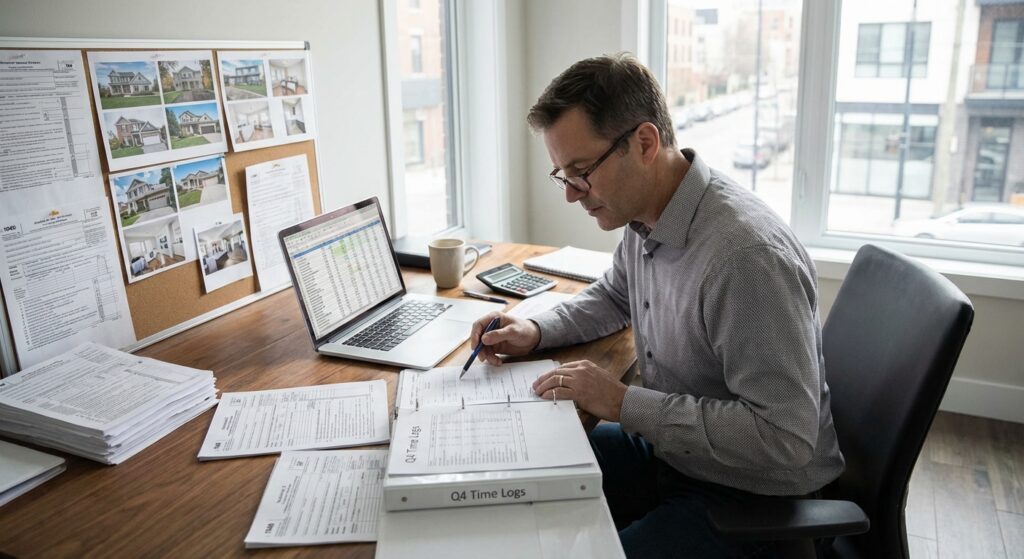
Real Estate Professional Status and the 750-Hour Rule: Your Complete 2026 Tax Guide
For the 2026 tax year, real estate investors who meet the real estate professional 750 hours requirement can unlock substantial passive activity loss deductions that aren’t available to passive investors. The IRS rules under Internal Revenue Code Section 469 offer a powerful strategy for tax planning when properly documented and executed. Understanding these requirements can save you thousands in annual taxes while accelerating your wealth-building strategy through real estate investment.
Table of Contents
- Key Takeaways
- What Is Real Estate Professional Status?
- Understanding the 750-Hour Requirement
- How Passive Activity Loss Deductions Work
- Documentation and IRS Compliance Requirements
- Uncle Kam in Action: Real-World Example
- Next Steps
- Frequently Asked Questions
- Related Resources
Key Takeaways
- Real estate professional status requires documenting more than 750 hours of work in real estate for the 2026 tax year.
- Qualifying professionals can deduct unlimited passive activity losses against W-2 income and other income sources.
- Proper time tracking and contemporaneous documentation are critical for IRS defense of your status.
- The 750-hour requirement applies annually—failing to meet it in one year can trigger reclassification.
- Multiple material participation tests exist; meeting just one qualifies you for passive activity loss relief.
What Is Real Estate Professional Status?
Quick Answer: A real estate professional is an individual who works more than 750 hours annually in real estate activities and meets IRS material participation requirements, allowing unlimited passive activity loss deductions against other income.
Real estate professional status is a tax classification that fundamentally changes how the IRS treats your rental property losses. Without this status, passive activity loss limitations restrict your ability to deduct real estate losses against your W-2 income or investment returns. With professional status, those restrictions disappear entirely, creating a powerful tax planning advantage for serious real estate investors.
The IRS defines a real estate professional under IRC Section 469 as someone who meets two critical requirements. First, you must work in real estate activities during the tax year. Second, you must spend more than 750 hours annually on these activities, or meet an alternative material participation test. This definition applies whether you’re a licensed real estate agent, broker, developer, property manager, or investor actively acquiring and disposing of properties.
Who Qualifies as a Real Estate Professional?
The IRS recognizes several categories of real estate professionals for the 2026 tax year. Licensed real estate agents and brokers are the most obvious candidates. However, real estate developers, property managers handling rental activities, appraisers, and investors actively trading in properties also qualify if they meet the participation requirements. Even investors who aren’t licensed can achieve professional status if they dedicate sufficient time and effort to their portfolio.
For real estate investors specifically, the critical factor isn’t licensing—it’s demonstrating that you’re engaged in the real estate business as a trade or business. This means your real estate activities must be the primary focus of your professional time. You cannot achieve real estate professional status if real estate is a secondary activity alongside a full-time W-2 job and minimal real estate involvement.
The Impact on Your 2026 Tax Return
Achieving real estate professional status creates an immediate tax filing advantage. For 2026, your rental property losses become deductible against all income sources—not just other passive income. If you own rental properties generating $150,000 in annual losses through depreciation and ordinary business deductions, those losses offset your W-2 salary, self-employment income, and investment returns dollar-for-dollar. This can reduce your overall tax liability by 30-37%, depending on your tax bracket.
Pro Tip: Real estate professional status isn’t automatic. The IRS aggressively challenges claims on audits. Maintain detailed time logs starting January 1, 2026, using spreadsheets, calendars, or time-tracking software. Document every hour spent on acquisition, management, disposition, and administrative activities related to real estate.
Understanding the 750-Hour Requirement
Quick Answer: For 2026, you must document more than 750 hours of work in real estate during the calendar year—approximately 14.5 hours per week—to meet the primary material participation test for real estate professional status.
The 750-hour threshold is the most commonly used pathway to real estate professional status. It represents roughly 15 hours weekly across a 52-week year. This hourly requirement applies whether you’re a part-time investor managing 10 properties or a full-time real estate agent handling client transactions. The IRS doesn’t care how you distribute these hours—you could work 10 hours in January and zero hours in February, then make up the difference in other months. What matters is the annual total exceeding 750 hours.
What Activities Count Toward the 750 Hours?
The IRS broadly interprets “real estate activities” for hour-counting purposes. Time spent on property acquisition—including market research, property inspections, due diligence reviews, and negotiation—counts fully. Property management hours include tenant screening, rent collection, maintenance scheduling, lease drafting, and accounting. Disposition activities (selling properties) count from listing through closing. Administrative work like bookkeeping, tax planning, and regulatory compliance also qualify.
- Acquisition Activities: Researching properties, site visits, financial analysis, negotiations with sellers, inspections.
- Disposition Activities: Listing properties, showing to buyers, negotiating sales, closing preparation.
- Management Activities: Tenant relations, maintenance coordination, rent collection, lease administration.
- Administrative Activities: Bookkeeping, financial analysis, tax planning, legal compliance work.
- Professional Development: Real estate courses, license maintenance, industry conference attendance.
What Activities Don’t Count?
The IRS excludes passive observation from hour calculations. Simply owning property doesn’t count—you must actively work on it. Reviewing brokerage statements for a real estate investment trust (REIT) doesn’t qualify. Time spent by employees, contractors, or advisors (unless they’re you) cannot be attributed to your hours. Likewise, attending a real estate investment club meeting to listen to speakers counts differently than volunteering to present a deal analysis.
The critical distinction is personal participation. Your spouse’s hours count only if she also qualifies as a real estate professional separately. Your property manager’s work on your behalf doesn’t count toward your 750 hours, though your work reviewing their management and making decisions does.
| Activity Type | Counts Toward 750 Hours? |
|---|---|
| Property inspections and showings | YES |
| Tenant interviews and screening | YES |
| Mortgage application preparation | YES |
| Tax planning and bookkeeping | YES |
| Passive ownership without active work | NO |
| Property manager’s activities (not yours) | NO |
| REIT investment monitoring | NO |
How Passive Activity Loss Deductions Work
Quick Answer: Real estate professionals can deduct passive activity losses (including depreciation deductions) against all income sources in 2026, not just passive income, creating powerful tax reduction opportunities.
Without real estate professional status, the IRS limits passive activity losses to passive income. If you generate $50,000 in rental losses from depreciation but earn $150,000 in W-2 income, you can only deduct up to your passive income. Extra losses carry forward indefinitely. This creates a frustrating tax position: your properties generate negative taxable income but offer minimal current-year tax benefits.
Real estate professional status eliminates this restriction. Your $50,000 in rental losses offset your $150,000 W-2 income directly on your 2026 tax return. This reduces your taxable income to $100,000. At a 32% effective tax rate, you save approximately $16,000 in taxes on that single property.
Understanding Depreciation as the Primary Loss Driver
For most investors, real estate depreciation represents the largest source of passive activity losses. Building structures typically depreciate over 27.5 years for residential property. A $500,000 property with a $400,000 depreciable building value generates $14,545 in annual depreciation deductions—with zero cash outflow. Combined with mortgage interest, property taxes, repairs, and insurance, your total annual losses often exceed your rental income by substantial margins.
Here’s the critical tax advantage: depreciation is a “paper loss” that reduces your taxable income without reducing cash flow. Your tenant pays rent that covers (and hopefully exceeds) your actual expenses. But your tax return shows a loss due to depreciation. As a real estate professional, you deduct this tax loss against your W-2 salary or business income. Result: positive cash flow with negative taxable income in many years.
Did You Know? Building depreciation on a $1 million property generates approximately $36,400 in annual deductions. Over a 10-year holding period, that totals $364,000 in cumulative losses—completely separate from your actual cash flow and repairs. Real estate professionals can use these deductions to shelter other income throughout the holding period.
Income Limitations and Phase-Out Rules
Unlike passive investors facing income limitations at $150,000 of modified adjusted gross income (MAGI), real estate professionals face no income restrictions on passive activity loss deductions. A real estate professional earning $500,000 annually can deduct unlimited passive losses against that income. This advantage creates enormous tax savings for high-income investors who qualify for professional status.
The only limitation applies when your passive losses exceed income in a given year. Excess losses carry forward indefinitely to future years or apply against your capital gain when you sell the property. Unlike passive investors (who lose excess deductions at death), professional status allows you to use these carryforward losses strategically across your portfolio.
Documentation and IRS Compliance Requirements
Quick Answer: For 2026, maintain contemporaneous time logs documenting your 750 hours with dates, activities, time spent, and property identification. This documentation is your primary defense against IRS challenges.
The IRS frequently challenges real estate professional status claims during audits. In response, you need meticulous documentation supporting your 750-hour claim and material participation. Vague statements like “I spent a lot of time on my properties” will not survive audit. Specific, contemporaneous records demonstrating 750+ hours annually provide the foundation for defending your tax position.
Creating Defensible Time Records
Begin tracking time on January 1, 2026. Use a daily calendar, time-tracking app, or dedicated spreadsheet. Each entry should include the date, activity type (acquisition, management, disposition, or administrative), which property is involved, time spent in hours and minutes, and brief description of what you accomplished. Example: “January 15, 2026—Property acquisition—123 Main Street—2 hours—Conducted property inspection, reviewed title report, analyzed comps.”
- Track time daily or weekly, not at year-end. The IRS values contemporaneous records created at the time activities occur.
- Include property addresses or identification numbers so each hour is traceable to specific real estate activities.
- Document meetings with real estate agents, lenders, attorneys, accountants, and contractors related to your investments.
- Preserve invoices, emails, text messages, and calendar entries supporting your time records.
- Maintain summaries showing quarterly and annual totals to demonstrate you’ve exceeded 750 hours.
Supporting Documentation Strategy
Time logs alone aren’t sufficient for aggressive IRS agents. Corroborating documentation strengthens your position significantly. Email correspondence about property decisions, text message chains with contractors discussing improvements, calendar invites for property tours and meetings, bank and credit card statements showing property expenses, and contracts reflecting your active involvement all support your real estate professional status claim.
If you’re a licensed real estate agent or broker, your MLS activity, transaction records, and client file documentation automatically support your professional status. For investors, create a parallel documentation system even if you’re unlicensed. Photos from property visits, inspection reports you commissioned, meeting notes with contractors, and lease agreements you negotiated all demonstrate active involvement.
Pro Tip: Have your CPA or enrolled agent summarize your 750-hour documentation on your tax return using Form 8582 supplementary schedules. This communicates to the IRS that you’ve carefully tracked and documented real estate professional status, discouraging casual audits.
Maintain all documentation for at least seven years after filing your 2026 tax return. The IRS audit statute for real estate professional status claims typically extends three years from filing, but can extend to six years if substantial underreporting occurs. Consider storing digital copies in cloud storage and paper originals in fireproof storage.
Uncle Kam in Action: Real Estate Investor Saves $47,500 Annually Through Real Estate Professional Status
Client Snapshot: Marcus, a 54-year-old real estate investor in California, owned 12 rental properties generating significant rental income but substantial paper losses through depreciation. His W-2 income from a consulting business totaled $280,000 annually, placing him in the 32% federal plus 9.3% California state tax bracket (41.3% combined).
Financial Profile: Marcus’s 12 properties generated $185,000 in annual rental income. However, depreciation, mortgage interest, property taxes, maintenance, and property management fees created a combined loss of $115,000 annually. As a passive investor, Marcus was limited to deducting only $25,000 of passive losses against his W-2 income each year (due to MAGI limitations). The remaining $90,000 in losses carried forward indefinitely.
The Challenge: Marcus wanted to accelerate his real estate portfolio growth by acquiring additional properties, but his inability to deduct rental losses against his W-2 income made additional properties economically unviable. Tax liability on $160,000 in annual taxable income (after limited passive loss deductions) created cash flow constraints that prevented him from acquiring the three additional properties he’d identified.
The Uncle Kam Solution: Uncle Kam’s team helped Marcus document that he spent more than 800 hours annually on real estate activities. Marcus tracked acquisitions of new properties, active participation in property management decisions, tenant screening and interviews, financial analysis and budgeting, contractor negotiations for improvements, disposition planning for underperforming properties, and regular property inspections. With meticulous 2026 documentation, Marcus qualified for real estate professional status on his tax return.
The Results:
- Tax Savings (2026): Marcus’s $115,000 real estate loss offset his W-2 income directly. This reduced his taxable income from $280,000 to $165,000. At his blended 41.3% rate, Marcus saved $47,500 in federal and state taxes ($115,000 × 41.3%).
- One-Time Investment: Uncle Kam charged $3,200 for comprehensive 750-hour documentation, tax planning strategy, and Form 8582 preparation for the 2026 tax return.
- Return on Investment (ROI): Marcus achieved a 14.8x return on investment ($47,500 ÷ $3,200) in the first year alone. Over a 10-year period maintaining real estate professional status, this strategy generated projected cumulative tax savings of $475,000.
This is just one example of how our proven tax strategies have helped clients achieve significant savings and accelerate wealth-building through real estate investment. Marcus reinvested his 2026 tax savings to acquire two additional properties, increasing his portfolio to 14 units and creating a compounding advantage for future years.
Next Steps
If you own rental properties and spend significant time managing your real estate portfolio, take these three actions immediately:
- 1. Start Time Tracking Today: Don’t wait until year-end. Create a tracking system (spreadsheet, app, or calendar) to document daily real estate activities and hours starting immediately. Include property addresses, activity types, and time spent in minutes.
- 2. Gather Supporting Documentation: Compile emails, invoices, contractor agreements, property inspection reports, photos, and meeting notes reflecting your active real estate involvement. Organize these by property and activity type for your accountant.
- 3. Consult a Tax Professional: Discuss your real estate portfolio with an experienced tax advisor who specializes in real estate professional status. They’ll assess whether you meet the 750-hour requirement and help design a documentation strategy aligned with your property portfolio.
Frequently Asked Questions
Can I achieve real estate professional status if I work a full-time W-2 job?
Technically yes, but practically difficult. The IRS scrutinizes claims where someone maintains full-time employment and claims real estate professional status simultaneously. However, if you genuinely spend 750+ hours annually on real estate—perhaps working evenings and weekends plus vacation time—you can qualify. Success requires meticulous documentation proving the majority of your personal time focuses on real estate activities, not your W-2 job.
What if I own properties with my spouse? Can we both claim real estate professional status?
Each spouse must independently qualify for real estate professional status based on their own 750+ hours of participation. You cannot combine hours. If one spouse works full-time in real estate (as an agent or investor) and the other works outside real estate, typically only the real estate-focused spouse qualifies. However, if both spouses actively participate in property management, acquisition, and disposition activities, each can achieve status independently with separate documentation.
Does my property management company’s work count toward my 750 hours?
No. Your property manager’s hours don’t count toward your personal 750-hour requirement. However, your time reviewing their reports, making management decisions, replacing underperforming managers, and handling escalated tenant issues does count. If you’re actively involved in property management oversight and decision-making (not passive ownership), those hours accumulate toward your 750-hour threshold.
What alternative material participation tests exist besides the 750-hour requirement?
The IRS recognizes several alternative material participation tests under IRC Section 469. You can qualify with 500+ hours if you’re the only person providing services. You can qualify by demonstrating your activity represents substantially all personal services provided to the business. You can qualify if you’ve materially participated in the activity for five of the prior ten years. Licensed real estate professionals (agents, brokers, appraisers) who materially participated in real estate for three of five prior years can qualify. Each test has specific documentation requirements. Working with an experienced tax advisor to identify the easiest path for your situation is crucial.
If I fail to meet 750 hours one year, do I lose real estate professional status permanently?
No. Real estate professional status applies on a year-by-year basis. If you fail to meet 750 hours in 2026, you lose the status for that tax year only. You’ll be subject to passive activity loss limitations for 2026. If you exceed 750 hours in 2027, you regain professional status for 2027. However, failing to meet the threshold should be avoided—maintain consistent documentation systems to ensure you exceed 750 hours every year you plan to claim the status.
Can I use estimated hours if I don’t have exact daily time records?
The IRS strongly prefers contemporaneous records created during the year showing actual hours. If your records are incomplete or estimated, the burden shifts to you to prove by “clear and convincing evidence” that you spent 750+ hours on real estate activities. Expert testimony, reconstructed calendars, and corroborating documentation can support estimated hours, but this approach is riskier than maintaining daily records. Don’t rely on estimates—track actual time starting January 1, 2026.
How long should I maintain documentation supporting my 750-hour claim?
Maintain all time logs, emails, invoices, and supporting documentation for a minimum of seven years after filing your tax return claiming real estate professional status. The IRS has a standard three-year audit window, but can extend to six years if substantial underreporting is discovered. For real estate professional status claims, some agents have pursued assessments beyond six years. Permanently archiving digital copies in cloud storage protects you against future challenges.
Related Resources
- Comprehensive real estate investor tax planning strategies
- How to structure your real estate portfolio for maximum tax efficiency
- Advanced tax strategies for real estate professionals
- Real estate investor case studies and success stories
- IRS Publication 925 – Passive Activity and At-Risk Rules
Last updated: January, 2026

