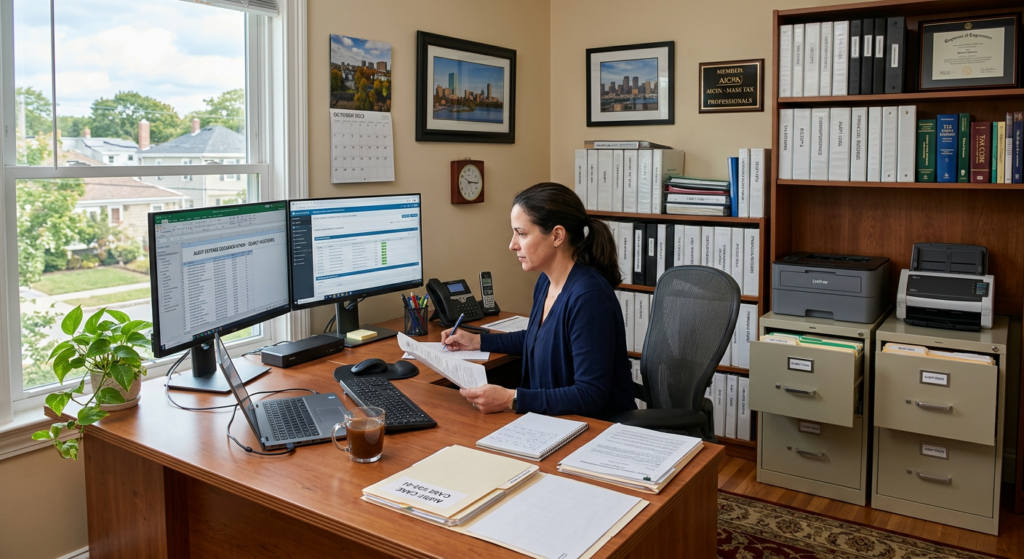
Quincy Home Office Audit Defense: Your 2026 Tax Strategy Guide
Home office deductions have become one of the IRS’s top audit targets, especially for self-employed professionals and remote workers claiming Quincy home office audit defense strategies. With the IRS’s revived Office of Fraud Enforcement targeting an estimated $700 billion tax gap in 2026, understanding how to properly defend your home office deduction has never been more critical. This comprehensive guide provides Massachusetts-based business owners with essential audit defense tactics, documentation requirements, and preventative strategies to protect your tax savings.
Table of Contents
- Key Takeaways
- Why Home Office Deductions Are Audit Targets in 2026
- What Documentation Do You Need for Home Office Audit Defense?
- Common Home Office Audit Red Flags to Avoid
- Two Methods for Calculating Your Home Office Deduction
- How the IRS Examines Home Office Claims
- Uncle Kam in Action
- Next Steps
- Frequently Asked Questions
Key Takeaways
- The IRS Office of Fraud Enforcement is actively targeting home office deductions as part of 2026 audit priorities.
- Proper documentation and consistent record-keeping are your strongest audit defense tools.
- Red flags include incomplete records, personal use, and deductions exceeding reasonable percentages.
- The simplified method ($5 per square foot) reduces audit risk through standardized calculations.
- Professional guidance helps you claim legitimate deductions while maintaining audit defensibility.
Why Home Office Deductions Are Audit Targets in 2026
Quick Answer: The IRS prioritizes home office deductions because they often lack proper documentation, involve inflated expense claims, and create substantial tax savings that attract enforcement scrutiny in 2026.
With millions of remote workers and self-employed professionals claiming home office deductions since the pandemic, the IRS has identified this area as a high-risk audit zone. The agency’s 2026 enforcement strategy specifically targets deductions lacking adequate substantiation. According to Bloomberg Law and recent IRS criminal investigation reports, improper documentation represents one of the most common indicators of tax fraud that the IRS examines.
Why the IRS Focuses on Home Office Claims
Home office deductions attract IRS attention because they involve subjective judgments about what qualifies as business use. Self-employed individuals and business owners frequently claim deductions for utilities, rent, insurance, and repairs that may partially relate to personal use. The line between legitimate business expenses and personal expenses becomes blurred, creating opportunities for inadvertent errors or intentional overstatements.
The IRS’s revived Office of Fraud Enforcement actively pursues cases where taxpayers cannot demonstrate exclusive and regular business use of their home office. In 2026, expect heightened scrutiny on: excessive deduction percentages relative to home size, inability to prove business use through contemporaneous records, and inconsistencies between claimed deductions and actual business activities.
The Remote Work Surge and Audit Activity
Since 2020, remote work adoption increased dramatically, leading millions of employees and 1099 contractors to claim home office deductions for the first time. Many taxpayers filed these deductions without understanding IRS requirements for exclusive business use and proper documentation. The IRS now reviews these claims systematically, making 2026 a critical year to ensure your home office deduction withstands audit scrutiny.
Pro Tip: If you’ve been claiming a home office deduction for multiple years without proper documentation, consider consulting a tax professional immediately. Proactive correction demonstrates good faith compliance and may reduce penalties if an audit occurs.
What Documentation Do You Need for Home Office Audit Defense?
Quick Answer: Comprehensive documentation includes measurements of your home office space, contemporaneous records of business use, receipts for all claimed expenses, and written documentation explaining your business use.
The IRS specifically looks for documentation proving: exclusive and regular business use of your home office, accurate square footage measurements, and legitimate business expenses. Without proper documentation, even legitimate deductions become indefensible during an audit. Use our LLC vs S-Corp Tax Calculator to determine your business structure, then ensure you maintain appropriate records for your chosen entity type.
Essential Home Office Audit Defense Documentation
- Photographs of your home office showing dedicated workspace and business use
- Written description of how you use the space for business purposes
- Square footage measurements with supporting documentation (floor plans, blueprints)
- Total home square footage for percentage calculations
- Receipts, invoices, and utility bills for claimed expenses
- Mortgage statements, property tax records, or lease agreements
- Business calendar or daily log showing work-from-home days
- Client communication records (emails, contracts) referencing home office location
Building Your Audit Defense File
Create a dedicated file containing all documentation related to your home office deduction. Organize expenses by category (utilities, insurance, repairs, depreciation). Maintain copies of your tax return Schedule C and all supporting worksheets. For each tax year, retain documentation for at least seven years—the extended statute of limitations for fraud cases never expires.
Photographing your home office creates contemporaneous evidence of business use. Take photos showing your desk, computer setup, filing systems, and any client-facing areas. These visual records prove business use more effectively than verbal explanations during an audit examination.
 Free Tax Write-Off Finder
Common Home Office Audit Red Flags to Avoid
Quick Answer: Major red flags include claiming excessive percentages of home as office, inability to prove exclusive business use, inconsistent year-to-year deductions, and mixing personal and business expenses.
The IRS uses statistical analysis to identify suspicious home office deductions. Claims exceeding reasonable percentages compared to similar businesses immediately trigger examination. For example, claiming 40% of a 2,000-square-foot home as office space for a consulting business raises red flags. Understanding what triggers audits helps you avoid claiming questionable deductions.
IRS Red Flags for Home Office Deductions
| Red Flag Indicator | Why It Triggers Audit Scrutiny |
|---|---|
| Deductions exceeding 25-30% of home | Suggests inflated claims inconsistent with actual business use patterns |
| No supporting documentation provided | Indicates taxpayer cannot substantiate exclusive business use |
| Significant year-to-year variations | Raises questions about calculation consistency and business structure changes |
| Mixing business and personal expenses | Violates exclusive use requirement and suggests inadequate record-keeping |
| Inadequate records and receipts | Prevents IRS from verifying legitimacy of claimed amounts |
| Claiming guest bedroom as office | Suggests dual-use space inconsistent with exclusive business requirement |
Fraud Indicators and Their Consequences
According to recent Bloomberg Law guidance on IRS fraud enforcement, certain patterns trigger criminal investigation rather than routine examination. These include: backdating documents, maintaining duplicate financial records, falsifying measurements or business use claims, and providing misleading information to tax preparers. The consequences are severe—civil fraud penalties reach 75% of underpayment plus potential criminal prosecution.
Even unintentional errors become problematic when patterns suggest deliberate misrepresentation. For instance, claiming exclusive business use of a room you also use as a guest bedroom creates legal issues. The IRS expects taxpayers to maintain consistency between their factual business operations and their tax reporting.
Two Methods for Calculating Your Home Office Deduction
Quick Answer: The simplified method ($5 per square foot, max 300 square feet) offers less audit risk, while the regular method requires detailed expense tracking but allows greater deductions for qualifying expenses.
For the 2026 tax year, Schedule C provides two calculation methods. Understanding when each method provides optimal results helps you maximize legitimate deductions while maintaining audit defensibility. Your choice impacts both your current tax liability and your audit risk exposure.
The Simplified Method: Reduced Audit Risk
The simplified method multiplies your home office square footage by $5, up to 300 square feet. Maximum deduction: $1,500 annually. This approach eliminates audit complexity because it removes the requirement to track individual utility bills, insurance costs, and repair expenses. The IRS accepts the $5 rate as standardized, reducing questions about your calculation methodology.
This method works best if your home office is approximately 200-300 square feet and your actual expenses (utilities, insurance, repairs) fall below the $5 per square foot calculation. It’s particularly valuable for Quincy home office audit defense because it provides the IRS with minimal substantiation challenges.
The Regular Method: Maximum Deductions
The regular method calculates actual business-use percentage of your home, then applies that percentage to qualifying expenses: mortgage interest (or rent), property taxes, utilities, insurance, repairs, maintenance, and depreciation. This method provides higher deductions for homes with significant utility costs, property taxes, or substantial office spaces.
However, the regular method requires meticulous documentation. You must prove the business percentage, maintain detailed expense records, and be prepared to justify every claimed dollar during an audit. Your home office audit defense becomes more complex because the IRS examines each expense category’s legitimacy.
How the IRS Examines Home Office Claims
Quick Answer: The IRS uses statistical profiling to select returns for examination, then requests documentation proving exclusive business use, accurate measurements, and legitimate expenses.
When your return is selected for audit, the IRS typically conducts a correspondence examination, requesting specific documentation by mail. You’ll receive a Notice of Examination specifying which tax items they’re questioning, generally providing 30 days to respond. Understanding the examination process helps you prepare an effective audit defense.
Typical Examination Process for Home Office Deductions
The IRS examination typically begins with a detailed questionnaire requesting information about your home office use, business activities, and square footage calculations. You must explain how the space is used, provide measurements, and submit copies of expenses claimed. Some audits advance to in-person home visits where IRS agents physically inspect the office space.
Field audits (in-person visits) are less common for straightforward home office claims but more likely if: your deduction percentage seems unusually high, you’ve claimed significant depreciation, or your business type suggests full-time office presence elsewhere. Having organized, comprehensive documentation ready before the IRS contacts you demonstrates preparedness and professionalism.
Did You Know? The IRS can examine returns for three years after filing (six years if underreporting income exceeds 25%), but statute of limitations never expires for fraud. Maintaining complete documentation beyond standard retention periods provides crucial protection if questions arise years later.

Uncle Kam in Action: Defending a Quincy Marketing Professional’s Home Office Deduction
Sarah, a self-employed marketing consultant in Quincy, Massachusetts, had been claiming a $8,500 annual home office deduction using the regular method for three years. When her 2024 return was selected for examination, she received a Notice of Examination requesting substantiation. Without proper documentation, she faced potential disallowance of the entire deduction plus 20% accuracy-related penalties.
Sarah contacted Uncle Kam for assistance. Our team conducted a comprehensive audit defense review. We discovered she could legitimately claim the deduction but had critical documentation gaps. We helped her organize photographs proving exclusive business use of a dedicated bedroom (approximately 120 square feet), gathered utility bills demonstrating higher-than-average electricity costs for computer equipment, and documented her home’s total square footage (2,000 sq ft).
Calculating her legitimate percentage: 120 sq ft ÷ 2,000 sq ft = 6% of home used for business. We prepared a detailed response to the IRS showing 6% of mortgage interest, property taxes, insurance, utilities, and a conservative depreciation calculation. The IRS accepted our submission with minimal adjustments, allowing Sarah to retain 95% of her claimed deduction.
Results: By providing comprehensive documentation and working with a tax professional, Sarah saved approximately $1,600 in disallowed deductions and $320 in penalties. Her tax savings and penalty avoidance represented a 5:1 return on her professional consultation investment. She now maintains organized audit defense files that will withstand future IRS scrutiny.
Next Steps
Don’t wait for an audit notice to organize your home office documentation. Take these immediate actions:
- Measure your home office and calculate the percentage of your total home used for business.
- Photograph your home office showing dedicated business use and equipment setup.
- Organize receipts, utility bills, and mortgage statements for the past three years.
- Review your calculation method and contact our Quincy tax preparation team to verify you’re claiming the optimal amount.
- Schedule a tax advisory consultation to ensure your home office deduction strategy aligns with 2026 IRS enforcement priorities.
Frequently Asked Questions
What constitutes exclusive and regular business use for home office audit defense?
Exclusive use means the space is used only for business activities, not for personal activities like guest sleeping or entertainment. Regular use means you use the space consistently throughout the year for business purposes. The IRS interprets these requirements strictly—even occasional personal use disqualifies the entire space. A bedroom used primarily as an office but occasionally for guests fails the exclusive use test.
Can I claim a home office deduction if my employer requires me to work from home?
Employees are generally prohibited from claiming home office deductions under current IRS rules. The deduction is primarily available to self-employed individuals, business owners, and business partners. However, some military personnel serving at temporary duty locations and certain other specific situations may qualify. If you’re an employee working from home, consult a tax professional about your specific circumstances.
Should I use the simplified method or regular method for my home office deduction?
The simplified method ($5 per sq ft, max $1,500) works best if you have a smaller office (under 200 sq ft) and moderate utility costs. The regular method works better if your home office exceeds 200 square feet, you have high property taxes or utility costs, or you’re in an expensive Massachusetts market. Calculate both methods for your situation—you can only claim one per tax year, but you can switch methods between years.
What happens if the IRS disallows my home office deduction during an audit?
If the IRS disallows your deduction, you’ll receive a Notice of Proposed Adjustment. You have appeal rights—you can request Appeals consideration before paying additional taxes. If you disagree with the determination, you can petition Tax Court. Having comprehensive documentation allows you to defend your position effectively at every stage of the audit process.
How long should I keep home office documentation?
Maintain documentation for at least seven years after filing. The standard statute of limitations is three years, six years if underreporting exceeds 25%, and unlimited for fraud cases. Since fraud determinations can arise unexpectedly, retaining records for seven years is prudent. For depreciation claims, retain asset documentation indefinitely, as depreciation recapture may be assessed many years later.
Can I claim depreciation on my home office under current 2026 tax rules?
Yes, if using the regular method. Depreciation calculations require obtaining your home’s cost basis and useful life. Claiming depreciation creates complexity because you must recapture the depreciation when selling your home, reducing capital gains exclusion. Evaluate whether depreciation benefits justify future recapture obligations. The simplified method excludes depreciation, making it simpler if you’re uncertain about this calculation.
What if I received a Notice of Examination for my home office deduction?
When receiving a Notice of Examination, respond within the specified deadline (typically 30 days). Provide only the documents requested, organized clearly with index tabs. Consider consulting a tax professional or enrolled agent—they can represent you before the IRS and handle correspondence. Documentation quality often determines examination outcomes, making professional guidance valuable for defending your home office deduction effectively.
This information is current as of 3/9/2026. Tax laws change frequently. Verify updates with the IRS if reading this later.
Related Resources
- 2026 Tax Strategy Solutions for Business Owners
- Self-Employed Tax Planning and Schedule C Optimization
- Business Owner Tax Strategies and Deduction Maximization
- Professional Tax Preparation and Filing Services
- Client Success Stories and Tax Savings Case Studies
Last updated: March, 2026

