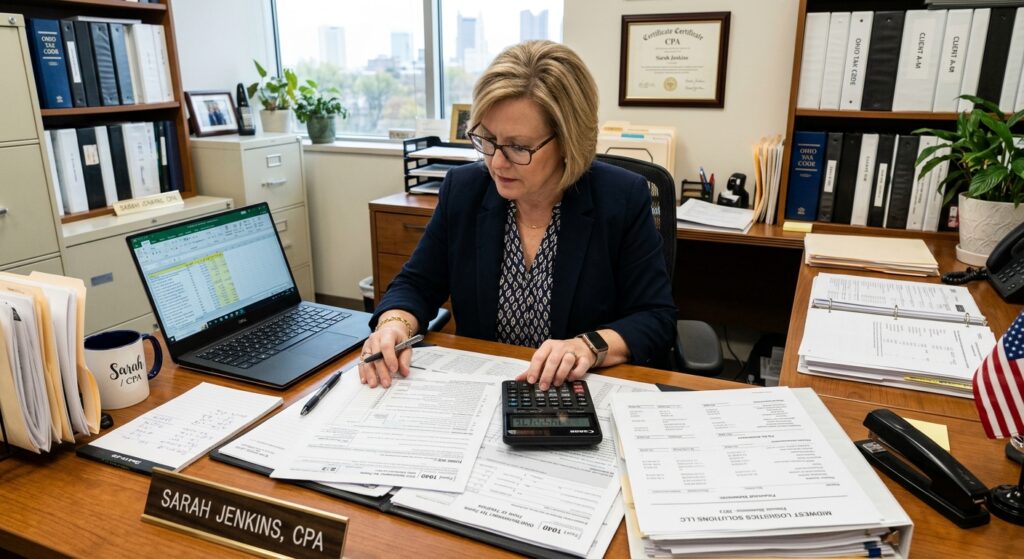
Professional Tax Strategies for Accountants in Ohio: Maximize Deductions and Credits for 2026

Professional Tax Strategies for Accountants in Ohio: Maximize Deductions and Credits for 2026
For accountants in Ohio, the 2026 tax year brings significant opportunities to optimize your professional practice through new deductions, strategic entity decisions, and proactive tax planning. Working with a tax preparation service in Ohio that understands the unique challenges facing accounting professionals ensures you’re capturing every available deduction while maintaining compliance with evolving IRS regulations under the One Big Beautiful Bill Act (OBBBA). With the standard deduction rising to $32,200 for married filing jointly and new professional deductions introduced in 2026, accountants must evaluate their business structure, document all eligible expenses, and implement strategic planning before year-end.
Table of Contents
- Key Takeaways
- What New Tax Laws Apply to Accountants in Ohio in 2026?
- What Business Deductions Can You Maximize as an Accounting Professional?
- Should You Elect S Corporation Status?
- How Can You Leverage Retirement Contributions for Maximum Tax Savings?
- What Strategic Planning Steps Should You Take Now?
- Next Steps
- Frequently Asked Questions
Key Takeaways
- The One Big Beautiful Bill Act (OBBBA) introduced new deductions for 2026, including overtime pay (up to $12,500) and vehicle loan interest (up to $10,000).
- Standard deduction for 2026 increased to $32,200 for married filing jointly and $16,100 for single filers.
- S Corporation election can save 15.3% self-employment tax on reasonable distributions compared to sole proprietorship.
- Solo 401(k) limits increased to $72,000 combined, with catch-up provisions for those aged 60-63.
- Form W-2 now requires separate reporting of tips and overtime compensation starting in 2026.
What New Tax Laws Apply to Accountants in Ohio in 2026?
Quick Answer: The One Big Beautiful Bill Act (OBBBA) introduced significant changes in 2026, including new deductions for overtime pay and vehicle loan interest, higher standard deductions, and updated Form W-2 reporting requirements for tips and overtime compensation.
The One Big Beautiful Bill Act (OBBBA), passed in late 2025 and implemented for 2026 tax returns, fundamentally changes how accountants in Ohio must approach tax planning and compliance. For professional tax preparers and accounting consultants, these changes create both opportunities and responsibilities.
Understanding the Overtime Pay Deduction
One of the most significant new provisions for 2026 is the deduction for overtime pay. If you pay overtime compensation to employees or contract workers, you can now deduct up to $12,500 per return (or $25,000 for married filing jointly). This deduction applies to wages paid for hours worked beyond 40 per week.
For accounting firms with multiple employees working overtime during busy tax season (December through April), this deduction can provide meaningful tax relief. However, the overtime must be properly documented on Form W-2 as of 2026, meaning your payroll system must separately track overtime hours and compensation.
Vehicle Loan Interest Deduction (New for 40 Years)
For the first time in nearly 40 years, personal vehicle loan interest is now tax deductible. As an accountant in Ohio, if you use a vehicle for business purposes or client meetings, you can deduct up to $10,000 annually in vehicle loan interest through 2028.
Important restrictions apply: the vehicle must be brand new, have undergone final assembly in the United States, weigh less than 14,000 pounds, and be used for personal purposes more than 50% of the time. Leased or used vehicles do not qualify. If your firm recently purchased new vehicles for partner use or client meeting transportation, you may be eligible for this deduction on interest paid in 2026.
Form W-2 Reporting Changes
Beginning with 2026 tax returns, employers must report qualified tips and overtime compensation separately on Form W-2. This requires upgrading payroll systems to track these items independently. For accounting firms with multiple staff members, ensuring your payroll provider can handle these new reporting requirements is essential to avoid penalties.
Pro Tip: Review your current payroll software now to confirm it supports the 2026 Form W-2 reporting requirements for tips and overtime. Many systems require updates before year-end, so don’t wait until March 2027 to discover compliance gaps.
What Business Deductions Can You Maximize as an Accounting Professional?
Quick Answer: Beyond standard business deductions (office rent, utilities, equipment), accountants in Ohio can maximize deductions for continuing education, professional licenses, software subscriptions, home office expenses, and vehicle depreciation.
Accounting professionals often overlook legitimate deductions that can significantly reduce taxable income. As a certified public accountant (CPA) or tax professional, you operate a specialized business with unique deduction opportunities available to most professionals.
Professional Development and Continuing Education
CPAs in Ohio are required to complete continuing professional education (CPE) hours to maintain their licenses. All costs related to CPE—courses, seminars, conferences, and examination fees—are fully deductible as business expenses. This includes:
- Online tax software certification courses
- AICPA and state CPA society membership dues
- Conference registration fees and travel expenses
- Professional journals and publications
- Specialized accounting software training programs
Technology and Software Subscriptions
Modern accounting practices depend on sophisticated software. Deductible technology expenses include tax preparation software (UltraTax, ProSystem fx), client accounting services (QuickBooks, Xero), document management systems, and cybersecurity tools. If you maintain a home office, internet and phone service used for business are also deductible.
A critical distinction: if you use software or subscriptions for both personal and business purposes, you must allocate the expense reasonably. For example, if you use an iPad 80% for client meetings and 20% for personal use, you can deduct 80% of the cost as a business expense.
Vehicle and Transportation Deductions
Accountants often visit client offices or meet with referral partners. You can deduct vehicle expenses using either the standard mileage method or actual expenses. For 2026, keep meticulous mileage logs noting the business purpose of each trip. If you purchased a new vehicle in 2025 or 2026, the new vehicle loan interest deduction (up to $10,000) provides additional tax relief beyond standard depreciation.
Pro Tip: Use your phone’s built-in location tracking or apps like MileIQ to automatically log business miles. This eliminates the common problem of forgetting client visits and losing valuable deductions.
Should You Elect S Corporation Status?
Quick Answer: For accounting professionals in Ohio earning more than $60,000 annually, S Corporation election typically saves 15.3% in self-employment taxes on distributions, though it requires reasonable salary payments and additional compliance costs.
One of the most powerful tax strategies for self-employed accountants is electing S Corporation status. If you operate as a sole proprietor (Schedule C) or partnership, you pay 15.3% self-employment tax on all net business income. With S Corporation election, this changes significantly.
As an S Corporation, you must pay yourself a reasonable W-2 salary subject to employment taxes. However, any remaining profit can be distributed to you as a dividend, which avoids self-employment tax entirely. For example, if your accounting practice generates $100,000 in annual profit:
| Business Structure | W-2 Salary | Self-Employment Tax | Dividend Distribution |
|---|---|---|---|
| Schedule C (Sole Proprietor) | N/A | $15,300 (15.3% of $100,000) | N/A |
| S Corporation | $60,000 | $9,180 (15.3% of $60,000) | $40,000 (zero SE tax) |
In this scenario, S Corporation election saves $6,120 in self-employment taxes annually ($15,300 – $9,180 = $6,120). However, S Corporation status requires payroll processing, quarterly estimated taxes, and annual Form 1120-S filing, adding approximately $1,500-$3,000 annually in compliance costs.
The IRS requires that your W-2 salary be reasonable for the services you perform. As an accounting professional, the IRS expects your salary to be competitive with market rates for your position. Aggressive distributions with minimal salary often trigger IRS audits.
To determine if S Corporation election makes sense for your situation, use our LLC vs S-Corp Tax Calculator to model your specific circumstances and compare the tax savings against compliance costs.
How Can You Leverage Retirement Contributions for Maximum Tax Savings?
 Free Tax Write-Off Finder
Quick Answer: For 2026, self-employed accountants can contribute up to $72,000 to a Solo 401(k), with enhanced catch-up provisions for ages 60-63, and can open or fund traditional IRAs for additional $7,000 deductions.
Retirement contributions are among the most powerful tax deductions available to accounting professionals. For 2026, the limits and options are more generous than ever, especially for those in their late 50s and early 60s.
Solo 401(k) Advantages for Self-Employed Accountants
If you operate as a sole proprietor or single-member LLC, a Solo 401(k) provides unmatched contribution flexibility. For 2026, the combined employee and employer contribution limit is $72,000. This breaks down as:
- Employee deferral: Up to $24,500 (standard limit)
- Ages 60-63 super catch-up: Additional $11,250
- Employer profit-sharing: Up to remaining amount (total cannot exceed $72,000)
For an accountant aged 62 with $150,000 in net self-employment income, you could contribute $35,750 as the employee portion ($24,500 + $11,250 super catch-up) plus approximately $31,000 as employer contribution, totaling $66,750 in tax-deductible retirement savings.
The timing is critical: Solo 401(k) plans must be established before December 31, 2026 to accept contributions for the 2026 tax year. If you don’t have a Solo 401(k), establish one immediately to maximize your 2026 deduction.
Traditional IRA Contributions and Deduction Phase-Outs
If you’re not covered by a workplace retirement plan, you can contribute up to $7,000 to a traditional IRA (or $8,000 if age 50+) and deduct the full amount. However, if you’re covered by a 401(k) or other qualified plan, the deduction phases out at higher income levels for 2026.
For self-employed accountants with high income, the IRA deduction phase-out range is significant, but a backdoor Roth strategy can circumvent this limitation. This technique allows high-income professionals to fund Roth IRAs indirectly while avoiding the income limits that apply to direct Roth contributions.
Pro Tip: If you’re considering a Solo 401(k), act immediately. Year-end deadlines are December 31, and many financial institutions are busy with business from other accountants. Early action ensures your plan is properly funded before the deadline.
What Strategic Planning Steps Should You Take Now?
Quick Answer: Document all business expenses through December 31, 2026, evaluate S Corporation election timing, fund retirement plans before year-end, and review entity structure to ensure optimal tax positioning for 2026 and beyond.
As an accounting professional in Ohio, you understand better than most that proactive tax planning beats reactive filing. The remaining months of 2026 offer critical opportunities to optimize your tax position. Here’s a strategic roadmap:
Document Every Business Expense (August Through December)
Maintain detailed records of all business expenses with supporting documentation. The IRS requires substantiation for deductions, and maintaining contemporaneous records throughout the year is far easier than reconstructing them during tax season. For accountants in Ohio, documentation becomes especially important given the new Form W-2 reporting requirements for tips and overtime.
Evaluate S Corporation Election
If you haven’t already elected S Corporation status, model the tax impact using your current year’s estimated income. The election must be made by a specific deadline depending on when you want it to be effective. Generally, for most accounting practices earning over $60,000 annually in profit, S Corporation election provides meaningful tax savings that exceed compliance costs.
Fund Retirement Plans Before Year-End
If you don’t have a Solo 401(k) or SEP-IRA, establish one immediately. The deadline for plan establishment is December 31, 2026. Funding contributions can typically be made until your tax return due date (April 15, 2027, or October 15 with extension), but establishing the plan itself requires year-end action.
| Retirement Plan Type | 2026 Contribution Limit | Plan Establishment Deadline |
|---|---|---|
| Solo 401(k) | $72,000 combined | December 31, 2026 |
| SEP-IRA | Up to 25% of net self-employment income | December 31, 2026 |
| Traditional IRA | $7,000 (or $8,000 age 50+) | December 31, 2026 |
Next Steps
Your 2026 tax optimization begins now. Take these actionable steps immediately:
- Week 1: Review your current business structure (sole proprietor, LLC, S Corp, C Corp) and evaluate if S Corporation election would reduce your self-employment taxes.
- Week 2: Contact a financial institution to establish a Solo 401(k) or SEP-IRA if you don’t have one. Ensure the plan is established before December 31, 2026.
- Week 3: Audit your business expense tracking system. Confirm that your payroll software can handle 2026 Form W-2 reporting for tips and overtime.
- Week 4: Meet with a tax professional in Ohio to discuss entity structure optimization and model S Corporation election scenarios specific to your practice.

Uncle Kam in Action: Accountant Sarah’s S Corp Decision
Sarah Chen operates a solo accounting practice in Columbus, Ohio, specializing in small business tax and accounting services. In 2025, her practice generated $95,000 in net profit after all business expenses. As a sole proprietor filing Schedule C, she paid the full 15.3% self-employment tax on this income, equaling approximately $14,565 annually.
In early 2026, Sarah consulted with Uncle Kam’s tax strategy team about S Corporation election. After modeling her specific situation, the analysis showed that S Corporation election would allow her to structure her income as $70,000 in W-2 salary (subject to employment taxes) plus $25,000 in dividend distributions (avoiding self-employment tax). This structure would reduce her self-employment tax from $14,565 to $10,710, saving $3,855 annually.
After accounting for additional compliance costs ($2,000 annually for payroll processing and Form 1120-S preparation), Sarah’s net tax savings would be $1,855 in year one, with growing benefits as her practice expands. Importantly, Sarah maintained her W-2 salary at reasonable market rates for Columbus, Ohio, ensuring full IRS defensibility.
In addition, Sarah established a Solo 401(k) and contributed $35,750 (combining employee deferral and catch-up provision), reducing her 2026 taxable income further. By combining S Corporation election with strategic retirement planning, Sarah reduced her effective tax rate from 22% to 18% on her business income.
Sarah’s story demonstrates how accountants in Ohio can apply the strategies discussed in this article to their own practices. The combination of entity structure optimization, retirement planning, and expense documentation created meaningful tax savings while maintaining full compliance with IRS requirements. Learn more about similar strategies by visiting Uncle Kam’s client results page to see how other professionals have optimized their tax situations.
Frequently Asked Questions
What is the OBBBA and how does it affect accountants in Ohio?
The One Big Beautiful Bill Act (OBBBA), passed in late 2025, implemented significant tax changes for 2026. For accountants, the most relevant provisions include the overtime pay deduction (up to $12,500), vehicle loan interest deduction (up to $10,000), and updated Form W-2 reporting requirements for tips and overtime. The OBBBA also increased the standard deduction to $32,200 for married filing jointly and solidified provisions from the Tax Cuts and Jobs Act.
Is S Corporation election right for every accounting professional?
No. S Corporation election makes sense primarily for practices generating more than $60,000 in annual net profit. Below that threshold, the compliance costs typically exceed the tax savings. Additionally, if your practice has uneven income throughout the year, S Corporation election requires quarterly estimated tax payments, adding complexity. Consult with a tax professional to model your specific situation before electing.
Can I deduct my home office rent or mortgage interest?
If you operate your accounting practice from a dedicated home office, you can deduct either the simplified method ($5 per square foot up to 300 square feet, or $1,500 maximum) or calculate actual expenses (rent, utilities, insurance, repairs prorated by business use percentage). However, if you own your home and deduct mortgage interest as a personal itemized deduction, you cannot also deduct the same mortgage interest as a business expense. Choose the method that provides the larger deduction based on your specific situation.
When is the deadline to establish a Solo 401(k) for 2026?
The deadline to establish a Solo 401(k) plan is December 31, 2026. However, you can typically make contributions to the plan until your tax return due date (April 15, 2027, or October 15 if you file an extension). The IRS is strict about the plan establishment deadline, so don’t delay if you want to take advantage of this strategy for 2026.
What vehicle expenses can I deduct as an accounting professional?
You can deduct vehicle expenses using either the standard mileage method (tracking business miles driven) or actual expenses (fuel, maintenance, insurance, repairs, depreciation). If you purchased a vehicle in 2025 or 2026, the new vehicle loan interest deduction (up to $10,000 annually) provides additional tax relief beyond standard depreciation. Keep detailed mileage logs noting the business purpose of each trip to substantiate your deduction.
How does the new charitable deduction for non-itemizers affect my 2026 taxes?
Beginning in 2026, you can deduct up to $1,000 ($2,000 for married filing jointly) in cash charitable contributions even if you take the standard deduction. This new deduction is separate from itemized deductions and applies to cash donations to qualified charities. If you donate securities or property, this deduction does not apply—you must itemize those contributions.
What happens if I don’t update my payroll system for 2026 Form W-2 reporting?
The IRS requires employers to separately report qualified tips and overtime compensation on Form W-2 beginning in 2026. If your payroll system cannot generate these separate line items, you risk penalties for incorrect Form W-2 filing. Additionally, employees need accurate information for their personal tax returns. Contact your payroll provider immediately to ensure 2026 compliance before year-end.
Related Resources
- Tax Strategy Services for Accounting Professionals
- Business Owner Tax Planning and Optimization
- Entity Structuring and LLC vs S-Corp Decisions
- Professional Tax Preparation and Filing Services
- Tax Planning Calculators and Tools
Last updated: April, 2026

