
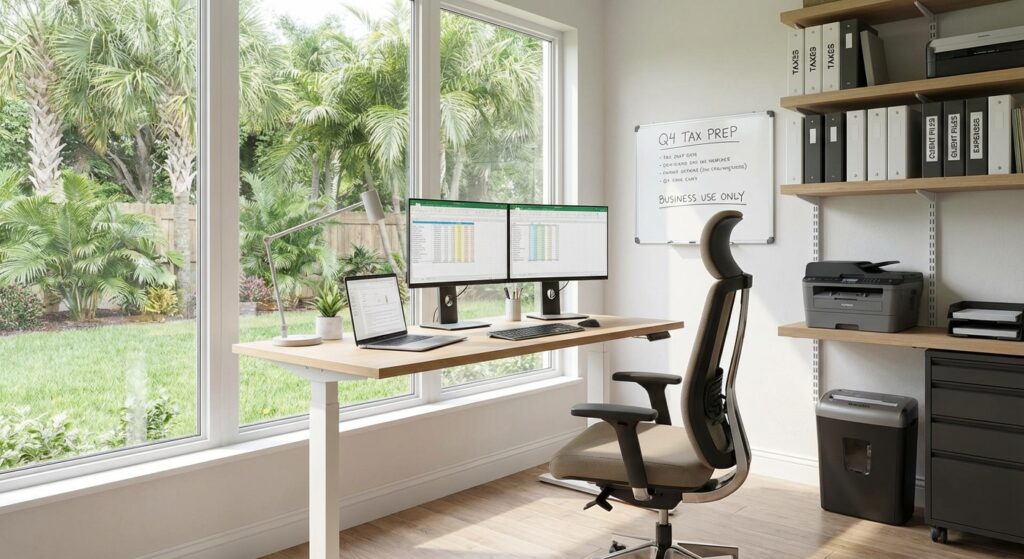
Complete Guide to Orlando Remote Worker Taxes for 2026: Maximize Your Deductions
Remote workers in Orlando face unique tax challenges in 2026. Understanding how to properly report self-employment income, claim home office deductions, and optimize your orlando remote worker taxes can save thousands of dollars annually. Florida’s advantage as a no-state-income-tax state makes strategic tax planning even more critical for independent contractors and freelancers.
Table of Contents
- Key Takeaways
- Understanding Orlando Remote Worker Taxes in 2026
- What Are Your Self-Employment Tax Obligations?
- How Can You Maximize Your Home Office Deduction?
- Which Business Expenses Are Deductible for Remote Workers?
- When Are Estimated Quarterly Taxes Due?
- What Tax Advantages Does Florida Offer Remote Workers?
- Uncle Kam in Action: Orlando Remote Worker Success
- Next Steps
- Frequently Asked Questions
Key Takeaways
- Remote workers in Orlando must file Schedule C and pay 15.3% self-employment tax on net income for 2026.
- The standard deduction for 2026 is $14,600 for single filers, but self-employed workers can claim significant additional deductions.
- Home office deductions can be claimed using either the simplified method ($5 per square foot) or actual expense method.
- Florida’s lack of state income tax provides substantial tax savings compared to most other states.
- Quarterly estimated tax payments are required if you expect to owe $1,000 or more in taxes for 2026.
Understanding Orlando Remote Worker Taxes in 2026
Quick Answer: Orlando remote workers are self-employed and must report income on Schedule C, pay 15.3% self-employment tax, and can deduct home office expenses and business-related costs to reduce taxable income for 2026.
Remote workers operating from Orlando face a distinct tax situation compared to traditional employees. Whether you’re a freelancer, contractor, or business owner working from home, your orlando remote worker taxes depend on how you structure your business and what deductions you claim. The key distinction is that you’re classified as self-employed, which comes with both challenges and opportunities under 2026 tax law.
Unlike W-2 employees, remote workers must handle their own tax withholding, estimated payments, and business expense deductions. This responsibility, while complex, allows for significant tax optimization strategies. Understanding the fundamental tax structure is your first step toward maximizing deductions and minimizing your actual tax liability.
The Self-Employment Classification and What It Means
If you’re a remote worker in Orlando receiving 1099 income, you’re classified as self-employed. This classification determines how your income is reported, taxed, and what deductions become available. Self-employment status applies whether you operate as a sole proprietor, single-member LLC taxed as a sole proprietorship, or an S corporation.
For 2026, self-employed individuals must report all business income on Schedule C (Form 1040), calculate net profit or loss, and then use that information to determine self-employment tax. This self-employment tax covers both the employer and employee portions of Social Security and Medicare taxes—a combined 15.3% rate that applies to 92.35% of your net self-employment income.
Why Remote Workers Benefit from Professional Guidance
Many Orlando remote workers underestimate the complexity of their tax situation. Without proper planning, you may miss valuable deductions or face unexpected tax bills. Professional guidance through comprehensive tax strategy helps you understand your complete picture and identify opportunities for optimization.
Pro Tip: Remote workers should track all business expenses from day one of operations. Proper documentation makes claiming deductions simpler and protects you during IRS audits.
What Are Your Self-Employment Tax Obligations?
Quick Answer: For 2026, you owe 15.3% self-employment tax on 92.35% of your net self-employment income, though you can deduct 50% of this tax from your adjusted gross income.
Self-employment tax represents one of the largest tax obligations for Orlando remote workers. Unlike traditional employees whose employers withhold Social Security and Medicare taxes, you must calculate and pay both portions yourself. Understanding this obligation is critical for proper 2026 tax planning.
The self-employment tax rate for 2026 is 15.3%, calculated on your net self-employment income. However, the actual calculation is more nuanced. You calculate self-employment tax on 92.35% of your net profit, and then you can deduct 50% of the self-employment tax you pay as an above-the-line deduction, reducing your adjusted gross income.
Calculating Self-Employment Tax for 2026
Let’s walk through a practical example. Suppose your remote work business generates $75,000 in net income for 2026 after business expenses:
- Net self-employment income: $75,000
- Multiply by 92.35%: $75,000 × 0.9235 = $69,262.50
- Multiply by 15.3%: $69,262.50 × 0.153 = $10,599.16 self-employment tax
- Deductible portion (50%): $10,599.16 × 0.50 = $5,299.58
This deduction reduces your adjusted gross income, which can have significant cascading benefits for other tax provisions. You can use our Self-Employment Tax Calculator to estimate your 2026 self-employment tax obligations based on your projected income.
The Medicare Threshold and Additional Medicare Tax
For 2026, high-income self-employed individuals may face additional Medicare tax. If your combined wage and self-employment income exceeds $200,000 (single filer), you’ll owe an extra 0.9% Medicare tax on the excess. This is a critical consideration for Orlando remote workers earning above these thresholds.
Pro Tip: Understanding your self-employment tax liability early in the year allows you to make strategic decisions about business structure or income timing that could reduce your total tax burden.
How Can You Maximize Your Home Office Deduction?
Quick Answer: For 2026, claim your home office deduction using either the simplified method ($5 per square foot) or the actual expense method, whichever provides greater tax savings.
The home office deduction is one of the most valuable deductions available to Orlando remote workers. Since your entire workspace is devoted to business operations, you’re eligible to claim a portion of your home expenses as business deductions. This includes rent or mortgage interest, utilities, insurance, and depreciation.
The IRS allows two methods for calculating the home office deduction. The simplified method is straightforward and requires minimal documentation, while the actual expense method potentially offers larger deductions but requires meticulous record-keeping. Your choice depends on your home’s size, actual expenses, and record-keeping preferences.
The Simplified Method: $5 Per Square Foot
The simplified method allows you to deduct $5 per square foot of your home office space for 2026, up to a maximum of 300 square feet ($1,500 maximum deduction). This method is ideal if you have a small, clearly defined home office and want to minimize record-keeping.
If your home office is 200 square feet, your deduction would be $1,000 for 2026 ($200 × $5). This method requires no receipts or complex calculations—simply measure your dedicated office space and apply the $5 rate. It’s particularly advantageous for remote workers who want simplicity and certainty.
The Actual Expense Method: Detailed Deductions
The actual expense method calculates your home office deduction based on your genuine home expenses. You determine what percentage of your home is used for business (using square footage), then deduct that percentage of applicable expenses. Deductible expenses include mortgage interest, property taxes, utilities, insurance, repairs, and depreciation.
For example, if your 1,500-square-foot home has a 300-square-foot office (20% of total space), you can deduct 20% of your qualifying home expenses. If your annual property tax is $4,000, mortgage interest is $8,000, utilities are $1,800, and homeowners insurance is $1,200, your deductible home office expenses would be: ($4,000 + $8,000 + $1,800 + $1,200) × 20% = $3,200 for 2026.
This method typically produces larger deductions but requires detailed documentation. Keep receipts for all home expenses and maintain records supporting your square footage calculations and business use percentage. Many Orlando remote workers benefit from professional tax advisory to optimize this calculation.
Pro Tip: Photograph your home office space and measure square footage precisely. This documentation protects you if the IRS questions your deduction claim during an audit.
Which Business Expenses Are Deductible for Remote Workers?
Quick Answer: Deductible business expenses for remote workers include office supplies, software subscriptions, professional development, health insurance, equipment, and travel—any ordinary and necessary business expense.
Beyond the home office deduction, Orlando remote workers can claim numerous business expenses that reduce taxable income. These deductions represent real cash you’ve spent on business operations, so keeping accurate records is essential for 2026 tax compliance.
Essential Deductible Expenses for Remote Workers
- Office supplies: Computer, monitor, keyboard, desk, chair, printer, paper, ink
- Software and subscriptions: Microsoft Office, Adobe Creative Cloud, Zoom, project management tools, accounting software
- Internet and phone: Business portion of residential internet and phone bills
- Professional development: Online courses, certifications, training, conference attendance
- Insurance: Business liability insurance, professional liability insurance, home office contents coverage
- Travel and meals: Client meetings, business trips (50% of meals for 2026)
- Advertising and marketing: Website hosting, domain registration, social media promotion
- Vehicles: Mileage for business trips at the IRS standard rate for 2026
The critical test for any deduction is whether the expense is “ordinary and necessary” for your business. Office supplies are clearly deductible, while personal expenses like gym memberships or personal clothing are not, even if you use them while working.
Capital Equipment and Depreciation
Larger purchases like computers, furniture, or equipment involve special depreciation rules. Items costing under $2,700 can typically be expensed immediately under Section 179, while higher-value items must be depreciated over multiple years. This distinction significantly impacts your 2026 tax liability.
Pro Tip: Create a spreadsheet tracking all business expenses throughout 2026. Organize by category (supplies, software, travel) to simplify Schedule C completion and accelerate tax preparation.
When Are Estimated Quarterly Taxes Due?
Quick Answer: If you expect to owe $1,000 or more in taxes for 2026, you must pay estimated quarterly taxes by April 15, June 15, September 15, and January 15 of the following year.
One challenge unique to self-employed Orlando remote workers is the requirement to pay estimated quarterly taxes. Unlike W-2 employees who have taxes withheld automatically, you must calculate your tax liability and make payments four times yearly. Missing these deadlines can result in penalties and interest charges.
The estimated tax requirement applies if you expect to owe $1,000 or more in federal income tax and self-employment tax combined for 2026. This threshold is relatively low, meaning most Orlando remote workers must file quarterly estimates.
Quarterly Payment Schedule for 2026
- Q1 (Jan-Mar): Due April 18, 2026
- Q2 (Apr-Jun): Due June 15, 2026
- Q3 (Jul-Sep): Due September 15, 2026
- Q4 (Oct-Dec): Due January 18, 2027
You can calculate estimated taxes using Form 1040-ES or work with a tax professional to ensure accuracy. The IRS provides worksheets to help you calculate the proper amount based on your projected 2026 income.
Calculating Safe Harbor Estimated Payments
To avoid underpayment penalties, you must pay the greater of: (1) 90% of your 2026 tax liability, or (2) 100% of your 2025 tax liability (110% if your 2025 AGI exceeded $150,000). Many Orlando remote workers use their prior year tax liability as a baseline, adjusting for significant income changes.
Pro Tip: Set aside 25-30% of your gross revenue for taxes immediately after receiving income. This buffer ensures you can comfortably make estimated payments without impacting business operations.
What Tax Advantages Does Florida Offer Remote Workers?
Quick Answer: Florida has no state income tax, providing substantial tax savings compared to other states. Remote workers pay only federal taxes on business income.
Florida’s lack of state income tax represents a significant advantage for Orlando remote workers. This absence saves 2-10% depending on your federal tax bracket, compared to remote workers in high-tax states. For someone earning $100,000 in net self-employment income, this advantage translates to thousands of dollars in annual savings.
This advantage is particularly pronounced compared to states like California (up to 13.3%), New York (up to 10.9%), or New Jersey (up to 10.75%). A remote worker based in Orlando with $75,000 in net income would save approximately $3,000-$7,500 annually compared to similar workers in high-tax states, while still obtaining the same services and infrastructure.
Florida’s Tax Environment for Remote Workers
Beyond income tax, Florida offers other business-friendly features. There’s no corporate income tax, no capital gains tax, and no inheritance tax. These provisions create an attractive environment for remote entrepreneurs and established business owners operating from Florida.
However, Florida does have sales tax (currently 6% statewide, with local additions bringing totals to 6-7.5%), property taxes, and various business-related fees. Remote workers should account for these when calculating their actual tax burden compared to other states.
Strategic Implications for Orlando Remote Workers
The state income tax advantage makes Florida particularly attractive for remote workers considering relocation. If you’re currently in a high-tax state and your clients operate nationwide, relocating to Orlando could represent a major tax optimization strategy. You can work with entity structuring specialists to ensure your business is optimally organized for Florida’s tax environment.
Pro Tip: If you’re relocating to Orlando for tax benefits, maintain documentation proving Florida residency. Keep utility bills, rental agreements, voter registration, and driver’s license records for IRS verification.

Uncle Kam in Action: How an Orlando Remote Worker Reduced Tax Liability by 28%
Sarah, a digital marketing consultant in downtown Orlando, earned $125,000 in gross revenue from remote clients in 2025. When she came to Uncle Kam, she was paying 42% in combined federal and self-employment taxes—a staggering burden that left her with only $72,500 in take-home income despite six-figure earnings.
Sarah’s primary issue was disorganization. She was tracking expenses sporadically, claiming minimal home office deduction, and not taking advantage of any retirement planning strategies. Our team performed a comprehensive audit of her business structure and tax situation for 2026 planning.
We implemented three strategic changes: First, we documented her actual home office expenses ($8,500 annually—mortgage interest, property tax, utilities, insurance calculated by percentage), creating deductions 8.5 times larger than the simplified method would allow. Second, we established a system for tracking all business expenses throughout the year, identifying $18,000 in previously unclaimed deductions (software subscriptions, professional development, client travel, marketing). Third, we established a Solo 401(k) allowing her to contribute $30,000 of her 2026 income pre-tax as owner contributions.
The 2026 results were transformative. Her effective tax rate dropped from 42% to approximately 30%. On her $125,000 income, she saved over $15,000 in federal taxes while still maintaining full business capability and growth. Additionally, she built retirement savings of $30,000 while reducing current-year taxes.
Sarah invested $2,500 in Uncle Kam’s professional tax strategy service, generating a 6x return on investment in the first year alone. More importantly, she now has systems in place for 2026 and beyond, ensuring consistent tax optimization without reactive scrambling at filing time. Learn more about similar results for remote workers by visiting our client results page.
Did You Know? The average freelancer misses $8,000-$12,000 in deductible business expenses annually. Proper documentation and strategic planning could put thousands back in your pocket for 2026.
Next Steps: Optimize Your 2026 Orlando Remote Worker Taxes
Now that you understand the fundamental structure of orlando remote worker taxes for 2026, it’s time to take action. These steps will help you implement the strategies discussed and maximize your tax efficiency:
- Organize Your 2026 Records: Create a system for tracking income (invoices, deposits) and expenses (credit card statements, receipts) immediately. Spreadsheets, bookkeeping software, or business accounting solutions all work—consistency matters most.
- Calculate Your Home Office Deduction: Measure your dedicated workspace in square feet and decide between the simplified ($5/sq ft) or actual expense method. Document everything photographically.
- Set Up Quarterly Tax Payments: Estimate your 2026 tax liability using Form 1040-ES or professional guidance. Schedule calendar reminders for quarterly payment deadlines to avoid penalties.
- Establish a Retirement Plan: Consider a Solo 401(k) or SEP-IRA to reduce taxable income while building retirement savings. These decisions impact your 2026 tax liability significantly.
- Consult a Tax Professional: Have a comprehensive strategy conversation before year-end. A CPA can identify additional opportunities specific to your situation and business structure.
Taking these actions now ensures you’re positioned for tax efficiency throughout 2026 and ready for filing in 2027. The key is proactive planning rather than reactive scrambling.
Frequently Asked Questions
Do I need to file quarterly estimated taxes if I’m a remote worker in Orlando?
Yes, if you expect to owe $1,000 or more in combined federal income and self-employment tax for 2026, you must file quarterly estimated taxes. Most remote workers earning $30,000 or more annually meet this threshold. Filing quarterly prevents underpayment penalties and spreads your tax liability across the year, improving cash flow.
Can I deduct my home internet and phone bills as a business expense?
You can deduct the business portion of your internet and phone bills. If you have a dedicated business line, 100% is deductible. For combined personal-business accounts, calculate the percentage used for business purposes. Many remote workers use 50% or 75% based on usage patterns. Documentation supporting this allocation strengthens your position if audited.
What’s the difference between Schedule C and business income reported on a 1099?
Schedule C is the form you complete to report your self-employment income and deductions to the IRS. The 1099 form is issued by clients who paid you—it’s a reporting document they send to the IRS showing what they paid you. You must report all 1099 income on Schedule C, plus any income for which you didn’t receive a 1099 (if your 1099 amount was under $600). The Schedule C is where you calculate your actual taxable business profit.
Is self-employment tax deductible?
Yes, you can deduct 50% of your self-employment tax as an above-the-line deduction on your Form 1040 for 2026. This deduction reduces your adjusted gross income, which can trigger benefits in other tax provisions. If you paid $10,000 in self-employment tax, you deduct $5,000, reducing your AGI by that amount.
Can I claim business use of my vehicle if I work from home?
Yes, you can claim vehicle expenses for business-related driving even if you work from home. This includes drives to client meetings, the bank for business deposits, supply stores for office equipment, or conferences. Commuting between your home and a regular workplace isn’t deductible, but going from home to a one-time business meeting is. Track your business miles separately and maintain contemporaneous records.
Do I need to pay sales tax on services provided to out-of-state clients?
Generally, no. Services provided to out-of-state clients typically don’t trigger Florida sales tax. However, if you’re selling tangible products or services to Florida customers, you may be required to collect sales tax. The answer depends on your specific business model and the nature of your services. Consult with a professional regarding your particular situation.
How do I handle business expenses paid through a credit card?
Business expenses are deductible when paid, not when charged (for cash-basis taxpayers, which most self-employed individuals are). If you pay a software subscription with a credit card in December 2026, that expense is deductible in 2026, even if you don’t pay the credit card bill until 2027. Keep receipts and statements showing the purchase date and amount.
Related Resources
- Complete Self-Employed Tax Strategy Guide
- IRS Schedule C Instructions and Forms
- Professional Tax Strategy Planning Services
- IRS Home Office Deduction Information
- Business Accounting and Bookkeeping Solutions
This information is current as of 2/16/2026. Tax laws change frequently. Verify updates with the IRS (IRS.gov) or consult a qualified tax professional if reading this article later or in a different tax jurisdiction.
Last updated: February, 2026

