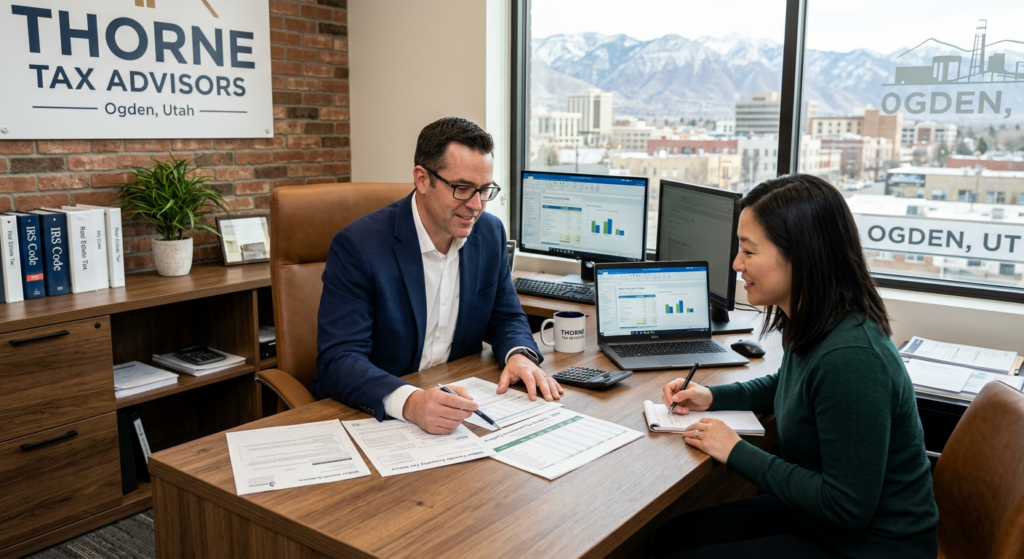
Ogden Real Estate Tax Advisor: 2026 Property Tax Strategies for Investors

Ogden Real Estate Tax Advisor: 2026 Property Tax Strategies for Investors
Ogden, Utah has emerged as a thriving real estate investment market, and working with an experienced Ogden real estate tax advisor can unlock significant tax savings opportunities for property investors. Whether you own rental properties, operate short-term rentals, or are considering your first investment property, understanding the 2026 tax landscape is critical. The One Big Beautiful Bill Act, passed in 2025, fundamentally changed how real estate investors can deduct expenses, depreciate assets, and manage capital gains. This guide reveals the latest tax strategies that Ogden-area property investors should leverage before year-end.
Table of Contents
- Key Takeaways
- How Much Can SALT Deductions Save You?
- What Are Real Estate Depreciation Benefits?
- What Property Tax Deductions Can You Claim?
- What Self-Employment Tax Benefits Can Real Estate Investors Claim?
- How Can You Reduce Capital Gains Taxes?
- Uncle Kam in Action
- Next Steps
- Frequently Asked Questions
Key Takeaways
- The 2026 SALT deduction cap is now $40,000 for married couples filing jointly (quadrupled from $10,000), benefiting Ogden real estate investors with high property tax bills.
- 100% bonus depreciation is now permanent through the OBBBA, allowing immediate deduction of full asset costs for rental property improvements.
- The 20% Qualified Business Income (QBI) deduction is permanent for 2026, reducing taxable income for real estate business owners.
- Working with an Ogden real estate tax advisor helps you avoid missing deductions worth $5,000 to $25,000+ annually per property.
- Strategic property sales can minimize capital gains taxes through depreciation recapture understanding and timing strategies.
How Much Can SALT Deductions Save You?
Quick Answer: For 2026, Ogden real estate investors can now deduct up to $40,000 in state and local property taxes if married filing jointly. This quadrupled cap could save you $5,000 to $15,000+ in federal taxes, depending on your tax bracket.
The most transformative change for 2026 is the expansion of the State and Local Tax (SALT) deduction cap. Under the One Big Beautiful Bill Act, the cap increased from $10,000 to $40,000 for married couples filing jointly (and to $20,000 for single filers). This change remains in effect through 2029. For an Ogden real estate tax advisor’s clients, this is game-changing news.
Property taxes in Weber County, where Ogden is located, can easily run $2,000 to $8,000+ annually per property, depending on assessed value. If you own multiple investment properties or a substantial primary residence, your combined property taxes likely exceed the old $10,000 cap. The new $40,000 cap means you can now deduct three to four times more, directly reducing your taxable income.
SALT Deduction Calculation Example
Let’s say you own two rental properties in Ogden with combined property taxes of $18,000 annually. Under 2025 rules, you could only deduct $10,000, leaving $8,000 undeductible. For 2026, you can deduct the full $18,000. If you’re in the 24% tax bracket, this additional $8,000 deduction saves you $1,920 in federal taxes annually. Multiply that over a 10-year ownership period, and the savings reach $19,200 before inflation adjustments.
An Ogden real estate tax advisor will also help you optimize which combination of property taxes and state income taxes to deduct, since you can choose to deduct either sales taxes or state income taxes (but not both) alongside property taxes up to the $40,000 limit.
Itemizing vs. Standard Deduction
For 2026, determine whether itemizing deductions (including SALT) or taking the standard deduction benefits you more. Higher-income property owners with substantial SALT and mortgage interest deductions will typically benefit from itemizing.
What Are Real Estate Depreciation Benefits?
Quick Answer: The 2026 100% bonus depreciation provision allows you to deduct the full cost of qualifying property improvements immediately, rather than depreciating them over 27.5 years. This accelerates tax deductions and improves cash flow significantly.
Before 2026, property improvements faced a gradual depreciation schedule. A roof replacement costing $15,000 would be deducted over decades. The OBBBA’s permanent 100% bonus depreciation changes this entirely. For Ogden real estate investors, this is a powerful tax planning tool.
Qualified property eligible for bonus depreciation includes buildings placed in service after September 27, 2017. This covers rental property improvements such as HVAC systems, flooring, appliances, and structural repairs. Consult with your Ogden real estate tax advisor to identify which improvements qualify, as personal property improvements (carpeting, fixtures) may depreciate faster than building components (roof, foundation).
Depreciation Strategy for Ogden Investors
Using bonus depreciation strategically accelerates deductions into years when you have higher income. If you closed on a rental property in late 2025 and made $30,000 in capital improvements during 2026, you could claim the full $30,000 as a deduction on your 2026 return. This reduces your 2026 taxable income significantly, lowering your tax bracket and potentially saving you thousands in federal taxes.
Building costs must be properly separated between land (non-depreciable) and improvements (depreciable). An experienced Ogden real estate tax advisor will allocate acquisition costs correctly, ensuring maximum tax benefit without audit risk.
Depreciation Recapture Planning
When you sell a rental property, depreciation deductions you claimed are recaptured at a 25% tax rate (higher than long-term capital gains rates of 0%, 15%, or 20%). Plan property sales strategically to minimize recapture taxes. Some Ogden investors benefit from holding properties longer to offset recapture with new improvements claimed in later years.
What Property Tax Deductions Can You Claim?
Quick Answer: Beyond SALT deductions, rental property owners can deduct operating expenses like maintenance, repairs, insurance, property management fees, and advertising. These business deductions reduce taxable rental income dollar-for-dollar.
An Ogden real estate tax advisor focuses on maximizing operating expense deductions that directly offset rental income. These are separate from SALT and depreciation deductions and provide immediate, dollar-for-dollar tax relief.
Deductible Operating Expenses for Rental Properties
- Mortgage interest (note: principal is not deductible)
- Property management fees and leasing commissions
- Maintenance and repairs (replacing worn components)
- Utilities (if landlord-paid)
- Homeowners insurance and liability coverage
- HOA fees and condo association dues
- Advertising for tenants (online listings, signage)
- Cleaning and yard maintenance
- Property taxes (also claimed as SALT deduction up to $40,000)
- Tax preparation fees for rental schedules
A common mistake is confusing repairs with capital improvements. Repairs (fixing existing components) are immediately deductible. Improvements (upgrading or extending asset life) must be depreciated. Your Ogden real estate tax advisor distinguishes these to maximize immediate deductions while properly capitalizing long-term improvements.
Pro Tip: Keep meticulous records of all property-related expenses. The IRS scrutinizes rental property deductions frequently. Documentation separating repairs from improvements protects your deductions during audits.
Home Office Deduction for Real Estate Professionals
If you actively manage rental properties from a home office in Ogden, you may deduct a portion of rent, utilities, and equipment. The simplified method allows $5 per square foot (up to 300 square feet). An Ogden real estate tax advisor determines whether your office qualifies for this valuable deduction.
 Free Tax Write-Off Finder
What Self-Employment Tax Benefits Can Real Estate Investors Claim?
Quick Answer: The 20% Qualified Business Income (QBI) deduction for 2026 allows real estate investors to exclude up to 20% of qualifying rental income from taxation. This could save $2,000 to $10,000+ annually depending on rental income levels.
Real estate professionals in Ogden benefit from the 20% QBI deduction, which is now permanent through the OBBBA. This deduction applies to qualified real estate rental income, potentially reducing your taxable income by 20% of your net rental profits.
For example, if your rental properties generate $50,000 in net income after expenses and depreciation, the QBI deduction allows you to exclude $10,000 from taxation. In the 24% federal tax bracket, this saves $2,400 in federal taxes annually. Multiply this across multiple properties, and savings escalate rapidly.
The QBI deduction phases out for higher-income taxpayers ($182,100 for single filers, $364,200 for married couples filing jointly in 2026). An Ogden real estate tax advisor monitors your income to optimize deduction timing and entity structure for maximum benefit.
Self-Employment Tax on Real Estate Income
Rental income from passive real estate is generally exempt from self-employment tax (the 15.3% SE tax on net profits). However, if you’re considered a real estate professional (spending 750+ hours annually on real estate activities), income may be subject to different treatment. Additionally, if you operate your rental business as a sole proprietor or partnership, consider forming an LLC or S-Corporation structure to optimize self-employment tax liability.
Our Self-Employment Tax Calculator for Nashville helps estimate potential SE tax savings when restructuring your real estate business, though Ogden-specific calculations will vary based on your income and property portfolio.
How Can You Reduce Capital Gains Taxes?
Quick Answer: Strategic timing of property sales, proper depreciation tracking, and understanding capital gains rates (0%, 15%, or 20% for long-term gains) allows Ogden investors to minimize taxes when selling appreciated properties.
When you sell a rental property at a profit, you face capital gains tax. Long-term capital gains (held over one year) receive preferential rates: 0% for lower-income filers, 15% for most middle-income, and 20% for high earners. Additionally, a 3.8% net investment income tax applies to higher-income individuals on investment gains.
An Ogden real estate tax advisor helps you coordinate property sales with income levels. If you have a low-income year, selling properties when capital gains rates are 0% or 15% (rather than 20%) saves significant taxes.
Depreciation Recapture and Sale Planning
Depreciation deductions claimed during ownership are recaptured at 25% tax rates when you sell. If you claimed $50,000 in depreciation over 20 years of ownership, you’ll owe 25% tax ($12,500) on that depreciation upon sale. However, this is separate from capital gains tax on appreciation. Understanding both components allows your Ogden real estate tax advisor to structure sales optimally.
Some investors benefit from installment sales, where you spread gain recognition across multiple years, keeping yourself in lower tax brackets. Others use 1031 exchanges to defer capital gains entirely by reinvesting proceeds into like-kind replacement properties.
Primary Residence Exemption Strategy
Your primary residence exempts up to $250,000 of capital gains (single) or $500,000 (married) from taxation if owned and used as primary residence for 2 of the last 5 years. Some Ogden investors strategically convert investment properties to primary residences before sale to capture this exemption. However, depreciation recapture still applies. Consult your Ogden real estate tax advisor before making this move.

Uncle Kam in Action: How Sarah Doubled Her Real Estate Tax Savings
Sarah, an Ogden-based real estate investor, owned three rental properties generating $120,000 in combined annual rental income. She had worked with a general tax preparer for years but never optimized her real estate tax strategy. Her property tax bills totaled $22,000 annually, and she made $40,000 in capital improvements annually but didn’t track them separately from repairs.
When Sarah consulted with an experienced Ogden real estate tax advisor at Uncle Kam, the advisor immediately identified three major opportunities: First, Sarah was only deducting $10,000 in SALT deductions (the old cap), missing $12,000 in deductible property taxes annually. Second, her capital improvements were being lumped together with repairs, preventing her from claiming full depreciation benefits. Third, she wasn’t claiming the 20% QBI deduction available to real estate business owners.
The advisor restructured Sarah’s 2026 tax approach. By claiming the new $40,000 SALT cap, she deducted all property taxes. By separating repairs ($8,000) from improvements ($40,000), she claimed full depreciation on the improvements. And by qualifying for the QBI deduction, she excluded an additional $24,000 from taxation ($120,000 net income × 20% = $24,000).
Total tax savings for 2026: approximately $12,500. This included $2,880 from the expanded SALT deduction (12,000 × 24% bracket), $2,400 from the QBI deduction (10,000 potential deduction equivalent), and additional depreciation deduction timing benefits. Sarah’s investment in professional Ogden real estate tax advisor services paid for itself many times over. She now plans property acquisitions and sales strategically with her advisor’s guidance, protecting her wealth from unnecessary taxation.
Sarah’s ROI on tax advisory services: She paid $2,500 for comprehensive tax planning and preparation. Her tax savings: $12,500+. Return on Investment: 400%+. See more client results from Uncle Kam’s real estate tax advisory practice.
Next Steps
Real estate tax planning is not a one-time event. The 2026 tax landscape offers unprecedented opportunities for Ogden investors to reduce taxes legally and strategically. Here’s how to move forward:
- Schedule a comprehensive real estate tax strategy consultation with an Ogden real estate tax advisor to evaluate your specific portfolio and opportunities.
- Document all property expenses, repairs, and improvements for 2026 to maximize deduction claims on your tax return.
- Review your entity structure with a tax professional to determine if LLC, S-Corporation, or other structures reduce your tax liability.
- Plan property sales strategically using depreciation recapture and capital gains rate analysis to minimize tax impact.
- Establish monthly or quarterly tax planning reviews to stay ahead of changing IRS regulations and optimize your year-end position.
Frequently Asked Questions
What is the 2026 SALT deduction limit for Ogden real estate investors?
For 2026, the SALT deduction cap is $40,000 for married couples filing jointly and $20,000 for single filers. This applies to state and local property taxes, income taxes, and sales taxes (not all three, but a combination totaling up to the limit). This represents a significant increase from the previous $10,000 cap and remains in effect through 2029.
Can I claim 100% depreciation on my rental property improvements in 2026?
Yes, through the permanent 100% bonus depreciation provision in the OBBBA, you can immediately deduct the full cost of qualifying property improvements placed in service in 2026. However, the improvements must be tangible property (HVAC, flooring, appliances, roofing) and not land. Buildings themselves depreciate over 27.5 years but can benefit from bonus depreciation for components. Consult your Ogden real estate tax advisor to determine which improvements qualify.
Do I qualify for the 20% QBI deduction on my rental income?
If you have taxable income from rental real estate, you may qualify for the 20% Qualified Business Income deduction. This deduction allows you to exclude up to 20% of qualifying rental income from taxation. However, the deduction phases out for higher-income taxpayers ($182,100 single, $364,200 MFJ in 2026). Additionally, certain real estate professionals have special rules. An Ogden real estate tax advisor can confirm your eligibility.
What is depreciation recapture, and how does it affect my property sale?
Depreciation recapture is a tax rule that requires you to pay taxes at 25% rates on depreciation deductions you’ve claimed during ownership when you sell the property. For example, if you claimed $50,000 in depreciation over your holding period and sell for a $100,000 gain, you owe 25% tax on $50,000 (the depreciation) plus capital gains tax on $50,000 (the appreciation). Understanding this helps plan sales strategically with your Ogden real estate tax advisor.
Are rental property management fees tax-deductible?
Yes, if you hire a property management company to manage your Ogden rental properties, those fees are fully tax-deductible as business expenses. They reduce your net rental income dollar-for-dollar. However, if you self-manage, you cannot claim these as deductions. Property management fees are typically 8-12% of monthly rent, making them significant deductions on multi-property portfolios.
Can I use a 1031 exchange to defer capital gains taxes when selling my Ogden rental property?
Yes, a 1031 exchange (named after IRC Section 1031) allows you to defer capital gains taxes entirely by selling a property and reinvesting proceeds into a like-kind replacement property. You have 45 days to identify replacement properties and 180 days to close. If structured correctly with a qualified intermediary, you can indefinitely defer taxes by reinvesting repeatedly. An Ogden real estate tax advisor can coordinate 1031 exchanges strategically with your long-term investment plan.
Related Resources
- 2026 Real Estate Tax Strategy Guide
- Tax Planning for Real Estate Investors
- Entity Structure Optimization for Real Estate
- Ongoing Tax Advisory Services
- 2026 Tax Deadline Calendar
Last updated: March, 2026

