
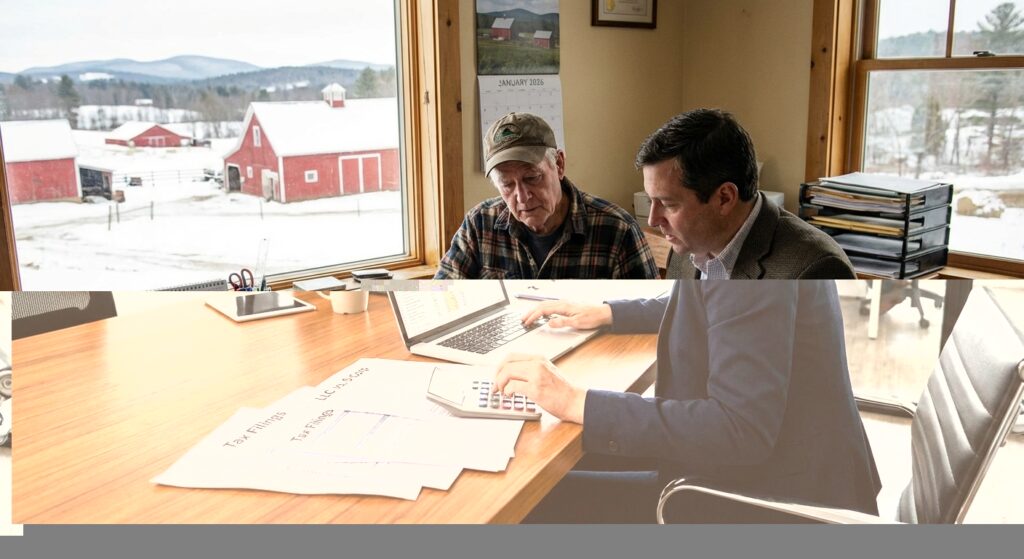
New Hampshire Installment Sale Real Estate: Master the 2026 Capital Gains Tax Advantage
For the 2026 tax year, New Hampshire property owners and real estate investors now have unprecedented control over their capital gains tax liability. The One Big Beautiful Bill Act (OBBBA) introduced a game-changing provision allowing qualified farmers and real estate professionals to spread capital gains tax on eligible farmland sales over four equal installments. This approach, available beginning January 1, 2026, transforms how savvy investors manage liquidity and cash flow when selling valuable real estate. If you own farmland or qualified property in New Hampshire, understanding this new installment sale strategy could save you tens of thousands in the first year alone.
Table of Contents
- Key Takeaways
- What Is the OBBBA Installment Sale Rule for New Hampshire Real Estate?
- Who Qualifies for the New Hampshire Installment Sale Tax Treatment?
- How Does the Installment Election Work in Practical Terms?
- How Are Capital Gains Calculated Under the 2026 Rule?
- Step-by-Step: Claiming Your Installment Sale Election
- Uncle Kam in Action
- Next Steps
- Frequently Asked Questions
- Related Resources
Key Takeaways
- For 2026, the OBBBA allows qualified farmers to spread capital gains tax on farmland sales over four equal annual installments, easing immediate tax burden.
- The election applies to New Hampshire farmland sales beginning January 1, 2026, with the first installment due by April 15, 2027.
- Qualified farmland must have been actively farmed for at least 10 years prior to sale, and the buyer must covenant to farm for 10 years post-sale.
- Federal capital gains rates remain 0%, 15%, or 20% for long-term gains, applied to the full gain amount in the year of sale.
- New Hampshire imposes no state capital gains tax, making this federal election particularly valuable for NH property owners.
What Is the OBBBA Installment Sale Rule for New Hampshire Real Estate?
Quick Answer: The One Big Beautiful Bill Act allows qualified farmers to elect to pay capital gains tax on farmland sales in four equal annual payments starting with the year of sale, improving cash flow without reducing total tax owed.
The OBBBA, signed into law on July 4, 2025, fundamentally changed how property owners manage capital gains on qualified real estate transactions. For New Hampshire real estate investors and farmers, this new provision represents a significant planning opportunity. Beginning with sales that occur on or after January 1, 2026, qualified property owners can now elect to spread their capital gains tax liability over four consecutive tax years rather than paying the entire amount in the year the property sells.
This is critically important to understand: the election does not reduce the total amount of tax owed on the gain. Rather, it spreads the tax payment over four years, dividing the total capital gains tax bill into equal quarterly installments. For example, if a New Hampshire farmer has a $200,000 capital gain taxed at the 15% long-term rate, the total tax due is $30,000. Instead of paying all $30,000 in the year of sale, the farmer pays $7,500 annually for four years, with the first payment due April 15, 2027 (with the 2026 tax return).
Key Difference: Tax Payment Spread vs. Tax Reduction
One of the most misunderstood aspects of this provision is that it spreads tax payments, not the tax calculation itself. The IRS determines the total taxable gain in the year of sale, calculates the applicable long-term capital gains tax rate (0%, 15%, or 20% for 2026), and multiplies to arrive at the total tax owed. Only the payment schedule—not the underlying tax liability—is divided into four equal parts. New Hampshire property owners benefit from improved cash flow and business flexibility, not from a reduced tax bill.
Federal Focus: No New Hampshire State Capital Gains Tax
New Hampshire does not impose a state capital gains tax on the sale of real property, giving property owners a significant advantage. This means the entire benefit of the OBBBA installment election flows directly to reducing federal tax burden. Real estate investors in neighboring states may not enjoy the same advantage if their state imposes its own capital gains tax or decouples from federal law.
Pro Tip: Verify your specific property qualifies as “farmland” under current IRS guidance. The definition requires the land be used for farming purposes (crop production or livestock raising) and have been actively farmed substantially all of the 10 years prior to sale. Discuss qualifying property categories with your CPA early in the planning process.
Who Qualifies for the New Hampshire Installment Sale Tax Treatment?
Quick Answer: The OBBBA installment election applies only to qualified farmers selling farmland that has been actively farmed for at least 10 prior years, where the buyer agrees to continue farming the property for 10 years following the sale.
Eligibility for the 2026 installment sale election is strict and requires meeting several specific criteria. The IRS does not provide broad flexibility, and taxpayers must document their compliance with each requirement.
Requirements for Seller Qualification
- You must be selling qualified farmland located in the United States.
- You must have personally owned or operated the farmland for farming purposes (or leased it to a qualifying tenant who farmed it).
- The land must have been farmed substantially all of the 10-year period immediately preceding the sale.
- The sale must occur in a tax year beginning on or after January 1, 2026.
- You must affirmatively elect the installment method on your tax return for the year of sale.
Buyer Covenant: A Critical Requirement
Perhaps the most important requirement—and one often overlooked—is the buyer’s covenant. For you to elect the installment payment method, the buyer must agree in writing (either through a formal covenant, a legally enforceable contract provision, or another binding agreement) that the purchased farmland will be used in a farming operation for at least 10 years after the sale. This covenant must be attached to both the seller’s and buyer’s tax returns for the year of sale.
The covenant requirement exists to ensure the farmland remains in agricultural production and the federal tax benefit serves its policy purpose. New Hampshire real estate investors purchasing farmland for development or non-agricultural use would not satisfy this requirement, making the installment election unavailable.
| Qualification Element | Requirement for 2026 Sales |
|---|---|
| Property Type | Qualified farmland located in the US (crop or livestock land) |
| Prior Use Period | Actively farmed substantially all of 10 years before sale |
| Sale Date | Must occur on or after January 1, 2026 |
| Buyer Covenant | Buyer agrees in writing to farm for 10 years post-sale |
| Election Method | Must elect on tax return for year of sale; covenant attached |
How Does the Installment Election Work in Practical Terms?
Quick Answer: You elect the installment method on your 2026 tax return, the IRS calculates total capital gains tax owed, you divide that amount by four, and you pay one quarter with each tax return for four consecutive years.
The mechanics of the installment election, while straightforward in concept, require careful attention to IRS procedures and deadlines. Understanding the workflow helps you plan for cash flow and ensures you avoid costly compliance errors.
Timeline and Payment Schedule for 2026 Sales
For a qualified farmland sale that closes in 2026 (any date between January 1 and December 31, 2026), the payment timeline works as follows:
- Year 1 (2026 Sale): Property sells in 2026. You file your 2026 tax return by April 15, 2027. You make the first installment payment (25% of total tax) with that return.
- Year 2 (2027): You file your 2027 tax return by April 15, 2028. You make the second installment payment (25% of total tax) with that return.
- Year 3 (2028): You file your 2028 tax return by April 15, 2029. You make the third installment payment (25% of total tax) with that return.
- Year 4 (2029): You file your 2029 tax return by April 15, 2030. You make the final installment payment (25% of total tax) with that return.
This four-year spread fundamentally changes cash flow for New Hampshire real estate investors. Instead of depleting operating capital in the year of sale, you retain liquidity to reinvest, pay down debt, or fund business expansion over four years.
Real-World Example of the Installment Calculation
Consider a practical scenario involving a New Hampshire farmer: Sarah Seller purchased 160 acres of farmland in 2015 for $100,000 (basis). In September 2026, she sells the property to Ben Buyer for $300,000. Ben signs a covenant agreeing to farm the land for 10 years. Sarah has met all qualification requirements.
Calculation of capital gain: $300,000 (sale price) minus $100,000 (basis) = $200,000 long-term capital gain. Applied at the 2026 federal long-term capital gains rate of 15%, Sarah’s total tax liability is $200,000 × 15% = $30,000.
Sarah elects the installment method and divides the tax: $30,000 ÷ 4 = $7,500 annual installment. She pays $7,500 with her 2026 return (filed April 15, 2027), $7,500 with her 2027 return, $7,500 with her 2028 return, and $7,500 with her 2029 return. The total tax never changes—only the timing of payment.
Did You Know? Qualified business owners structuring their real estate holdings may benefit from consulting with a business strategist. Our LLC vs S-Corp Tax Calculator for Tacoma helps you explore whether your holding structure optimizes the installment sale benefit.
How Are Capital Gains Calculated Under the 2026 Rule?
Quick Answer: Capital gain equals sale price minus adjusted basis. For 2026, long-term gains are taxed at 0%, 15%, or 20% depending on your income bracket and filing status.
The capital gains calculation itself follows standard federal tax law and is not changed by the 2026 installment provision. However, understanding how your specific gain is calculated is essential for planning.
Determining Your Adjusted Basis
Adjusted basis is your starting point and typically equals your original purchase price plus documented capital improvements, minus any depreciation claimed. For farmland held for many years, basis calculations can become complex. For 2026 sales, you should work with a tax professional to document all basis elements: original purchase price, settlement costs, previous improvements, and any prior depreciation or casualty losses. Having accurate basis documentation prevents audit risk and ensures your installment calculation is correct from the start.
Long-Term vs. Short-Term Capital Gains in 2026
The 2026 installment election applies only to long-term capital gains (property held more than one year). Long-term gains qualify for preferential tax rates of 0%, 15%, or 20%, depending on your total taxable income and filing status. Short-term gains (property held one year or less) are taxed at ordinary income rates and do not qualify for the installment election under the 2026 OBBBA provision.
Most qualified farmland held by farmers for many years will be long-term property, so the preferential rates apply. However, if you purchased farmland less than 12 months before selling in 2026, the installment election does not apply.
2026 Long-Term Capital Gains Rate Schedule
| 2026 Tax Bracket / Income Level | Long-Term Capital Gains Rate |
|---|---|
| 10% and 12% ordinary income brackets | 0% (no federal tax on gain) |
| 22%, 24%, 32%, and 35% ordinary income brackets | 15% (on the capital gain amount) |
| 37% ordinary income bracket | 20% (on the capital gain amount) |
Step-by-Step: Claiming Your Installment Sale Election
Quick Answer: File Form 8949 reporting the full capital gain in the year of sale, note the installment election, attach the buyer’s covenant, and pay only one quarter of the tax with your 2026 return.
To properly claim the installment election, follow these documented steps. Missing any step can result in forfeiting the benefit and owing full tax in the year of sale.
Step 1: Secure the Buyer Covenant
Before closing, work with your real estate attorney and the buyer to draft a legally binding covenant stating the buyer will farm the property for 10 years post-closing. This covenant must be included in the purchase agreement or attached as an exhibit. Both you (the seller) and the buyer must sign it. Obtain a copy for your tax file immediately after closing.
Step 2: Prepare Form 8949 for the Year of Sale
Form 8949 (Sales of Capital Assets) is where you report the farmland sale. On this form, you report the property description, date acquired, date sold, proceeds (sale price), cost or other basis, and gain or loss. Importantly, you must document that this is a long-term capital asset sale qualifying for the installment election. Attach a note or statement to the form clearly indicating your election to spread the tax payment under the 2026 OBBBA provision.
Step 3: Attach the Buyer Covenant to Your Return
The IRS requires that both the seller and buyer attach a copy of the covenant to their respective tax returns for the year of sale. For your 2026 return (filed April 15, 2027), physically attach or file a copy of the signed covenant as an exhibit. This documentation proves the buyer committed to farming the property for 10 years and establishes your eligibility for the installment election.
Step 4: Calculate Your Installment Payments
Once Form 8949 is complete and the full capital gain is calculated, apply the appropriate long-term capital gains rate for 2026 (0%, 15%, or 20% based on your tax bracket). Multiply the total gain by the applicable rate to determine total tax owed. Divide that total by four to calculate your annual installment amount. Ensure your CPA or tax software correctly calculates this to avoid payment errors.
Step 5: Pay Only One Quarter with Your 2026 Return
When you file your 2026 tax return on April 15, 2027, pay only 25% of the total capital gains tax with that return. This is the first of four equal installments. Make a note in your records of the payment date and amount, and retain this documentation for the IRS.

Uncle Kam in Action: How a New Hampshire Farmer Saved $22,500 in Year One
Meet David Mitchell, a fourth-generation New Hampshire farmer operating 280 acres of cultivated cropland and pasture in Cheshire County. At age 62, David decided to retire and downsize his operation. He sold 160 acres of his highest-value cropland to a younger neighboring farmer, Jake Thompson, for $375,000. David’s original cost basis from his 1998 purchase was $80,000, giving him a $295,000 long-term capital gain.
Without the 2026 OBBBA installment election, David would have faced a federal capital gains tax bill of $295,000 × 15% = $44,250 due April 15, 2027. This would have substantially depleted his retirement savings needed for home improvements and healthcare planning.
Working with Uncle Kam, David and Jake structured the transaction to comply with the installment election requirements. Jake signed a legally binding farming covenant, agreeing to cultivate the 160 acres for at least 10 years. David reported the full $44,250 tax liability on Form 8949 with his 2026 tax return, but elected the installment method. This reduced his first-year tax payment to $11,062.50 (one quarter of the total). The remaining $33,187.50 was split into three equal annual payments of $11,062.50 in 2027, 2028, and 2029.
The financial impact was transformative. David improved his farmhouse, funded a grandson’s college education, and paid down farm equipment debt—all from the $33,187.50 he retained by not paying the full tax in year one. His total tax remained $44,250, but the four-year spread gave him breathing room during his retirement transition. Jake benefited too, avoiding the upfront cash required to compensate David for the tax burden, making the deal more affordable for the next-generation farmer.
This scenario demonstrates how real estate investors can strategically use the 2026 installment election to optimize both cash flow and retirement planning. The election doesn’t reduce taxes—it aligns tax payments with operational cash flow, a powerful tool for succession planning and farm transitions across New Hampshire and beyond.
Next Steps
If you own qualified farmland in New Hampshire or are considering a sale in 2026, take these actions now:
- Schedule a consultation with a tax professional to determine if your property qualifies for the installment election.
- Gather documentation of your adjusted basis, purchase records, and improvement receipts from the past 10 years.
- If negotiating a 2026 sale, ensure the purchase agreement includes language about the buyer’s 10-year farming covenant.
- Review your overall tax strategy at our tax strategy services to integrate the installment election with retirement and estate planning.
- File your 2026 return with the covenant attached and the installment election properly documented by the April 2027 deadline.
Frequently Asked Questions
Does this apply to all real estate sales in New Hampshire?
No. The 2026 OBBBA installment election applies only to qualified farmland sales where the buyer covenants to continue farming. It does not apply to residential properties, commercial real estate, or any land not used for active farming operations. Additionally, the farmland must have been substantially farmed for all of the 10 years prior to sale.
What happens if the buyer refuses to sign the farming covenant?
If the buyer will not commit to a 10-year farming covenant, the installment election is not available. You would owe the full capital gains tax in the year of sale. This covenant is non-negotiable for the election to apply. Discuss this requirement early with potential buyers to avoid complications at closing.
Can I sell the property after 2026 and still use the installment election?
Yes. The rule applies to sales occurring in tax years beginning January 1, 2026, or later. A sale closing in December 2026 qualifies. A sale closing in January 2027, 2028, or beyond also qualifies. However, the sale must meet all other qualification requirements, including the 10-year prior farming history and buyer covenant.
What if I have a huge capital gain—will the installment election still help?
Yes. The election divides tax payments regardless of gain size. A $500,000 gain creating $75,000 in tax gets divided into $18,750 annual payments. A $1,000,000 gain creating $150,000 in tax gets divided into $37,500 annual payments. The larger your gain, the more significant the cash flow benefit of the four-year spread. Consult with a tax strategist to ensure your installment plan aligns with your overall financial goals.
Are there any interest charges or penalties on installment payments?
No interest charges or penalties are assessed for using the installment election method. You are simply spreading the payment of taxes already due. Each installment is due with your annual tax return for that year. Make the payment on time to avoid late-payment penalties.
What if the buyer stops farming the property after five years?
The covenant is a binding agreement between you and the buyer. If the buyer violates the covenant by discontinuing farming operations before the 10-year term, you may have legal remedies under contract law (including potential damages), but the IRS does not rescind the installment election. Your tax payment schedule remains unchanged. However, consult with a real estate attorney to understand your enforcement options if a covenant is violated.
Can I amend a prior-year return to claim the installment election if I missed it?
The election must be made on the original tax return for the year of sale. If you did not elect it originally, you may be able to file an amended return (Form 1040-X) within three years of the original filing date to claim it retroactively. However, this situation is complex and requires immediate professional assistance. Do not delay—contact a tax professional if you sold qualified farmland in 2026 and did not claim the installment election.
Is New Hampshire’s lack of capital gains tax a permanent advantage?
Currently, New Hampshire has no capital gains tax on real property sales. However, tax laws can change through legislative action. Some states have proposed capital gains taxes in recent years. While no such proposal exists in New Hampshire at this writing, tax laws are subject to change. This article reflects the law current as of February 2026. Always verify the current tax law with a professional before finalizing major real estate transactions.
Related Resources
- Real Estate Investor Tax Strategies
- Comprehensive Tax Strategy Services
- Business Entity Structuring
- Farm Progress: OBBBA Farmland Rule Details
- Uncle Kam Client Success Stories
Last updated: February, 2026
Compliance Disclaimer: This information is current as of February 9, 2026. Tax laws change frequently. Verify updates with the IRS or a qualified tax professional if reading this after 2026. This article does not constitute tax advice and should not be relied upon as such. Consult a qualified tax professional regarding your specific situation.

