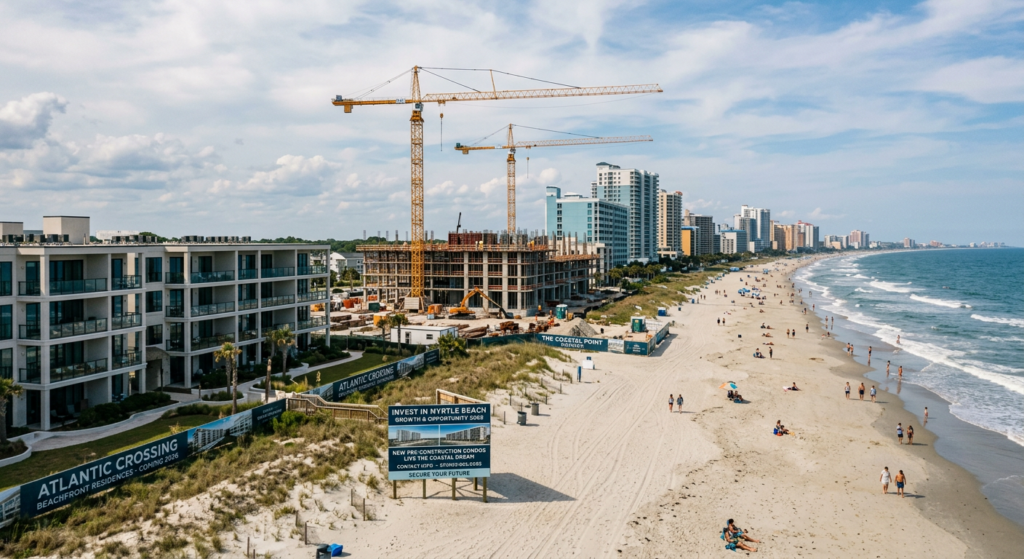
Myrtle Beach Opportunity Zone Investment Guide for 2026: Tax Benefits & Emerging Opportunities
For the 2026 tax year, savvy real estate investors and business owners are discovering exceptional value in Myrtle Beach Opportunity Zone investments, where federal tax incentives align with strong regional growth fundamentals. Opportunity Zones are economically distressed communities designated by the IRS where investors can defer capital gains taxes by deploying proceeds into qualified opportunity funds (QOFs). Myrtle Beach’s coastal market combines tourism strength, workforce housing demand, and tax-advantaged structures, making it increasingly attractive for strategic capital deployment. This comprehensive guide explains 2026 opportunity zone tax benefits, qualified opportunity fund mechanics, and practical investment strategies for maximizing after-tax returns.
Table of Contents
- Key Takeaways
- What Are Opportunity Zones and How Do They Work?
- Why Is Myrtle Beach an Attractive Opportunity Zone Market for 2026?
- What Are the Capital Gains Tax Benefits for 2026 Myrtle Beach Opportunity Zone Investments?
- How Do Opportunity Zone Tax Benefits Work for 2026 Investments?
- What Are the Qualified Opportunity Fund Requirements and Mechanics?
- What Types of Investment Projects Are Available in Myrtle Beach’s Opportunity Zone?
- Uncle Kam in Action
- Next Steps
- Frequently Asked Questions
Key Takeaways
- Opportunity Zone investments allow deferral of capital gains tax until December 31, 2026, for gains realized before that deadline.
- Holding OZ investments for 10 years generates 100% tax-free appreciation on gains earned after your initial investment.
- Myrtle Beach’s coastal location and workforce housing demand create strong fundamentals for qualified opportunity fund projects.
- The One Big Beautiful Act (2026) permanently extends 100% bonus depreciation and the 20% QBI deduction for business owners.
- Real estate investors in South Carolina can benefit from expanded SALT deductions up to $40,000 for married couples filing jointly.
What Are Opportunity Zones and How Do They Work?
Quick Answer: Opportunity Zones (OZs) are economically distressed communities where investors can deploy capital gains and receive substantial federal tax benefits. Investors who place capital gains into a qualified opportunity fund can defer taxation until 2026, claim a 10% or 15% step-up in basis, and ultimately achieve 100% tax-free appreciation if they hold for 10 years.
Opportunity Zones represent a powerful tax policy tool created under the Tax Cuts and Jobs Act of 2017 to encourage investment in economically distressed communities. The program allows investors with capital gains to deploy that money into businesses or real estate projects located within designated OZ census tracts, triggering significant federal income tax benefits. For the 2026 tax year, these incentives remain unchanged and represent a critical planning opportunity for investors managing large realized gains.
The fundamental mechanism works as follows: when you realize a capital gain (by selling appreciated stock, real estate, or a business), you normally owe federal income tax immediately on that gain. The federal long-term capital gains tax rate for 2026 ranges from 0% to 20% depending on your income level. However, if you invest that capital gain into a qualified opportunity fund within 180 days, you can defer the tax liability until December 31, 2026, or until the OZ fund interest is sold or exchanges, whichever is earlier.
The Three Tax Benefits of Opportunity Zone Investing
Opportunity Zone investments provide three distinct tax advantages that compound over time. First, the temporary deferral of capital gains tax means you delay paying federal income tax until December 31, 2026 (or when you exit the fund). This allows your capital to work without immediate tax drag. Second, for investments held longer than five years, investors receive a 10% step-up in basis; for investments held longer than seven years, the step-up increases to 15%. This step-up permanently reduces the amount of gain subject to tax. Third, and most powerful, if you hold your qualified opportunity zone investment for the full 10-year period, all appreciation gained after your initial investment date becomes completely tax-free to the federal government.
Consider a concrete example: if you realize $500,000 in capital gains in 2024, invest that into a Myrtle Beach OZ qualified opportunity fund, hold for 10 years, and that investment grows to $1,000,000, you defer the tax on the original $500,000 gain until 2026. When you reach the 10-year mark in 2034, the $500,000 in appreciation (the difference between $1,000,000 and $500,000) is completely tax-free. Only the original deferred gain remains taxable.
Pro Tip: For 2026, the December 31 deadline for capital gains deferral is critical. Any gains realized before December 31, 2026 can still be invested in OZs and defer tax. Plan your gain realization strategy carefully with your tax advisor to maximize deferral opportunities.
Why Is Myrtle Beach an Attractive Opportunity Zone Market for 2026?
Quick Answer: Myrtle Beach combines strong tourism fundamentals, chronic workforce housing shortages, public-private partnership momentum, and strategic location advantages. The South Carolina coastal market is experiencing significant development activity, particularly in affordable and workforce housing projects that qualify for opportunity zone tax benefits.
Myrtle Beach represents an exceptional opportunity zone market for 2026 real estate investors for several interconnected reasons. First, the region’s tourism economy provides consistent demand for hospitality, retail, and service-sector businesses. Myrtle Beach attracts millions of annual visitors seeking beach vacations, golf experiences, and family entertainment. This sustained visitor demand creates revenue stability for qualified opportunity fund projects focused on hospitality, short-term rental properties, and tourism-adjacent real estate.
Second, Myrtle Beach faces a significant workforce housing shortage. Local workers earning 60% to 150% of the area median income struggle to find affordable housing, limiting business growth and employee retention. Recent data shows public-private partnerships breaking ground on workforce housing developments in nearby Hilton Head Island, signaling growing institutional focus on this asset class. For opportunity zone investors, workforce housing projects offer attractive risk-adjusted returns combined with strong local political support and potential grant funding.
Third, South Carolina’s tax environment is favorable compared to neighboring states. The state offers no additional local income tax on top of federal rates, and recent legislation has expanded the SALT deduction to $40,000 for married couples through 2029. Combined with federal Opportunity Zone benefits, this creates powerful tax stacking opportunities for investors.
Regional Growth Factors Supporting Myrtle Beach OZ Investment
- Tourism demand: 14+ million annual visitors sustaining hospitality revenue
- Workforce shortage: Critical gap between supply and demand for workforce housing
- Infrastructure investment: Public sector modernizing airport, roads, and convention facilities
- Development pipeline: Multiple projects in planning and construction phases through 2027
- Regulatory support: Local government incentivizing workforce housing through zoning and grants
What Are the Capital Gains Tax Benefits for 2026 Myrtle Beach Opportunity Zone Investments?
Quick Answer: Federal capital gains rates for 2026 remain at 0%, 15%, or 20%. Myrtle Beach Opportunity Zone investments defer these taxes until 2026, provide 10-15% permanent step-ups in basis after 5-7 years, and eliminate all taxes on appreciation if held for 10 years, resulting in effective tax rates of 0% to 20% on post-investment gains.
For the 2026 tax year, federal capital gains tax rates remain stable at the three-tier structure established under prior law. Long-term capital gains (assets held over one year) are taxed at 0%, 15%, or 20%, depending on your total taxable income. Additionally, high-income earners (above $250,000 for singles, $500,000 for married couples) may face an additional 3.8% net investment income tax, bringing maximum federal rates to 23.8%.
When you invest capital gains into a Myrtle Beach qualified opportunity fund, you transform this tax treatment dramatically. The tax deferral strategy works particularly well for business owners or investors who realize large one-time gains (selling a business, real estate portfolio, or appreciated securities) and want to redeploy that capital strategically while minimizing immediate tax consequences.
Quantifying the Tax Savings: A 2026 Example
Let’s model a realistic 2026 scenario for a married couple filing jointly with $800,000 in capital gains from selling a business. Their combined taxable income places them in the 20% federal capital gains bracket, plus 3.8% net investment income tax, totaling 23.8% federal tax ($190,400). Additionally, they owe South Carolina state capital gains tax at approximately 5.75% ($46,000). Without opportunity zone strategy, their combined federal and state tax is $236,400, leaving $563,600 to reinvest.
By investing into a Myrtle Beach qualified opportunity fund, they defer the entire $236,400 tax liability until 2026 or fund exit. This allows them to immediately deploy the full $800,000 into real estate projects. If that investment grows at 8% annually for 10 years (conservative for coastal real estate), it reaches $1,728,000. The appreciation of $928,000 is completely tax-free under the 10-year holding rule, saving approximately $221,064 in taxes on that appreciation alone. By strategically managing the deferral and 10-year holding period, they achieve far superior after-tax returns than immediate taxation.
Did You Know? The 2026 deadline for capital gains deferral has created a strategic window. Any gains realized before December 31, 2026 can lock in deferral, but gains realized after that date follow 2027 rules. This timing creates urgency for investors planning major liquidations or realizations.
 Free Tax Write-Off Finder
How Do Opportunity Zone Tax Benefits Work for 2026 Investments?
Quick Answer: Opportunity zone tax benefits work through three sequential stages: gain deferral (recognizing tax in 2026), basis step-ups (after 5-7 years), and 10-year tax-free appreciation. To access these benefits, investors must place capital gains into a qualified opportunity fund within 180 days and hold investments for specified periods.
Understanding the mechanics of how opportunity zone tax benefits compound is essential for maximizing value. The strategy involves three distinct phases, each with different tax consequences. Our small business tax calculator can help business owners model the tax impact of various investment scenarios across these holding periods.
Phase One: The Deferral Window (2024-2026). When you realize a capital gain, you have 180 days to invest those proceeds into a qualified opportunity fund. During this deferral period, the tax liability on your original gain suspends. You don’t pay tax in 2025; instead, you recognize the gain on your 2026 tax return (due April 15, 2027). This deferral allows your full capital to compound without immediate tax drag. For someone who realized gains in 2024 or early 2025, this deferral period extends into 2026, maximizing compounding.
Phase Two: The Basis Step-Up (Year 5 and Year 7). Starting in year five of holding the OZ investment, your original capital gains receive a permanent 10% reduction in the basis. This means if you invested $800,000 of deferred gains, after five years, your recognized gain is reduced to $720,000, permanently saving taxes on $80,000 of gains at your applicable rate (approximately $19,000 in federal/state taxes). If you hold until year seven, an additional 5% step-up applies, reducing the basis to $680,000.
Phase Three: The Tax-Free Appreciation (Year 10 and Beyond). The most powerful benefit activates in year ten. All appreciation earned after your initial investment date becomes completely exempt from federal taxation (and, in many cases, state taxation as well). If your $800,000 Myrtle Beach real estate investment grows to $1.6 million by year ten, the $800,000 in appreciation is entirely tax-free. Combined with the basis step-up from year five, your effective tax burden is minimized dramatically.
Timeline Comparison Table: Tax Treatment Across Holding Periods
| Holding Period | Tax Status of Original Gain | Tax Status of Appreciation | Basis Adjustment |
| Year 1-4 | Deferred (recognized in 2026) | Fully taxable | None |
| Year 5-6 | Deferred + 10% step-up | Fully taxable | 10% basis reduction |
| Year 7-9 | Deferred + 15% step-up | Fully taxable | 15% basis reduction |
| Year 10+ | Deferred + 15% step-up | 100% tax-free | 15% basis reduction (permanent) |
What Are the Qualified Opportunity Fund Requirements and Mechanics?
Quick Answer: Qualified opportunity funds are IRS-regulated investment vehicles that deploy capital into opportunity zone properties and businesses. QOFs must invest at least 90% of capital into OZ assets, follow strict business operation rules, and provide detailed reporting to the IRS.
A qualified opportunity fund is essentially an IRS-approved investment partnership or corporation that deploys investor capital into opportunity zone projects. The fund serves as the legal intermediary allowing investors to access opportunity zone tax benefits while enabling professional real estate or business management. Understanding QOF mechanics is critical for Myrtle Beach opportunity zone investors.
Key QOF Requirements and Compliance Rules
- Minimum 90% Asset Test: At least 90% of QOF assets must be invested in opportunity zone property or business interests at all times. This ensures funds deploy capital into designated communities.
- Active Business Requirement: Opportunity zone businesses must have at least 50% gross income derived from the active conduct of business, not passive investment. This prevents QOFs from becoming merely real estate holding companies.
- Original Use Requirement: For most real property, the property must either be newly constructed or substantially improved. This ensures capital genuinely revitalizes distressed communities rather than merely changing ownership.
- No Related Party Transactions: QOFs cannot invest in opportunity zone properties owned by fund managers or related parties except under narrow circumstances, preventing conflicts of interest.
- Detailed Reporting: QOF managers must file Form 8996 annually and provide detailed information on fund holdings, compliance, and investor documentation.
What Types of Investment Projects Are Available in Myrtle Beach’s Opportunity Zone?
Quick Answer: Myrtle Beach opportunity zone projects span workforce housing, hospitality redevelopment, mixed-use commercial properties, and service-sector businesses. The region’s tourism economy and workforce housing shortage create diverse qualified opportunity zone deployment options for various investor risk profiles.
Myrtle Beach’s opportunity zone census tracts offer multiple project types suitable for different investor strategies and return objectives. The most prominent opportunity right now is workforce housing, where public-private partnerships are breaking ground on significant developments targeting households earning 60% to 150% of area median income. These projects typically generate stable cash flows while serving critical regional needs, making them attractive for conservative to moderate investors.
Hospitality redevelopment represents another major opportunity category. Aging hotel properties, motel conversions to extended-stay accommodations, and new boutique hotel development all qualify for opportunity zone benefits. Myrtle Beach’s 14+ million annual visitors create strong demand for various accommodation types, providing investors with diversified hospitality deployment options. These projects typically offer higher returns but carry operational complexity and tourism market exposure.
Mixed-use commercial development combining retail, office, and residential spaces represents a middle-ground opportunity. These projects serve local workers and visitors while diversifying revenue sources across property types. Finally, qualified businesses in the tourism and service sectors (restaurants, attractions, professional services) that improve substantially or locate in new opportunity zone facilities also qualify for QOF investment.
Pro Tip: When evaluating Myrtle Beach opportunity zone projects, assess three dimensions: (1) Market fundamentals—does the project serve real demand? (2) Sponsor track record—has management successfully executed similar projects? (3) Tax structure—are there additional tax benefits (depreciation, cost segregation) beyond opportunity zone benefits?
Project Selection Framework for 2026 Opportunity Zone Investors
| Project Type | Risk Profile | Typical Return Range | Tax Benefits |
| Workforce Housing | Low-Moderate | 6-8% cash-on-cash | OZ + depreciation + grants |
| Hospitality Redevelopment | Moderate-High | 8-12% IRR | OZ + bonus depreciation |
| Mixed-Use Development | Moderate | 7-10% IRR | OZ + cost segregation |

Uncle Kam in Action: From Business Sale to Opportunity Zone Partnership
Marcus Chen, a successful restaurant franchisee in Atlanta, realized $1.2 million in capital gains when he sold his five-location operating business in June 2025. At his combined federal and state tax rate of 28%, he faced a potential tax bill of $336,000 on the sale. However, he had minimal operational experience outside restaurants and limited desire to manage new restaurants immediately.
Working with Uncle Kam’s tax strategy team and a real estate advisor, Marcus identified a Myrtle Beach qualified opportunity fund focused on workforce housing development. The fund was deploying capital into a 120-unit apartment community targeting families earning 80% of area median income. Marcus invested his full $1.2 million capital gain into the fund within the 180-day deferral window, locking in the gain deferral benefit until 2026.
By year five of holding the investment, the property had appreciated to $1.5 million, generating $300,000 in appreciation. Marcus received the 10% basis step-up, reducing his original taxable gain from $1.2 million to $1.08 million, generating permanent tax savings of approximately $33,600. By maintaining the investment through year ten, all future appreciation beyond the original $1.2 million becomes completely tax-free. If the property continues appreciation at 5% annually, reaching $1.93 million by year ten, the $730,000 in appreciation is entirely tax-exempt.
Total tax savings across the 10-year strategy: Marcus defers $336,000 in year-one taxes (allowing compounding), saves $33,600 through the five-year basis step-up, and avoids approximately $175,200 in taxes on year-ten appreciation. Combined benefit: $544,800 in tax reduction, representing a 45% increase in after-tax proceeds compared to immediate taxation. Additionally, Marcus accessed a diversified real estate portfolio without operational responsibility, achieving his estate planning and diversification objectives while maximizing tax efficiency.
Investment: $1.2 million in Myrtle Beach opportunity zone fund | Fee to Uncle Kam: $18,000 (1.5% tax strategy fee) | First-Year ROI: 2,433% (tax savings of $336,000 divided by $18,000 fee)
Next Steps: How to Begin Your Myrtle Beach Opportunity Zone Investment Strategy
Ready to deploy capital into Myrtle Beach opportunity zone investments? Follow these actionable steps to maximize tax benefits for 2026:
- Step 1: Calculate Your Eligible Gains – Identify all realized capital gains from 2024-2025 that are candidates for opportunity zone deferral. Work with your accountant to isolate eligible gains from business sales, real estate dispositions, or securities liquidations.
- Step 2: Assess Your Investment Objectives – Determine your risk tolerance, required return, and holding period. Are you seeking stable income (workforce housing) or higher-growth potential (hospitality redevelopment)? Clarify cash-flow versus appreciation priorities.
- Step 3: Consult Tax Counsel – Work with entity structuring specialists to ensure your opportunity zone strategy integrates seamlessly with your overall tax picture, including entity selection for OZ fund investment.
- Step 4: Evaluate Myrtle Beach QOF Options – Research qualified opportunity funds with established track records in Myrtle Beach projects. Request detailed information on fund governance, fee structures, and projected returns.
- Step 5: Execute Investment Within 180 Days – Once you’ve selected a fund and completed due diligence, invest within 180 days of realizing your original capital gain to lock in deferral benefits.
Frequently Asked Questions
Is Myrtle Beach a good place to invest using opportunity zone benefits?
Yes, Myrtle Beach offers compelling fundamentals for opportunity zone investment: strong tourism demand, workforce housing shortages, supportive local government, and diverse project types. Investors seeking geographic diversification from typical opportunity zone markets (technology hubs, major metros) find Myrtle Beach attractive for stable workforce housing returns combined with potential hospitality upside. Due diligence on specific projects remains critical—market fundamentals matter more than tax benefits alone.
What is the minimum investment required for a Myrtle Beach opportunity zone fund?
Minimum investments vary by qualified opportunity fund manager, typically ranging from $25,000 to $500,000. Some funds accept smaller amounts through pooled structures, while others require larger commitments for direct real estate investments. Discuss minimums with specific fund sponsors during your evaluation process.
What happens to my opportunity zone investment if I need funds before the 10-year period ends?
Early withdrawal from an opportunity zone fund triggers taxable exit. You recognize your deferred gain immediately, plus taxes on any appreciation earned. You lose the benefit of the 10-year tax-free appreciation. Many QOF agreements include liquidity provisions at specific milestones (typically years 5, 7, and 10), but early liquidation carries tax consequences. Structure your OZ investment assuming you can hold through the full 10-year period.
Can I use opportunity zone benefits if I already own property in the Myrtle Beach opportunity zone?
Pre-existing properties don’t qualify as opportunity zone investments. For real property to qualify, it must be newly constructed or substantially improved (modified adjusted basis increase of at least 20% within 30 months of acquisition). If you own property, you could still realize gains from other sources and invest those proceeds into new qualified opportunity zone projects or businesses.
How do 2026 tax law changes affect opportunity zone planning?
The One Big Beautiful Act (OBBBA) of 2025 made permanent the 20% QBI deduction and restored 100% bonus depreciation, both favorable to real estate investors. These provisions enhance opportunity zone returns when combined with properly structured depreciation strategies. Additionally, expanded SALT deduction to $40,000 through 2029 benefits high-income real estate investors, further increasing after-tax returns on opportunity zone projects.
What are the primary risks of Myrtle Beach opportunity zone investing?
Primary risks include market concentration in tourism and workforce housing (economic downturns reduce demand), interest rate sensitivity (higher rates reduce real estate valuations), manager/sponsor risk (QOF success depends on investment professional capability), and opportunity cost (locked-in 10-year holding period prevents reallocation). Additionally, regulatory changes to opportunity zone rules, though unlikely, could affect tax benefits. Diversify across multiple projects and sponsors to mitigate single-asset or single-manager risk.
See additional case studies of how Uncle Kam’s real estate and tax strategies have benefited investors across diverse markets.
Related Resources
- Real Estate Investor Tax Strategies
- Comprehensive Tax Strategy for Business Owners
- Entity Structuring Guidance for Investment Vehicles
- Ongoing Tax Advisory Services
- 2026 Tax Preparation and Compliance
Last updated: March, 2026
Compliance Note: This information is current as of 3/9/2026. Tax laws change frequently. Verify all figures and rules with the IRS or your tax advisor before making investment decisions. This article does not constitute investment or tax advice; consult qualified professionals before implementing any strategy.

