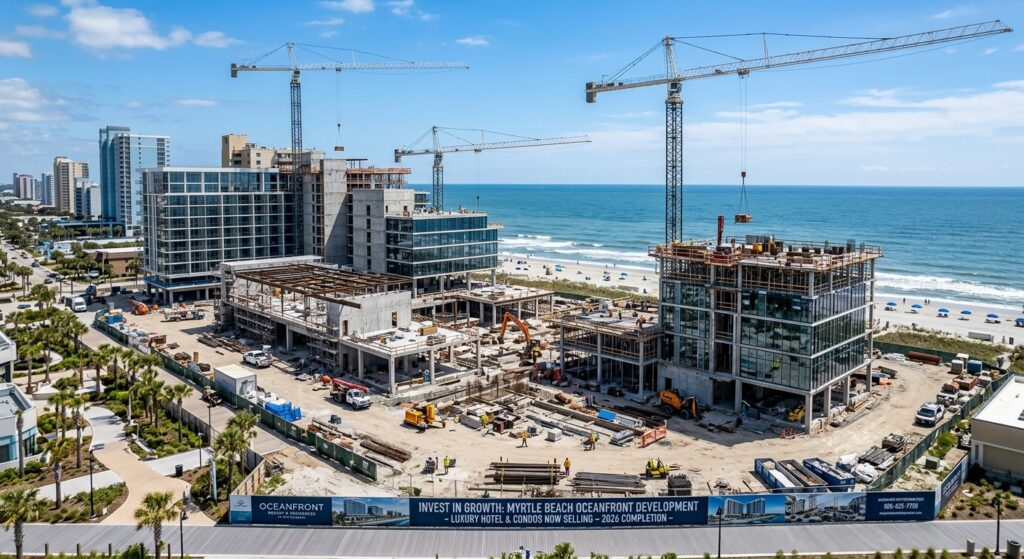
Myrtle Beach Opportunity Zone Capital Gains: Your 2026 Tax Strategy Guide
For 2026, savvy investors are leveraging Myrtle Beach opportunity zone capital gains strategies to defer significant taxes while building wealth in one of America’s fastest-growing coastal markets. Opportunity zones offer a unique tax-deferred investment mechanism where capital gains can be reinvested in qualified properties, allowing you to defer taxes until 2026 (or when you eventually exit the investment). This strategy has become increasingly important for real estate investors, business owners, and high-net-worth individuals seeking to optimize their tax position while capitalizing on Myrtle Beach’s explosive development and tourism economy.
Table of Contents
- Key Takeaways
- What Are Opportunity Zones and How Do They Work?
- How Capital Gains Deferral Works in 2026
- Why Myrtle Beach is a Premier Opportunity Zone Destination
- The Tax Benefits and Basis Step-Up Rules
- Qualified Opportunity Fund Requirements and Investment Rules
- Your Step-by-Step Investment Action Plan
- Frequently Asked Questions
Key Takeaways
- Opportunity zones allow you to defer capital gains taxes until December 31, 2026, or when you sell the investment, whichever comes first.
- After holding qualified opportunity zone investments for 10 years, you can exclude 100% of appreciation gains from federal taxation.
- Myrtle Beach’s multiple designated opportunity zones provide diverse real estate investment options across residential, commercial, and hospitality sectors.
- You must reinvest capital gains within 180 days of realizing them to qualify for the deferral benefit.
- For 2026 tax planning, investors should act now to maximize both current-year gains and the basis step-up benefits available before the December 31, 2026 deadline.
What Are Opportunity Zones and How Do They Work?
Quick Answer: Opportunity zones are economically distressed census tracts designated by the IRS where investors can defer, reduce, and potentially eliminate capital gains taxes through qualified investments in businesses or real estate.
Opportunity zones represent one of the most powerful tax incentives created in recent decades. Under Section 1400Z of the Internal Revenue Code, the federal government designated approximately 8,700 economically disadvantaged communities across the United States as opportunity zones. These zones were created with a dual purpose: to incentivize investment in underdeveloped areas while providing substantial tax benefits to investors.
When you realize a capital gain from selling appreciated assets—whether that’s investment property, business stock, or cryptocurrency—you face immediate federal income tax on that gain. However, by reinvesting that gain into a Qualified Opportunity Fund (QOF) that invests in an opportunity zone, you can defer that tax liability to a specific date. This deferral mechanism works regardless of whether you’re a business owner, real estate investor, or high-net-worth individual looking for tax-efficient strategies.
How the Deferral Mechanism Functions
The mechanics of opportunity zone investing involve three distinct tax benefits that compound over time. First, you defer your original capital gains tax. Second, if you hold the investment for five years, the basis increases by 10% of the deferred gain. Third, if you hold for ten years, you can exclude 100% of appreciation that occurs after you’ve held the investment. This creates a powerful incentive structure that rewards patience and long-term commitment to opportunity zone investments.
The Role of Qualified Opportunity Funds
You cannot directly invest in opportunity zones yourself. Instead, you must invest through a Qualified Opportunity Fund (QOF), which is a legally established investment vehicle that pools capital from multiple investors and deploys it into qualified opportunity zone businesses and real estate. The IRS maintains a registry of all certified QOFs to ensure compliance with opportunity zone regulations.
How Capital Gains Deferral Works in 2026
Quick Answer: For 2026, you have until December 31, 2026 to defer capital gains from sales or other taxable events. After that date, deferred gains become immediately taxable, regardless of whether you’ve exited the investment.
The capital gains deferral under opportunity zones operates on a specific timeline. When you realize a capital gain in any year, you have 180 days to reinvest that gain into a QOF. The reinvestment deadline is critical—miss it by a single day and you lose the deferral benefit entirely. For 2026 tax planning, this means if you realized gains in 2025 or early 2026, you still have opportunities to deploy capital into opportunity zones before the deadline passes.
The 2026 Deadline: A Critical Planning Point
Here’s where 2026 becomes particularly important for your tax strategy. The deferral of your original capital gains tax extends only until December 31, 2026, or when you sell your opportunity zone investment, whichever comes first. This means that gains deferred in 2016 or later will see their tax deferral period expire on that date. If you haven’t exited your investment by then, the deferred taxes become immediately due and payable.
Understanding this timeline is essential for 2026 tax planning. If you made an opportunity zone investment in 2016 and held it continuously, you might now be facing a decision: sell before December 31, 2026 to lock in your basis step-up, or hold past that date and pay the deferred taxes. Working with a tax professional to model these scenarios is crucial.
Calculating Your Deferred Tax Liability
The deferred tax you’ll owe is based on your original capital gain amount and your applicable federal tax rate. For 2026, the long-term capital gains tax rates remain at 0%, 15%, or 20% depending on your filing status and total income. A married couple filing jointly with taxable income over approximately $518,900 would face the 20% rate on long-term capital gains.
Pro Tip: If you’re approaching the December 31, 2026 deadline with an opportunity zone investment showing substantial appreciation, holding past that date may actually be advantageous if the post-December 31 gains will be subject to the 10-year exclusion. Run specific numbers with your tax advisor to determine the optimal exit strategy.
Why Myrtle Beach is a Premier Opportunity Zone Destination
Quick Answer: Myrtle Beach offers designated opportunity zone census tracts with strong economic fundamentals, tourism growth, and diverse investment opportunities in hospitality, residential, and commercial real estate sectors.
Myrtle Beach, South Carolina, has emerged as one of the most attractive opportunity zone investment markets in the Southeast. The area’s economy is built on three powerful pillars: tourism, residential development, and commercial real estate appreciation. Over 18 million tourists visit Myrtle Beach annually, and the area has consistently ranked among the fastest-growing coastal markets in the United States.
Horry County’s Opportunity Zone Footprint
Horry County, which includes Myrtle Beach and surrounding municipalities, contains multiple designated opportunity zones. These aren’t peripheral areas—they’re located in vibrant, increasingly valuable parts of the region. The county has experienced significant population growth, with new residents attracted by affordable cost of living, job opportunities, and lifestyle amenities. This combination of demographic tailwinds and economic growth creates ideal conditions for opportunity zone investments to appreciate substantially.
Investment Types Available in Myrtle Beach Zones
Myrtle Beach opportunity zones support diverse investment types. Short-term rental properties generate steady cash flow while appreciating in value. Boutique hotels and hospitality properties benefit from year-round tourism. Mixed-use developments combining residential and retail space take advantage of both residential demand and commercial growth. Workforce housing projects address the area’s critical housing shortage while benefiting from strong demand. Each investment type offers different risk-return profiles and tax benefits.
Working with a local tax professional in Myrtle Beach who understands the specific opportunity zone tracts, local development patterns, and South Carolina tax implications ensures you select investments aligned with both your financial goals and tax strategy.
Did You Know? Myrtle Beach is one of only four U.S. cities with three distinct opportunity zone designations, giving investors multiple geographic options within a single metro area to diversify their opportunity zone portfolios.
The Tax Benefits and Basis Step-Up Rules
Quick Answer: Opportunity zones provide three distinct tax benefits: deferral of original capital gains, a 10% basis increase after 5 years, and potential 100% exclusion of post-investment appreciation after 10 years.
The tax benefit structure of opportunity zones operates in layers. Understanding each layer helps you maximize your tax savings. Your original deferred capital gain (the amount you reinvested) receives a basis step-up. This increases your cost basis in the investment, which reduces your ultimate tax liability when you exit. The longer you hold the investment, the more valuable this step-up becomes.
The Five-Year Basis Adjustment
After holding your opportunity zone investment for five years, the IRS allows you to increase your basis (cost basis for tax purposes) by 10% of the original deferred gain. This permanent reduction in your taxable gain doesn’t seem dramatic, but it compounds with other benefits. If you reinvested $1 million in deferred capital gains, holding for five years increases your basis by $100,000, directly reducing your tax liability.
The Ten-Year Gain Exclusion
The crown jewel of opportunity zone taxation arrives when you hold your investment for ten years. At that point, any appreciation that occurred after your initial investment becomes permanently excluded from federal income taxation. If you invested $1 million and the investment appreciated to $2 million over ten years, the $1 million gain is entirely excluded from federal tax. You only owe tax on the original deferred capital gain amount, not on the new appreciation.
This is a remarkable benefit that creates a powerful incentive for long-term holding. It’s why investors are willing to accept illiquidity and opportunity zone compliance requirements—the ten-year exclusion can result in substantial tax savings.
Comparing Opportunity Zones to Alternative Strategies
| Tax Strategy | Immediate Tax | Tax Deferral Period | Long-Term Benefit |
|---|---|---|---|
| No Strategy (Direct Sale) | 20% federal tax in year of sale | None | No additional benefit |
| 1031 Exchange | Deferred | Indefinite (if continuing exchanges) | Tax deferred only; no reduction |
| Opportunity Zone | Deferred until 2026 | Until December 31, 2026 | Up to 100% exclusion on appreciation after 10 years |
Qualified Opportunity Fund Requirements and Investment Rules
 Free Tax Write-Off Finder
Quick Answer: QOFs must register with the IRS, invest at least 90% of capital in qualified opportunity zone property, and ensure that acquired property has been substantially improved or is newly constructed.
Not every investment in a census tract designated as an opportunity zone qualifies for the tax benefits. The investment must flow through a Qualified Opportunity Fund that meets specific regulatory requirements. Understanding these requirements helps you evaluate whether a particular QOF will actually deliver the promised tax benefits.
QOF Registration and Compliance
Every QOF must register with the IRS and provide an eligible taxpayer identification number. This registration requirement creates accountability and allows the IRS to track opportunity zone investments. When evaluating a QOF, always verify its registration status on the official CDC Opportunity Zones website. An unregistered fund cannot provide the promised tax benefits, regardless of where the investment is located.
The 90% Investment Requirement
QOFs must deploy at least 90% of capital into qualified opportunity zone property within the designated period (eight-and-a-half months from the QOF’s formation for investments made in 2017 or later). This requirement ensures QOFs are genuinely investing in opportunity zones, not using them as a tax arbitrage vehicle while deploying capital elsewhere. Ask any QOF about its deployment timeline and strategy to understand how quickly your capital will be deployed.
Substantial Improvement Standards
When a QOF acquires real property in an opportunity zone, that property must either be newly constructed or substantially improved. The “substantial improvement” test requires that the cost of improvements equals or exceeds the fair market value of the property at the time of acquisition. This prevents developers from simply buying existing properties without adding value. For a property worth $500,000, improvements must total at least $500,000 to qualify.
Your Step-by-Step Investment Action Plan
Quick Answer: Identify your capital gains, select a qualified QOF operating in Myrtle Beach, commit capital within 180 days, and establish a compliance monitoring system to track holding periods for tax benefit eligibility.
Converting opportunity zone awareness into actionable investment requires following a structured process. Each step is critical to ensuring compliance and maximizing tax benefits.
Step 1: Identify and Quantify Realizable Gains
Begin by identifying what capital gains you’ve realized or will realize this year. This might come from selling business interests, liquidating investment property, selling appreciated securities, or other taxable events. Quantify the exact amount of the gain (not including return of basis). For example, if you sold a rental property for $500,000 and your adjusted cost basis was $300,000, your capital gain is $200,000. This $200,000 is the amount you must reinvest within 180 days.
Step 2: Evaluate Myrtle Beach Opportunity Zone QOFs
Research qualified opportunity funds actively investing in Myrtle Beach opportunity zones. Evaluate each fund based on several factors: management team experience in real estate and hospitality, specific projects planned, timeline for capital deployment, historical performance if the fund has previous investments, fee structure, and investor governance rights. Don’t make your investment decision based solely on tax benefits—the underlying investment must make economic sense.
Step 3: Execute the Capital Deployment (Within 180 Days)
Once you’ve selected a QOF, you have 180 days from the date you realized your original capital gain to deploy the funds. This deadline is absolute. Submit your capital commitment and funds transfer documentation. Ensure you receive written confirmation showing the exact date your investment was received and the amount of deferred gain being reinvested.
Step 4: Establish Compliance and Monitoring Systems
Create a tracking system for your opportunity zone investment that documents the date you invested, the amount of deferred gain, the QOF name and EIN, the specific opportunity zone tracts involved, and critical dates (five-year anniversary and ten-year anniversary). These dates determine when basis adjustments and gain exclusions become available. Share this information with your tax advisor so they can properly plan for the recognition of deferred gains.
Frequently Asked Questions
What happens to my deferred gains if I hold past December 31, 2026?
If you continue holding your opportunity zone investment past December 31, 2026, your original deferred capital gain becomes immediately taxable, and you must report it on your 2026 tax return due in April 2027. However, if your investment has appreciated since you acquired it, you may not be subject to tax on that post-investment appreciation if you’ve held the investment for ten years. This creates a strategic decision point where the analysis becomes complex and requires professional guidance.
Can I invest in multiple Myrtle Beach opportunity zone QOFs?
Yes, you can and often should diversify your opportunity zone investments across multiple QOFs. There’s no requirement to concentrate all your deferred gains in a single fund. Diversification reduces risk and allows you to benefit from different management teams and investment strategies. Just ensure each QOF is registered with the IRS and that your total capital deployment occurs within 180 days of realizing your original gains.
Are there South Carolina state tax implications I should know about?
South Carolina conforms to federal opportunity zone rules, meaning state capital gains taxation generally follows federal treatment. However, South Carolina also has specific tax incentives for business investment and real estate development that might apply to your opportunity zone investment. Working with a tax professional familiar with both federal and South Carolina tax law ensures you capture all available benefits and understand any state-specific compliance requirements.
What due diligence should I perform on a Myrtle Beach QOF before investing?
Perform thorough due diligence by verifying IRS registration, reviewing offering documents, interviewing fund managers about their Myrtle Beach market experience, examining specific projects targeted for investment, understanding fee structures, checking references from existing investors if possible, and reviewing the fund’s compliance procedures. Never invest based solely on tax benefits. The underlying investment must make financial sense independent of the tax advantages, or you risk experiencing both a tax loss and a financial loss.
How does the 180-day reinvestment deadline work if I have multiple capital gains in different months?
Each capital gain event has its own 180-day clock. If you realize a gain in January and another gain in June, you have 180 days from the January event for that gain and 180 days from the June event for that gain. You could theoretically be investing throughout the year, provided each specific gain deployment occurs within 180 days of its realization. However, this complexity increases your administrative burden and compliance risk, so many investors prefer realizing gains at the same time.
Can I use opportunity zones for both personal real estate and business investments?
Opportunity zones can be used for any type of capital gain reinvestment, whether from personal real estate sales, business dispositions, or investment portfolios. The QOF itself invests in qualified opportunity zone businesses or real estate, which could be commercial, residential, hospitality, or other property types. Your personal use of the funds doesn’t matter—only that you reinvest your realized capital gains into a qualified QOF within the required timeframe.

Uncle Kam in Action: The Real Estate Investor’s Myrtle Beach Success Story
Marcus, a 55-year-old commercial real estate investor from Charlotte, had spent two decades building a portfolio of office buildings across the Southeast. In 2024, he sold two office complexes for $4.2 million, realizing $1.8 million in capital gains. Facing a federal tax bill exceeding $360,000 (at the 20% long-term capital gains rate), Marcus was exploring how to deploy his proceeds strategically.
Marcus’s tax advisor introduced him to Myrtle Beach opportunity zones. The area’s tourism economy and residential growth aligned with Marcus’s investment thesis. He identified a qualified opportunity fund that was developing three boutique hotels in different Myrtle Beach opportunity zone census tracts. The fund’s management team had successfully completed similar projects and planned to hold properties for appreciation over ten years.
Marcus deployed his entire $1.8 million capital gain into the QOF within the 180-day window. By doing so, he deferred his $360,000 federal tax liability until at least December 31, 2026. The fund acquired and substantially improved three boutique hotel properties that generated modest but positive cash flow.
Fast forward to 2026: the three hotel properties had appreciated to $2.4 million in value. Marcus received regular cash distributions from occupancy and developed a strategic plan. Rather than holding past December 31, 2026 and triggering the deferred gain recognition, Marcus arranged a tax-deferred exchange of his investment stake. This allowed him to redeploy his appreciated capital into a second-generation opportunity zone investment without recognizing gains.
By using opportunity zones, Marcus achieved several outcomes: $360,000 in deferred federal taxes that he deployed to other business investments, generated positive cash distributions from the hospitality properties, participated in $600,000 of property appreciation, and maintained optionality about whether to eventually pay the deferred taxes or reinvest into additional opportunity zones. His total financial return included both the immediate tax deferral benefit and the underlying real estate appreciation. Learn more about how we help investors like Marcus optimize capital gains strategies.
Next Steps
- Calculate your realized or anticipated capital gains for 2026 and identify the exact amount available for opportunity zone reinvestment.
- Schedule a consultation with a tax professional who understands both opportunity zones and your specific situation to evaluate whether this strategy aligns with your financial goals.
- Research 3-5 qualified opportunity funds operating in Myrtle Beach opportunity zones and request detailed information about their specific projects, management experience, and investor terms.
- If you proceed, execute your capital deployment within the 180-day window and establish a documentation system for tracking the investment across critical holding period milestones.
- Contact our tax strategy specialists to develop a comprehensive plan that integrates opportunity zones with your broader tax and financial strategy.
Related Resources
- Real Estate Investor Tax Strategy Guide
- Myrtle Beach Tax Preparation Services
- Capital Gains Tax Planning Blog Series
- IRS Opportunity Zones FAQ
- Official CDC Opportunity Zones Resource Center
Last updated: March, 2026

