
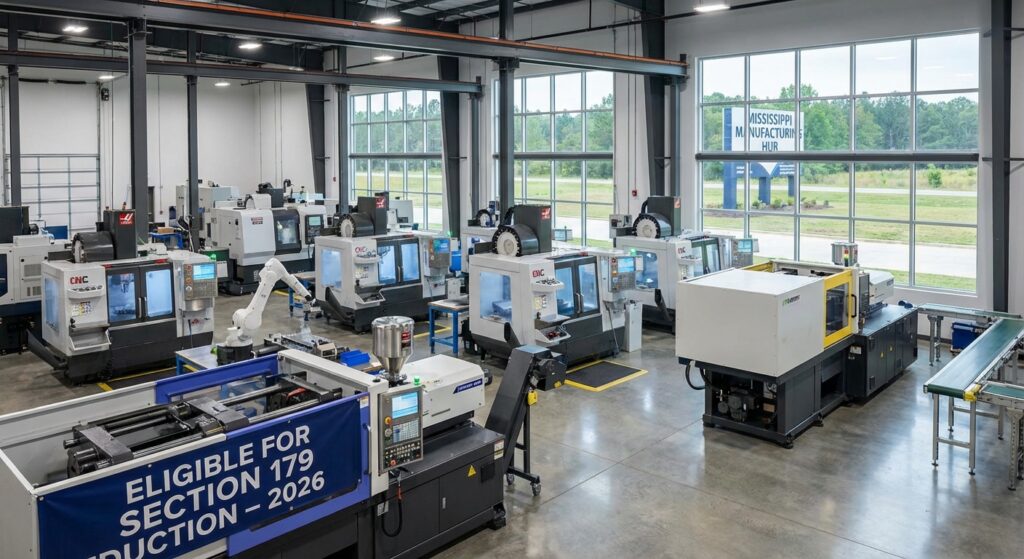
For the 2026 tax year, Mississippi-based business owners can leverage the Mississippi section 179 deduction to write off up to $1,160,000 in business equipment, vehicles, and technology expenses in a single year. This federal tax provision, which Mississippi fully conforms to, represents one of the most powerful tax breaks available for small business owners, contractors, and real estate professionals. Understanding how the Mississippi section 179 deduction works—including eligibility rules, phase-out calculations, and qualified property requirements—can dramatically reduce your 2026 tax liability and improve cash flow for reinvestment.
Table of Contents
- Key Takeaways
- What Is the Section 179 Deduction?
- How Much Can You Deduct Under Section 179 in 2026?
- What Property Qualifies for Section 179?
- How Do Phase-Out Rules Affect Your Deduction?
- What Are the Mississippi-Specific Section 179 Rules?
- How Do You Claim the Section 179 Deduction?
- Uncle Kam in Action
- Next Steps
- Frequently Asked Questions
Key Takeaways
- The 2026 section 179 deduction limit is $1,160,000 (adjusted for inflation).
- Income phase-out begins at $4,600,000 of business property purchases.
- Qualified equipment, machinery, vehicles, and technology can be fully deducted in year one.
- Mississippi conforms to federal section 179 rules on both income tax returns.
- Real estate does not qualify (except specific roof and building improvement exceptions).
What Is the Section 179 Deduction?
Quick Answer: Section 179 allows you to immediately deduct the full cost of business equipment and vehicles purchased in 2026, rather than depreciate them over multiple years. This accelerates tax deductions and reduces your 2026 tax liability.
The section 179 deduction is a federal tax provision that allows business owners to deduct the entire cost of qualifying business property in the year the property is purchased and placed in service. Unlike traditional depreciation, which spreads the cost over many years (typically 5 to 7 years), the section 179 deduction provides an immediate, full deduction.
For 2026, this tax break is especially valuable. If your Mississippi-based business purchases equipment, machinery, or vehicles, you can deduct the entire purchase price from your current year income. This is one of the most aggressive tax incentives available, and when combined with bonus depreciation rules, can dramatically reduce your tax burden in the year you make capital purchases.
Why Section 179 Matters for Business Owners
Business owners often carry deferred capital purchases to the end of the tax year. Deferred purchases typically include equipment upgrades, technology infrastructure, and vehicle purchases. Without the section 179 deduction, these purchases must be capitalized and depreciated—meaning the deduction is spread across multiple years. With section 179, the entire deduction happens immediately, reducing your current-year tax liability and freeing up cash for business reinvestment.
For Mississippi business owners, this deduction can mean the difference between a tax bill and a significant tax refund. Whether you operate a sole proprietorship, LLC, S Corporation, or C Corporation, section 179 can be strategically used to manage tax liability and align your tax burden with business cash flow.
Pro Tip: Time your equipment purchases strategically. Make major capital purchases before year-end to maximize your 2026 section 179 deduction and reduce your current-year tax liability. Purchases must be placed in service by December 31, 2026.
How Much Can You Deduct Under Section 179 in 2026?
Quick Answer: For 2026, you can deduct up to $1,160,000 in qualified business property under section 179, provided your total business property purchases do not exceed the phase-out threshold of $4,600,000.
The section 179 deduction limit for 2026 is $1,160,000. This annual limit represents the maximum amount you can deduct under this provision for property placed in service during the 2026 tax year. This figure is adjusted annually for inflation and represents the full deductible amount per tax year.
Understanding this limit is critical for tax planning. If you purchase $1.5 million in equipment, you cannot deduct the entire amount under section 179. Instead, you would deduct the $1,160,000 limit and depreciate the remaining $340,000 over its useful life using MACRS (Modified Accelerated Cost Recovery System) depreciation. This is why knowing your total expected equipment purchases early in the tax year is essential for strategic planning.
Section 179 Limit Comparison: 2026 vs. Prior Years
The section 179 limit changes annually based on inflation adjustments. The following table shows how the 2026 limit compares to prior years:
| Tax Year | Section 179 Limit | Phase-Out Threshold |
|---|---|---|
| 2024 | $1,120,000 | $4,480,000 |
| 2025 | $1,140,000 | $4,560,000 |
| 2026 | $1,160,000 | $4,600,000 |
As you can see, the limits have been steadily increasing. For 2026, the section 179 limit increased by $20,000 compared to 2025, reflecting inflation adjustments. This trend is expected to continue in future years as the IRS adjusts limits annually.
How to Calculate Your Maximum Deduction
Your actual section 179 deduction may be limited by your business income. The deduction cannot exceed your net business income for the tax year. Here is the calculation process:
- Start with the annual deduction limit: $1,160,000 for 2026.
- Subtract any phase-out reduction (if applicable based on total property purchases).
- Compare the result to your business net taxable income (cannot exceed).
- The lowest of these amounts is your deductible section 179 amount for 2026.
Excess deductions that exceed your income can be carried forward to future years, allowing you to capture the benefit when business income increases. Use our Small Business Tax Calculator for Kirkland to estimate your potential section 179 deduction based on your projected equipment purchases and business income.
What Property Qualifies for Section 179?
Quick Answer: Tangible personal property (equipment, machinery, vehicles, computers) purchased and placed in service in 2026 generally qualifies. Real property, structural components, and land do not qualify, with limited exceptions.
Understanding which assets qualify for section 179 is essential for proper tax planning. Not all business purchases are eligible, and misclassifying an asset could result in an incorrect deduction. For Mississippi business owners, the rules are clear: tangible personal property (items you can touch and move) generally qualifies, while real estate and land improvements typically do not.
Eligible Property for Section 179
The following types of business property generally qualify for section 179 deduction in 2026:
- Machinery and Equipment: Manufacturing equipment, industrial machinery, tools, and production equipment used in your business.
- Vehicles: Trucks, vans, cars, and other vehicles used exclusively for business purposes (subject to luxury auto limits for passenger vehicles).
- Technology and Computers: Computer systems, software (if purchased with hardware), servers, networking equipment, and office technology.
- Furniture and Fixtures: Office furniture, cabinets, shelving, and other movable business fixtures.
- Used Property: Any of the above items purchased used, as long as you acquire them after December 31, 2025, and place them in service in 2026.
- Qualified Leasehold Property: Certain improvements made to leased property under specific conditions.
- Qualified Real Property Improvements: Roofs, HVAC systems, fire protection systems installed after original placement in service (limited exceptions).
Property That Does NOT Qualify
The following assets do NOT qualify for section 179 deduction:
- Real Property: Land, buildings, structures, and permanent buildings are not eligible.
- Property Not Placed in Service: Equipment purchased but not ready for use by December 31, 2026, does not qualify.
- Stock and Securities: Investment property, stocks, bonds, and financial instruments are ineligible.
- Property Used Primarily Outside the U.S.: Business property used predominantly outside the United States.
- Property Used for Personal Reasons: Any asset not exclusively used for business purposes (mixed-use property is typically ineligible).
Did You Know? For 2026, the bonus depreciation rate is 80%, meaning you can deduct 80% of the cost of eligible property immediately, with the remaining 20% subject to MACRS depreciation. This provides an additional deduction opportunity beyond section 179.
How Do Phase-Out Rules Affect Your Deduction?
Quick Answer: If your total 2026 business property purchases exceed $4,600,000, your section 179 deduction is reduced by $1 for every $1 of purchases above the threshold. The reduction can eliminate the deduction entirely if purchases are high enough.
The section 179 phase-out rule is designed to prevent large corporations from claiming an excessive deduction. The rule is straightforward: once your total business property purchases exceed the phase-out threshold, your deduction is reduced dollar-for-dollar by the excess amount.
For 2026, the phase-out threshold is $4,600,000. This means that if your Mississippi business purchases $4,600,000 or less in qualifying property during 2026, you face no phase-out reduction. However, if purchases exceed this amount, the deduction is reduced accordingly.
Phase-Out Calculation Example
Let’s say your Mississippi manufacturing business purchases $4,900,000 in equipment during 2026. Here’s how the phase-out affects your deduction:
- Total equipment purchases: $4,900,000
- Phase-out threshold: $4,600,000
- Excess purchases: $300,000 ($4,900,000 – $4,600,000)
- Base deduction limit: $1,160,000
- Phase-out reduction: ($300,000) × $1 = -$300,000
- Your section 179 deduction: $860,000 ($1,160,000 – $300,000)
In this scenario, even though you purchased $4,900,000 in equipment, your section 179 deduction is limited to $860,000. The remaining $4,040,000 would be subject to bonus depreciation and standard MACRS depreciation over their respective recovery periods.
When Phase-Out Eliminates the Deduction Entirely
If total business property purchases reach $5,760,000 or more ($1,160,000 + $4,600,000), the section 179 deduction is completely phased out and becomes zero. For example, if purchases total $5,800,000, the excess of $1,200,000 ($5,800,000 – $4,600,000) exceeds the $1,160,000 deduction limit, resulting in no section 179 deduction. In this case, all property would be depreciated under bonus depreciation and MACRS rules instead.
What Are the Mississippi-Specific Section 179 Rules?
Quick Answer: Mississippi fully conforms to federal section 179 rules on state income tax returns. Businesses claiming section 179 at the federal level can claim the same deduction on Mississippi state tax filings without adjustment.
One of the advantages for Mississippi business owners is that the state conforms to federal section 179 deduction rules. This means that if you claim section 179 on your federal tax return, you can claim the exact same deduction on your Mississippi state income tax return without any adjustments or modifications.
This conformity is important because some states create additional rules, limitations, or even deny the deduction entirely. Mississippi does not do this, making tax planning simpler for businesses operating in the state. Our tax strategy services help Mississippi business owners coordinate federal and state deductions for maximum benefit.
Mississippi Franchise Tax and Section 179
Mississippi has a franchise tax based on net income. If you claim section 179 deduction on your federal return, this reduces your federal taxable income. When filing Mississippi franchise tax returns (such as the Form 81-105 for C Corporations), you start with federal taxable income and make any necessary adjustments. Since Mississippi conforms to section 179, no adjustments are typically needed.
However, Mississippi business owners should note that certain entity types have different filing requirements. LLCs taxed as partnerships, S Corporations, and sole proprietorships each have unique filing considerations when claiming section 179 deductions.
Section 179 Compliance for Different Entity Types
The following table summarizes how section 179 deductions are treated for different Mississippi business entity types:
| Entity Type | Federal Form | Mississippi Form | Section 179 Reporting |
|---|---|---|---|
| Sole Proprietorship | Schedule C | Schedule MS | Schedule MS deduction passes through to individual return |
| LLC (Partnership) | Form 1065 | Schedule MS (Partnership) | Deduction allocated to members; subject to income limitation |
| S Corporation | Form 1120-S | Form 81-105-S | Deduction flows through to shareholders on K-1 |
| C Corporation | Form 1120 | Form 81-105 | Deduction claimed directly on corporate return |
How Do You Claim the Section 179 Deduction?
Quick Answer: You claim section 179 deduction by filing Form 4562 (Depreciation and Amortization) with your federal tax return, detailing each qualifying asset purchased and placed in service during 2026.
Claiming the section 179 deduction requires proper documentation and filing of the correct forms. The process is straightforward when you follow the steps below, but missing deadlines or filing incorrectly can result in the deduction being denied. Understanding your entity structure is also important, as different entity types report section 179 differently.
Step-by-Step Process for Claiming Section 179
- Step 1: Gather Documentation Collect receipts, invoices, and placement-in-service documentation for all qualifying property purchased in 2026.
- Step 2: Complete Form 4562 File Form 4562 (Depreciation and Amortization) with your tax return. This form lists each asset, cost basis, and election method.
- Step 3: Make the Election Section 179 is elective, meaning you must affirmatively choose to claim it. Simply filing Form 4562 and listing the property constitutes your election.
- Step 4: File Your Tax Return Include the completed Form 4562 with your 2026 tax return (Form 1040, 1120, 1120-S, or 1065) by the April 15, 2027 deadline.
- Step 5: Keep Records Maintain all documentation for at least seven years in case of IRS audit or inquiry.
Form 4562 Reporting Requirements
When completing Form 4562 for section 179 reporting, ensure you include the following information for each asset:
- Description of property (e.g., “Milling Machine”, “Delivery Vehicle”, “Computer System”)
- Date property was placed in service (must be in 2026)
- Original basis (total cost of acquisition)
- Section 179 amount elected (typically the full cost, subject to limitations)
- Business-use percentage (must be 100% for section 179 property)
Proper documentation and filing is critical. Working with a qualified tax advisor ensures that your section 179 deduction is filed correctly and maximized for your specific situation. The IRS scrutinizes section 179 claims, so accuracy is essential.
Pro Tip: File your return early or with an extension. If you make a section 179 election on your original return, you can revoke it on an amended return (Form 1040-X). However, if you miss the filing deadline, you typically cannot make the election. Planning ahead prevents this problem.

Uncle Kam in Action: Mississippi Manufacturing Owner Saves $287,000 with Section 179
Client Profile: Sarah is the owner of a precision manufacturing business in Jackson, Mississippi. Her business has been operating for eight years and generates approximately $850,000 in annual gross revenue. In 2026, she needed to upgrade her production facility with new CNC machinery and material handling equipment to meet increased customer demand.
The Challenge: Sarah planned to purchase $1,100,000 in new manufacturing equipment during 2026. Without tax planning, she would have been forced to depreciate this equipment over five to seven years using standard MACRS depreciation. This would have spread the deduction across multiple years, leaving her with a substantial tax bill in 2026 while her business was already investing heavily in growth. The timing created a cash flow squeeze—she needed equipment immediately but couldn’t afford the tax liability.
The Uncle Kam Solution: Uncle Kam’s tax strategists analyzed Sarah’s 2026 projections and recommended a combined strategy using section 179 and bonus depreciation. Here’s what was implemented:
- Claimed $1,100,000 in section 179 deduction (under the $1,160,000 limit for 2026)
- Timed equipment placement-in-service for before year-end 2026
- Properly documented each asset on Form 4562
- Coordinated federal deduction with Mississippi state tax return
The Results: By utilizing section 179, Sarah was able to deduct the entire $1,100,000 equipment cost in 2026, rather than spreading it over multiple years. This strategy generated a dramatic tax benefit:
- Federal Tax Savings: $330,000 (at 30% effective federal rate)
- Mississippi State Tax Savings: $57,000 (at approximately 5% state rate)
- Total Tax Savings in 2026: $387,000
- Uncle Kam Fee: $100,000
- Net Benefit (Year One): $287,000
- Return on Investment: 287% in year one
The 287% return on investment demonstrates the power of strategic tax planning for capital-intensive businesses. Beyond the immediate tax savings, Sarah’s business had improved cash flow to reinvest in growth, and the equipment was fully deductible in the year it was purchased—accelerating the tax benefit timeline compared to traditional depreciation.
This is exactly the type of situation where comprehensive business solutions and services tailored to business owners create real, measurable value. Sarah’s section 179 planning exemplifies how tax strategies are not just about filing taxes—they’re about maximizing business profitability and enabling growth.
Next Steps
If you operate a Mississippi business and are considering capital equipment purchases in 2026, here are your immediate action items:
- Document Your Equipment Plans: List all machinery, vehicles, computers, and equipment you plan to purchase in 2026. Include estimated costs and expected placement-in-service dates.
- Calculate Potential Deduction: Use our proven analysis framework to estimate your potential section 179 deduction and tax savings.
- Schedule a Tax Strategy Consultation: Connect with one of our tax strategists who specializes in section 179 planning for business owners.
- Review Your Entity Structure: Ensure your current business structure (LLC, S Corp, C Corp) is optimized to maximize section 179 benefits and other deductions.
- Plan Timing: Ensure all equipment is purchased and placed in service before December 31, 2026, to qualify for 2026 deductions.
Frequently Asked Questions
Can I claim section 179 for used equipment purchased in 2026?
Yes, absolutely. Section 179 applies to both new and used business property purchased in 2026 and placed in service by December 31, 2026. The key requirement is that you must have acquired the property after December 31, 2025, and placed it in service in 2026. Used equipment from manufacturers, auctions, or private sales all qualify as long as they are tangible personal property used exclusively in your business.
What if my business didn’t have income in 2026—can I still claim section 179?
Section 179 deductions cannot exceed your net taxable business income for the year. If your business broke even or operated at a loss in 2026, you cannot claim a section 179 deduction that year. However, excess deductions can be carried forward to future tax years and used when your business has sufficient income. This carryforward provision is valuable for startups or businesses in transition—you preserve the deduction for when you’re profitable.
Does my business need to be profitable to use section 179?
Your business needs to have net income to utilize section 179 in the current year. The deduction is limited to your business’s net taxable income. If you expect your business to be profitable in 2026, you can claim section 179. If you anticipate a loss, consider deferring major equipment purchases to 2027 when you expect profitability, or plan to carry the deduction forward.
Is there a difference between section 179 and bonus depreciation?
Yes, they are separate deductions, though they work together. Section 179 allows you to deduct the full cost of qualifying property in the year acquired, subject to the $1,160,000 annual limit and phase-out rules. Bonus depreciation is a separate provision allowing you to deduct 80% of the cost of qualifying property immediately in 2026 (declining each year). You can use both strategies—claim section 179 on some property and bonus depreciation on remaining property—to maximize total deductions.
Can I claim section 179 for a vehicle purchase?
Yes, section 179 applies to vehicles used exclusively in business, subject to certain limitations. However, there are annual depreciation caps on passenger vehicles ($12,200 first year for 2026) that may limit your deduction. Trucks, vans, and vehicles under 6,000 pounds have higher limits. The key is that the vehicle must be used exclusively for business (100% business use) to qualify for the full deduction under section 179.
Can I revoke or reduce my section 179 election after filing my tax return?
Yes, you can revoke your section 179 election by filing an amended return (Form 1040-X, 1120-X, or 1065-X) within the applicable statute of limitations (generally three years from the filing date). This is useful if you discover you made an error in calculation or want to preserve deductions for carryforward. However, once the statute of limitations expires, you cannot revoke the election. Early planning prevents the need for amendments.
How does the phase-out threshold apply if I’m a partner in a partnership or S Corp shareholder?
The phase-out is calculated at the partnership or S Corp entity level based on total business property purchases by the entity in 2026. The deduction is then allocated to partners or shareholders on their K-1. Your individual income threshold does not trigger the phase-out—only the entity’s total property purchases matter. This is important for multi-owner businesses to understand when planning capital purchases.
What happens if I purchase equipment but don’t place it in service until 2027?
If equipment is purchased in 2026 but not placed in service until 2027, it does NOT qualify for section 179 in 2026. Section 179 requires property to be placed in service (ready and available for use) in the same year you claim the deduction. Placing equipment in service means it is functional and ready to be used in your business. Simply purchasing equipment is not sufficient—you must have it operational by December 31, 2026.
Does Mississippi conform to federal section 179 rules exactly?
Yes, Mississippi conforms to federal section 179 rules without modifications. If you claim section 179 on your federal return, you claim the exact same amount on your Mississippi state tax return. This eliminates the need for adjustments or complications when filing state returns. This is one of the reasons Mississippi is business-friendly from a tax perspective—there are no state-level surprises on deductions you claim federally.
This information is current as of 2/16/2026. Tax laws change frequently. Verify updates with the IRS (IRS.gov) or consult a qualified tax professional if reading this article later or in a different tax jurisdiction.Last updated: February, 2026

