
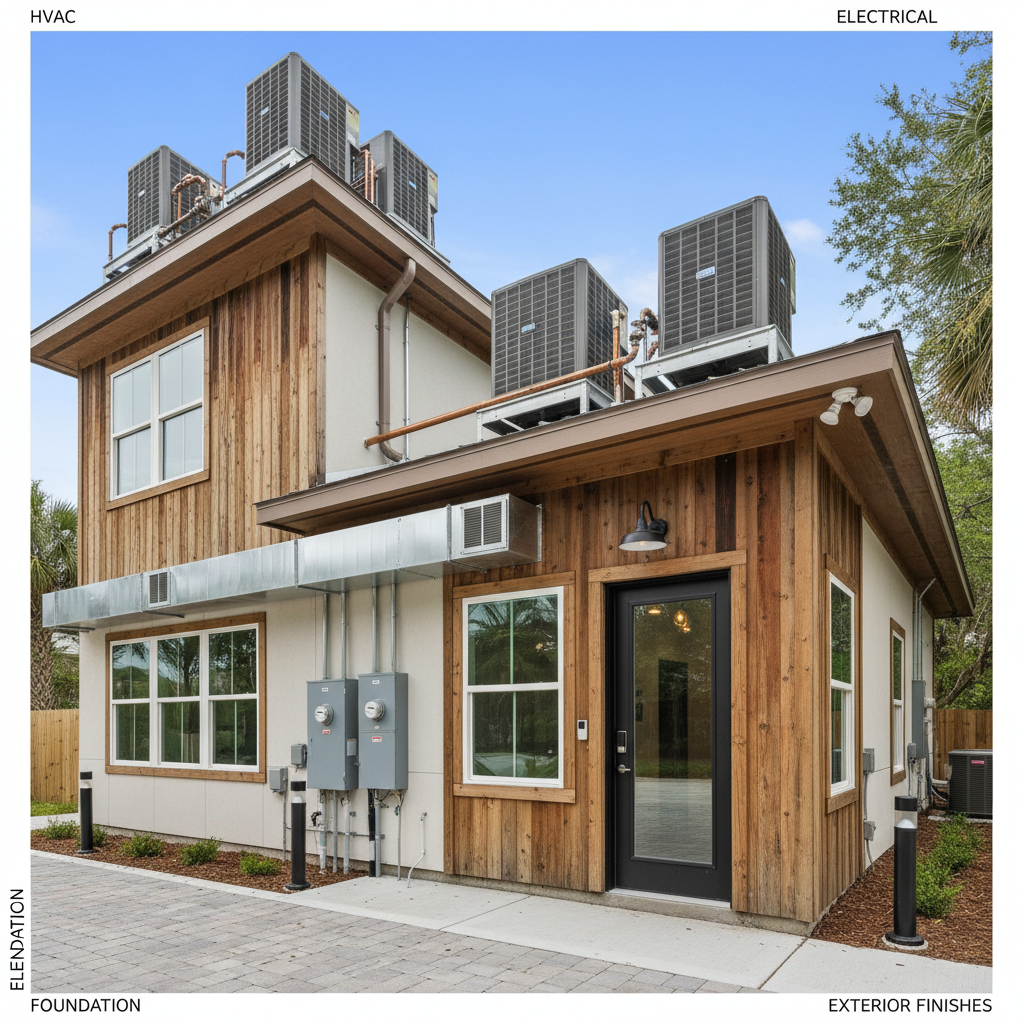
Louisiana Cost Segregation: The 2026 Tax Strategy Guide for Real Estate Investors


Louisiana Cost Segregation: The 2026 Tax Strategy Guide for Real Estate Investors
For the 2026 tax year, Louisiana cost segregation strategies represent one of the most powerful tools available to real estate investors seeking to accelerate tax deductions and reduce their taxable income. A cost segregation study breaks down your rental property into shorter-lived asset categories that qualify for accelerated depreciation, potentially reclassifying 20-40% of your property’s value into bonus-eligible categories. With permanent 100% bonus depreciation now in effect through the One Big Beautiful Bill Act, the timing to implement louisiana cost segregation has never been better. This comprehensive guide explains how cost segregation works, which property components qualify for accelerated depreciation, and how to maximize your 2026 tax savings through strategic planning.
Table of Contents
- Key Takeaways
- What Is Cost Segregation and How Does It Work for Louisiana Properties?
- How Does Permanent 100% Bonus Depreciation Change the Equation for 2026?
- Which Property Components Qualify for Accelerated Depreciation?
- How Can Section 179 Deduction Expansion Amplify Your Tax Savings?
- What Does a Real-World Louisiana Cost Segregation Scenario Look Like?
- Uncle Kam in Action
- Next Steps
- Frequently Asked Questions
- Related Resources
Key Takeaways
- Louisiana cost segregation reclassifies 20-40% of property value into 5, 7, or 15-year depreciation categories instead of 27.5 years.
- Permanent 100% bonus depreciation under the One Big Beautiful Bill Act allows immediate deduction of qualifying components placed in service after January 19, 2025.
- Section 179 deduction limit has doubled to $2.5 million for 2026, with phase-out threshold at $4 million.
- Qualifying components include appliances, HVAC systems, flooring, fixtures, and personal property (not the building structure or land).
- The Section 199A Qualified Business Income deduction is now permanent at 20%, with new $400 minimum deduction for eligible taxpayers starting in 2026.
What Is Cost Segregation and How Does It Work for Louisiana Properties?
Quick Answer: A cost segregation study is a detailed engineering analysis that reclassifies property components into shorter recovery periods. Instead of depreciating your entire property over 27.5 years, cost segregation allows you to identify components with 5, 7, or 15-year lives, accelerating your deductions.
Cost segregation is fundamentally about being precise with tax law. When you purchase a rental property in Louisiana, the IRS requires you to depreciate the building structure over 27.5 years. However, not every part of your property is the building structure. Many components—like appliances, flooring, HVAC systems, and fixtures—have shorter useful lives and can qualify for accelerated depreciation schedules.
A professional cost segregation study involves a detailed engineering and accounting analysis of your property. Engineers visit the property, document every component, and classify items based on their useful life under IRS guidelines. The result is a detailed report that breaks down your property cost into categories by recovery period. For a typical residential rental property in Louisiana, this analysis often reveals that 20-40% of the total property value can be reclassified into shorter-lived asset categories.
The Three-Category Framework of Cost Segregation
Understanding how properties are segmented is essential to maximizing your louisiana cost segregation benefits. The IRS recognizes three main categories of property with different recovery periods.
- 5-Year Property: Includes appliances, carpeting, and certain building components like waterproofing, fire suppression systems, and security systems. These assets depreciate quickly, generating substantial early-year deductions.
- 7-Year Property: Covers items such as fixtures, lighting systems, and built-in cabinetry. This middle category captures components with moderate useful lives.
- 15-Year Property: Includes qualified leasehold improvements, restaurant property, and certain specialized systems. This category still provides significantly faster depreciation than 27.5 years.
The remaining portion of your property value—typically 60-80%—remains classified as the building structure and continues to depreciate over 27.5 years. Land, which cannot be depreciated under any circumstances, is separated out from all these calculations. This framework ensures compliance with IRS regulations while maximizing your available deductions.
Why Timing Matters for Louisiana Investors Right Now
The timing of your cost segregation analysis matters significantly for 2026. Properties acquired or improved after January 19, 2025, qualify for permanent 100% bonus depreciation, meaning you can deduct the full cost of qualifying components in the year they’re placed in service. If you purchased or significantly improved a Louisiana rental property in 2025 or 2026, implementing louisiana cost segregation now captures this valuable benefit before depreciation schedules lock in.
How Does Permanent 100% Bonus Depreciation Change the Equation for 2026?
Quick Answer: Permanent 100% bonus depreciation means you can immediately deduct the full cost of qualifying property components in the year placed in service, rather than spreading deductions across multiple years. This is a dramatic acceleration of tax benefits.
The One Big Beautiful Bill Act, signed into law July 4, 2025, permanently restored 100% bonus depreciation for qualified property acquired after January 19, 2025. This represents a seismic shift in tax planning. Prior to this legislation, bonus depreciation was scheduled to phase down from 100% in 2022 to 80% in 2023, 60% in 2024, 40% in 2025, and eventually disappear entirely by 2027. The permanent restoration eliminates this timeline uncertainty and provides long-term planning stability.
What This Means for Your Louisiana Property Strategy
For Louisiana real estate investors, permanent 100% bonus depreciation combined with cost segregation creates an extraordinary opportunity. Consider a concrete example: you purchase a rental property and the cost segregation study identifies $80,000 in 5-year property components. Under 2026 tax rules with permanent bonus depreciation, you can deduct the entire $80,000 in 2026, rather than spreading it over five years. This front-loads your tax deductions into the current year, potentially reducing your 2026 taxable income by $80,000.
The impact magnifies when you have multiple properties or substantial renovation projects. If you own three rental properties and conducted cost segregation studies identifying $150,000 in bonus-eligible components across all three properties, you could claim the entire $150,000 as a deduction in 2026. This massive deduction flows through to your federal income tax return, potentially reducing your overall tax liability significantly.
Pro Tip: Permanent bonus depreciation removes the pressure to rush implementation. However, delaying your louisiana cost segregation study means deferring tax benefits. The sooner you complete your analysis and place components in service, the sooner you capture deductions that shelter other income streams.
Which Property Components Qualify for Accelerated Depreciation?
Quick Answer: Tangible assets with recovery periods of 20 years or less qualify—including HVAC systems, appliances, flooring, fixtures, and security systems. The building structure (27.5 years) and land (non-depreciable) do not qualify.
Understanding which specific components of your Louisiana property qualify for accelerated depreciation is critical to maximizing your cost segregation benefits. The IRS has established clear guidelines about what qualifies, and a thorough cost segregation study identifies all eligible items within your property.
Commonly Qualifying 5 and 7-Year Components
Most cost segregation studies identify substantial value in these shorter-lived categories. In a typical residential rental property, you’ll find appliances with assigned useful lives of 5 years. Built-in refrigerators, ovens, dishwashers, and microwave units all qualify. Kitchen and bathroom fixtures including faucets, handles, and mirrors typically fall into the 7-year category. Carpeting, vinyl flooring, tile work, and wall coverings also qualify for 7-year depreciation. Fire suppression systems, security systems, and other specialized safety equipment frequently classify as 5-year property.
HVAC systems represent one of the largest qualifying components in most properties. A properly executed cost segregation analysis will isolate the HVAC equipment separate from the building structure, allowing accelerated depreciation on equipment that often represents 10-15% of total property value. Lighting systems, electrical components within the improvement (distinct from the building shell), and water heaters all qualify for shorter recovery periods.
- Appliances (refrigerators, stoves, dishwashers, washers, dryers)
- HVAC systems (heating and cooling equipment)
- Flooring (carpet, vinyl, laminate—separate from concrete base)
- Kitchen and bathroom fixtures (faucets, cabinets, countertops)
- Security systems, fire suppression systems, sprinkler systems
- Window coverings, lighting fixtures, electrical systems
- Landscaping, exterior lighting, and site improvements
What Does NOT Qualify
It’s equally important to understand what doesn’t qualify for accelerated depreciation. The building structure itself—the walls, roof, foundation, and the basic envelope—continues to depreciate over 27.5 years and cannot be accelerated through cost segregation. Land, in all circumstances, cannot be depreciated. You must carefully separate land cost from improvement cost on your purchase documentation.
Repairs that restore property to former condition without adding value may be deductible immediately under different rules but don’t participate in cost segregation. This distinction between repairs (immediately deductible) and improvements (capitalized and depreciated) requires careful analysis with a tax professional.
How Can Section 179 Deduction Expansion Amplify Your Tax Savings?
Quick Answer: For 2026, Section 179 allows immediate expensing of up to $2.5 million in property improvements, with phaseout beginning at $4 million. This doubles the 2025 limit and provides additional acceleration beyond bonus depreciation.
The One Big Beautiful Bill Act doubled the Section 179 deduction limit from $1.25 million to $2.5 million for tax years beginning in 2025. The phase-out threshold increased to $4 million. While Section 179 is traditionally associated with business equipment purchases, it can apply to certain qualifying improvements made to nonresidential real property—if you qualify as a real estate professional.
For Louisiana properties, Section 179 can be used in conjunction with cost segregation to achieve even greater deductions. If you qualify as a real estate professional under IRS standards (750 hours of real estate activities annually with more than half your working time devoted to real estate), you can use Section 179 to immediately deduct roofs, HVAC systems, fire suppression systems, and security systems placed on nonresidential property.
Real Estate Professional Status and Its Tax Implications
Determining whether you qualify as a real estate professional is essential for maximizing Section 179 benefits on real property improvements. The IRS definition is strict: you must engage in real estate activities for at least 750 hours during the tax year, and you must spend more than half of your total working hours in real estate-related work. If you meet these requirements, Section 179 opens doors to immediate deductions on significant improvements.
Most passive real estate investors won’t qualify as real estate professionals unless they actively manage properties full-time. However, investors transitioning out of full-time employment or those whose spouses actively manage properties full-time should evaluate their situation. Even if you don’t qualify, bonus depreciation and cost segregation still provide powerful acceleration mechanisms for your louisiana cost segregation strategy.
What Does a Real-World Louisiana Cost Segregation Scenario Look Like?
Quick Answer: A typical $400,000 rental property might be allocated as: $100,000 land (non-depreciable), $240,000 building structure (27.5 years), and $60,000 in cost segregation components (5, 7, and 15-year categories).
Let’s walk through a realistic scenario to illustrate how louisiana cost segregation works in practice. Imagine you purchase a residential rental property in Louisiana for $400,000 total acquisition cost. The purchase agreement allocates $100,000 to land and $300,000 to improvements. Under standard depreciation, you’d depreciate $300,000 over 27.5 years, generating annual depreciation of approximately $10,909.
You commission a cost segregation study, which conducts a detailed engineering analysis of the property. The study identifies the following allocation:
| Category | Amount | Recovery Period | 2026 Deduction |
|---|---|---|---|
| Land | $100,000 | Non-depreciable | $0 |
| Building Structure | $200,000 | 27.5 years | $7,273 (standard) |
| 5-Year Property | $40,000 | 5 years | $40,000 (bonus) |
| 7-Year Property | $35,000 | 7 years | $35,000 (bonus) |
| 15-Year Property | $25,000 | 15 years | $25,000 (bonus) |
| TOTAL | $400,000 | $107,273 |
In this scenario, with permanent 100% bonus depreciation applied to the cost segregation components, you claim $100,000 in bonus depreciation immediately (the $40,000 + $35,000 + $25,000 in shorter-lived property) plus $7,273 in standard building depreciation for a total first-year deduction of $107,273. This compares dramatically to the $10,909 you would have claimed under standard depreciation without cost segregation.
At a 37% federal tax rate (highest bracket for 2026), this additional $96,364 in deductions would reduce your federal tax liability by approximately $35,655 in the first year alone. The actual benefit varies based on your tax bracket and other income sources, but the magnitude of value creation through louisiana cost segregation becomes immediately apparent.
Did You Know? Cost segregation studies typically cost between $3,500 and $8,000 depending on property complexity and location. Given the potential tax savings often exceeding $30,000 to $100,000, the ROI on a cost segregation study is typically 3:1 to 10:1 in the first year alone.
Uncle Kam in Action: Louisiana Real Estate Investor Captures $42,000 in Year-One Tax Savings
Client Profile: Marcus, a successful Louisiana real estate investor, owned three rental properties across Baton Rouge and New Orleans with a combined acquisition cost of $1.2 million. Marcus had completed cost segregation studies on two of his properties but had delayed implementing the strategy on his newest property, which he’d purchased in late 2024 for $450,000.
The Challenge: Marcus reported approximately $180,000 in rental income across his three properties for 2025. After expenses and standard depreciation of approximately $43,636 annually (using 27.5-year depreciation on $1.2 million in improvements), his taxable rental income was reducing his overall tax position, but not optimally. He realized that his newest property hadn’t been analyzed for cost segregation, and with permanent bonus depreciation now in place, he was missing significant opportunities.
The Uncle Kam Solution: We commissioned a cost segregation study on his third property, which identified $135,000 in 5, 7, and 15-year components. Under 2026 tax rules with permanent 100% bonus depreciation, the entire $135,000 qualified for immediate deduction in 2026. Combined with standard building depreciation, this generated $146,455 in total depreciation deductions from that property alone.
The Results: By implementing louisiana cost segregation on his third property and optimizing depreciation across all three properties, Marcus reduced his 2026 taxable income by $168,091 (compared to his previous standard depreciation approach). At his 35% combined federal and state tax rate, this resulted in $58,832 in tax savings. After accounting for the $5,000 cost of the cost segregation study, Marcus achieved a net tax benefit of $53,832. His cost segregation investment generated an 10.8:1 return on investment in the first year.
More importantly, Marcus now has a strategic real estate tax plan for future acquisitions. For any new properties he purchases or substantially improves, cost segregation is now part of his standard operating procedure. This positions him to maximize the permanent 100% bonus depreciation available through 2026 and beyond.
Next Steps
Taking action on louisiana cost segregation requires a systematic approach to protect your tax position and maximize available deductions. Here’s your implementation roadmap for 2026:
- Audit your current property portfolio. If you own rental properties in Louisiana that haven’t been subject to cost segregation analysis, you may be missing deductions. Properties acquired or significantly improved after January 19, 2025, are prime candidates for immediate analysis.
- Consult a real estate tax specialist. Cost segregation requires expertise in both IRS regulations and engineering analysis. Partner with tax strategy professionals who understand permanent bonus depreciation rules and can optimize your specific situation.
- Commission cost segregation studies for new or significantly improved properties. Prioritize properties where major renovations occurred or new acquisitions with substantial personal property components.
- Implement cost segregation depreciation in your 2026 tax return. Work with your tax preparer to properly report cost segregation results on your Schedule E and adjust your estimated quarterly tax payments to reflect reduced tax liability.
- Monitor Section 179 expansion opportunities. If you qualify as a real estate professional or anticipate qualifying, evaluate Section 179 applications on property improvements for additional immediate deductions.
Frequently Asked Questions
Can I apply louisiana cost segregation to properties I purchased before 2025?
Yes, you can apply cost segregation to properties acquired at any time. However, the benefit of permanent 100% bonus depreciation applies specifically to property acquired or placed in service after January 19, 2025. For older properties, cost segregation still accelerates deductions but without the bonus depreciation component. Many investors use a technique called Form 3115 (Application for Change in Accounting Method) to retroactively adjust prior-year depreciation to reflect cost segregation results, recovering past tax benefits through amended returns.
How does cost segregation affect the sale or refinance of my Louisiana rental property?
When you sell a property where you’ve claimed cost segregation depreciation, the accumulated depreciation recapture will apply. Portions depreciated over 5, 7, and 15 years face 25% recapture tax rates, while the building structure faces 15% long-term capital gains rates (assuming Section 1250 property treatment). This recapture should be factored into your sale pricing strategy. For refinances, cost segregation typically doesn’t directly affect the financing process, though your increased depreciation deductions may affect your loan qualification by reducing apparent income. Consult with your tax advisor on the specific implications for your transaction.
What is the difference between cost segregation and standard depreciation accounting?
Standard depreciation treats your entire property improvement cost as building structure depreciable over 27.5 years. Cost segregation uses detailed engineering and accounting analysis to separate shorter-lived components into faster depreciation schedules. The legal basis is identical—both follow IRS guidelines—but cost segregation is more precise and detailed. Standard depreciation is simpler but leaves substantial tax benefits unclaimed. For serious real estate investors, cost segregation represents the optimal approach to tax compliance and planning.
How do I know if my property qualifies for cost segregation?
Virtually all properties with depreciable improvements can benefit from cost segregation analysis. Residential rentals, commercial properties, industrial facilities, and mixed-use properties are all candidates. The key is that the property has components with useful lives shorter than the building structure. Cost segregation specialists can determine your property’s potential during an initial consultation. Even if your potential cost segregation benefit seems modest, the low cost of analysis often justifies proceeding.
Will cost segregation trigger an IRS audit?
When properly conducted and documented by qualified professionals, cost segregation is a legitimate tax planning strategy endorsed by the IRS. The key is ensuring your analysis is defensible and based on sound engineering principles. Using established cost segregation firms with professional credentials significantly reduces audit risk. The detailed documentation created during a cost segregation study actually strengthens your audit defense by providing clear, professional support for your position. Concerns about audit risk should never prevent you from claiming tax benefits you legitimately qualify for under IRS rules.
Does permanent 100% bonus depreciation affect cost segregation planning for 2026 and beyond?
Permanent bonus depreciation fundamentally changes the equation by removing expiration risk. Previously, investors had to time property acquisitions carefully to capture depreciation before phase-downs occurred. With permanent 100% bonus depreciation now in place, you have long-term planning certainty. This means cost segregation remains valuable indefinitely, not just as a time-limited strategy. The permanence increases the long-term value proposition for property investments and supports sustained real estate portfolio development.
Related Resources
- Real Estate Investor Tax Strategies
- Comprehensive Tax Strategy Planning
- IRS Publication 946: How to Depreciate Property
- Optimal Entity Structure for Real Estate Investors
- Ongoing Tax Advisory Services
Last updated: February, 2026

